
The odd thing about Dell’s AI server re-rating is not that investors noticed demand. Everyone noticed demand. The harder question is why a company long treated as cyclical hardware began attracting infrastructure-style price targets as its AI server guidance kept moving higher. By mid-2026, analyst targets had stretched into a wide range, with the high end reaching $700 and several major upgrades clustering after Dell raised its AI server expectations again [1]. That kind of move cannot be explained cleanly by “NVIDIA GPUs” alone. GPUs created the opening; Dell’s job was to turn that opening into quoted, sourced, assembled, shipped, installed systems without letting component volatility eat the economics.
That is where Dell’s 2025 AI server story becomes more interesting than the stock chart. The operating sequence matters: Dell moved from roughly $10 billion of AI server revenue in FY2025 to guidance points of $15 billion, $20 billion, $25 billion, $50 billion, and then $60 billion by May 2026, with each raise giving analysts another reason to treat backlog as something closer to revenue visibility than to ordinary hardware optimism [2][3][4][5][6].

The guidance ladder did the re-rating work
The cleanest way to read Dell’s re-rating is not by starting with a multiple. Start with the shipment ladder. Analysts did not move from old hardware assumptions to $500-plus targets in one leap. They moved as Dell repeatedly raised what it said it could build and deliver.
| Milestone | What changed | Why it mattered |
|---|---|---|
| FY2025 actual | AI server revenue was around $10 billion [2]. | Dell had already moved beyond pilot demand into material shipments. |
| Early FY2026 | Guidance moved to about $15 billion [3]. | The company was no longer being valued only on a one-year spike. |
| August 2025 | Dell raised its AI server outlook to $20 billion [3]. | The raise came with enough margin pressure to test whether revenue growth was being bought too cheaply. |
| November 2025 | The outlook moved again to $25 billion [4]. | Backlog and order evidence made the earlier raise look less like a one-off. |
| February 2026 | FY2027 AI server guidance reached $50 billion [5]. | The market began pricing Dell as a scaled AI infrastructure supplier, not just a beneficiary of one demand cycle. |
| May 2026 | Guidance rose to $60 billion [6]. | The debate shifted from whether AI demand existed to how much Dell could convert into shipments. |
The August 2025 raise is worth pausing over because it was not a clean victory lap. Dell’s adjusted gross margin fell to 18.7% in Q2 FY2026, below the 19.6% estimate, and the stock dropped about 10% after the report [3]. That reaction was rational. A server company can grow itself into trouble if every incremental rack carries too little gross profit. The market had to see whether Dell could pass through rising input costs quickly enough, and whether customers would keep ordering after quotes changed.
By November, the order picture had strengthened enough for Dell to raise the AI server target to $25 billion, and later analysis pointed to a much larger backlog forming behind the business [4][7]. The February 2026 guide to $50 billion changed the scale of the discussion. HyperFRAME described it as a strategic shift rather than a routine server-cycle update, because Dell was effectively telling the market that AI infrastructure had become a forward workload large enough to reshape the company’s earnings profile [5]. May’s move to $60 billion extended that logic rather than replacing it [6].
The analyst response followed the same ladder. Evercore ISI raised its target from $160 to $205 in March 2026. Goldman Sachs later moved from $230 to $500 after the May 2026 update. J.P. Morgan’s July 2026 target reached $550, and the broader analyst target range ran from $360 to $700 by July 2026 [1][6]. Those numbers look dramatic if they are read as enthusiasm. They look more disciplined if they are read as repeated repricing of Dell’s ability to convert allocation, parts, factory capacity, and customer commitments into shippable systems.
Scale only mattered because it showed up in operations
Dell’s supply chain numbers sound like corporate boilerplate until they are put next to AI server demand. The company points to 25 manufacturing sites, reach across 180 countries, more than $100 billion of annual procurement, and about 7,700 supply chain staff [8]. A skeptical reader should discount the promotional shine in those figures, but not the operating reality behind them. AI servers are not shipped as a press release. They need constrained accelerators, memory, networking, power, cooling, rack integration, factory sequencing, customer-site readiness, and service coverage after installation.
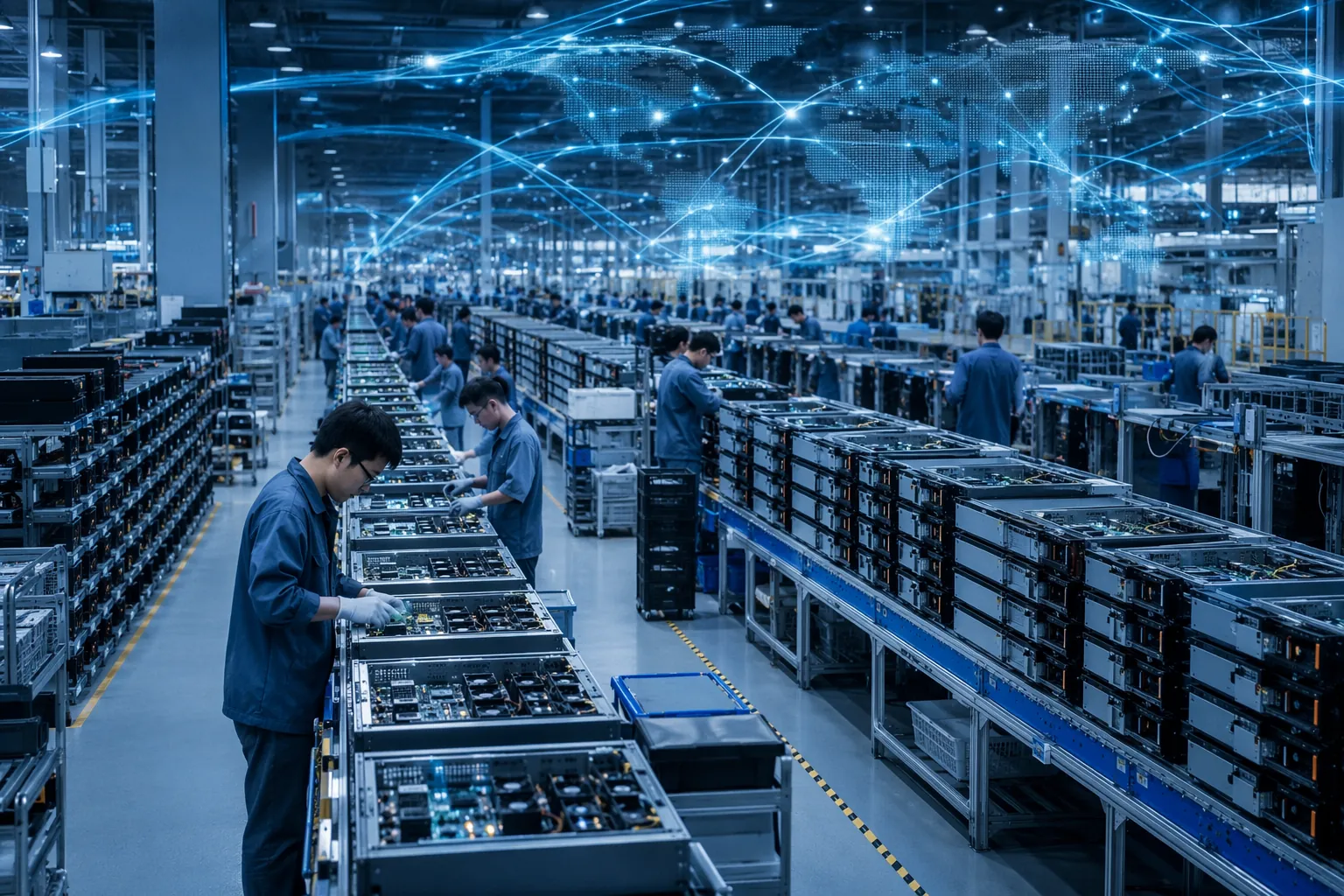
A smaller rival can win a design, take orders, and still struggle when the hard part becomes allocation and delivery. Dell’s advantage is not mystical. A $100 billion-plus procurement machine has more conversations with component suppliers, more room to negotiate, more ability to shift supply across regions, and more credibility when it asks for priority on scarce parts [8]. A 25-site manufacturing footprint does not guarantee execution, but it gives the operator more places to solve a bottleneck than a narrower factory model would.
This is also where the direct model matters. Channel-dependent hardware businesses can get caught between old quotes, distributor inventory, and customers who expect pricing stability even when components are moving. Dell’s direct enterprise relationships give it cleaner demand signals and faster routes to adjust pricing, configuration, and fulfillment. That does not make the customer happy when the quote changes. It does make the economics more controllable.
The demand side still deserves credit. Without the GPU buildout, the enterprise AI Factory push, and the customer appetite for accelerated infrastructure, Dell would not have had this opening. The Stack reported that Dell’s AI customer base had grown from under 2,000 to more than 4,000 enterprises, including 1,000 AI Factory clients added in a single quarter, with FY2026 customer spend cited at $64 billion [9]. End-market demand pulled the door open. Dell’s supply chain determined how much of that demand could become credible guidance.
Backlog became more valuable as delivery evidence improved
Backlog is useful only if investors believe it can be worked down profitably. In AI infrastructure, backlog can hide three different problems: customers waiting for GPUs, suppliers repricing memory, and factory schedules that cannot absorb rack-scale complexity. Futurum’s analysis put Dell’s backlog entering FY2027 at $43 billion and highlighted rack-scale deployment times of 24 to 36 hours with uptime above 99% [7]. Those are not cosmetic metrics. They speak to whether a large order book can actually become revenue without turning every installation into a custom rescue job.
The backlog also helped explain why analysts became willing to look past some near-term lumpiness. In ordinary hardware cycles, a big order book can vanish if customers delay refreshes or if pricing moves against them. In the AI server cycle, the order book was tied to infrastructure programs that were already constrained by supply. That made Dell’s execution record more important than a simple demand forecast. If the company could source, price, build, and deploy at scale, the backlog carried more informational value.
Some market-share claims around Dell’s AI server position should be handled carefully. A TBR figure circulating through research summaries put Dell at 46.7% of the OEM AI server market in 2025, roughly twice the next competitor, but the available sourcing trail is not strong enough to treat that number as independently settled. The safer conclusion is narrower: Dell had enough visible scale in orders, backlog, manufacturing, and customer growth for analysts to underwrite a materially larger AI server business [7][8][9].
The memory shock separated demand from control
The strongest test of Dell’s moat was not whether it could talk about AI demand. It was whether it could live through the memory market in 2025. Forbes, citing NAND Research, reported DRAM pricing up 172% year over year by Q3 2025 and NAND up 246% [10]. Dell COO Jeff Clarke described the cost environment in November 2025 this way: “We have not seen costs move at the rate we’ve seen… unprecedented” [4].
That kind of cost move attacks the dullest and most important part of the business: quote discipline. A server quote that stays open too long becomes a free option for the customer and a margin risk for the supplier. CRN reported that IT distributor quote validity windows compressed from 30 days to 15 days as the industry adjusted to the component environment [11]. Dell’s own response was faster than the old rhythm of enterprise hardware pricing; it was able to implement server pricing changes within days as input costs moved [4][11].
This is where a supply chain moat becomes visible. Procurement leverage helps secure components. Factory reach helps schedule and redirect builds. Direct customer relationships help reset quotes before a cost spike becomes a margin hole. None of those capabilities eliminates memory inflation. They change who absorbs it, how quickly pricing resets, and whether the supplier can keep shipping while competitors are still renegotiating through the channel.
The Q2 FY2026 margin miss showed the risk in real time. Adjusted gross margin at 18.7% was not what investors wanted to see, especially against a 19.6% estimate, and the stock sold off [3]. If that had been the whole story, Dell’s AI server ramp would have looked like a revenue chase. Instead, the later margin repair gave the market another operating data point. By Q4 FY2026, ISG operating margins recovered to 12.4%, up 360 basis points sequentially, according to TIKR’s analysis [6].
That recovery did not prove Dell was immune to component cycles. It proved something more useful: the company could reprice, procure, and execute quickly enough that a violent memory cycle did not permanently invalidate the AI server economics. For a hardware company asking investors to believe in a different multiple, that mattered more than another slide on total addressable market.
Why competitors could not all turn the same demand into the same multiple
There is no need to pretend Dell was alone in AI servers. Super Micro and other server vendors were part of the same demand wave, and many customers had reasons to qualify multiple suppliers. The distinction is that AI infrastructure demand exposed differences in operating architecture. When component supply is loose, speed and customization can carry a lot of weight. When GPUs, memory, racks, and delivery slots are all constrained, the supplier with deeper procurement relationships and broader manufacturing optionality has more ways to keep a promise.
Dell’s position was especially relevant for enterprise AI Factory demand. Large enterprises usually want more than a fast box. They want predictable delivery windows, service coverage, validated configurations, financing options, and a supplier that can support rollouts across countries rather than across a single lab. Dell’s 180-country reach and global supply chain staff count are not exciting, but they are exactly the pieces that make a multinational infrastructure program less fragile [8].
Preferred allocation is harder to prove from the outside than manufacturing footprint or backlog. It would be too strong to say Dell’s scale mechanically guaranteed priority from every supplier. The more defensible point is that suppliers allocating constrained GPUs, memory, and networking parts tend to care about volume, payment credibility, global deployment capability, and the likelihood that allocated parts will turn into finished systems. Dell had credible answers on those dimensions, and the shipment ladder showed that those answers were not merely theoretical.
The market stopped treating Dell as ordinary hardware
The 2025 story begins with a demand surge, but it does not end there. Dell’s stock did not earn higher targets simply because analysts discovered AI servers. It earned them because Dell kept supplying operating evidence: actual FY2025 AI server revenue around $10 billion, successive guidance raises through 2025, a $50 billion FY2027 step in early 2026, and a $60 billion update by May 2026 [2][3][4][5][6].
The memory crisis made that evidence more convincing, not less. It showed that demand alone was not enough. A supplier had to shorten quote windows, adjust pricing within days, protect allocation, and still work backlog into shipped systems. Dell’s Q2 margin disappointment exposed the pressure; the later ISG margin recovery showed the operating system could respond [3][6].
That is the operational reason the price-target discussion changed. Analysts were not only paying for AI excitement. They were paying for a company that had shown it could absorb component shocks, raise shipment expectations repeatedly, and make a large backlog look deliverable. The result was a re-rating from cyclical hardware toward infrastructure, built less on a story about GPUs than on the unglamorous machinery that gets servers out the door.
References
- Dell Technologies Analyst Forecasts and Price Targets, StockAnalysis
- Dell FY2025 AI Server Revenue Coverage, Reuters
- Dell Shares Drop After Margin Miss Despite AI Server Outlook Raise, Reuters, August 2025
- Dell Raises AI Server Outlook as Component Costs Surge, Reuters, November 2025
- Dell's $50B AI Server Guidance Marks Strategic Shift, HyperFRAME Research, February 2026
- Dell Technologies Valuation Update and AI Server Outlook, TIKR Research, May 2026
- Dell Q3 FY26 Analysis: AI Server Orders, Backlog, and ISG Margins, Futurum Group, November 2025
- Why AI Demands a New Supply Chain Operating Model, Dell Technologies
- Dell AI Factory Customer Growth Coverage, The Stack, 2026
- The AI Memory Supercycle and Server Cost Inflation, Forbes, February 2026
- GTDC Summit 2026: IT Distributor Quote Validity Compression, CRN, 2026
Comments
Join the discussion with an anonymous comment.