
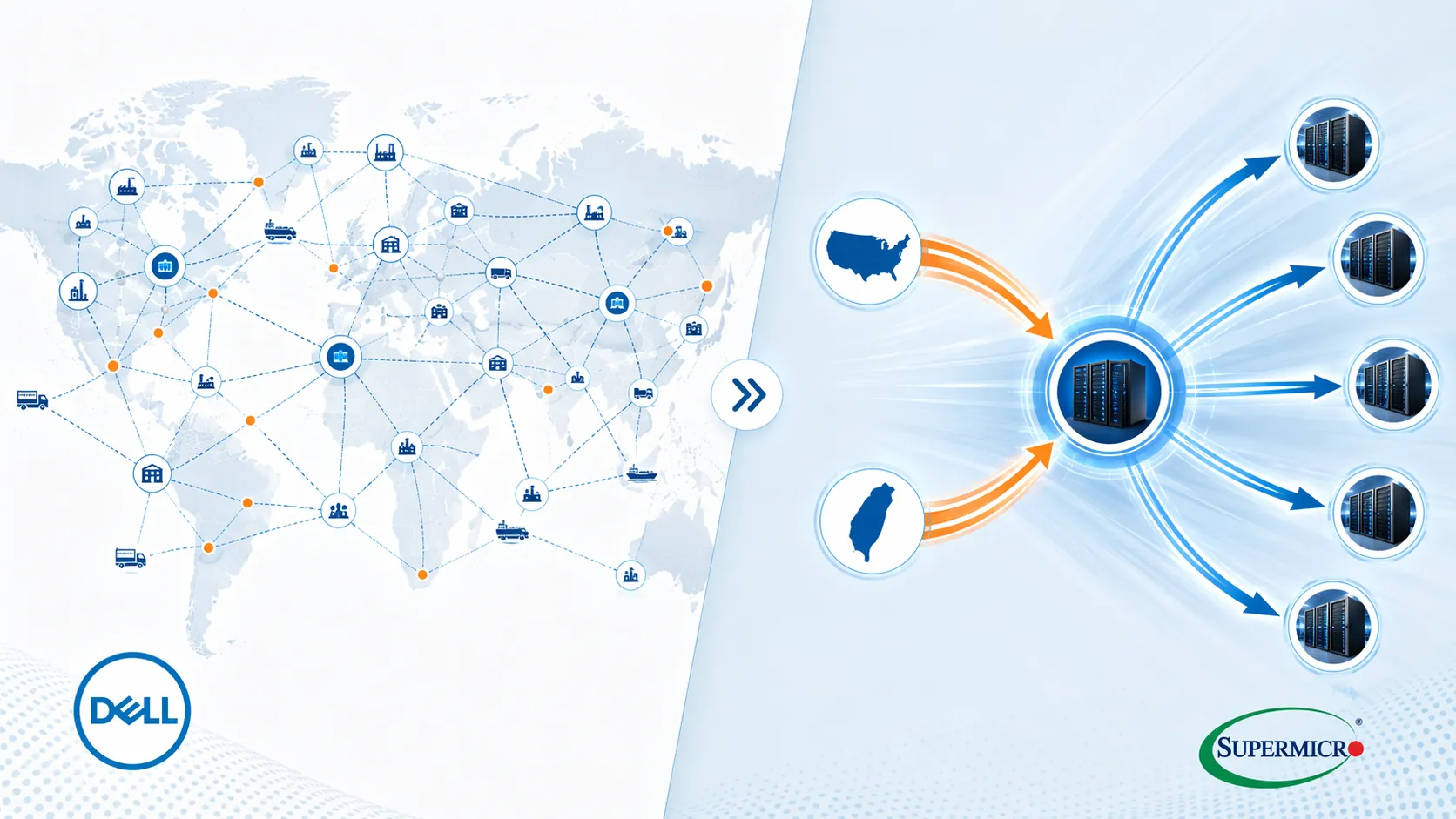
A Dell vs Supermicro AI server supply chain comparison is not really a question of which vendor has the more impressive GPU slide. By the time procurement has narrowed the field to these two, the harder question is which operating model the buyer is willing to live with after the purchase order: Dell’s globally distributed enterprise supply chain, or Supermicro’s faster, more concentrated build-and-ship model.
Dell brings a larger service and manufacturing machine: 25 manufacturing sites, reach across 180 countries, and an enterprise support apparatus built around global replacement coverage and managed infrastructure operations.[1] Supermicro brings a different kind of leverage: a US-and-Taiwan-centered model, shorter AI server lead times, lower hardware cost estimates, and a Building Block architecture that can move quickly when the buyer already knows how to integrate the stack.[1][2]
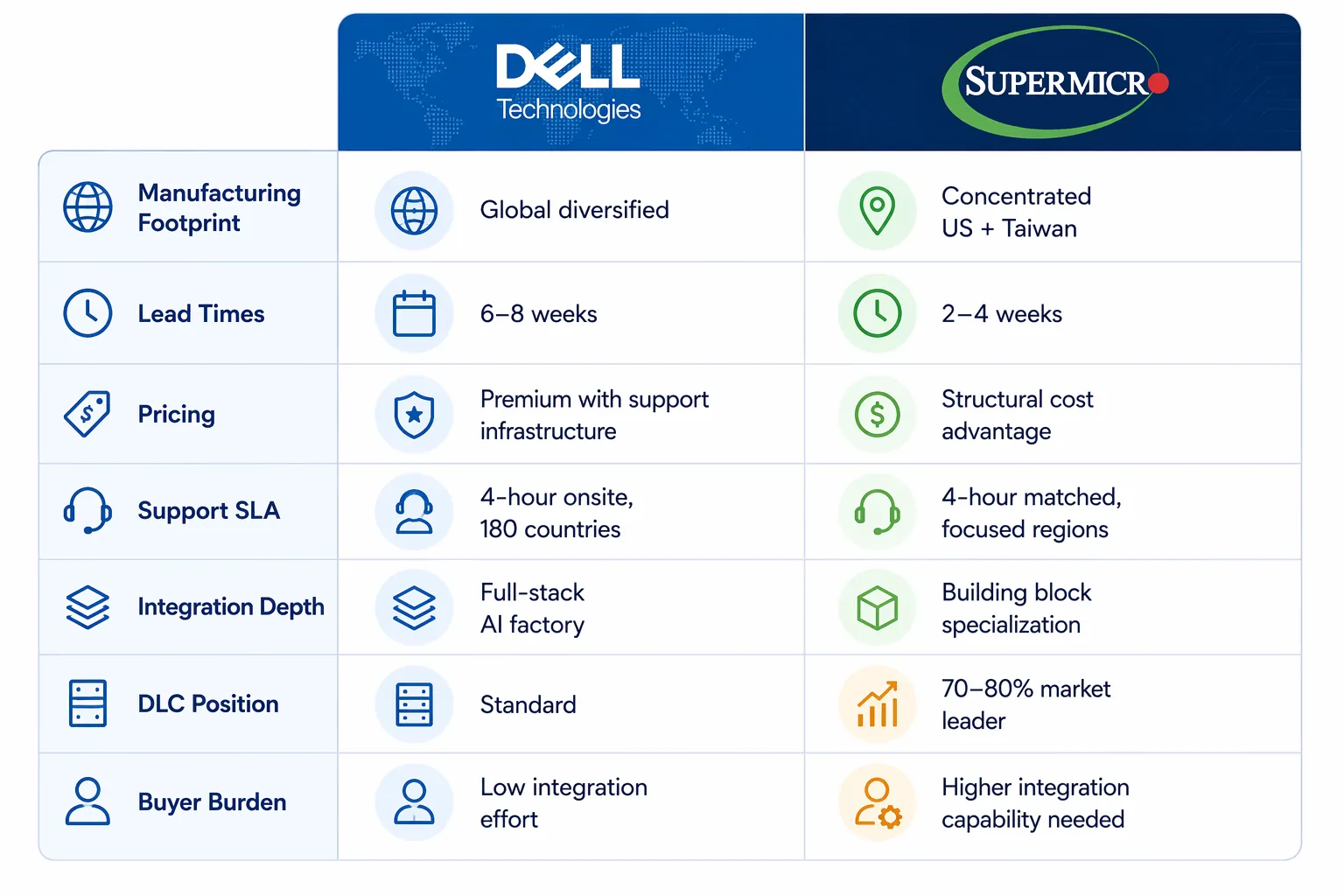
| Operating dimension | Dell | Supermicro |
|---|---|---|
| Manufacturing footprint | 25 manufacturing sites with coverage across 180 countries | Concentrated US + Taiwan model |
| AI server lead time | Estimated 6-8 weeks for AI server orders | Estimated 2-4 weeks for AI server orders |
| Pricing structure | Estimated 10-15% premium tied to support, management tooling, and certification overhead | Estimated 10-15% hardware cost advantage |
| Support reach | ProSupport Plus with 4-hour onsite replacement across 180 countries and 97% parts availability | Gold OS4HR can match a 4-hour SLA, but with a smaller global footprint |
| Integration model | Full-stack AI Factory approach across PowerEdge, PowerScale, PowerSwitch, and services | Focused Building Block specialization with more buyer-side integration responsibility |
| Direct liquid cooling position | Enterprise AI deployments supported through broader factory-built infrastructure programs | Estimated 70-80% DLC server market position, with the estimate not independently verified |
| Buyer-side operational burden | Lower coordination burden for global enterprises that want one vendor accountable across hardware, support, and services | Higher coordination burden, but more control for buyers with strong internal infrastructure and integration teams |
Two Supply Chain Architectures, Not Two Server Catalogs
Dell’s model is built for enterprises that need a vendor to absorb complexity across regions, service levels, parts logistics, management tooling, and certified infrastructure stacks. That does not make Dell automatically better. It means Dell is selling a broader risk-transfer arrangement around the server.
The supply chain case for Dell is strongest when a deployment has multiple sites, uneven regional support maturity, strict uptime expectations, and internal stakeholders who expect the OEM to remain accountable after installation. A four-hour onsite replacement promise has a different value in a single domestic cluster than it does across a multi-country AI rollout where the regional operations team cannot wait for procurement to negotiate exceptions after a failure.
Supermicro’s model is narrower and faster. Its Building Block architecture favors repeatable configurations, rapid customization, dense systems, and a supply chain that can put hardware into racks while a larger incumbent may still be routing the deal through enterprise support and services layers. Adam Silva Consulting estimates Supermicro AI server lead times at 2-4 weeks versus 6-8 weeks for Dell, and estimates a 10-15% hardware cost advantage for Supermicro.[2]
Those numbers matter most when time and density are the constraints. A neocloud building capacity ahead of signed demand, a lab scaling quickly into a production cluster, or a buyer with strong internal rack integration capability may care less about a single global support umbrella and more about how quickly systems can be configured, shipped, cooled, and commissioned.
What Happens When the Deployment Leaves the Lab
AI server procurement becomes political when a pilot order turns into a rollout. The constraint is no longer only GPU allocation. It becomes power availability, liquid cooling readiness, network design, storage coupling, replacement-parts confidence, site-by-site service coverage, and the number of internal teams needed to make the system run.
Dell has been explicit that AI infrastructure changes the supply chain operating model from sequential execution to parallel engineering. In Dell’s framing, compute, power, cooling, and networking have to be engineered simultaneously, with factory-built modular systems reducing the handoff risk between design, sourcing, integration, and deployment.[3]
That is vendor-authored positioning, but it reflects a real procurement problem. If the server arrives before the cooling loop, if the network design changes after the rack layout is frozen, or if storage integration remains a separate project, the buyer has not saved time. The delay has simply moved from the OEM’s factory schedule to the customer’s deployment floor.
Dell’s AI Factory approach is meant to keep those interfaces inside a more integrated commercial and technical envelope: PowerEdge servers, PowerScale storage, PowerSwitch networking, and services are positioned as parts of one operating model rather than separate procurement lanes.[1] For a large enterprise, that can reduce the number of parties arguing over root cause when performance, thermals, firmware, or service coverage become the bottleneck.
Supermicro’s advantage shows up earlier in the schedule. A focused Building Block model can make configuration and production faster, especially where the buyer has already standardized on the surrounding stack. The tradeoff is that more of the orchestration burden may sit with the customer: validating the final architecture, coordinating networking and storage choices, preparing the facility for high-density racks, and managing escalation paths across more components and partners.
That tradeoff is not a flaw if the buyer is built for it. Some infrastructure teams would rather keep architectural control and avoid paying for enterprise packaging they do not need. Others will discover too late that a lower server price is not the same as a lower deployment cost when internal engineering hours, third-party integrators, spares planning, and executive escalation time are included.
Lead Time and Price Belong in the Same Conversation
Treating lead time, price, and support as separate spreadsheet columns hides the actual procurement decision. A 10-15% premium can be rational if it buys global service coverage, integrated management tooling, certification work, and fewer buyer-side coordination failures. A 10-15% hardware cost advantage can be equally rational if the buyer has the engineering depth to absorb integration work and the financial pressure to turn capacity live quickly.[2]
Dell’s premium, as estimated by Adam Silva Consulting, is tied to ProSupport Plus global SLA infrastructure, iDRAC management tooling, and broader ISV certification overhead.[2] Those are not cosmetic line items for an enterprise buyer. Remote management, known support paths, and certification coverage can reduce the number of exceptions operations teams have to manage across sites.
Supermicro’s cost advantage is more compelling when the buyer is not asking the OEM to carry the same enterprise support load. If procurement is buying for a technically mature neocloud, a dedicated AI infrastructure operator, or a single-region buildout with strong internal hardware operations, the customer may prefer to keep the savings and spend its own labor where it has better control.
The mistake is to compare Dell’s fully loaded enterprise model with Supermicro’s faster hardware model as if both include the same downstream obligations. They often do not. The more global, regulated, and politically visible the deployment, the more expensive internal surprises become.
Support Coverage Is a Supply Chain Feature
Support is sometimes treated as an after-sales matter. For AI servers, it is part of the supply chain. Dense GPU systems concentrate operational risk; a failed component is not just a ticket but stranded capacity, delayed training time, or missed customer commitments.
Dell’s ProSupport Plus coverage is described as offering four-hour onsite replacement across 180 countries, with 97% parts availability.[1] That is the kind of promise procurement can take to a risk committee, especially when the deployment footprint crosses regions and the buyer cannot afford to maintain a deep internal spares network everywhere.
Supermicro’s Gold OS4HR can match a four-hour SLA at lower cost, but the available sourcing describes a smaller global footprint than Dell’s.[1] For a buyer with concentrated sites, that may be enough. For a multinational enterprise trying to standardize AI infrastructure across uneven service geographies, the difference can become visible only when the first urgent replacement is needed.
This is where the buyer’s own operating model matters. If internal teams already hold spares, manage field escalation tightly, and build around known failure patterns, Supermicro’s leaner support envelope may be acceptable. If regional IT teams depend on the OEM to carry the burden, Dell’s broader service infrastructure has a clearer procurement value.
Liquid Cooling Favors Speed, but the Evidence Needs Care
Direct liquid cooling is one of the areas where Supermicro’s speed-and-density model looks especially relevant. Adam Silva Consulting estimates that Supermicro commands 70-80% of the direct liquid cooling server market and has a 2-4 week lead-time advantage on DLC configurations.[2] That is a useful signal, but it should be treated as a consultancy estimate rather than an independently verified market share figure.
The operational question is simpler than the market-share claim. If a buyer needs liquid-cooled systems configured quickly, and has the facility readiness and engineering team to handle the surrounding work, Supermicro deserves serious consideration. The value is not only a lower unit price; it is the possibility of pulling deployment weeks forward when power and cooling are already planned.
Dell’s position is different. It may not be the fastest path for every DLC-heavy build, but its factory-built modular approach and broader AI Factory logic can matter when liquid cooling is only one part of a larger enterprise infrastructure transition.[3] Buyers with multiple regions, mixed workloads, and stricter internal governance may prefer a slower, more bundled path if it reduces interface risk.
Market Share Gives Context, Not a Decision
ABI Research’s 2024 AI server share data put Dell at roughly 20% and Supermicro at roughly 9%.[4] Those figures are useful as historical context, but they should not be treated as a clean mid-2026 procurement signal. AI server demand has moved quickly, and vendor trajectories can shift faster than annual share snapshots capture.
A larger share can indicate scale, installed-base confidence, and partner familiarity. It can also hide slower responsiveness for specific configurations. A smaller share can indicate concentration risk, or it can indicate a supplier specializing in the exact high-density use case the buyer needs. Procurement should use share as one input, not as a proxy for fit.
Supplier-Risk Signals Should Be Monitored, Not Exaggerated
Supermicro also carries a risk-monitoring issue that belongs in the procurement file. The DOJ-related uncertainty was ongoing as of July 2026; the company had not been charged as a corporate entity, while the indictment named three affiliated individuals.[5] That distinction matters. It is not the same as saying the company itself has been charged, but it is enough to justify monitoring legal, financing, customer, and supplier reactions during a large sourcing decision.
For buyers evaluating Supermicro, margin volatility and supplier-risk signals should also sit next to lead time and price rather than in a separate risk appendix. ChainSignal’s earlier analysis of Supermicro’s AI server margins is relevant here because pricing pressure, working-capital needs, and component availability can all show up later as delivery or support friction.
Dell’s risk profile is not risk-free; it is simply different. A broader global model can reduce geographic and service concentration risk, but it can also add process weight, commercial complexity, and less flexibility for buyers that want unusual configurations on compressed timelines.
Which Buyer Fits Dell
Dell fits best when the buyer wants the OEM to carry more of the deployment and support burden. That usually means multi-site enterprises, regulated industries, global operations teams, and procurement organizations that need to defend a premium by pointing to continuity, coverage, and accountability.
- Choose Dell when the deployment spans multiple countries and replacement-parts confidence matters as much as initial shipment speed.
- Choose Dell when internal teams want one integrated path across servers, storage, networking, services, and support.
- Choose Dell when finance will challenge the premium, but operations can quantify the value of SLA reach, iDRAC tooling, ISV certification, and fewer integration handoffs.
- Choose Dell when geopolitical diversification and global service coverage are explicit risk-office requirements.
The Dell buyer is not necessarily conservative. In many organizations, paying more upfront is the faster political route because it reduces the number of internal exceptions that have to be approved, staffed, and defended later.
Which Buyer Fits Supermicro
Supermicro fits best when the buyer values deployment velocity, density, configuration responsiveness, and hardware cost discipline more than a broad enterprise support wrapper. It is especially attractive when the customer’s own infrastructure team is capable enough to turn Supermicro’s flexibility into a working operating model.
- Choose Supermicro when 2-4 week lead times materially change the business case or capacity plan.
- Choose Supermicro when liquid-cooled, high-density configurations are central to the deployment and the facility plan is already mature.
- Choose Supermicro when a 10-15% hardware cost advantage can be retained rather than consumed by unplanned integration work.
- Choose Supermicro when internal teams can manage more architecture validation, vendor coordination, spares planning, and escalation discipline.
The Supermicro buyer is not simply buying cheaper hardware. The buyer is accepting a different division of labor. More value stays with the customer only if the customer is operationally strong enough to capture it.
The Practical Decision Rule
Pick Dell when the deployment needs global support breadth, parts availability, geopolitical diversification, and a more integrated enterprise delivery model. The premium is easiest to justify when a failed handoff would be more expensive than the upfront price difference.
Pick Supermicro when speed, density, capex discipline, and configuration responsiveness are the harder constraints, and when the buyer has enough internal integration capability to own more of the operating model. The cost advantage is real only if the organization can prevent it from turning into hidden coordination cost.
References
- OEM Comparison 2026, SLYD
- Supermicro vs Dell AI Server Head-to-Head, Adam Silva Consulting
- Why AI Demands a New Supply Chain Operating Model, Dell
- ABI Research 2024 AI server market share data, ABI Research, 2024
- DOJ-related Supermicro procurement risk context, U.S. Department of Justice
Comments
Join the discussion with an anonymous comment.