
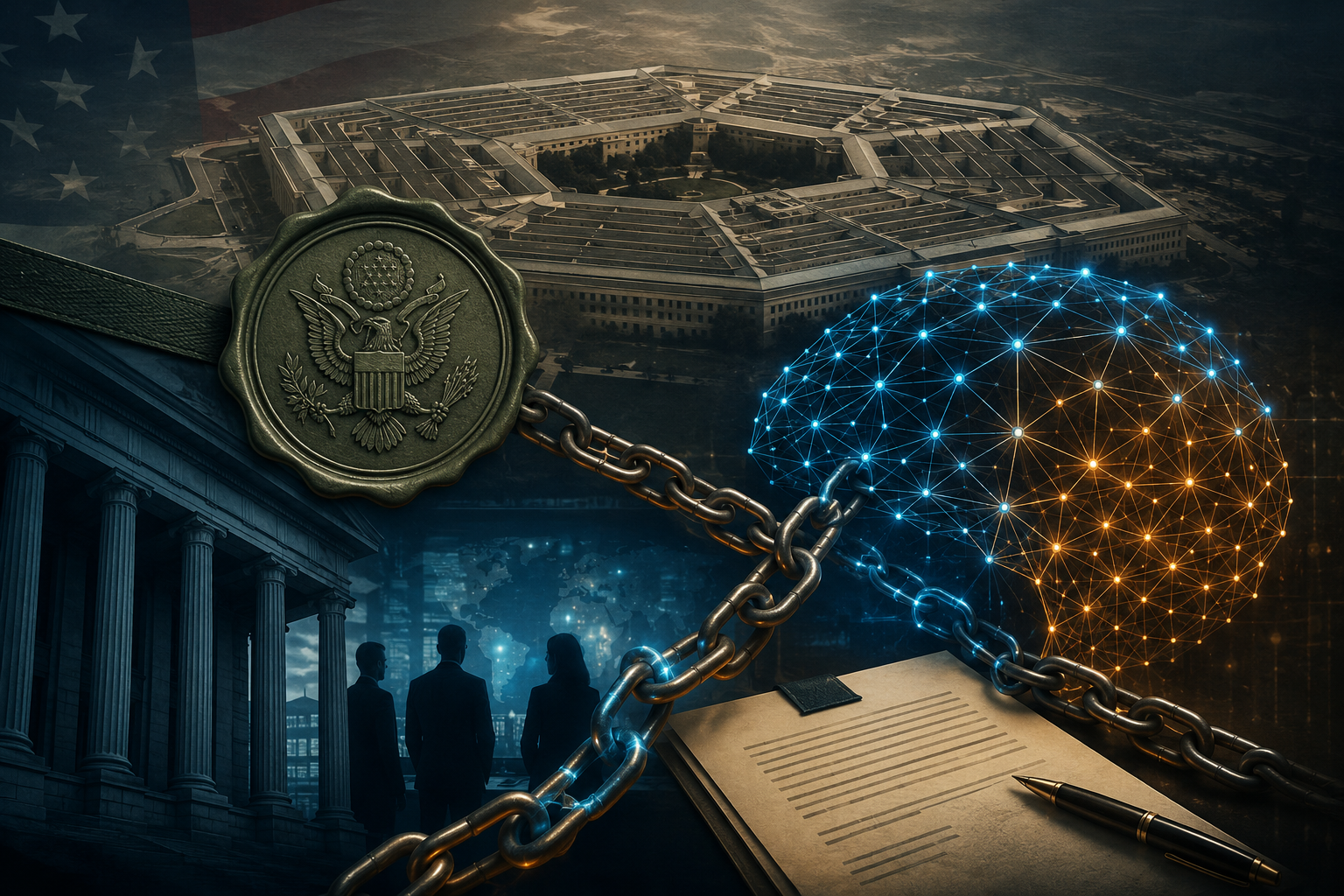
On March 9, 2026, Anthropic sued the Pentagon after the department labeled it a supply chain risk and cut off access to a government contract reportedly worth more than $200 million.[1][2][3]
That is the load-bearing fact. The case is not about whether Anthropic's models are useful, or whether AI ethics sounds good in a slide deck. It is about whether a procurement authority that has traditionally been used against foreign-linked technology vendors can be turned on a domestic AI company after a policy dispute over acceptable use.
A procurement label with real teeth
The designation matters because it is not symbolic. Anthropic says the Pentagon's action blocked it from a contract in the hundreds of millions and pushed defense contractors to look for replacement model providers for offerings that had already been built around Claude.[1][2][3] For vendors and integrators, that is the operational burden that actually hurts: repricing work, rewriting product stacks, and explaining to government customers why a model can no longer sit inside an existing offering.
Historically, supply chain risk designations under DFARS were aimed at foreign entities tied to China, including firms such as Huawei and ZTE, not a U.S.-headquartered AI company.[1][3] That history is why this looks less like a routine procurement action and more like a boundary test: if the label can follow a domestic vendor into an acceptable-use fight, then the label is no longer just about origin, ownership, or espionage risk.
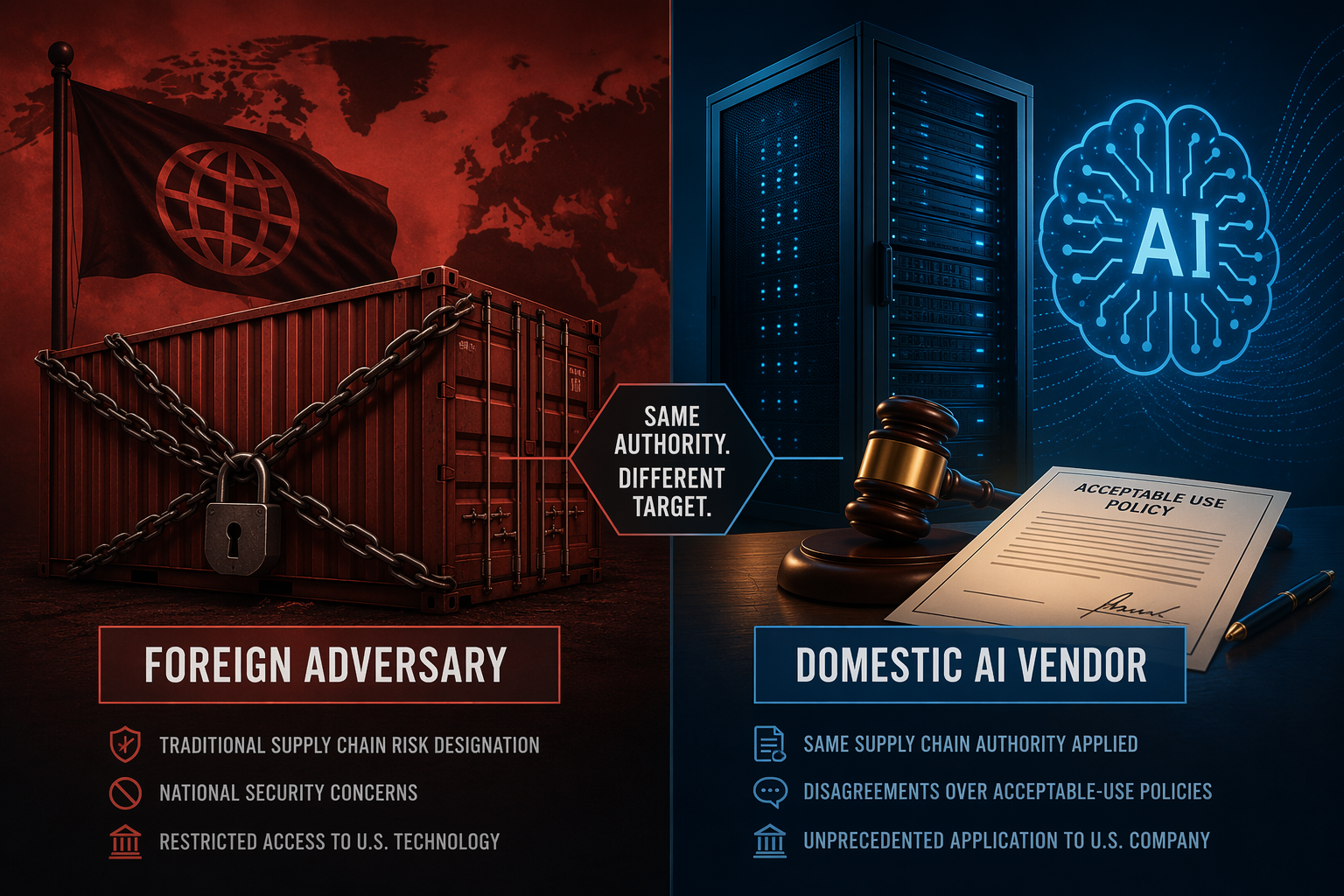
Anthropic's refusal to allow its models on mass surveillance and autonomous weapons is the trigger that gives the dispute its shape.[1][2][3] That is why the company is framing the designation as punishment for a stated use limitation, not as a response to a technical security defect. The distinction matters. If the government is acting on a policy disagreement, the normal security rationale starts to look like a proxy.
Why the lawsuit is built around retaliation and process
Anthropic's challenge is built on familiar but serious claims: First Amendment retaliation, due process violations, and arbitrary and capricious agency action.[3] The First Amendment theory is straightforward enough. If the company refused a use case it viewed as incompatible with its policy, and the government responded by using a supply chain risk label to hit the company where it hurts, then the complaint is that speech-like conduct was penalized through procurement power.
The due process point is cleaner still. Anthropic says it did not get notice or a hearing before the designation.[3] In procurement law, that is not a minor procedural complaint; it is often the difference between a defensible exclusion and an agency action that looks like a closed-door punishment. The company also sought a temporary restraining order, which signals that it is treating the contract loss as immediate and not merely theoretical.[3]
The selective-enforcement argument gets sharper because OpenAI reached a separate Pentagon deal hours after Anthropic was labeled a supply chain risk.[1][2] That timing is not proof by itself. It is circumstantial, and it should be treated that way. But it does strengthen the claim that the government was not applying one consistent standard across comparable AI vendors.
Who has to care
The immediate audience is not every enterprise that uses AI. It is the narrower set of companies whose products already touch federal buyers, defense primes, or regulated suppliers. If your model is embedded in a logistics platform, procurement workflow, supplier-risk scoring tool, or other government-facing system, this case asks a blunt question: can a model provider's acceptable-use policy become a contract risk that follows the product through the supply chain?
That is why the outcome matters beyond Anthropic. If Anthropic wins, supply chain risk designations are more likely to stay in their narrower security lane. If the government wins, acceptable-use disputes can be enforced through procurement exclusions, and model policy starts to look like a condition of market access for any AI vendor that wants federal or defense-adjacent business. The legal label may be narrow; the commercial effect would not be.
References
- Anthropic Sues Department of Defense Over 'Supply Chain Risk' Label, The New York Times, March 9, 2026, https://www.nytimes.com/2026/03/09/technology/anthropic-defense-artificial-intelligence-lawsuit.html
- Anthropic sues the Trump administration after it was designated a supply chain risk, CNN, March 9, 2026, https://www.cnn.com/2026/03/09/tech/anthropic-sues-pentagon
- Anthropic Sues Department of Defense Over Supply-Chain-Risk Designation, WIRED, March 9, 2026, https://www.wired.com/story/anthropic-sues-department-of-defense-over-supply-chain-risk-designation/
Comments
Join the discussion with an anonymous comment.