
The Sunshine Protection Act is not law yet. As of July 23, 2026, it has cleared the House, not the Senate. That caveat matters. So does the date on the vote: on July 14, 2026, the House passed H.R. 139 by 308-117, moving permanent daylight saving time from a familiar policy argument into a plausible enterprise systems event.[1]
The operational clock is less patient than the legislative one. Airlines for America warned that changes to daylight saving time can require 6 to 24 months of scheduling-system adjustment, including crew positioning, reservation systems, and international connectivity.[2] That warning is easy to file under aviation. Supply chain leaders should resist that instinct. The same dependency pattern appears wherever planning systems promise a local appointment, optimize an intraday move, hand a shipment from one jurisdiction to another, or interpret a time stamp as more than a string.
Public opinion helps explain why the issue keeps returning to Congress. In a 2025 AP-NORC survey, only 12% of Americans supported the current clock-changing system, while 56% preferred permanent daylight saving time.[3] That does not make Senate passage inevitable. It does make waiting for final certainty a poor default for organizations whose ERP, WMS, TMS, EDI, ELD, control tower, and AI planning layers were built around the assumption that U.S. clocks continue to change seasonally.

The problem is not one clock
A calendar change becomes expensive when different systems have been taught different meanings of time. A planner may see a 9:00 a.m. delivery appointment. A TMS may store that appointment in local facility time. An EDI message may carry a time zone code or omit one. A carrier portal may display the same slot after converting from UTC. A yard system may treat the appointment as a recurring weekly rule. An AI planning model may have learned that demand, labor availability, traffic congestion, and order release behavior shift after the spring and fall clock changes.
Permanent daylight saving time would remove the twice-yearly transition, but it would not simply delete the risk. It would change the relationship between clock time, daylight, seasonality, labor routines, school schedules, customer cutoffs, store opening patterns, border processes, and carrier networks. Systems that use local time as an operational fact, not just as display formatting, would need to be checked.
| Layer | Where time assumptions hide | Transition question |
|---|---|---|
| AI demand planning | Hourly features, seasonal variables, event calendars, anomaly rules | Does the model encode historical DST behavior as normal seasonality? |
| ERP and order management | Order cutoffs, promised dates, ATP/CTP logic, fiscal calendars | Are cutoffs stored as local time, UTC, or facility-specific rules? |
| WMS and appointment scheduling | Dock slots, labor waves, yard moves, recurring appointments | Will recurring rules remain correct after the legal offset changes? |
| TMS and routing | Pickup windows, driver schedules, carrier tender deadlines, ETA logic | Which optimization rules assume today’s seasonal clock behavior? |
| EDI and integrations | Timestamp formats, timezone qualifiers, middleware mappings | Do partners interpret the same timestamp the same way? |
| ELD/HOS and telematics | Driver logs, local-time compliance views, GPS schedules | Do compliance and dispatch screens handle the revised time regime? |
| Control tower | Milestone sequencing, alert thresholds, exception aging | Will alerts compare events in a consistent time basis? |
AI planning models need more than a new holiday calendar
For AI supply chain planning, the most tempting shortcut is to treat permanent daylight saving time as a one-time data-cleaning issue. Remove the old spring and fall anomalies, retrain the model, and move on. That may be adequate for some monthly planning use cases. It is not adequate for every model that sees intraday behavior.
OpenForecast’s treatment of daylight saving time as a time-series anomaly is useful because it shows the mechanical issue clearly: an hourly seasonal model with a 24-hour cycle can behave correctly in only part of the year when the clock changes disrupt the observed periodicity.[4] In supply chain terms, this matters for models that forecast hourly order intake, call-center demand, dock congestion, parcel induction, store replenishment signals, or same-day fulfillment capacity.
Permanent DST changes the training problem. Historical data contains years in which spring and fall transitions existed. Future data, if the law advances and takes effect, would not follow that same pattern. A model may have learned that the week after a clock change carries different behavior. It may have learned offset relationships between daylight, commute patterns, store traffic, and order timing. It may also have learned false anomalies around missing or duplicated hours.
There is no single correct repair. Documented approaches for handling DST in time series include shifting periodicity, adding categorical variables, and using Fourier or TBATS-style seasonal methods.[5] Each option answers a different modeling question. Shifted periodicity can help when the behavioral rhythm remains tied to clock time. Categorical variables can help when the model needs to distinguish DST periods, transition days, or post-transition effects. Fourier and TBATS-style methods can be useful when multiple seasonalities have to coexist without forcing every pattern into a simple daily cycle.
Anomaly detection is part of the toolkit, not the whole answer. ToolsGroup describes AI demand forecasting capabilities that include detecting abnormal demand patterns.[6] Logility has contrasted traditional calendar-based planning latency of 2 to 4 weeks with AI demand sensing approaches.[7] Those capabilities can help teams see transition effects faster, but they do not decide whether a historical DST feature should be retained, removed, recoded, or allowed to decay. That is a modeling and governance decision.
The practical sequence is to inventory the models by time granularity. Monthly S&OP models may need a lighter review. Daily and hourly models deserve closer inspection. The highest-risk group includes models that use local-time features, detect short-term anomalies, allocate capacity by hour, or train separately by region. Those models should get a documented retraining window, a backtesting plan, and business-owner signoff on which old DST effects are still relevant.
Scheduling and compliance systems carry the operational consequence
Forecasting errors are visible in dashboards. Scheduling errors land on dispatchers, dock supervisors, drivers, customer service teams, and EDI analysts. That is why the airline warning matters outside aviation: schedule networks are made of dependencies, not isolated calendars. A pickup window missed by one hour may become a tender rejection, a detention dispute, a missed rail cutoff, a late dock arrival, or a customer chargeback.
Trucking has its own time-sensitive exposure. Industry reporting on daylight saving changes points to qualitative impacts on hours-of-service compliance, ELD logs, and GPS scheduling accuracy.[8] The evidence is not a large controlled study, so it should not be inflated into a universal failure prediction. It is still enough to justify a targeted audit wherever dispatch, compliance, telematics, and customer appointment systems do not share the same time basis.
The HOS/ELD question is especially awkward because the same event can be seen through different operational lenses. A driver log may be reviewed for compliance. A dispatcher may be watching arrival feasibility. A customer portal may be measuring appointment adherence. A control tower may be aging an exception. If those views convert timestamps differently, the organization may not merely be late; it may disagree internally about whether it was late.
Warehouse appointment logic deserves equal scrutiny. Many dock scheduling systems were configured during implementation and then left alone unless a facility changed hours. Permanent DST would force a more basic question: are recurring appointments stored as local civil time, as UTC offsets, as facility calendars, or as rules inherited from a scheduling library? The answer determines whether the change is handled by an IANA timezone update, a vendor patch, a configuration change, or custom remediation.
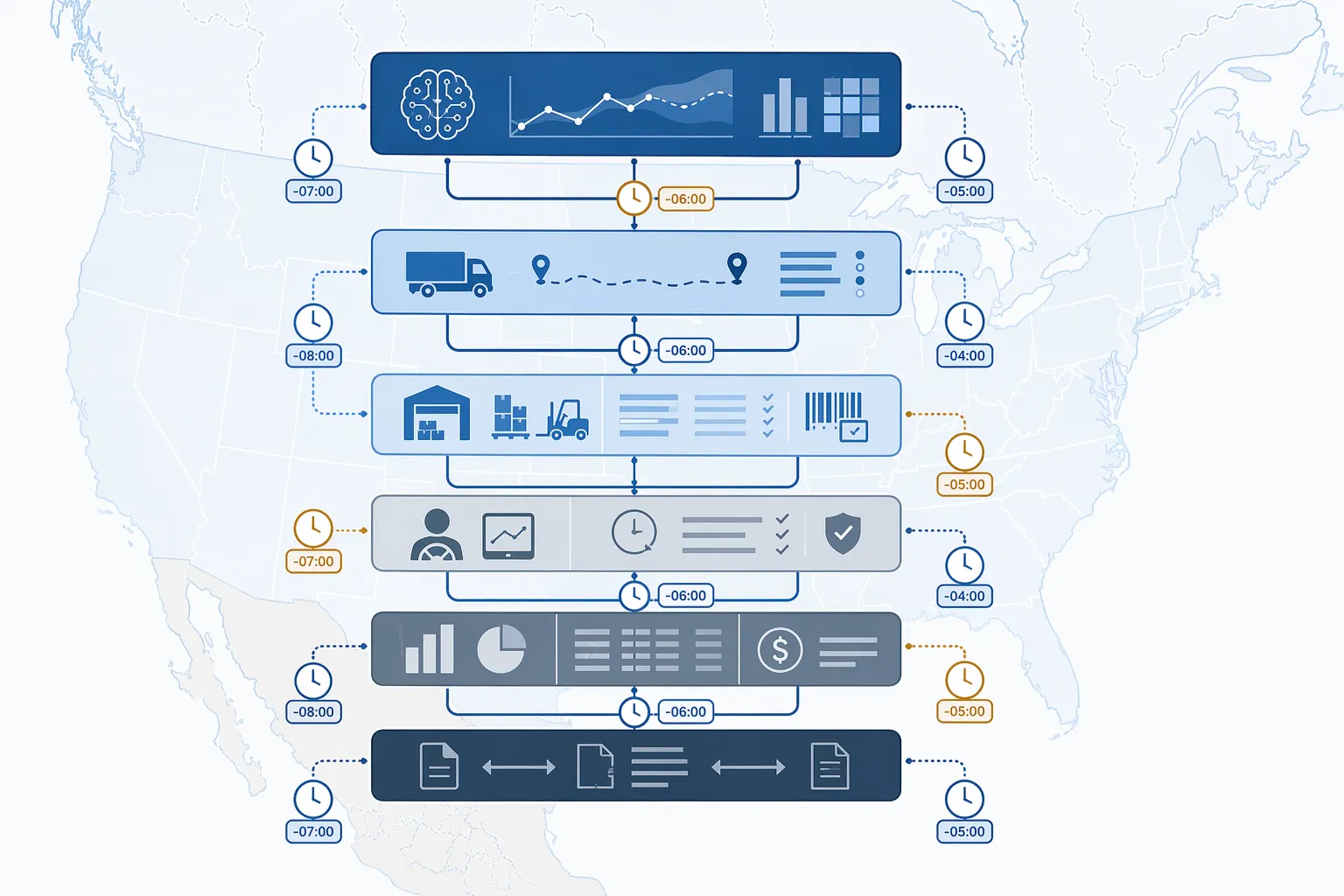
Walk the stack before the statute is final
The readiness audit should start with ownership, not software. Planning owns forecast behavior. Transportation owns pickup, delivery, tendering, and carrier execution. Warehouse operations owns dock capacity and labor waves. IT owns integrations, middleware, vendor coordination, timezone database updates, and regression testing. Finance and customer service may own the downstream consequences when promised times and measured performance diverge.
Then trace how time moves. Start with order capture. Does the order management system store requested delivery dates without times, local timestamps, or UTC timestamps? Are order cutoffs configured by customer, facility, market, or carrier lane? If an order is placed near midnight in one time zone and fulfilled in another, which system decides the business date?
Move into planning. Identify every model input that refers to hour, daypart, weekday, season, holiday, school calendar, promotion timing, or weather-linked behavior. A permanent-DST transition may not invalidate those features, but it changes the question they answer. “Hour of day” may be less stable if customer behavior tracks daylight rather than clock time. “Post-DST week” may become a historical artifact. “Season” may need to be separated from “legal time regime.”
In transportation, inspect tender deadlines, route optimization assumptions, pickup and delivery windows, customer appointment feeds, carrier portal integrations, ETA models, and exception rules. A TMS that displays local time correctly can still fail if its optimization layer uses a hard-coded offset or if a carrier API expects a different timestamp convention.
In the WMS and yard layer, focus on recurring dock slots, labor planning waves, gate check-in rules, trailer dwell calculations, and appointment rescheduling. The risk is not only the first day after a legal change. It is the quiet recurrence rule that creates appointments for months after the transition and is never manually reviewed.
In EDI and middleware, look for timestamp fields, timezone qualifiers, default mappings, partner-specific transformations, and exception handling. Some messages carry explicit offsets. Some depend on trading-partner convention. Some are converted by integration platforms before business users ever see them. This is where two companies can both be technically “right” and still disagree about the appointment they made.
Control towers and visibility platforms need a separate pass because they aggregate time from many systems. Milestone sequence, exception aging, dwell alerts, missed-appointment logic, and estimated-arrival confidence scores all depend on consistent temporal interpretation. A control tower can only coordinate across systems if it is not normalizing inconsistent timestamps into a clean-looking but wrong timeline.
Questions to put to vendors
- Which IANA timezone database version does the product use, and how quickly are legislative timezone updates deployed?
- Where are timezone rules handled: application code, database layer, integration middleware, operating system, browser display, or customer configuration?
- Can historical forecasts be retrained with revised DST features while preserving auditability of prior planning cycles?
- How are recurring appointments, carrier schedules, and facility calendars recalculated after a timezone-rule change?
- What regression tests already exist for missing hours, duplicated hours, cross-time-zone handoffs, and non-U.S. trading partners?
The 30-minute alternative is a different kind of systems problem
Permanent daylight saving time is the main path supply chain teams are watching after the House vote. The Daylight Act’s 30-minute compromise scenario is less central, but technically sharper. SupplyChainDigital flagged the non-integer offset issue: modern ISO 8601 and IANA-aware systems can represent half-hour offsets, while some legacy ERP environments may assume whole-hour offsets.[9]
That scenario would not simply mean changing an offset value. It would test whether scheduling, reporting, EDI mapping, database schemas, spreadsheet exports, and partner integrations accept offsets such as 30 minutes without rounding, truncating, or rejecting them. Legacy systems that survived previous DST changes because they only toggled between whole-hour offsets could be exposed by a compromise policy that looks moderate politically and awkward technically.
Cross-border coordination will not wait for U.S. neatness
The United States can change U.S. law. It cannot make Canada, Mexico, carriers, ports, customs brokers, suppliers, and customers update their systems on the same internal schedule. Cross-border supply chains already handle multiple time zones; the added risk is divergence in daylight saving rules, implementation dates, vendor patch timing, and partner readiness.
International connectivity was part of the airline industry’s 6-to-24-month warning.[2] The supply chain equivalent is the lane where a purchase order is planned in one country, produced in another, tendered to a carrier using a regional system, cleared by a broker, received at a U.S. warehouse, and measured by a customer scorecard. Every handoff is an opportunity for a timestamp to become someone else’s local assumption.
The practical test is lane-based. Identify the lanes where a one-hour interpretation error would materially change service, compliance, or cost. Border-crossing windows, port cutoffs, rail interchange, temperature-sensitive freight, store-delivery curfews, and high-penalty retail appointments deserve earlier partner testing than lanes with wider appointment tolerance.
Transition disruption evidence is useful, but limited
There is broader evidence that clock changes impose costs, but supply chain leaders should use it carefully. Forbes cited a 5.7% increase in workplace injuries after the spring transition and a roughly $2 billion annual DST economic-cost estimate attributed to AEI’s William Shughart.[10] Those figures are context for disruption, not proof of a specific cost curve for warehouses, carriers, or planning teams.
A University of Oregon study published in the Journal of Economic Behavior & Organization found a two-week productivity decline after the spring transition, measured through GitHub activity across more than 174,000 knowledge workers.[11] That is a useful proxy for cognitive and work-pattern disruption. It was not a study of supply chain planners, dispatchers, or warehouse supervisors, so it should not be overclaimed.
The stronger operational argument does not require a dramatic productivity forecast. It is enough that the proposed policy can alter time assumptions in systems that coordinate physical work. Even a clean legislative change needs messy enterprise preparation when the affected process crosses model logic, compliance records, facility calendars, carrier schedules, and trading-partner integrations.
A readiness timeline that fits the 6-to-24-month warning
Supply chain leaders do not need to predict the Senate outcome to begin low-regret work. The first phase is discovery: build a timezone dependency map across planning, ERP, WMS, TMS, EDI, ELD/HOS, appointment scheduling, control tower, data lake, BI, and partner portals. Record whether each layer uses IANA timezone rules, fixed offsets, local timestamps, UTC storage, or undocumented convention.
The second phase is classification. Not every dependency deserves the same remediation budget. Sort systems by business consequence: compliance exposure, customer-penalty exposure, network-optimization exposure, forecast-materiality exposure, and partner-coordination exposure. A dashboard timestamp that displays one hour off is embarrassing. An ELD compliance interpretation, retail delivery appointment, or rail cutoff error is a different class of risk.
The third phase is vendor and partner confirmation. Ask platform providers how they handle IANA updates, legislative timezone-rule changes, historical DST features, recurring schedules, and regression testing. Ask key carriers, brokers, 3PLs, retail customers, and cross-border partners when they would patch, test, and freeze changes if the Senate advances the bill.
The fourth phase is model preparation. Define which AI planning models need feature review, which need retraining, which need anomaly rules updated, and which can be monitored without immediate rebuild. Preserve the ability to compare old and new model behavior. A transition of this kind is exactly where a model that looks more accurate in aggregate can still create operational mistakes in specific hours, lanes, or facilities.
The fifth phase is regression testing. Test missing-hour and duplicated-hour scenarios even if permanent DST would remove future transitions, because historical data, partner systems, and rollback cases may still surface them. Test cross-time-zone handoffs, recurring appointments, EDI timestamp transformations, ETA calculations, HOS/ELD views, and facility calendars. Include business users in the test, not only technical teams; they are the ones who know whether a theoretically valid timestamp makes operational sense.
The executive posture is straightforward: assign ownership now, map timezone dependencies before the law is final, press vendors for specific answers, and reserve a retraining and regression-testing window that respects the 6-to-24-month scheduling warning. If the Senate stalls, the organization still gains a cleaner time architecture. If the law advances, the team is not discovering its clock logic after the clock has already changed.
References
- H.R.139 - Sunshine Protection Act of 2026, Congress.gov, July 14, 2026, link
- Airlines warn daylight saving time changes require 6 to 24 months for scheduling systems, CBS News, July 2026, link
- AP-NORC poll on daylight saving time preferences, AP-NORC Center for Public Affairs Research, 2025, link
- Daylight Saving Time and Forecasting, OpenForecast, link
- How to deal with daylight saving time in time series modelling?, Cross Validated, link
- AI Demand Forecasting, ToolsGroup, link
- AI Demand Sensing, Logility, link
- Daylight Saving Time Impact on Trucking, Fetch Freight, link
- The Daylight Act and supply chain systems, SupplyChainDigital, link
- Daylight Saving Time Is Bad For Your Health, Forbes, March 2025, link
- Spring Forward, Fall Back: The effect of daylight saving time on productivity, Journal of Economic Behavior & Organization, 2024, link
Comments
Join the discussion with an anonymous comment.