

The phrase ai sales forecasting software sounds precise until a sales leader and a supply chain planner use it in the same room. One person may mean, “Can we call the quarter with confidence?” The other hears, “Can we buy components, reserve capacity, and allocate inventory without creating a mess six weeks from now?”
Both are legitimate forecasting questions. They are not the same question.
That distinction matters because many AI forecasting tools are excellent at reading CRM activity, opportunity stage movement, rep behavior, deal risk, and historical close patterns. They can help revenue teams inspect pipeline and reduce sandbagging or overcommit. But a cleaner bookings forecast does not automatically become a demand plan. Inventory, production, and procurement teams need timing, item-level demand, allocation rules, supplier exposure, and exception workflows. A dashboard that predicts revenue but cannot travel into those decisions will stop being useful right at the handoff.

The buyer’s first job, then, is not to ask which platform claims the highest forecast accuracy. It is to decide which forecast the business is trying to improve: pipeline revenue, operational demand, or the bridge between the two.
The market splits into three practical buying lanes
Most shortlists become clearer when the tools are grouped by the decisions they are built to support, rather than by generic AI features. The same terms appear everywhere — predictive analytics, machine learning, automation, dashboards — but the architecture underneath is usually pointed at one of three outcomes.
| Buying lane | Typical platforms | Primary data center of gravity | Best fit | Where supply chain teams should be careful |
|---|---|---|---|---|
| CRM pipeline forecasting tools | Clari, Gong, Salesforce Einstein, HubSpot | CRM opportunities, sales activities, rep updates, deal stage history, engagement signals | Calling the quarter, deal inspection, pipeline risk, sales manager coaching, revenue operations cadence | They may forecast bookings well but still lack item, location, lead-time, inventory, and supplier context |
| Supply chain and demand planning platforms | Blue Yonder, o9, Kinaxis, RELEX | Demand history, orders, inventory, supply constraints, replenishment, production, network and planning data | Inventory planning, production planning, replenishment, scenario modeling, supply-demand balancing | They may not capture early-stage pipeline intent unless CRM data is integrated and governed |
| Bridge platforms | Anaplan, Flowlity | Connected planning models that can link commercial forecasts with operational planning inputs | Organizations that need revenue forecasts to influence demand, inventory, and capacity planning | They still depend on clean source data and clear ownership between sales, finance, operations, and supply chain |
This is also why accuracy statistics need context. A Demand Gen Report article reprinting Gartner research says only 7% of sales organizations achieve forecast accuracy above 90%, with median forecast accuracy at 70–79%.[1] That helps explain why sales leaders are shopping for AI. It does not, by itself, tell a procurement lead whether the output can be trusted for supplier commitments.
Pipeline accuracy is not the same as demand planning usefulness
A CRM-centered forecast normally asks whether opportunities will close, when they will close, and how much revenue they will produce. That is valuable. If a sales organization has weak stage discipline, stale close dates, inflated deal values, or inconsistent manager judgment, AI can expose patterns that humans miss or avoid discussing.
Supply chain planning asks a different set of questions. Which SKUs or configurations are implied by the forecast? Which region or warehouse will need the product? Is the demand tied to a customer with allocation priority? Can the production plan absorb it? Are long-lead materials already constrained? What should be expedited, delayed, substituted, or reallocated?
A revenue forecast can improve and still fail those tests. For example, a CRM tool may correctly predict that a strategic account is likely to close this quarter. That is useful for the chief revenue officer. But if the opportunity record does not map to product mix, requested delivery timing, channel, geography, service level, and supply constraints, the supply chain team still has to translate the number manually. The forecast may be “accurate” in the sales meeting and still be operationally thin.
This is where a lot of tool evaluations drift. Sales teams demo forecast rollups, risk flags, next-best actions, conversation summaries, and manager inspection workflows. Planners ask whether the forecast can feed inventory, production, or procurement decisions at the right level of detail. If that question appears late in the buying process, the organization often discovers that it bought a better revenue dashboard, not a planning input.
When CRM-native tools are enough
CRM-native and revenue-intelligence tools are usually the right place to start when the primary pain is sales forecast discipline. Clari, Gong, Salesforce Einstein, and HubSpot-style forecasting environments are built around the operating rhythm of sales teams: opportunity updates, pipeline coverage, deal health, rep activity, manager judgment, and forecast categories.
For a software company, a services business, or a manufacturer whose supply chain is not materially constrained by near-term deal movement, that may be enough. The value is in making the revenue number less political and more inspectable. Sales leaders can see which deals are slipping, which reps are overcommitting, and which segments are changing faster than the manual rollup suggests.
These tools become less sufficient when the forecast is expected to trigger physical decisions. A manufacturer with long supplier lead times, a distributor balancing scarce inventory, or a brand managing regional replenishment cannot stop at opportunity probability. The planning team needs a translation layer from deal intent to demand signal. Without that layer, the CRM forecast remains upstream commentary.
That does not mean supply chain teams should dismiss CRM data as sales theater. It means they should ask what parts of the CRM forecast are usable. A late-stage opportunity with a named account, defined product configuration, requested delivery window, and clean historical conversion pattern is a different signal from a vague early-stage opportunity with a large amount and no operational detail. The software should help separate those signals rather than average them into a confident-looking number.
Where demand planning platforms start from a stronger operational base
Blue Yonder, o9, Kinaxis, and RELEX sit closer to the world where planners actually make tradeoffs. Their center of gravity is demand planning, replenishment, supply-demand balancing, scenario analysis, inventory, capacity, and planning workflows. For supply chain teams, that matters because the forecast is already connected to consequences.
The difference shows up in the questions the system is prepared to answer. A planning platform is more likely to care whether demand is constrained by supply, whether a promotion creates a replenishment spike, whether a substitution is available, or whether a factory plan can absorb a shift. That is a different architecture from a system optimized to decide whether a rep’s commit number is believable.
The catch is that demand planning platforms may not automatically understand sales pipeline intent. If the commercial organization sells large projects, engineered products, enterprise contracts, or customer-specific bundles, historical shipments alone may miss important future demand. The demand planning system then needs governed CRM inputs, not a loose export of every opportunity in the funnel.
Gartner has predicted that 70% of large organizations will adopt AI-based supply chain forecasting to predict future demand by 2030.[2] That prediction is about supply chain forecasting, not simply sales pipeline forecasting. The distinction is worth keeping intact because the adoption wave will not remove the integration work between commercial intent and operational feasibility.
Bridge platforms deserve a separate look
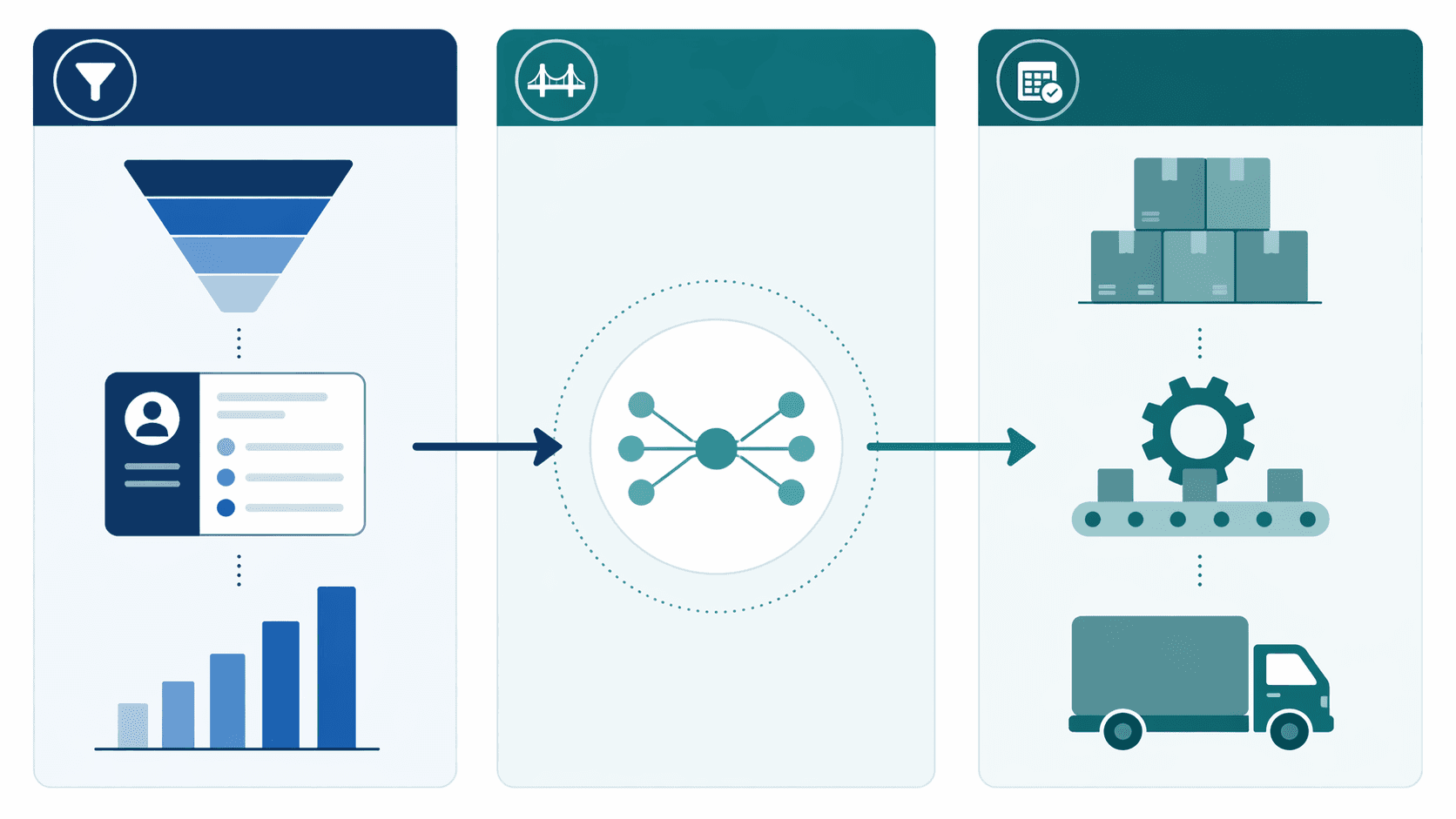
Bridge platforms such as Anaplan and Flowlity are interesting because they acknowledge the handoff problem directly. They are not merely trying to make a sales manager’s number more accurate, and they are not only trying to optimize replenishment from historical demand. Their promise is to connect commercial forecasting with planning models that operations can act on.
Anaplan’s strength is connected planning: finance, sales, operations, and supply chain teams can work from related planning models rather than separate spreadsheets and dashboards. That makes it a candidate when the forecast must move through sales and operations planning, capacity planning, financial planning, and executive scenario review. The buying question is whether the organization is ready to model those relationships and govern them.
Flowlity is positioned closer to supply chain planning, with forecasting and inventory-oriented use cases appearing in sales forecasting software lists alongside broader AI planning tools.[3] For a supply-chain-led buyer, the relevant question is not whether it has a polished sales dashboard. It is whether the platform can connect demand signals to inventory, replenishment, and planning actions in a way the operations team will actually use.
Bridge platforms are not magic translators. They still need clean account, product, calendar, hierarchy, and planning master data. They still need agreement on which pipeline stages should influence demand, how probabilities are converted, who can override the forecast, and how exceptions are reviewed. The advantage is architectural fit: the tool is being evaluated for the handoff, not only for the rollup.
The generative AI divide is real enough to matter, but not enough to decide the purchase
The newer generation of AI-native forecasting tools is changing buyer expectations. Older predictive systems often relied on structured CRM fields, activity data, historical stage movement, and statistical models. Newer generative AI-native systems can also interpret unstructured signals: call notes, emails, conversation themes, deal narratives, buying committee changes, and rep behavior that does not fit neatly into a field.
Oliv AI, in a vendor-authored comparison, says its proprietary study of more than 1,000 forecasts across more than 50 companies found pre-generative AI tools delivering 70–85% accuracy, while generative AI-native platforms reached 90–98%.[4] That is a useful claim for understanding how vendors are framing the architecture shift. It should not be treated as an independent benchmark. Oliv AI is a vendor promoting its own platform, and the study design is not the same thing as a neutral market-wide audit.
Still, the architectural point should not be waved away. If a sales forecast depends heavily on the story inside calls, emails, negotiation language, stakeholder sentiment, or deal risk notes, a system that can interpret unstructured commercial data may outperform one that waits for a rep to update a field. That can improve pipeline visibility.
But supply chain buyers should keep asking the second question: after the AI interprets the deal, what happens next? If the output cannot be mapped to product, timing, location, customer priority, supply constraints, and planning workflows, a very smart pipeline forecast may still leave planners rebuilding the forecast in another system.
Data quality is where optimistic demos usually meet the floor
Every forecasting vendor talks about automation. Fewer demos linger on duplicate accounts, stale close dates, missing product fields, inconsistent stage definitions, rep-specific probability habits, disconnected ERP item masters, and one-off spreadsheet overrides. Yet those are the details that decide whether the forecast can survive operational use.
Oliv AI’s vendor study claims about 40% of sales forecasting software implementations fail to deliver ROI within the first year, and that dirty CRM data is the top failure driver, appearing in 63% of failed implementations.[4] Again, this is vendor data rather than an independent implementation benchmark. It is still directionally consistent with what planning teams see: if the underlying commercial data is inconsistent, AI mostly gives the inconsistency a better interface.
A Forecastio case describes a B2B enterprise improving forecast accuracy from 67% to 94% within six months through pipeline cleaning, AI tools, and a consistent methodology.[5] The useful lesson is not that every buyer should expect the same improvement. It is that process discipline and pipeline hygiene were part of the result. Software did not do the whole job by itself.
For a supply-chain-led organization, the data audit should go beyond CRM cleanliness. The team should test whether account, customer, product, item, region, channel, calendar, and planning hierarchies can be reconciled. A sales opportunity named at the account level may need to become demand at a product-location-week level. That is not a dashboard formatting issue; it is the operating model.
How to test the shortlist against supply chain decisions
The most useful buying process starts with the decision the forecast must support. A revenue operations team may only need a better commit forecast. A supply chain team may need to decide whether to build ahead, delay a purchase order, reserve scarce stock, change a production sequence, or warn a customer-facing team about constraints. Those decisions require different evidence.
| Evaluation question | Why it matters | What a strong answer looks like |
|---|---|---|
| What exactly is being forecast? | Bookings, revenue, units, shipments, demand, and constrained supply are not interchangeable. | The vendor can state the forecast object clearly and show how it maps from CRM opportunity to operational demand signal. |
| Which data sources are required? | CRM data alone may not include product, inventory, lead-time, capacity, or supplier context. | The integration plan covers CRM, ERP, planning systems, item masters, customer hierarchies, and relevant historical demand. |
| At what level can the forecast be consumed? | Supply chain teams often plan by item, location, customer group, week, plant, or channel. | The forecast can be disaggregated or mapped to the planning level without manual spreadsheet translation. |
| Who can override or approve the forecast? | Sales, finance, and supply chain may each have legitimate information and conflicting incentives. | The workflow records assumptions, approvals, exceptions, and overrides rather than hiding judgment in offline files. |
| What downstream action changes? | A forecast is only valuable operationally if it changes inventory, production, procurement, allocation, or service decisions. | The vendor can show the decision path from forecast signal to planning action, not only a score or dashboard. |
| How exposed is the model to dirty data? | AI tools can amplify bad CRM habits if fields, stages, and product mappings are unreliable. | The implementation includes data readiness, field governance, pipeline cleaning, and ongoing exception monitoring. |
This test usually separates the shortlist quickly. If the vendor can only show sales manager inspection, it belongs in the pipeline lane. If it can show replenishment or production planning but treats CRM as an afterthought, it belongs in the demand planning lane. If it can demonstrate the translation between commercial pipeline and operational planning, it belongs in the bridge conversation.
Be careful with ROI models that look too clean
ROI models can be useful during budgeting, but they often hide the hardest assumptions. Aviso, for example, presents an illustrative model showing 2,476% first-year ROI for a 10-rep team, with forecast variance improving from ±15% to ±5%.[6] That is a vendor’s illustrative calculation using assumed inputs, not an independent study showing what buyers should expect.
For a sales-led purchase, that kind of model may still help frame the business case: less time spent on manual forecasting, better rep focus, improved pipeline execution, and fewer missed calls. For a supply chain business case, the value should be tested differently. Did the forecast reduce expedites? Did it lower obsolete inventory? Did it improve service levels? Did it prevent overbuying? Did it give suppliers a steadier signal? Did planners stop reconciling three versions of the forecast before every meeting?
Those outcomes are harder to model cleanly because they depend on lead times, planning frequency, constraint severity, product complexity, and data governance. They are also the outcomes that matter if supply chain is expected to act on the number.
A practical buying path
A sensible evaluation does not need to start with twenty demos. It can start with a short internal alignment exercise that prevents the wrong category from winning because it has the best user interface.
- Name the decision. Decide whether the forecast is mainly for revenue inspection, inventory planning, production planning, procurement, allocation, or executive scenario planning.
- Define the forecast object. Be explicit about whether the organization needs bookings, revenue, units, shipments, unconstrained demand, constrained demand, or supply-adjusted demand.
- Map the data handoff. Trace how an opportunity becomes a demand signal and where product, customer, timing, location, and probability are added or corrected.
- Sort vendors into lanes. Put CRM-native tools, demand planning platforms, and bridge platforms in separate comparisons instead of forcing them into one feature grid.
- Run a dirty-data pilot. Use real CRM and planning data, including stale opportunities, missing fields, inconsistent product mappings, and disputed overrides.
- Measure planning consequences. Evaluate whether the tool changes inventory, production, procurement, or allocation decisions, not only whether the sales dashboard looks better.
The pilot should include both sales and planning users. Sales can tell whether the opportunity interpretation is fair. Supply chain can tell whether the output is usable. Revenue operations can judge whether the workflow is maintainable. If only one group participates, the tool may optimize one meeting and create work for the next one.
Which platform category fits which buyer?
If the organization only needs revenue pipeline confidence, CRM-native forecasting software may be enough. Clari, Gong, Salesforce Einstein, HubSpot, and similar tools should be judged on CRM integration, forecast inspection, rep adoption, deal risk detection, manager workflow, and whether the sales organization will actually keep the data clean.
If the organization’s main pain is inventory, replenishment, supply-demand balancing, or production planning, broader demand planning platforms deserve the heavier evaluation. Blue Yonder, o9, Kinaxis, RELEX, and similar systems should be judged on planning depth, constraint handling, scenario modeling, ERP and planning-system integration, and the ability to incorporate commercial signals without letting noisy pipeline data distort the plan.
If the organization needs both — and many supply-chain-led manufacturers, distributors, and complex B2B businesses do — bridge platforms should move up the shortlist. Anaplan, Flowlity, or a well-integrated combination of CRM forecasting and supply chain planning systems may be a better fit than a standalone sales forecasting tool with impressive accuracy claims but no operational landing zone.
The right choice is the one that supports the decision the forecast is supposed to drive. A high claimed accuracy percentage is worth examining, especially as generative AI-native tools mature. It should not distract from the practical test: can the forecast move from pipeline visibility into inventory, production, and procurement workflows without being rebuilt by hand?
References
- Harnessing AI: Transforming Sales Forecasting For Greater Accuracy And Strategic Action, Demand Gen Report
- Gartner Predicts 70% of Large Orgs Will Adopt AI-Based Supply Chain Forecasting to Predict Future Demand by 2030, Gartner, September 16, 2025
- Best Sales Forecasting Software in 2026: Top AI Tools to Improve Forecast Accuracy, Flowlity
- Best AI Sales Forecasting Software, Oliv AI
- Improve Sales Forecasting Accuracy, Forecastio
- Predictive Sales Forecasting: Real-World Implementation and ROI, Aviso
Comments
Join the discussion with an anonymous comment.