
An AI data center project can clear the first filter that infrastructure teams usually care about—power access—and still lose the deployment quarter. The failure point is increasingly upstream of construction but downstream of expensive planning commitments: the site is selected, equipment assumptions are modeled, transformer and GPU timing are reserved in the schedule, and then local permission collapses.
That is no longer an anecdotal nuisance. Data Center Watch’s Q1 2026 update, reported by Fortune, counted 75 AI data center projects worth more than $130 billion delayed or cancelled in the quarter, matching the full-year total for 2025. Active opposition groups rose from 396 at the end of 2025 to 833 in Q1 2026 across 49 states.[1] For supply chain planners, those are not communications metrics. They are schedule-risk indicators.
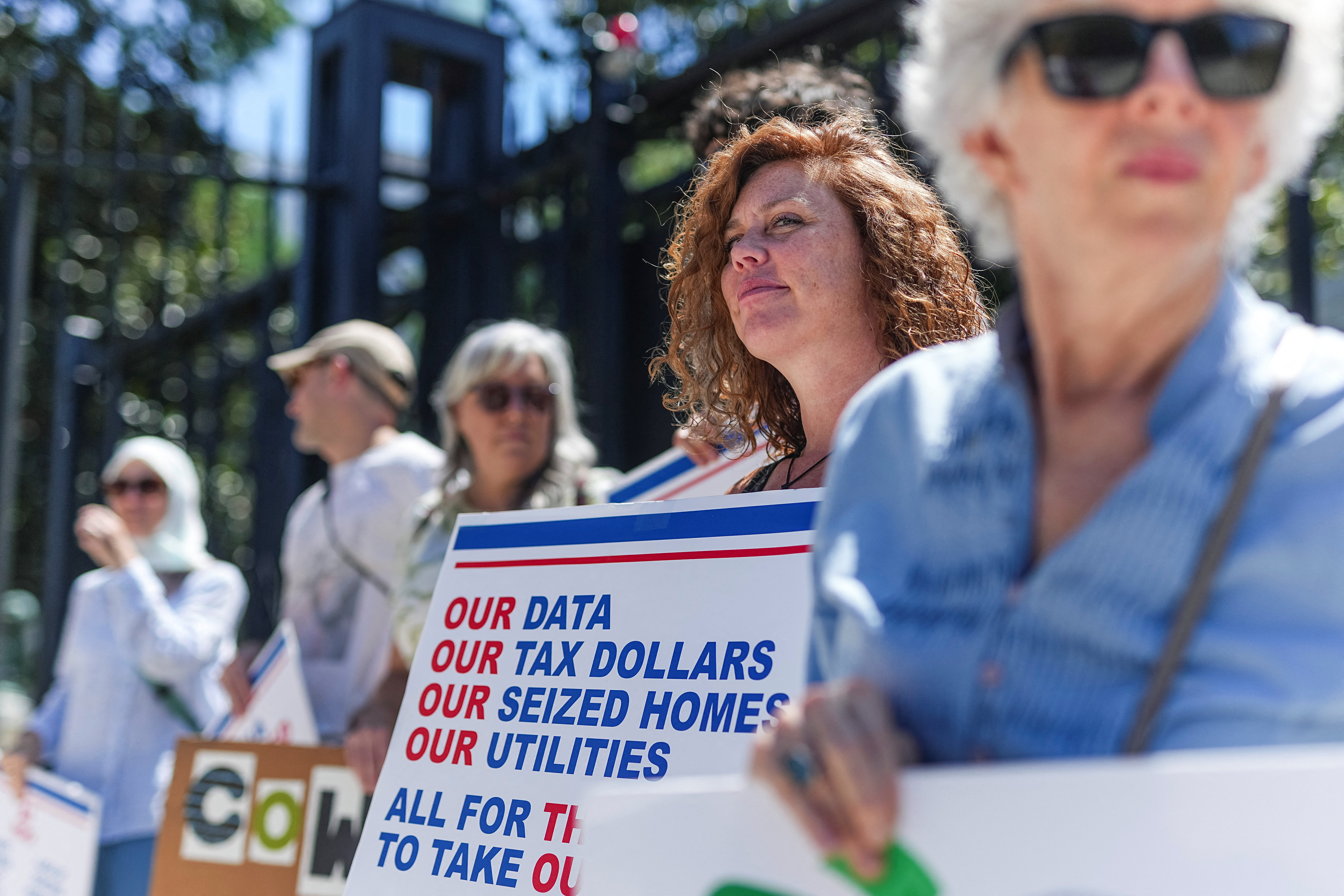
Gallup’s March 2026 survey found that 71% of Americans oppose AI data centers in their local area, with 48% strongly opposed.[2] That does not mean any given site will fail. A national sentiment poll is not a parcel-level permitting model. But it does mean the old assumption—that community resistance will be handled after site control, utility talks, and procurement timing are already lined up—is now a weak assumption.
The Delay Does Not Stay Local
A blocked site does not merely move a project marker from one county to another. It can unsettle the entire procurement chain that was built around that location. The planner has to ask whether the transformer slot still fits the new interconnection plan, whether the GPU delivery window still lines up with the revised buildout, whether cooling assumptions survived the geography change, and whether the new jurisdiction has its own political calendar waiting in the background.
The mechanism is straightforward enough to be dangerous: opposition delays or cancels a site; the project forfeits, idles, or disrupts equipment allocations; the replacement site enters a different power, permitting, logistics, and construction environment; the equipment plan that looked rational in the first schedule becomes a stranded or mistimed commitment.
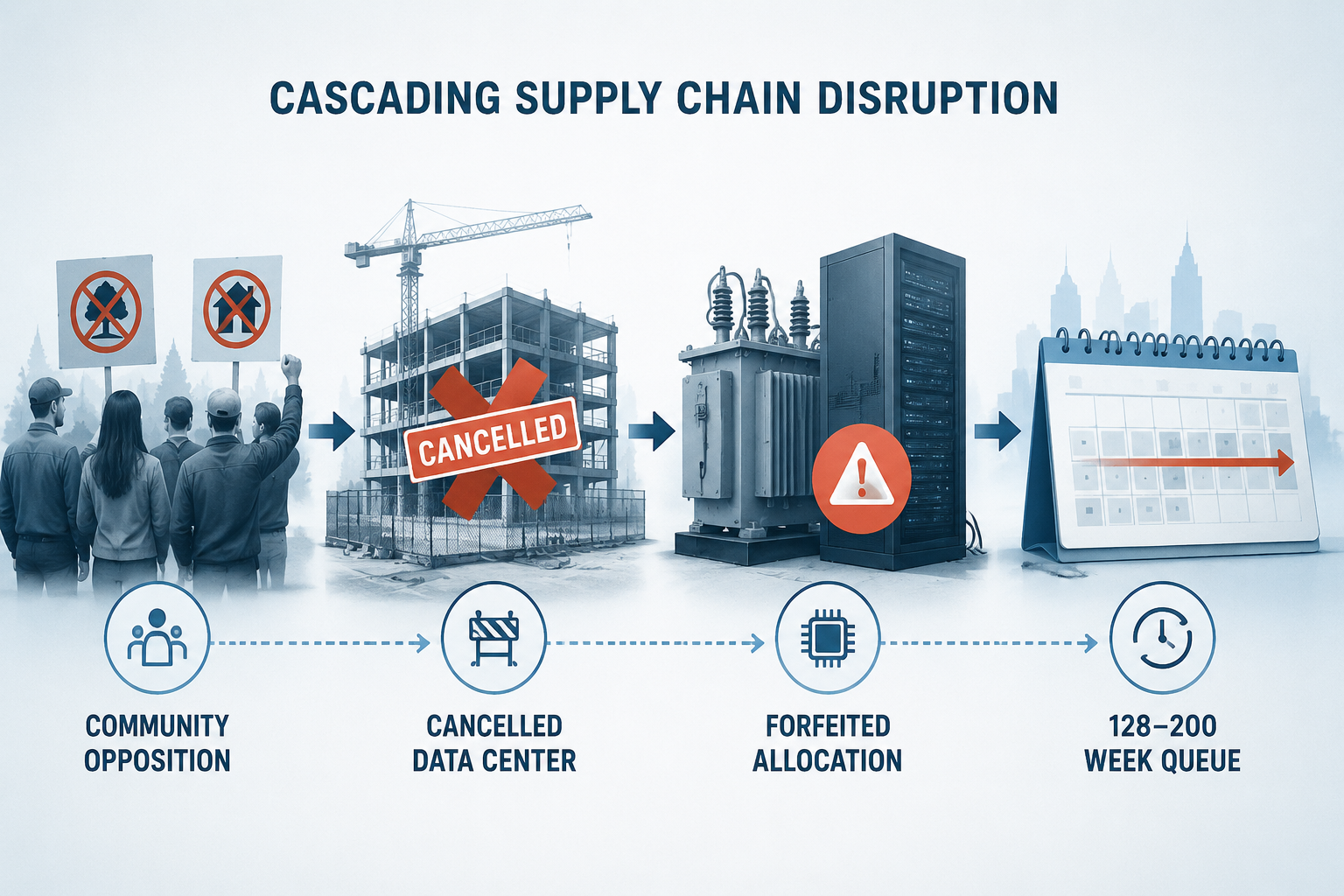
Transformer timing is the bluntest example. Fusion Worldwide’s Q1 2026 industry data put transformer lead times at 128 to 200 weeks, while GPU allocation stood at 36 to 52 weeks.[3] Wood Mackenzie, cited by pv magazine USA in May 2026, similarly described a U.S. transformer market under severe constraint, with lead times extending to four years.[4] In that environment, a cancelled site is not a clean reset. It is a re-entry into a queue that may already be longer than the executive planning horizon used to justify the build.
There is a temptation to treat equipment as portable: if one location fails, ship the gear to another. That works only when the second site has compatible grid requirements, substation timing, cooling design, construction sequencing, tax treatment, and political durability. The further a replacement site moves from the original assumptions, the less useful the original allocation becomes.
GPU allocation creates a different version of the same problem. A server deployment window is not valuable by itself; it is valuable when the shell, power, network, cooling, and commissioning schedule are ready to absorb it. If public opposition pushes energization past the GPU delivery window, the procurement team has to negotiate deferrals, find another absorbing site, or accept idle capital. None of those choices is a public-affairs problem.
The Community Objections Are Operational Inputs
Treating the opposition as generic “backlash” misses the planning content inside it. Communities are arguing over water use, electricity demand, ratepayer exposure, land conversion, diesel backup generation, noise, tax abatements, and whether promised jobs justify the grid and infrastructure commitments. Some objections are environmental. Some are fiscal. Some are rooted in distrust after residents conclude that developers and utilities made decisions before the public meeting began.
For a planner, the point is not to decide whether every objection is equally strong. The point is that each one can map to a different project control. Water risk changes cooling options. Ratepayer risk changes utility commission scrutiny. Land-use risk changes zoning and litigation exposure. Trust risk changes how quickly a local meeting becomes a moratorium campaign. Those are not soft variables when the equipment schedule is already committed.
This is where many AI infrastructure plans still lag the market. They model megawatts, interconnection timing, fiber routes, tax incentives, and component lead times, then leave social acceptance as a late-stage outreach workstream. That sequencing is backwards once opposition has the ability to cancel the site and push the project back into transformer and GPU queues.
Power Access Is No Longer a Complete Site Screen
Nixon Peabody’s May 2026 site-selection alert described the shift as a move toward a “power-plus-permission” model: power access still matters, but documented community acceptance and legislative durability now belong beside it in site diligence.[5] That framing is useful because it avoids the false binary that every AI data center is doomed or every protest is manageable. Some sites remain viable. The definition of viable has changed.
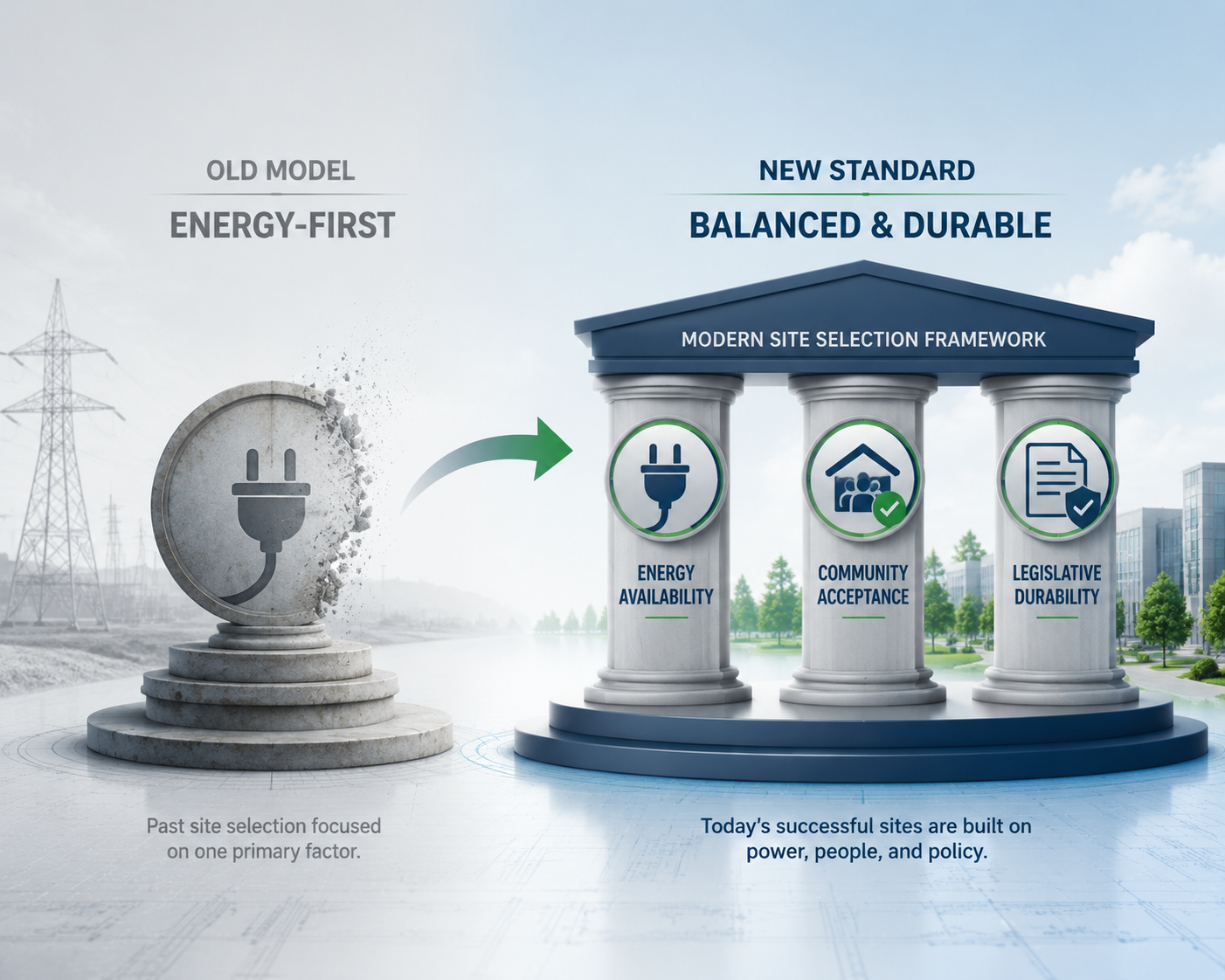
An energy-first screen asks whether the project can obtain enough power at the right cost and timing. A power-plus-permission screen asks whether that access can survive the public, legislative, ratepayer, and utility-commission processes that follow. The difference matters because procurement commitments are made against the second answer, not the first.
| Old planning assumption | Q3 2026 planning question |
|---|---|
| Power availability defines site viability. | Can power access survive community, legislative, and ratepayer scrutiny? |
| Permits are procedural once the preferred site is chosen. | Which approval step can still stop the project after equipment commitments begin? |
| Community outreach starts after site control. | What evidence shows local acceptance before the site enters the critical path? |
| A cancelled site can be replaced with another market. | Will the replacement site preserve transformer, GPU, cooling, logistics, and grid-upgrade assumptions? |
| Regulatory risk is a legal review item. | Could pending bills, moratorium proposals, or utility-cost rules change the deployment schedule? |
The practical change is not a new public-relations checklist. It is a change in gating logic. Community acceptance has to be tested before a transformer slot is treated as executable capacity. Legislative durability has to be assessed before the site is used as an absorbing location for GPU deliveries. Ratepayer exposure has to be examined before the power agreement is treated as stable.
Regulation Is Becoming Part of the Supply Plan
The regulatory layer is not just background noise. The 2026 landscape includes more than 300 data center bills across more than 30 states, at least 12 state moratorium bills, and the White House Ratepayer Protection Pledge signed in March 2026 by Amazon, Google, Meta, Microsoft, OpenAI, Oracle, and xAI, with commitments around self-funded generation and grid-upgrade payments.[5] For planners, these developments change the assumptions behind utility cost allocation, approval timing, and who pays when a project requires grid reinforcement.
The moratorium risk deserves special attention because it can arrive after a pipeline has already been sequenced. A bill does not need to become permanent policy to create procurement damage. If it freezes approvals long enough to miss a transformer production window or force a GPU delivery change, the supply chain effect has already occurred.
Pro-growth states and regions still exist, including parts of the Midwest and Texas. But “lower risk” is not the same as “no risk.” A planner choosing a friendlier jurisdiction still needs to know whether local ratepayers may challenge grid costs, whether county officials can withstand organized opposition, and whether state-level incentives are durable across the project’s actual build schedule.
Replacement Sites Can Break Upstream Assumptions
The more constrained the upstream supply base becomes, the less tolerance there is for site churn. A replacement site may require different transformer specifications, a different grid-upgrade sequence, different cooling equipment, different freight routing, and a different construction labor plan. Even if the project keeps the same capacity target, the bill of materials and timeline may no longer match the first procurement model.
The June 2026 helium shock is a reminder of how quickly a site move can collide with an unrelated supply assumption. Iranian strikes on Qatar’s Ras Laffan removed about 30% of global helium supply, according to Fusion Worldwide and Supply Chain Connect reporting.[6] That does not mean every AI data center cooling plan depends on helium in the same way. It does mean geographic shifts can expose procurement teams to constraints that were not material in the original location model.
The same logic applies to grid equipment and high-end compute. If a project moves from one utility territory to another, the transformer issue may not be a simple matter of preserving a purchase order. If the deployment moves from one internal capacity plan to another, the GPU issue may not be a simple matter of changing a delivery address. The supply plan was built around a site. When the site fails, the plan fails in pieces.
What Belongs in the Planning Model Now
The new planning model does not need to make community risk mystical. It needs to put the right questions early enough that a “no” can still change the site decision before the project consumes scarce allocations.
- Community acceptance: evidence of local support, organized opposition, meeting history, land-use objections, and trust conditions before site selection is treated as final.
- Legislative durability: pending bills, moratorium proposals, zoning changes, election timing, and state-level policy stability across the construction window.
- Ratepayer exposure: who pays for generation, transmission, distribution upgrades, and backup capacity if the project proceeds.
- Equipment recoverability: whether transformer, switchgear, GPU, networking, and cooling allocations can be redirected without destroying the schedule.
- Replacement-site compatibility: whether the fallback site preserves grid design, cooling assumptions, freight lanes, tax treatment, and commissioning sequence.
None of this requires planners to predict every town-hall outcome. It requires them to stop treating permission as an after-action item. The risk should sit on the same critical-path view as interconnection studies, transformer procurement, GPU delivery windows, and construction milestones.
The aggregate equipment impact is still not publicly quantified. There is no reliable public count of transformer slots forfeited because a project was cancelled after opposition, or GPU allocations reshuffled because a site missed its energization date. That uncertainty should make planners more careful, not less. When the measured facts show a surge in delayed and cancelled projects, and the known lead times run into years, waiting for a perfect reallocation dataset is a poor control strategy.
The Q3 2026 Standard
In Q3 2026, a bankable AI data center site is not simply a parcel with power access. It is a parcel where power access, public permission, legislative durability, and equipment timing can coexist long enough for the deployment plan to be real.
That is the planning standard procurement teams should use before they commit scarce transformer capacity, reserve GPU delivery windows, or promise an AI infrastructure quarter to the business. Social license to operate is not reputational garnish or post-selection outreach. It is one of the conditions that determines whether the supply chain schedule exists at all.
References
- Data Center Watch Report, Data Center Watch.
- Americans Oppose AI Data Centers in Their Area, Gallup, March 2026.
- Q1 2026 State of Industry, Fusion Worldwide.
- U.S. transformer market faces severe supply constraints as lead times extend to four years, pv magazine USA, May 11, 2026.
- Data center site selection strategy update, Nixon Peabody LLP, May 7, 2026.
- The 2026 Supply Chain Supercycle, Supply Chain Connect, 2026.
Comments
Join the discussion with an anonymous comment.