
The backlash starts with concert tickets, but the failure pattern is broader
The push to avoid AI-driven dynamic pricing in concert tickets is not really a protest against algorithms; it is a reaction to what happens when a pricing engine moves faster than the people who have to defend it. Ticketmaster became the most recognizable shorthand for that problem. In April 2026, a jury found Live Nation and Ticketmaster acted as a monopoly, while the remedies phase remained open, so the case now functions as a legal and reputational warning rather than a finished outcome [1].

The same trust problem shows up in more ordinary settings. In December 2025, Reuters reported that Instacart ended AI-driven price experiments after criticism, with some users seeing grocery costs rise by as much as 23% [2]. That is not the same thing as surveillance pricing; it is a demand-based experiment that still looked arbitrary and exploitative to the customer who encountered it. FIFA’s World Cup 2026 pricing backlash sits in the same family. Fortune reported that dynamic pricing may be backfiring by keeping actual fans out of the tournament [3]. Different markets, same pattern: prices became opaque, there were no visible limits, and nobody on the customer side believed a human could step in when the result looked wrong.
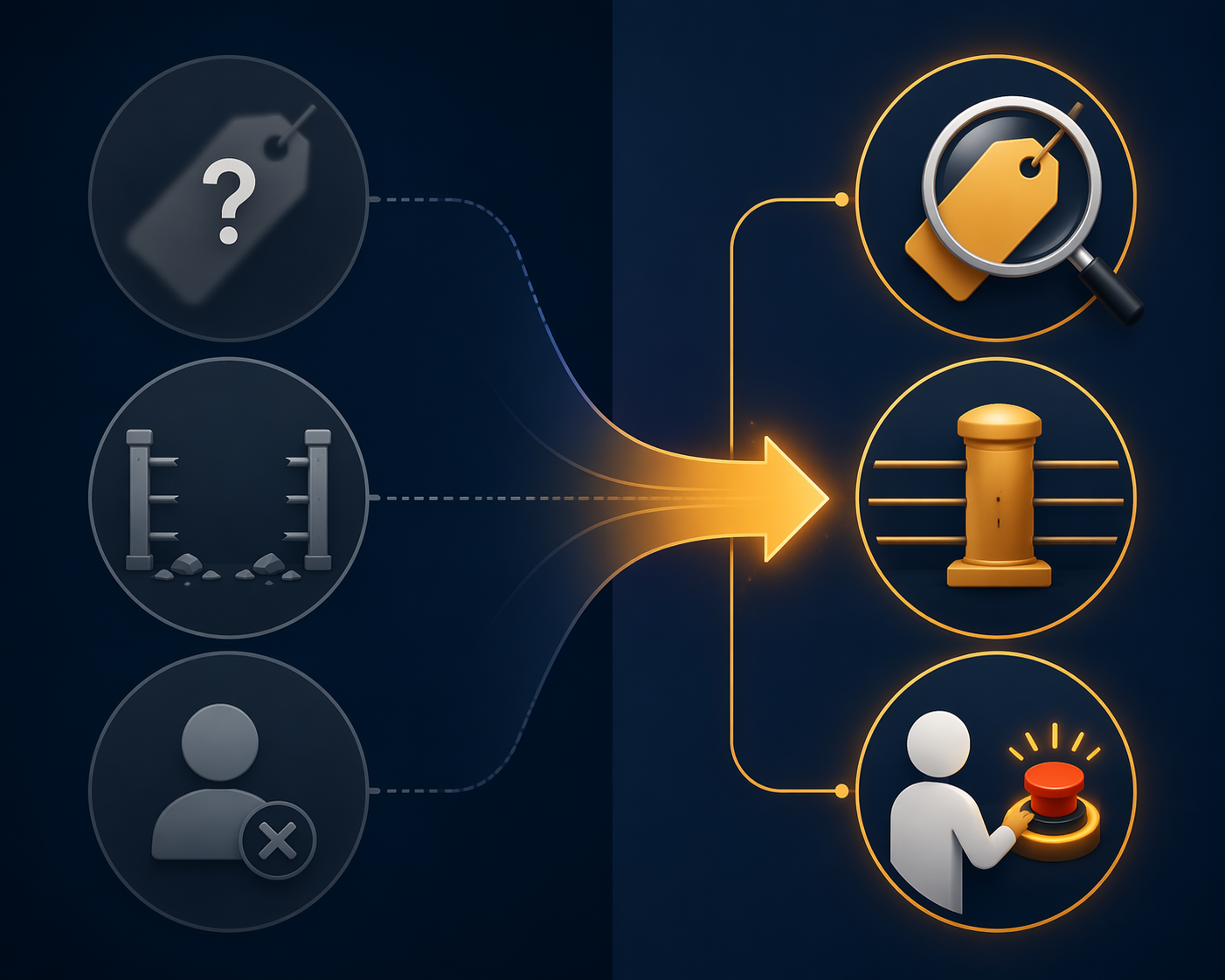
That is why these cases matter to supply chain teams. The immediate lesson is not that dynamic pricing is broken. The lesson is that a pricing model can be commercially sophisticated and operationally reckless at the same time if it has no way to explain itself, no ceiling on volatility, and no escalation path when edge cases turn into disputes.
The adoption gap is where governance risk builds up
McKinsey’s November 2025 B2B pricing survey makes the timing problem clear. Among 419 pricing executives, 65% to 85% expected to adopt gen AI or agentic AI in pricing within one to three years, but only 5% to 10% had scaled it [4]. That is not a universal forecast for every sector, but it does show a high-risk window: ambition is rising faster than governance maturity.
A single-vendor volatility index from Decodo helps explain why this matters in practice. The 2025 index tracked 1.5 million price data points across more than 120 platforms, capturing prices every four hours and normalizing them to U.S. dollars; Amazon alone was cited as making about 319 price changes per day, or 116,509 per year, and some categories exceeded 55% volatility [5]. Those figures should be treated as directional, not as a market census, but they show how quickly automated pricing can swing once it is allowed to run continuously.
The legal pressure is aimed at opacity, not just price movement
The regulatory picture is tightening, but it is important not to collapse all of these issues into one vague category. New York’s Algorithmic Pricing Disclosure Act, which took effect in November 2025, requires retailers using personal data for algorithmic prices to display: “THIS PRICE WAS SET BY AN ALGORITHM USING YOUR PERSONAL DATA,” and it allows civil penalties of up to $1,000 per violation [6]. The FTC’s January 2025 surveillance pricing study found intermediaries with access to precise location data, browser history, mouse movements, and purchase patterns across more than 250 businesses [7]. California Attorney General Rob Bonta also sent inquiry letters to grocers, hotels, and retailers in 2026 [8]. Those signals all point in the same direction: pricing practices that depend on personal data are under scrutiny, but demand-based dynamic pricing in tickets or supply contracts is still a separate question.
The B2B cases that hold up built governance first
The stronger B2B examples are valuable because they show what successful adoption actually looks like. McKinsey described a $15 billion distributor that first improved margin by more than 200 basis points with analytical AI and then added about 50 basis points more with agentic AI in just 10 weeks, but only after 18 months of foundational pricing process redesign [4]. The sequence matters more than the headline. The AI layer did not rescue a weak pricing system; it amplified a system that had already been reorganized around cleaner rules and clearer ownership.
A 2025 SCMR case makes the same point in a smaller, more concrete setting. A foodservice supplier saved more than 8% in overcharges by moving packaging categories to dynamic pricing tied to raw material indices, and it did so with co-developed dashboards and shared pricing models with suppliers [9]. That is the opposite of a black box. The supplier relationship was not treated as a place to surprise the other side; it was treated as a place where both sides needed to see the logic.
Simon-Kucher’s March 2025 analysis is consistent with that pattern. Its view was that AI dynamic pricing in B2B industrial companies works only under specific conditions: high market volatility, strong data quality, meaningful change-management investment, and continued human oversight [10]. Many industrial firms do not yet meet all of those conditions, which is exactly why the governance question should come before the rollout question.
The controls that need to exist before rollout
- Transparency: suppliers and internal reviewers should be able to understand what drives a price change, even if they cannot see every model parameter.
- Guardrails: define price caps, volatility bands, or contractual floors and ceilings before the system starts negotiating.
- Human override: set documented escalation thresholds so procurement, logistics, or commercial leaders can stop or review edge-case changes before they become disputes.
That is the practical lesson from the consumer backlash. When the pricing logic cannot be explained, when the move can swing too far, and when no one has authority to intervene, the burden shifts to the people who answer complaints after the fact. Supply chain leaders do not need to reject AI pricing to avoid that outcome. They need to make sure the system can be defended, bounded, and overridden before it is allowed to govern supplier relationships.
References
- Jury finds that Live Nation and Ticketmaster acted as a monopoly, NPR, April 2026
- Instacart ends AI-driven price experiments after criticism, Reuters, December 2025
- FIFA's foray into dynamic pricing may be backfiring by keeping actual fans out of the World Cup, Fortune, 2025
- B2B pricing: Navigating the next phase of the AI revolution, McKinsey, November 2025
- AI-powered dynamic pricing fairness, Decodo, 2025
- New York's Algorithmic Pricing Disclosure Law Takes Effect, Jones Day, November 2025
- FTC Surveillance Pricing Study, FTC, January 2025
- Algorithmic And Surveillance Pricing Pushes Retail Into Legal Minefield, Forbes, 2026
- Putting dynamic pricing into practice, SCMR, 2025
- AI and dynamic pricing in B2B industrial companies: why it’s not a match made in heaven, Simon-Kucher, March 2025
Comments
Join the discussion with an anonymous comment.