
Search for “SpaceX AI logistics supply chain” and the phrase sounds like one inspectable system: a command layer that buys parts, schedules factories, moves inventory, launches satellites, and lands boosters. That is not the useful way to look at it. SpaceX appears to apply AI across several operating problems that share data intensity and speed, but not the same risk profile, governance model, or transferability.
The practical distinction matters. A material-planning algorithm that changes safety stock rules inside MRP is not the same class of decision as an autonomous satellite maneuver. Computer vision on a weld seam is not the same problem as vertically integrating launch hardware. Lumping them together makes SpaceX sound more magical and less instructive.
| AI application | What it changes | Transferable lesson |
|---|---|---|
| Vertical integration | Controls more production knowledge, data, and feedback loops inside the company | AI improves faster when operational data and process ownership are not scattered across too many handoffs |
| Manufacturing automation | Uses vision and production data to detect defects and tune process behavior | Inspection AI only works when defect definitions, traceability, and response rules are disciplined |
| Material planning optimization | Changes safety stock, EOQ, and planning-method rules inside MRP | Near-term ROI is more plausible where planning policy and master data can be corrected, measured, and governed |
| Autonomous logistics | Lets machines execute time-sensitive movement decisions where human latency is unacceptable | Autonomy requires explicit authority boundaries before speed becomes an advantage |
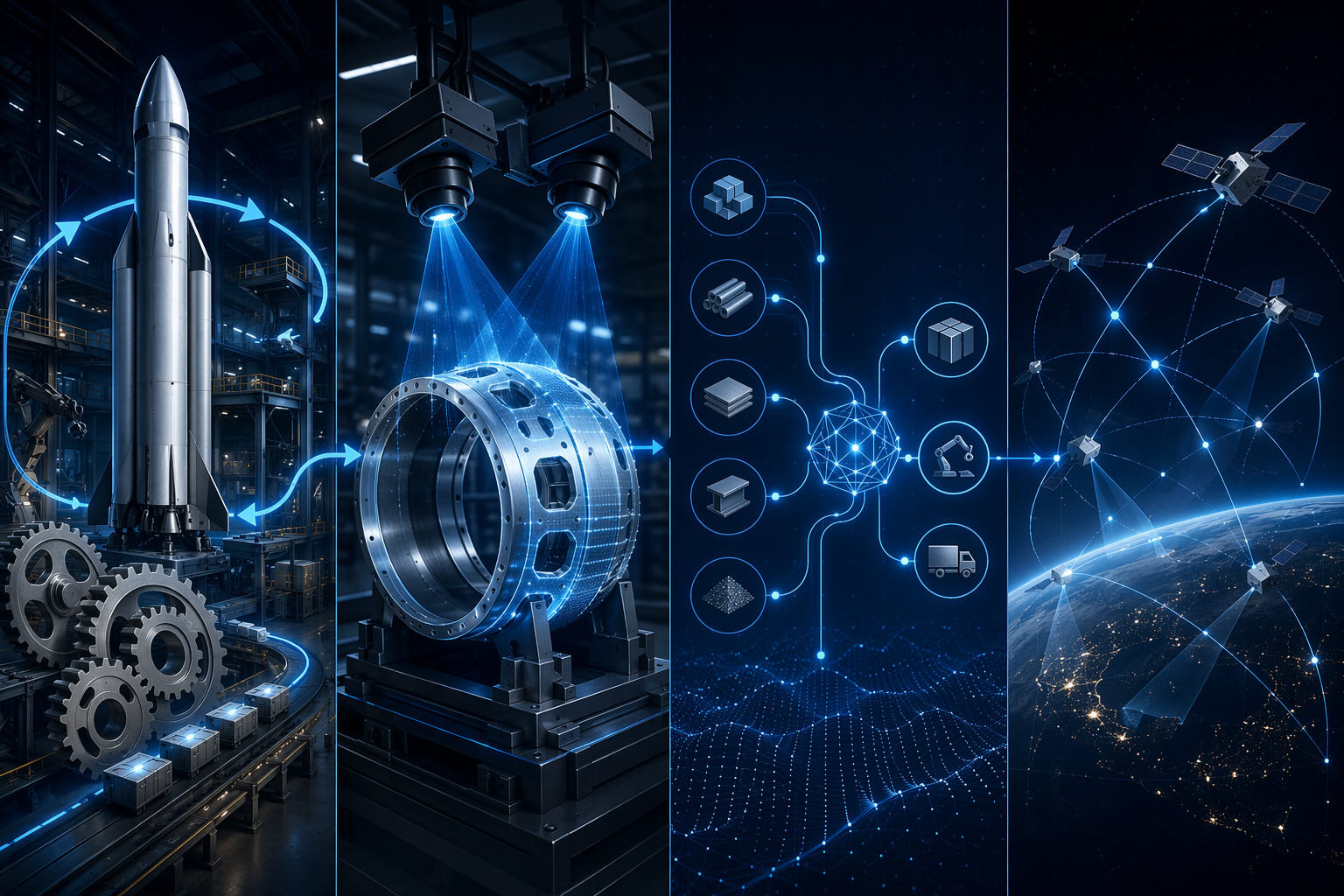
Vertical Integration Comes Before the Algorithm
The commonly reported figure is that SpaceX manufactures about 85% of its launch hardware in-house. The same secondary-source discussion places Falcon 9 launch cost around $62 million, compared with roughly $150 million to $400 million for competitors, though the 85% manufacturing figure is not an official SpaceX KPI disclosure and should be treated as a widely cited estimate rather than a company-certified metric.[1]
For supply chain leaders, the important point is not the headline appeal of building nearly everything yourself. It is the operating condition that vertical integration creates. When design, production, quality feedback, supplier decisions, and inventory consequences sit closer together, an AI model has a better chance of seeing the work as it actually happens rather than as a delayed abstraction inside a spreadsheet.
That does not mean vertical integration is automatically superior. It raises capital intensity, managerial burden, and execution risk. But it does explain why SpaceX is a poor benchmark for companies that outsource most critical process knowledge and then ask AI to optimize the leftovers. The data trail from a weld, a design change, a shortage, a nonconformance, and a revised build plan is easier to tighten when the organization owns more of the loop.
The Most Transferable Case Is Material Planning, Not Orbital Autonomy
The Planning Precision Program is the piece supply chain executives should study first. According to former SpaceX supply chain lead David C. Smith, the internal program used AI-enhanced safety stock calculations, economic order quantity optimization, and automated planning-method rules embedded into the MRP system, and it reportedly freed about $70 million in inventory. The caveat is important: the savings figure comes from Smith’s account, not from an independently audited SpaceX disclosure.[2]
That caveat does not make the case uninteresting. It makes it more operationally useful. The claim is not that a black-box optimizer found money by looking clever in a demo. The reported design put the decision logic inside the planning system where material planners already lived: safety stock policy, order quantities, planning methods, and the MRP exception stream. That is the territory where excess inventory is usually created one reasonable-looking decision at a time.
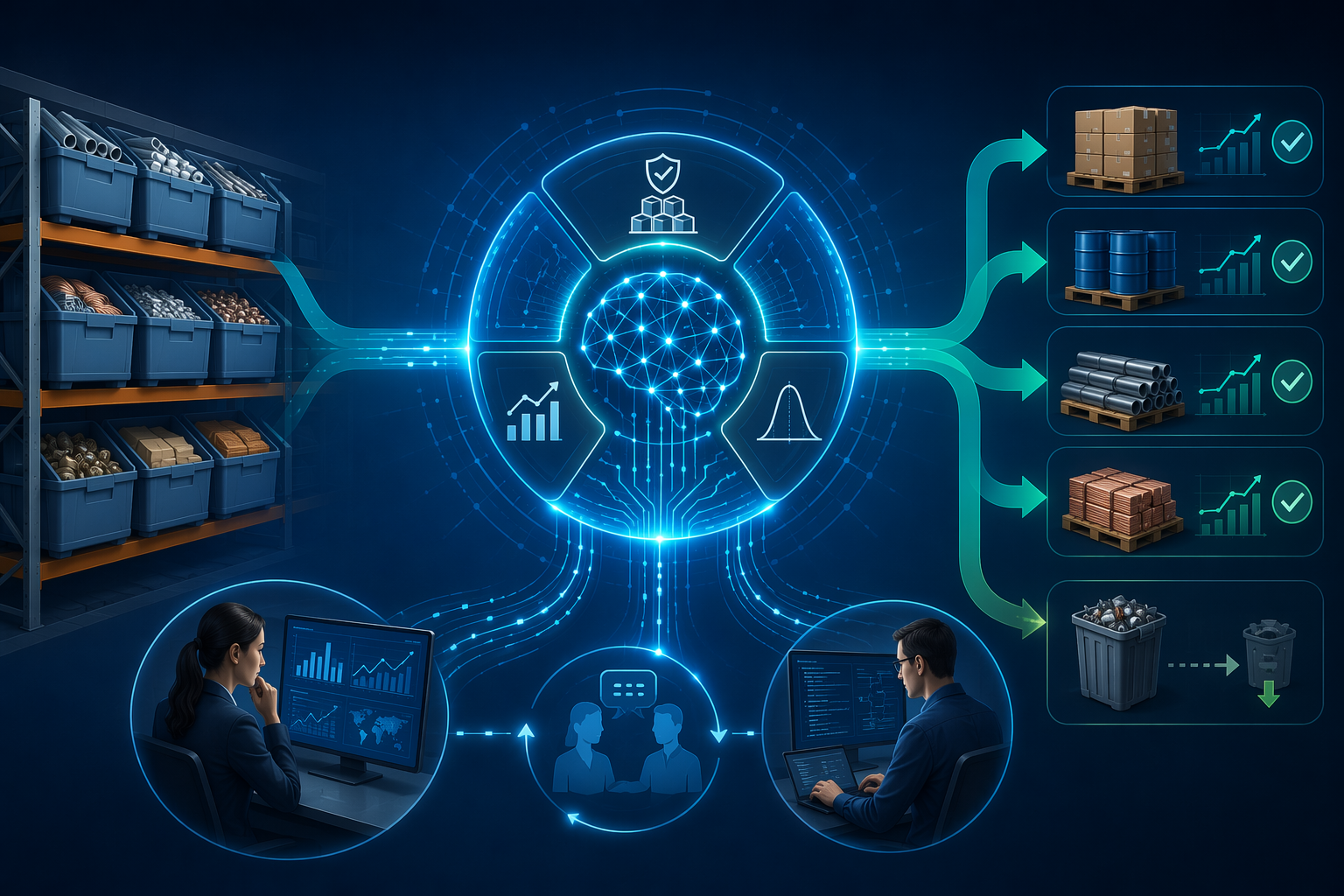
The staffing pattern is as revealing as the algorithm list. Smith describes a setup involving roughly 50 material planners, many with engineering backgrounds, supported by 7 data engineers and a dedicated software engineering team.[2] That is not a dashboard project. It is a cross-functional operating intervention aimed at changing how planning rules were set, maintained, and trusted.
In a normal factory, safety stock is rarely just a formula. It is an argument with history in it: unreliable suppliers, engineering churn, minimum buys, shelf-life constraints, expediting scars, quality escapes, and planners who know which parts will shut down a line even when the ERP classification says otherwise. EOQ has the same problem. A mathematically clean quantity can be wrong if the master data hides demand volatility, supplier behavior, inspection lead time, or packaging constraints.
That is why embedding AI into MRP is more consequential than generating a recommendation outside it. Once the rule changes are inside the planning run, they affect purchase signals, reschedule messages, inventory targets, and planner workload. They also create accountability: if a rule is wrong, the system has to expose where it came from and who can correct it. A procurement director cannot govern a model by admiration. Someone has to own the part master, the planning method, the exception policy, and the override trail.
This is where the SpaceX example is most portable. Many companies do not need autonomous logistics. They do have too much inventory, fragile planning parameters, and planners spending their mornings deciding which system messages to ignore. If the data foundation is good enough to distinguish real demand from noise, and if the organization is willing to let planners and data engineers work on the same operating problem, AI-assisted planning can move from experiment to working capital impact.
Manufacturing AI Moves From Inspection to Control
Manufacturing automation is the second SpaceX lesson worth slowing down for, because it changes the role of AI from analysis after the fact to decision support at the point of production. Current analysis around SpaceX and xAI describes a trajectory toward computer vision for real-time defect detection in welding, assembly, and composite layup; multimodal production-data integration; and closed-loop process optimization.[3][4]
As of Q3 2026, that xAI connection should be treated as an emerging direction rather than a completed proof point. The useful signal is not that a new corporate relationship instantly transforms factory performance. It is that advanced manufacturing AI is moving toward control logic: models that read images, sensor streams, work instructions, nonconformance histories, and process parameters quickly enough to influence what happens next.
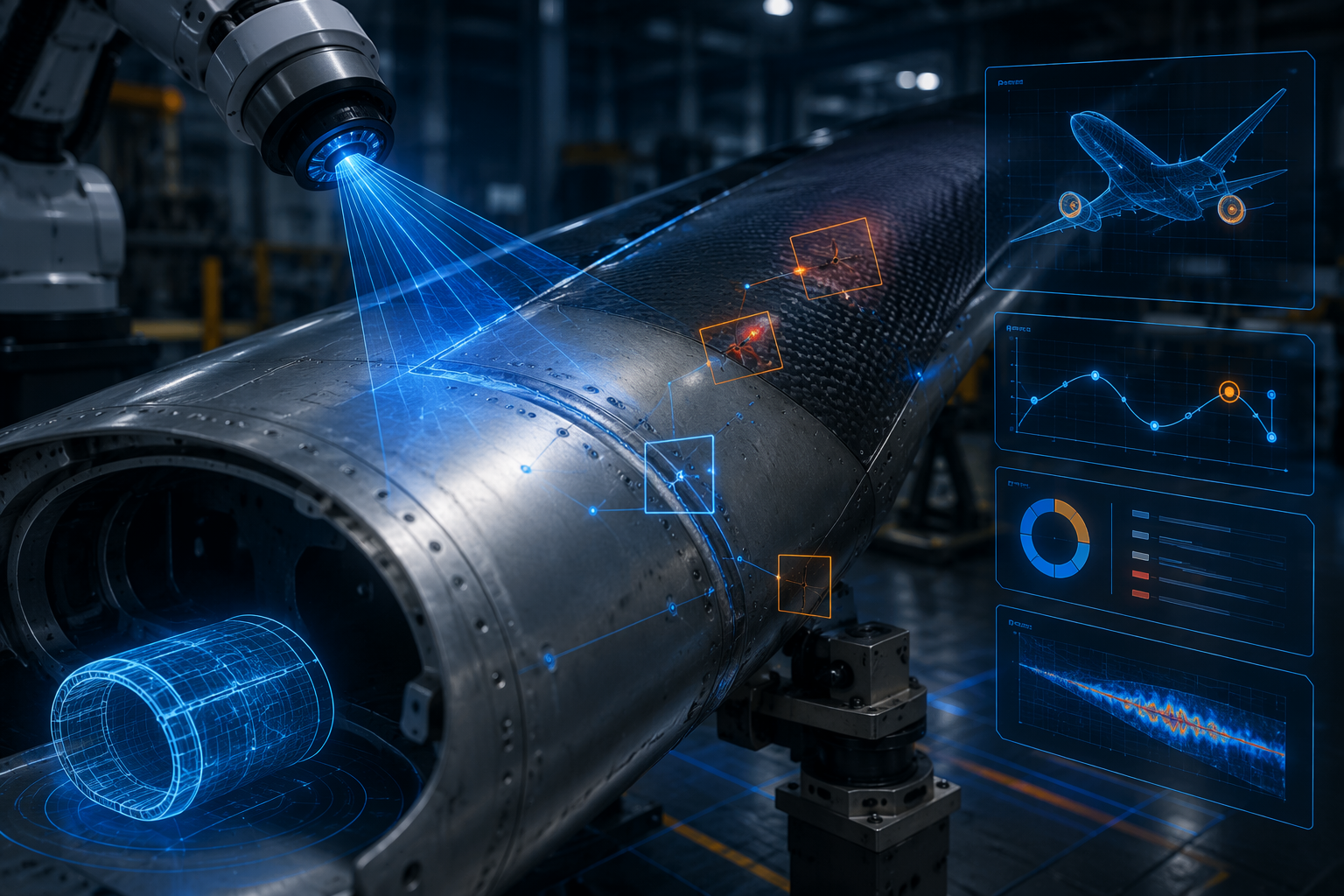
Computer vision in aerospace manufacturing sounds clean until it meets the floor. A model may flag an anomaly along a weld seam, but the business value depends on what happens after the flag. Does the station stop? Does a technician rework the part? Does quality engineering review the defect class? Is the image tied to serial number, lot genealogy, operator, tooling condition, and environmental data? If the answer is no, the model has created another inspection queue rather than a better process.
The hard part is not seeing defects. It is deciding which defects matter, which process settings should change, and which feedback should return to engineering. Closed-loop optimization asks the factory to trust machine recommendations in a setting where scrap is expensive and escapes are worse. That trust is built through traceability, calibrated thresholds, controlled response plans, and quality teams that can audit why a recommendation was made.
SpaceX’s production environment is unusual, but the discipline is not exotic. Any manufacturer considering AI vision should start with the same uncomfortable inventory of readiness: defect taxonomy, image quality, sensor coverage, part genealogy, escalation rules, and the actual authority given to the model. A pilot that detects anomalies but cannot change inspection burden, rework behavior, or process capability is a technical success with limited operating value.
Autonomous Logistics Is the Outer Boundary
SpaceX’s autonomous logistics examples are the most dramatic and the least directly imitable. Starlink reportedly performed about 300,000 autonomous collision-avoidance maneuvers in 2025, ingesting Department of Defense tracking data and executing decisions without human approval.[5] That is logistics in the literal sense: assets moving through a constrained network, with timing, routing, risk, and consequence compressed beyond human review cycles.
The same outer-boundary logic appears in landing and docking. G-FOLD is described as a fuel-optimal landing algorithm used for propellant-conserving booster landings, while Dragon’s autonomous docking systems handle spacecraft approach and connection tasks where delay and ambiguity can be unacceptable.[5] These are not warehouse-routing analogies with better lighting. They are machine-speed decisions in environments where the system must know its authority before the event arrives.
Most commercial supply chains should resist the temptation to copy the risk posture. A distribution network that lets an algorithm reroute trucks, rebalance inventory, or release purchase orders without human approval still needs bounded authority. What is the cost ceiling? Which customers can be affected? Which constraints are hard stops? When does the model escalate? Who reviews exceptions after the fact? Autonomy is not the absence of governance; it is governance encoded before the decision window closes.
Commercial Spinoffs Suggest Some Practices Travel
Former SpaceX supply chain leaders have launched commercial tools including Datum, described as supply chain SaaS, and The MRP Refinery, described as an AI agent for material planning.[6] That does not turn SpaceX into a vendor case study, and it does not prove every method survives outside aerospace. It does suggest that at least some of the planning discipline, data-engineering patterns, and MRP-focused automation are portable enough to be packaged for other operators.
The distinction matters for buyers. A commercialized planning tool may carry useful lessons from SpaceX, but it cannot import SpaceX’s operating context: in-house manufacturing depth, engineering tempo, tolerance for custom tooling, and planner-engineer collaboration. Software can accelerate a method. It cannot substitute for deciding who owns planning parameters, who fixes bad data, and who has authority to change the rules that drive purchase and production signals.
What to Take From SpaceX Without Copying SpaceX
SpaceX is not a clean template for the average supply chain, and the public evidence base is thinner than the mythology around it. There is no official SpaceX supply chain KPI deck for outsiders. The strongest claims available here come from former employees, secondary analysis, and specialist commentary rather than a complete company disclosure package. That means the right use of the case is selective, not devotional.
- Vertical integration teaches control of operational data and feedback loops. If critical process knowledge lives outside the company, AI will inherit the delay and distortion of those handoffs.
- Manufacturing AI teaches inspection and process-control discipline. Vision models need defect definitions, traceability, and response rules before they can reduce quality burden.
- Planning optimization teaches measurable near-term value. Safety stock, EOQ, and planning-method rules are ordinary levers, but changing them inside MRP can affect real inventory dollars.
- Autonomous logistics teaches governance for machine-speed decisions. The lesson is not to remove people everywhere; it is to define where human latency is the risk and what authority the system has.
The better question is not whether a company can “do AI like SpaceX.” It is which SpaceX-like problem it actually has. A business with unreliable part masters and unmanaged planning parameters should not start with autonomy. A factory with weak defect traceability should not expect computer vision to rescue quality. A supply chain with mature MRP governance, credible demand signals, and planners who can work with data engineers may have a much nearer opportunity: use AI to change the rules that create inventory, expedite noise, and planner overload in the first place.
References
- SpaceX vertical integration and launch cost analysis, spacexstock.com
- Planning Precision Program and The MRP Refinery materials, David C. Smith
- SpaceX and xAI manufacturing automation analysis, MassRobotics
- SpaceX, xAI, and robotics manufacturing analysis, The Robot Report
- SpaceX AI, Starlink autonomy, G-FOLD, and autonomous docking analysis, SentiSight.ai
- Supply chain AI commercialization and SpaceX spinoff coverage, Control.com
Comments
Join the discussion with an anonymous comment.