
ServiceNow’s Q2 2026 earnings beat is a useful signal for supply chain leaders, but not because it settles the platform decision. The company reported $3.88 billion in subscription revenue, up 24.5% year over year; current remaining performance obligations of $13.2 billion, up 27%; total remaining performance obligations of $29 billion; and full-year subscription revenue guidance raised to $15.76 billion to $15.78 billion. It also said AI annual contract value crossed $1 billion and that agentic AI deployments increased 9x in nine months.[1]
Those are not small numbers. They explain why the market hears “AI demand” when ServiceNow reports. For a supply chain or procurement buyer, though, the first question is narrower: how much of that demand reaches source-to-pay, supplier work, manufacturing commercial operations, logistics orchestration, and cross-functional exception handling? ServiceNow does not disclose the supply-chain-specific share of its $1 billion AI ACV. The figure spans product lines, including IT, CRM, security, HR, finance, and supply chain.[1]

| Q2 2026 signal | What it says | What it does not say |
|---|---|---|
| $3.88B subscription revenue | ServiceNow’s subscription base is still growing at enterprise scale. | It does not break out supply chain workflow revenue. |
| $1B+ AI ACV | AI monetization is now material across the company. | It is aggregate AI ACV, not supply-chain-specific AI ACV. |
| Agentic deployments up 9x in nine months | Customers are deploying agentic capabilities more broadly. | The metric does not disclose which deployments are in procurement, logistics, or manufacturing. |
| $13.2B cRPO | Contracted near-term subscription obligations remain strong. | It does not prove functional depth in any one supply chain process. |
The earnings beat therefore matters as a doorway, not as proof. The supply chain case has to be built from deployment evidence: named customers, process scope, volume, timing, and whether the capability is already running or still being packaged into the roadmap.
FedEx Is the Most Important Test Case
FedEx is the strongest available evidence that ServiceNow’s workflow story extends beyond IT service management. At ServiceNow Knowledge 2026, coverage of the FedEx deployment described roughly 5 million ServiceNow workflows per month across hire-to-retire, source-to-pay, and ship-to-collect processes.[2] That scope matters. It is not a single help desk workflow being renamed as supply chain automation. It touches procurement, employee lifecycle, and logistics-linked commercial operations.
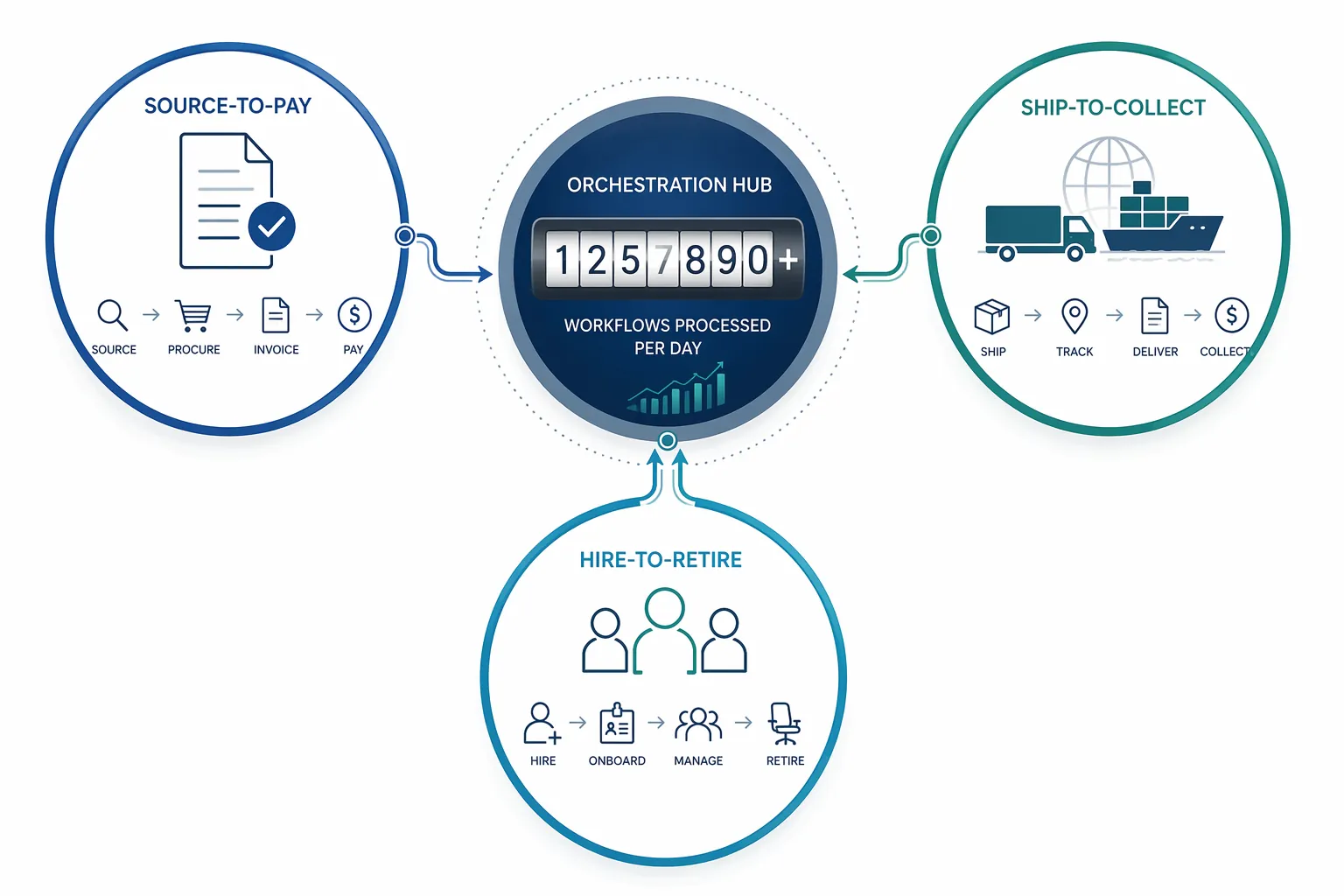
It also clarifies what kind of supply chain platform ServiceNow is trying to be. The company is not presenting itself here as the demand planning engine, the transportation optimizer, or the system of record for inventory. The stronger claim is that a workflow layer can sit across messy enterprise handoffs: a supplier risk signal, a procurement task, a finance review, a logistics exception, a customer-facing shipment issue, and the manager waiting for an answer.
FedEx and ServiceNow have also described an expanded collaboration that embeds FedEx Dataworks logistics intelligence into ServiceNow procurement workflows. The announced capabilities include Supplier Insights, Supplier Visibility, and Success Indicators, with FedEx CEO Raj Subramaniam pointing to “$1.8 trillion of inefficiency in global supply chains.”[3] The language is ambitious, but the distinction is important: the 5 million workflows per month are evidence of live operational scale, while the intelligent Source-to-Pay capabilities are described as newer AI-powered supply chain solutions being developed through the expanded collaboration.[2][3]
That split should shape buyer interpretation. FedEx validates ServiceNow’s presence in high-volume enterprise workflow. It does not, by itself, prove that every AI feature in the expanded source-to-pay story is mature, generally available, and repeatable for a manufacturer, retailer, or logistics provider with different systems and data quality.
Procurement Evidence Is Real, but Uneven in Scope
The most useful procurement evidence after FedEx is Dropbox. In a Genpact case study, Dropbox reduced its procurement cycle by more than 50% in eight weeks using ServiceNow with Genpact.[4] That is a sharper operational claim than a general AI adoption statistic because it names the process, the direction of change, and the time window.
It should still be read for what it is: a partner-published case study. It supports the conclusion that ServiceNow can help compress procurement cycle time in a favorable documented deployment. It does not support a broad claim that ServiceNow halves procurement cycles generally, or that the same outcome will appear without comparable process redesign, integration work, stakeholder discipline, and implementation support.
Nomura Research Institute adds another procurement-adjacent signal. Knowledge 2026 coverage cited a 50% faster supplier onboarding outcome.[2] Supplier onboarding is a good test of workflow substance because it exposes the practical layers buyers care about: vendor data intake, approvals, compliance checks, finance setup, risk review, and handoffs between procurement and internal service teams. Again, the metric is useful, but it is not the same kind of evidence as FedEx’s monthly workflow volume or Dropbox’s cycle-time case.
Taken together, these cases show that ServiceNow’s supply chain and procurement story is not only a slideware extension of IT workflows. They also show why the category is hard to evaluate. A supplier onboarding acceleration, a procurement cycle-time reduction, and a large cross-enterprise workflow volume are all relevant, but they measure different things. One speaks to speed inside a defined procurement process. One speaks to supplier setup. One speaks to scale across multiple enterprise domains.
Manufacturing Commercial Workflows Are a Different Kind of Proof
Club Car is often a more concrete example for manufacturing leaders because it sits closer to the commercial side of the value chain. ServiceNow’s customer story says Club Car reduced a five-day dealer reorder process to less than one day using ServiceNow CPQ with a single configuration engine. The same case cites 2,000 qualified leads per month and a 17% consumer conversion rate.[5]
This is not source-to-pay. It is not supplier risk management. It is also not a planning benchmark. Its relevance is different: it shows ServiceNow being used to remove friction from configuration, quoting, dealer reorders, and downstream commercial execution in a manufacturing context. For manufacturers trying to connect customer demand, dealer channels, order operations, and fulfillment work, that is a meaningful workflow pattern.
The evidence still comes from a ServiceNow customer story, so it should not be inflated into independent proof of manufacturing-sector performance. But it is process-specific enough to be useful in a shortlist conversation. A buyer can ask: do our quote, order, dealer, warranty, and field-service handoffs look like this, or are our biggest constraints upstream in planning, procurement, or plant execution?
The Product Roadmap Is Catching Up to the Case Evidence
ServiceNow’s April 2026 manufacturing value chain announcement fills in the product context around these cases. The company announced six AI-native solutions for manufacturing, including Quality Issue Management, Warranty Claims with AI Fraud Detection, CPQ with Configuration AI Agent, Order Operations with Voice AI Agents, and Field Service with Parts Management AI Agent.[6]
That product set points toward a clear product direction: use AI and workflow orchestration to move work across the commercial, quality, warranty, order, and service layers of manufacturing. For a supply chain organization, the appeal is not that ServiceNow becomes the only operational system. The appeal is that it may reduce the number of unresolved handoffs sitting between ERP records, planning outputs, supplier inputs, customer requests, and service actions.
Knowledge 2026 also introduced or emphasized broader AI operating concepts, including AI Control Tower, Action Fabric, and Autonomous Workforce coverage.[2] Those terms are easy to overuse. Their practical relevance for supply chain leaders is governance: who can see what the AI is doing, which systems it can touch, what approvals remain human-controlled, and how work is routed when an exception crosses departmental boundaries.
This is where ServiceNow has a credible wedge. Many supply chain AI tools specialize in prediction, optimization, or decision support. ServiceNow’s stronger claim is execution coordination: once a signal exists, who owns the next task, which policy applies, what evidence is attached, and how the handoff is tracked. That distinction is helpful, as long as the buyer does not confuse workflow orchestration with planning intelligence.
Where the Earnings Beat Falls Short as Supply Chain Evidence
The unresolved issue is not whether ServiceNow has supply chain workflow customers. It does. The unresolved issue is how much of the Q2 AI and subscription momentum belongs to those workflows, how repeatable the outcomes are, and how ServiceNow performs against systems built natively around procurement, ERP, supply planning, transportation, or manufacturing operations.
The $1 billion AI ACV figure is impressive, but it cannot be treated as a supply chain AI revenue number.[1] The 9x increase in agentic deployments is also meaningful, but it does not disclose how many deployments are in source-to-pay, logistics, quality, field service, or manufacturing order operations.[1] Buyers should resist the shortcut from “enterprise AI demand is strong” to “this vendor is functionally superior in my supply chain process.”
The competitive comparison is especially unsettled. SAP and Oracle have system-of-record depth in ERP. Procurement suites have category, sourcing, supplier, contract, and spend-management specialization. Planning vendors such as Blue Yonder, o9, and Kinaxis compete on modeling, scenario analysis, and supply-demand decisioning. ServiceNow should not be judged as though it were trying to replace each of those categories in the same way.
A more practical comparison starts with the work pattern. If the main problem is forecasting accuracy, constrained supply planning, inventory optimization, or network modeling, the planning stack remains the more natural center of gravity. If the problem is that supplier, procurement, logistics, finance, quality, and service teams keep dropping exceptions into email, spreadsheets, and disconnected queues, ServiceNow’s workflow layer deserves a closer look.
How Supply Chain Buyers Should Read the Signal
The right interpretation is neither dismissal nor acceptance. ServiceNow’s Q2 2026 results show that AI demand is translating into large commercial momentum, and the named supply chain and procurement cases show that the company’s workflow footprint is not confined to IT. FedEx gives the strongest proof of scale. Dropbox and Nomura Research Institute provide narrower procurement and supplier-process evidence. Club Car shows manufacturing commercial workflow improvement. The April manufacturing launches and Knowledge 2026 announcements show where the product line is headed.
For evaluation teams, the next questions should be operational rather than financial-market questions:
- Which supply chain workflows are live today, and which are roadmap or co-development?
- What systems must ServiceNow connect to: ERP, procurement suite, TMS, WMS, MES, supplier portal, planning platform, or customer service system?
- Does the buyer need decision optimization, workflow orchestration, or both?
- Which cycle-time, onboarding, exception-resolution, or service-level metric will prove that work actually moved faster?
- Who governs agentic actions when procurement, finance, supplier management, and logistics all touch the same exception?
This is also where broader evaluation resources are useful. A vendor directory can help place ServiceNow beside ERP-native, planning, procurement, and workflow-heavy alternatives. A domain-specific checklist can force the team to separate integration claims from live references. Agentic procurement comparisons can help distinguish autonomous task execution from ordinary workflow automation with AI branding.
The earnings beat is relevant because there is real supply chain workflow adoption behind the broader AI story. It does not yet prove supply-chain-specific AI revenue scale, and it does not settle ServiceNow’s competitive position against ERP, procurement, and planning-focused vendors.
References
- ServiceNow Reports Second Quarter 2026 Financial Results, ServiceNow, July 22, 2026.
- ServiceNow Knowledge 2026: Enterprise AI Implementation Needs Guardrails and Control, BizTech Magazine, May 2026.
- FedEx and ServiceNow Expand Strategic Collaboration with New AI-Powered Supply Chain Solution, FedEx Newsroom.
- Dropbox cuts its procurement cycle by 50% and counting with Genpact and ServiceNow, Genpact.
- Club Car, ServiceNow.
- ServiceNow puts AI to work across the manufacturing value chain, ServiceNow, April 2026.
Comments
Join the discussion with an anonymous comment.