
What This Analysis Covers — and What It Cannot
If you arrived here looking for a single named-company post-mortem — one manufacturer, one failed AI S&OP deployment, full attribution — that account does not exist in the public record in the form the keyword implies. No fully attributed, named manufacturing company AI S&OP failure case study has been published with the operational detail that would make it genuinely useful.
What does exist is something more useful for practitioners: a consistent pattern taxonomy. Across practitioner accounts, analyst research from 2025 and 2026, and documented deployment reviews, the same five organizational and infrastructure failure modes appear repeatedly — across company sizes, across industries, across ERP platforms. This analysis draws on those patterns to give you a diagnostic framework you can apply before committing to a deployment, not after one stalls.
The Pilot-to-Production Gap in Manufacturing AI Planning
The scale of the problem is not in dispute. What requires care is using the right numbers for the right context.
MIT's NANDA research program reviewed more than 300 publicly disclosed AI implementations in 2025 and found that 95% of generative AI pilots had not delivered measurable P&L impact. That figure applies to generative AI pilots broadly — across industries and functions. It is not an S&OP-specific or manufacturing-specific statistic, and treating it as one overstates what the data actually shows. The root cause the MIT researchers identified, however, is directly relevant: workflow integration gaps, not model flaws.
The manufacturing-specific figures are more targeted. A March 2026 survey by Digital Applied found that 80.3% of manufacturing AI projects fail to deliver measurable business value. McKinsey research found that only 16% of companies have successfully scaled AI in supply chain operations, despite 68% claiming to use it. Deloitte's 2026 analysis found that 42% of companies abandoned at least one AI initiative in the prior year.
That framing — decision ownership, governance, and trust thresholds — is precisely what the five failure patterns below are about.
Why S&OP Is a Distinctive AI Failure Environment
Generic enterprise AI deployment fails for generic reasons. S&OP AI deployment fails for specific structural reasons that are worth naming before the patterns themselves.
S&OP requires monthly cross-functional alignment across Sales, Finance, Operations, and Supply Chain. Each function arrives at that process with different data ownership, different incentives, and different accountability structures. Sales wants demand numbers that support revenue targets. Finance wants numbers that support margin commitments. Operations wants numbers that are actually achievable. Supply Chain wants numbers that reflect what the supply base can deliver. An AI recommendation that threads through all four of those constraints simultaneously is, by definition, going to conflict with someone's preferred position.
The second structural factor is the ERP culture problem. ERP transactions are deterministic: a purchase order created with the same inputs produces the same result every time. Planners who have spent their careers in ERP environments expect that standard of consistency from any system they use. AI recommendations are probabilistic — they express confidence intervals, not certainties. That mismatch is not a training gap. It is a fundamental difference in how the two systems represent knowledge, and it creates a credibility problem for AI recommendations that deterministic outputs do not face.
The third factor is planner accountability. In an S&OP process, the planner's name is attached to the output. When the plan is wrong — when a stockout occurs, when a production line sits idle, when a customer escalates — the planner is accountable. The algorithm is not. This is not a cultural problem to be managed away. It is a structural feature of how manufacturing organizations assign responsibility, and any AI S&OP deployment that ignores it will encounter the consequences.
- Monthly cross-functional alignment requirement: four functions, four different incentive structures, one shared output — any AI recommendation that conflicts with one function's position becomes that function's problem to resolve.
- Deterministic ERP culture: planners expect consistent, explainable outputs; probabilistic AI recommendations are structurally foreign to that expectation.
- Planner accountability dynamics: the planner's name is on the outcome; the algorithm's is not — this shapes every override decision a planner makes.

Pattern 1: No One Owns the Decision
The AI generates a recommendation: a stockout risk signal, a supplier delay indicator, a demand revision flag. The recommendation is accurate. The system is working as designed. And then nothing happens.
This pattern has a consistent mechanics. The recommendation enters the existing S&OP meeting agenda as an agenda item alongside everything else. The team reviews it. Someone with a competing priority — a buyer managing Q4 inventory targets, a sales leader protecting a revenue forecast — offers a reason to set it aside. No named owner exists who is accountable for responding to that specific type of recommendation. No response SLA defines how quickly a supplier delay signal must be acted on. No escalation path specifies what happens when a high-confidence stockout alert is not addressed within 48 hours.
A composite pattern drawn from documented mid-market industrial distributor deployments illustrates the mechanics precisely: an 8-week AI pilot successfully identifies recurring patterns in purchasing data that predict supplier delays 72 hours in advance, with accuracy above 80%. Twelve months later, the same stockouts are occurring at the same frequency. The AI is still generating the same alerts. Nobody owns them. They get reviewed in the weekly S&OP meeting, debated, and overridden by the buyer managing Q4 inventory targets. The system was right. The organization had no framework to act on it.
The remediation condition is specific: defined decision ownership per recommendation type — named owner, documented response SLA, and escalation path — must exist before go-live. This is not an organizational change that emerges from deployment experience. It is a prerequisite. Deploying without it is deploying into a structure that will systematically ignore the system's output regardless of its accuracy.
Pattern 2: ERP and Data Fragmentation That Pilot Scope Hides
Pilots use curated data. Production deployments encounter reality.
A typical mid-market manufacturer runs ERP, MES, CMMS, WMS, supplier portals, and spreadsheets — often alongside paper records for specific operations. A pilot typically draws on one source, usually the ERP, which represents roughly 40% of the information that matters for a production decision. The pilot works. The team is impressed. The decision is made to scale. And then production scope exposes three specific data failure mechanics that the pilot's curated scope concealed.
- The timestamp problem: ERP records reflect transaction entry time, not event time. A goods receipt entered at 4 PM reflects a physical delivery that arrived at 10 AM. At pilot scale, this discrepancy is noise. At production scale, with thousands of transactions, it creates systematic bias in lead-time calculations and demand signal timing.
- Field definition drift: The same field — 'standard lead time' — means calendar days in one plant, working days in another, and contract terms in a third. The pilot used one plant's data. Production scale surfaces all three definitions feeding the same model, producing outputs that are internally inconsistent without any visible error.
- The scope coverage gap: Ghost inventory is the clearest illustration. The system shows 500 units in a location. There are physically 380. Nobody knows the difference until there is a stockout. No AI system resolves a data quality problem — it amplifies it, accelerating bad decision-making at the speed and scale the AI was deployed to provide.
BCG research found that 61% of supply chain leaders cite poor data quality and system integration as the top barriers to successful AI implementation. The remediation condition here is not a data quality improvement program run in parallel with deployment. It is a unified data pipeline from all source systems, with latency under 15 minutes and standardized field definitions, established as a deployment prerequisite — before the AI goes live at production scope.
Pattern 3: The Planner Trust Deficit and the Black-Box Problem
When a planner receives an AI recommendation they cannot explain to their manager, cannot trace to a cause, and cannot defend against their own operational experience, the professionally correct response is to ignore it.
This is not technophobia. It is not change resistance. It is rational professional self-preservation. The planner's name is on the outcome. If the AI recommends building 2,000 units of a SKU in October and demand comes in at 800, the planner explains that decision — not the algorithm. The asymmetry of accountability makes caution the correct default when the recommendation is opaque.
A planner override without a captured reason is the single most reliable early signal of deployment failure. It means the planner had a reason — professional judgment, operational experience, a pattern they recognized — and the system has no mechanism to learn from it. The same recommendation will appear next month. The planner will ignore it again. Eventually they stop looking at the dashboard entirely.
Explainability in this context is not a feature preference. It is the condition under which adoption is possible at all. A recommendation that cannot be explained cannot be defended. A recommendation that cannot be defended will not be acted on, regardless of its accuracy.
The remediation condition is human-in-the-loop governance with logged overrides and captured reasons from the first day of production operation — not introduced after adoption problems emerge. The override log is not a compliance mechanism. It is the feedback channel through which the system learns which recommendation types are earning trust and which are not, so that the pattern of overrides can be analyzed and addressed systematically rather than repeated indefinitely.
Pattern 4: Undefined Success Metrics and Recommendation Fatigue
When teams cannot distinguish a good AI recommendation from a bad one — because no one defined what good looks like before deployment — the volume of recommendations becomes a liability.
RAND research found that 73% of failed AI initiatives lacked clear success metrics from the start. In an S&OP context, the absence of defined metrics produces a specific failure sequence. The system generates a high volume of signals — demand revisions, inventory alerts, supplier risk flags, capacity warnings. Without an agreed threshold for what constitutes an actionable signal versus background noise, every recommendation demands the same level of attention. Teams cannot triage. Review time per recommendation drops. Recommendations start getting acknowledged without being acted on. The S&OP meeting agenda gradually reverts to its pre-AI format, with the AI dashboard running in the background as a reference tool rather than an operational input.
- No agreed definition of what constitutes a high-confidence, actionable signal versus a low-priority flag — all recommendations receive equal (which means inadequate) attention.
- No baseline measurement established before go-live — teams cannot determine whether AI-assisted decisions are producing better outcomes than pre-AI decisions because no pre-AI performance data was captured.
- No defined review cadence per recommendation type — supplier delay signals and demand revision flags require different response windows, but without explicit design, both get reviewed in the same weekly meeting on the same timeline.
- No cross-functional agreement on what the AI is optimizing for — when Sales, Finance, and Operations have different implicit success criteria, every recommendation satisfies one function's definition of good while violating another's.
The remediation condition is defined, measurable success criteria per recommendation type, agreed across all participating functions before deployment begins. This is not a post-launch calibration exercise. It is the design work that makes the difference between a tool that changes decisions and a tool that generates reports.
Pattern 5: Operational Context the AI Cannot See
Every experienced manufacturing planner carries operational knowledge that exists nowhere in any system. It was never documented. It was never entered into the ERP. It lives in the planner's judgment, built over months or years of watching the same patterns recur.
No AI system can reconstruct this context from transaction data alone. And when the AI's technically correct recommendation conflicts with this undocumented operational reality, the recommendation gets ignored — and the system learns nothing from the override.
- A supplier that reliably over-promises lead times in Q4, so experienced planners quietly order at a higher safety stock threshold in October — not because the system says to, but because they have seen the pattern for three consecutive years.
- A major retail account that inflates initial orders by 20% every year and cancels the difference in week six. The AI sees a demand signal. The planner sees a pattern that makes the signal unreliable.
- A production scheduler who releases orders 48 hours early because a specific machine chronically runs behind schedule due to an unresolved maintenance backlog. The AI's capacity model does not know about the maintenance backlog.
- An S&OP output the team treats as directional rather than binding, because the real decisions happen in a Monday morning call that is not logged anywhere and does not feed back into the planning system.
The 95% generative AI pilot failure rate that MIT's NANDA research documented in 2025 is, at its core, a contextual knowledge problem. The pilots were technically functional. They did not know enough about the specific operation to earn trust from the people running it.
The remediation condition is a structured process for capturing and encoding operational context into the AI's training and feedback loop — before and during deployment, not as a post-launch correction. This means structured interviews with experienced planners before go-live, override logging with reason capture from day one, and a defined process for reviewing the pattern of overrides periodically to identify undocumented operational rules that can be formalized into the system's configuration.
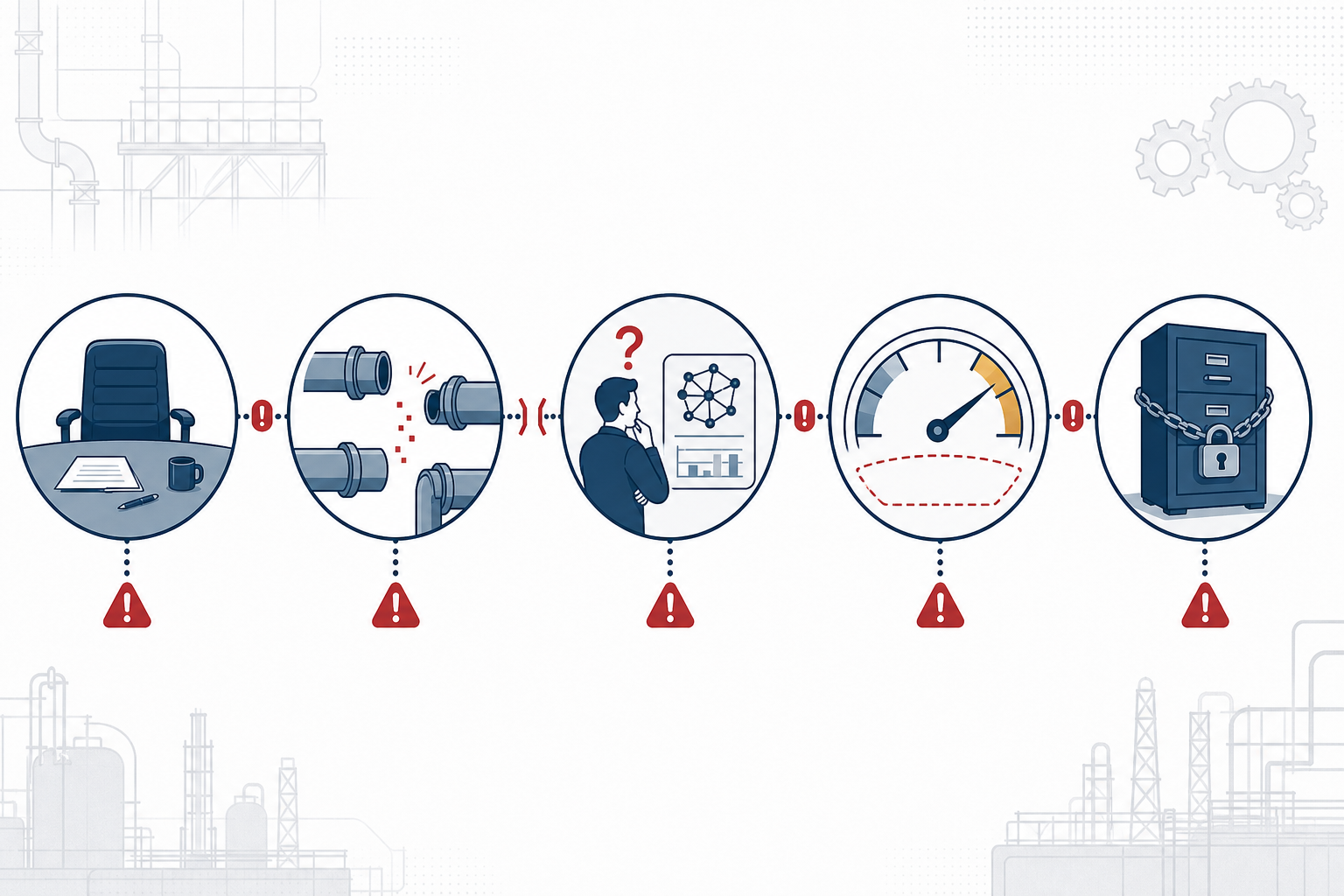
What These Five Patterns Share
None of these are technology failures.
In every pattern described above, the AI is doing exactly what it was designed to do. It is generating accurate supplier delay signals that no one owns. It is amplifying data fragmentation that the pilot scope concealed. It is producing probabilistic recommendations that planners cannot defend and therefore rationally ignore. It is generating high-volume outputs against undefined success criteria. It is making technically correct recommendations that conflict with operational context it has no way to access.
The failure is in the organizational and environmental conditions around the technology, not in the technology itself. This distinction matters because it changes where the remediation work happens. If the failure were model inaccuracy, the solution would be model improvement. Since the failure is in decision ownership, data infrastructure, trust architecture, success metric design, and operational context capture, the solution is organizational design work — and that work must happen before deployment, not as a response to deployment failure.
The organizations that close the pilot-to-production gap are not those with better AI models. They are those that treated the organizational design work as the primary deployment challenge — and completed it before the system went live.
Pre-Deployment Diagnostic: Five Questions to Answer Before AI S&OP Go-Live
The five patterns above each have a specific remediation condition. The table below translates those conditions into diagnostic questions that function as readiness gates — not a post-mortem checklist. If any of these questions cannot be answered affirmatively before go-live, the deployment is entering a known failure condition.
| Failure Pattern | Diagnostic Question | Remediation Condition | Go-Live Gate |
|---|---|---|---|
| No decision ownership | For each recommendation type the AI will generate, is there a named owner, a documented response SLA, and a defined escalation path? | Decision ownership matrix covering all recommendation types, signed off by function leads before go-live | Hard gate — deploy without this and accurate recommendations will be systematically ignored |
| Data fragmentation | Does a unified data pipeline exist from all source systems (ERP, MES, WMS, CMMS, supplier data) with latency under 15 minutes and standardized field definitions across all plants? | Unified pipeline with documented field definitions and latency SLA, validated against production data volume — not pilot data volume | Hard gate — pilot-scope data quality does not predict production-scope data quality |
| Planner trust deficit | Does the deployment include a mechanism to log planner overrides with captured reasons from day one, and is there a defined review process for analyzing override patterns? | Override logging built into the workflow before go-live; override review cadence defined and owned by a named role | Hard gate — without this, the system cannot learn from the pattern of its own failures |
| Undefined success metrics | Have all participating functions agreed on measurable success criteria per recommendation type, including signal thresholds, baseline measurements, and review cadence? | Cross-functional success criteria document, with pre-AI baseline measurements captured before go-live | Hard gate — without agreed criteria, teams cannot distinguish deployment success from deployment failure |
| Invisible operational context | Has a structured process been run to capture undocumented operational rules from experienced planners, and is there a mechanism to encode those rules into the system's configuration and feedback loop? | Pre-deployment operational context capture with experienced planners; defined process for periodic review of override patterns to identify new context for encoding | Soft gate — can be addressed in first 90 days post-launch if override logging is in place, but pre-deployment capture significantly reduces early failure risk |
The purpose of this diagnostic is not to delay deployment. It is to prevent the specific organizational failure mode where a technically capable AI system enters a production environment that was never designed to act on its outputs — and then gets blamed for failing to deliver value it was never given the conditions to provide.
The five patterns are predictable. The remediation conditions are specific. The diagnostic questions are answerable before go-live. Whether they get answered is an organizational choice, not a technology constraint.
Comments
Join the discussion with an anonymous comment.