
The split is the point
Apple's China AI story became much less abstract on July 15, 2026, when China's CAC approved Apple Intelligence after a long wait, with SCMP reporting that it joined Samsung's Galaxy AI as one of only two foreign AI services to clear that gate [1]. That matters because it turns a vague partnership rumor into a regulatory fact. Apple can keep selling into China, but only if the AI layer is made to fit China on China's terms.
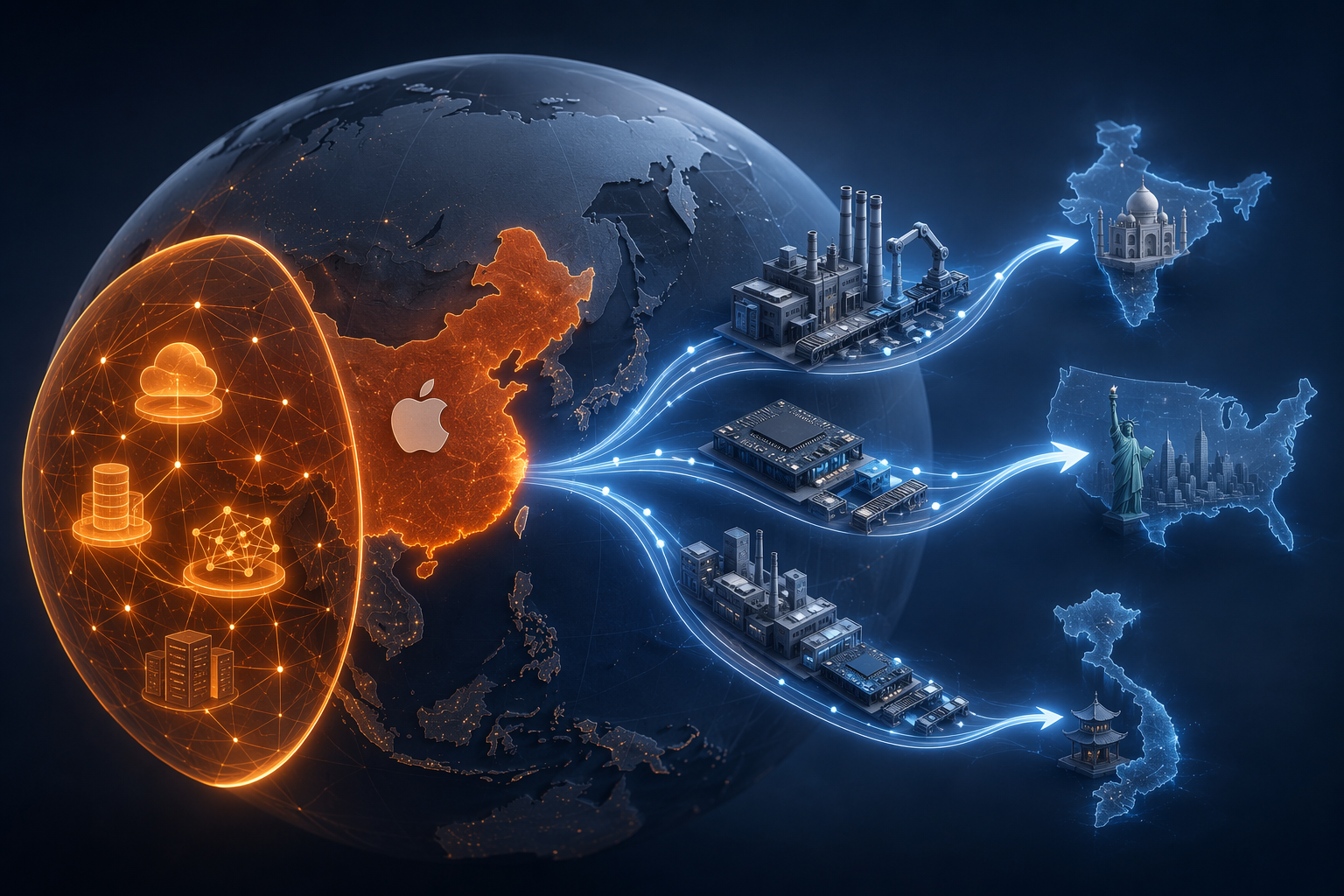
That is why this should not be read as an Apple-is-leaving-China or Apple-is-betting-everything-on-China story. The more precise reading is that Apple is separating market access from supply chain exposure. In China, the software layer has to be local enough to pass review and remain useful. Outside China, the physical operating model has to be spread out enough that no single country can hold the entire system hostage.
China-local AI is a market access problem
The Alibaba side of the partnership makes that dependence visible. CNBC reported in February 2025 that Alibaba chairman Joe Tsai said Qwen would power Apple Intelligence across iOS, iPadOS, macOS, and visionOS for China users, including text and image understanding and generation [2]. That is not a decorative localization layer. It is the model stack itself being adapted so Apple can operate in the China market at all.
Apple needs Chinese partners for three separate reasons: the CAC approval path, the requirement to localize models and features, and the basic need to stay competitive against Huawei and other domestic rivals that already present AI as part of the product experience. Those are operational constraints, not ideological choices. The partnership structure may keep evolving, but the direction is already clear: in China, Apple will not get to sell a globally identical AI product and call that a strategy.

The hardware side is moving the other way
The supply chain answer runs in the opposite direction. Apple announced a $500 billion U.S. investment in February 2025, including a Houston AI server factory [3]. The point is not that every dollar is AI-specific, but that chip capacity, server assembly, and advanced manufacturing are being treated as diversification problems, not as one giant China question.
That broader shift is what makes the strategy coherent. Final assembly is being pushed toward India and other non-China sites. AI server production is spreading across the U.S., Mexico, and Vietnam. Chip sourcing is also being rebalanced through non-China capacity. Apple is not trying to erase China from the map; it is trying to make sure China is no longer the place where every critical dependency has to meet.
Why the two moves fit together
Seen together, the AI partnership and the hardware shift solve different problems at different layers of the value chain. China-local AI preserves revenue, compliance, and competitive relevance in the market that requires them. Hardware diversification reduces tariff exposure, sanctions risk, pandemic-style disruption, and concentration around Taiwan-linked manufacturing risk. Those are not substitutes for each other, so trying to manage them with one blunt geographic answer would be the mistake.
That is why the right label is functional decoupling. It is partial, not absolute. The customer-facing software layer stays localized where regulation and competition demand it, while the production and chip layers are redistributed wherever the geopolitical risk is lower. Even then, the split is incomplete: component dependence does not disappear just because final assembly moves. But the direction is still clear enough to matter.
The lesson for supply chain leaders
The lesson is not to copy Apple line by line. It is to separate functions that face different kinds of geopolitical pressure. Market access, model approval, data localization, component sourcing, final assembly, and server deployment do not carry the same risk profile, even when they sit inside the same company. Apple is behaving as if a global technology firm can keep selling in China without letting China define the whole operating model. For other firms, that may become the template: keep the front end where the market requires it, and move the back end until no single country can freeze the business.
References
- China approves Apple Intelligence phones; Alibaba, Baidu emerging partners — South China Morning Post, 2026-07-15, https://www.scmp.com/tech/policy/article/3360685/china-approves-apple-intelligence-phones-alibaba-baidu-emerging-partners
- Apple will integrate Alibaba's AI into iPhones in China, chairman Joe Tsai says — CNBC, 2025-02-13, https://www.cnbc.com/2025/02/13/apple-will-integrate-alibabas-ai-into-iphones-in-china-chairman-joe-tsai-says.html
- Apple announces $500 billion U.S. investment — Apple Newsroom, 2025-02-24, https://www.apple.com/newsroom/2025/02/apple-announces-500-billion-us-investment/
Comments
Join the discussion with an anonymous comment.