
Why AI Demand Forecasting Is a Strategic Imperative for CPG
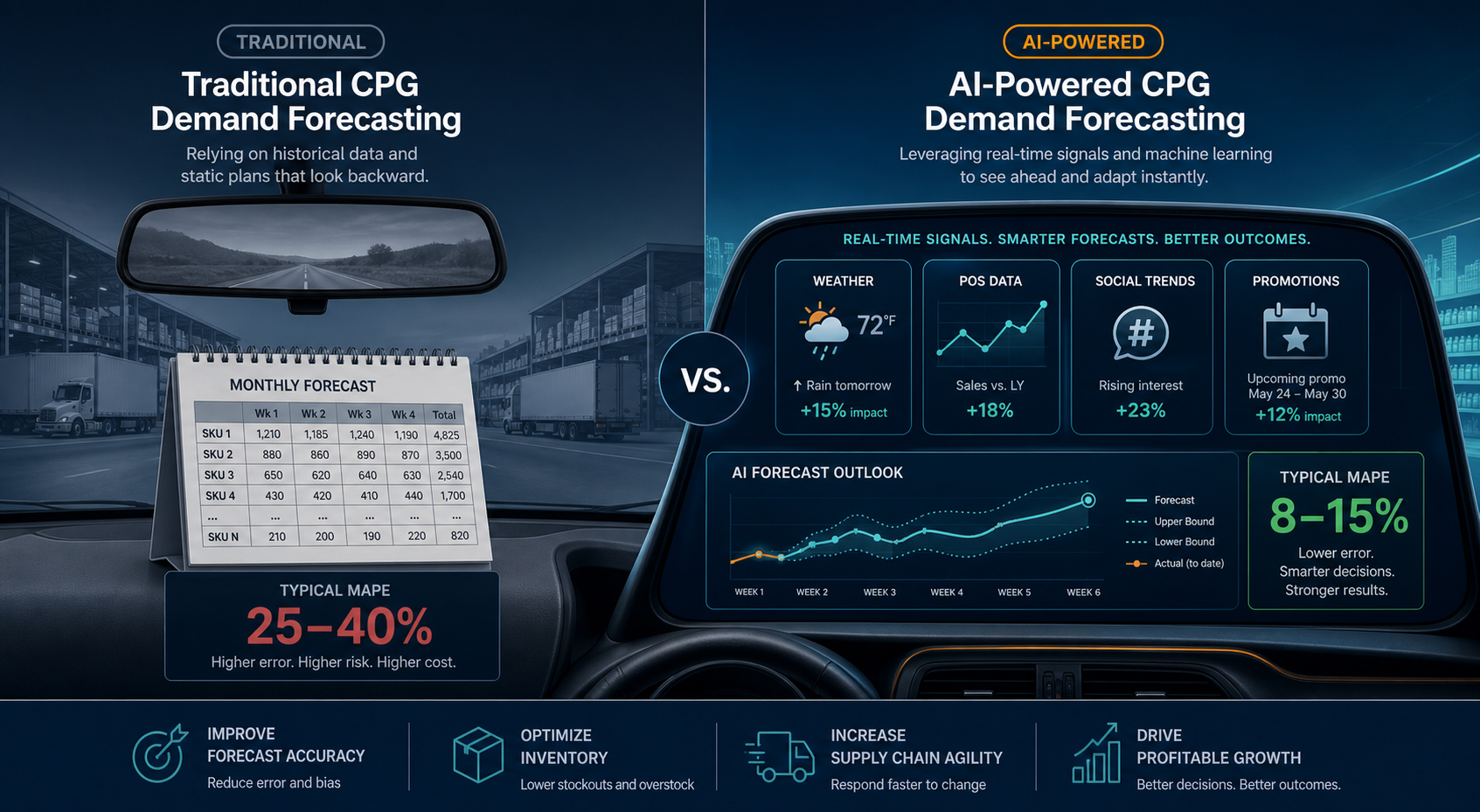
Consumer packaged goods (CPG) companies operate in one of the most volatile demand environments in the supply chain landscape. Seasonal promotions, weather shifts, social-media-driven trends, and retailer-specific inventory policies combine into a signal that traditional statistical forecasting models—moving averages, exponential smoothing, ARIMA—consistently fail to capture. The result is a structural forecast error that, by industry benchmarks, typically lands in the 25–40% MAPE range before any AI intervention.
That volatility is not a minor data problem; it drives millions in excess inventory carrying costs and, more damagingly, lost sales when products are absent from store shelves when demand spikes. The inability to incorporate external signals—local weather forecasts, competitor promotion calendars, real-time point-of-sale data—means CPG planners are effectively forecasting with a rearview mirror.
The urgency to move beyond traditional methods is now broadly recognized. According to a McKinsey survey published in 2024, 71% of CPG leaders had adopted AI in at least one business function. That number is not about experimentation; it reflects a structural shift as companies realize that AI-powered demand forecasting can reduce MAPE to the 8–15% range, effectively cutting forecast error by more than half. The case studies that follow show how five of the world’s largest CPG companies turned that potential into measurable, attributable outcomes.
The five deployments covered here—PepsiCo, Unilever Ice Cream, Kimberly-Clark, Coca-Cola, and Nestlé—span different geographies, product portfolios, and AI approaches. Yet they share a common pattern: each achieved forecast error reductions in the range of 10–35%, unlocked significant inventory and revenue benefits, and collectively demonstrate that AI demand forecasting is no longer an experimental technology in CPG—it is a competitive requirement.
PepsiCo: 98% Forecast Accuracy with TAZI AI Partnership
PepsiCo’s AI demand forecasting journey, detailed in a Chief AI Officer article published December 2025, is one of the most thoroughly documented large-scale deployments in the CPG space. The company partnered with TAZI AI to build machine learning models that predict daily demand at the individual sales-point level. The model ingests historical sales, seasonality, pricing, customer behavior, and—critically—external signals such as weather data, social media trends, and local events. This external signal integration is what distinguishes the AI approach from conventional statistical methods that rely almost entirely on internal history.
| Metric | Value | Source |
|---|---|---|
| Forecast accuracy for 86% of products | 98% | Chief AI Officer (TAZI AI partnership disclosure) |
| Truck stock-out rate reduction | 4% | Same source |
| Average order size increase | 3.1% | Same source |
| Average SKUs per order increase | 16% | Same source |
Comments
Join the discussion with an anonymous comment.