Vendor Move
Using AI-Powered Scenario Planning for Tariff Disruption Response
This editorial examines whether AI-powered scenario planning tools can help supply chains manage persistent tariff volatility, drawing on recent evidence from McKinsey, Kinaxis, KPMG, and Walmart to assess capabilities, proven outcomes, and organizational readiness requirements.
Tariff disruption has moved past the point where a quarterly sensitivity table is enough. In McKinsey’s 2025 supply chain risk survey of 100 companies, 82% said they had been affected by tariffs, with tariff exposure touching 20% to 40% of supply chain activity. Yet only 19% had deployed AI at scale in supply chain, while 75% remained in planning or pilot stages. The more uncomfortable number is the investment one: planned digital supply chain investment fell from 47% to 25% year over year as companies redirected attention toward tactical tariff response.[1]
That is the contradiction sitting inside many S&OP rooms in 2026. The operating problem is getting faster and more granular: SKU margins move, supplier allocations change, purchase orders need to be repriced or delayed, customer promises get questioned. But the capability budget that would let planners simulate those moves is often the first place organizations look when they need cash for immediate mitigation.
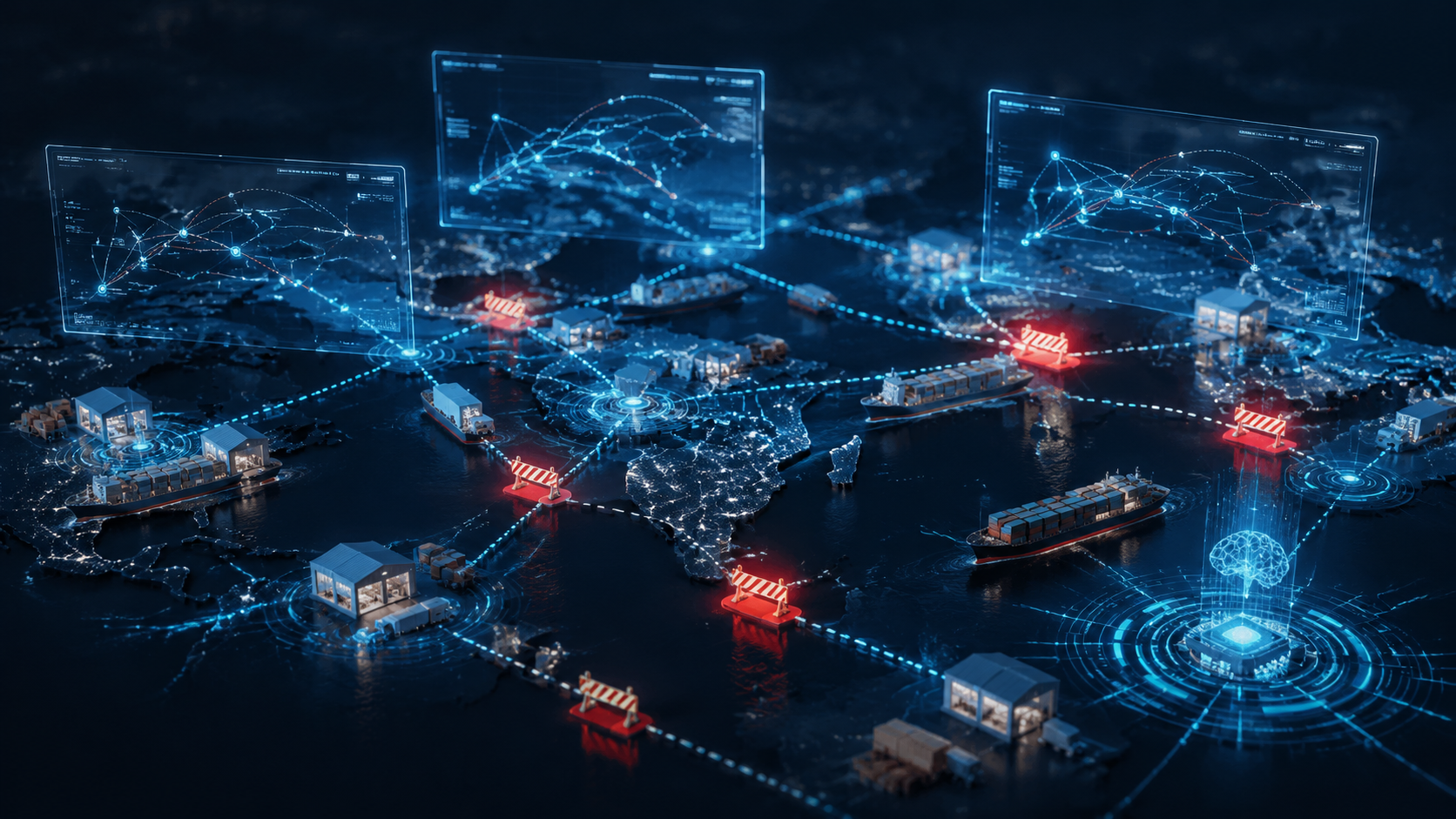
The useful question is not whether AI can produce another forecast or dashboard. For AI-enabled tariff disruption planning, the test is whether the system can shorten the loop between a tariff signal and a decision: which supplier gets the next order, which lane becomes uneconomic, which inventory buffer is worth holding, which customer commitment needs escalation, and who has authority to act before the window closes.
The Revealing Signal Is Planner Behavior
The strongest evidence that scenario planning has become operationally relevant is not a vendor promise about optimization. It is usage under stress. Kinaxis reported a 124% spike in scenario-planning tool usage after the June 2024 U.S. presidential debate and a 112% increase after the January 2025 tariff memo. In automotive, the company reported a 4.5x increase in daily usage, along with a 24% quarter-over-quarter jump.[2]
Those numbers are vendor-published and should be treated as directional rather than independently audited. Still, they matter because they describe revealed behavior. When tariff probability changed, planners did not wait for a finished finance view of landed cost. They reached for simulation tools. That is a different operating posture from asking each function to absorb a new tariff assumption in its own spreadsheet and reconcile the damage later.
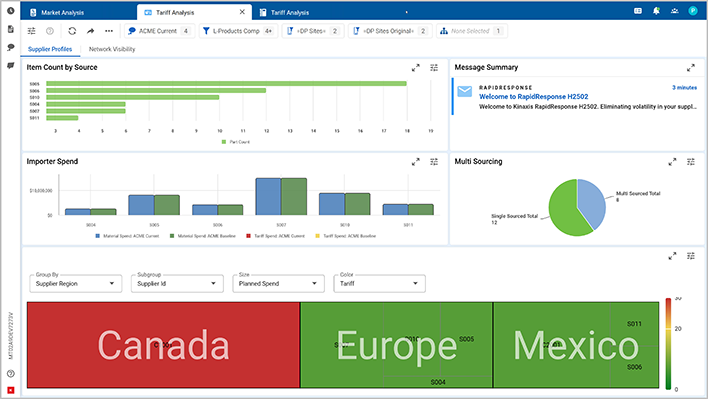
Kinaxis also says its Tariff Response capability can be deployed in as few as 21 days.[2] That is a useful implementation signal, not a universal planning timeline. A company with clean item-master data, current supplier terms, usable bills of material, and agreed decision rights may be able to move quickly. A company still arguing over whose landed-cost file is authoritative will spend those same 21 days discovering that the model is not the bottleneck.
The direction is corroborated by KPMG’s 2026 CEO Outlook Pulse Survey, which reported that 48% of organizations were actively modeling and deploying tariff mitigation strategies.[3] That does not prove effectiveness. It does show that the planning agenda has changed from general resilience language to specific mitigation modeling. The work is moving closer to the purchase order.
What AI Changes in the Tariff Response Cycle
A tariff event creates several planning questions at once. Procurement wants to know whether to shift volume. Finance wants to know which margin lines are exposed. Operations wants to know whether the alternate supplier can actually meet the schedule. Sales wants to know whether customer commitments still hold. Traditional planning processes can answer those questions, but often in sequence. AI-powered scenario planning is valuable when it lets the organization evaluate those dependencies together.
| Planning Question | Why Tariffs Make It Harder | Where AI Scenario Planning Helps |
|---|---|---|
| Which suppliers should receive allocation? | Tariff exposure changes supplier economics before contracts or capacity assumptions catch up. | Compares landed cost, lead time, capacity, and service impact across sourcing options. |
| Which lanes should be rerouted? | A tariff may make an existing route financially unattractive even if it remains physically available. | Tests alternate lanes against cost, delay, inventory, and customer-service effects. |
| Which inventory buffers are justified? | Blanket safety stock protects service but ties up cash and may sit in the wrong region. | Locates buffers where margin exposure and replenishment risk are highest. |
| Which commitments need escalation? | Customer promises may have been made under a cost structure that no longer applies. | Flags orders, regions, or SKUs where service, cost, and profitability conflict. |
The distinction is important. A digital twin that only visualizes the network is helpful for diagnosis. A what-if engine that compares feasible decisions is more useful. An agentic workflow that can recommend, route, and in limited cases execute actions is more powerful still. But each step requires more trust in the data and more clarity about who is allowed to approve a change.
That is why platform evaluation cannot stop at the demo layer. The relevant questions are closer to the ones raised in Choosing an AI Platform for Geopolitical Supply Chain Risk: which data sources are connected, how assumptions are governed, how exceptions are escalated, and whether the output is tied to workflows that planners actually use.
Walmart Shows the Upside and the Prerequisite
Walmart’s Wally AI agent is one of the more concrete examples of AI-enabled supply chain execution because the claimed benefits are operational rather than abstract. During its 2025 rollout, Wally was credited with $55 million in waste savings, a 20% to 25% reduction in out-of-stocks, and the elimination of 30 million unnecessary delivery miles.[4]
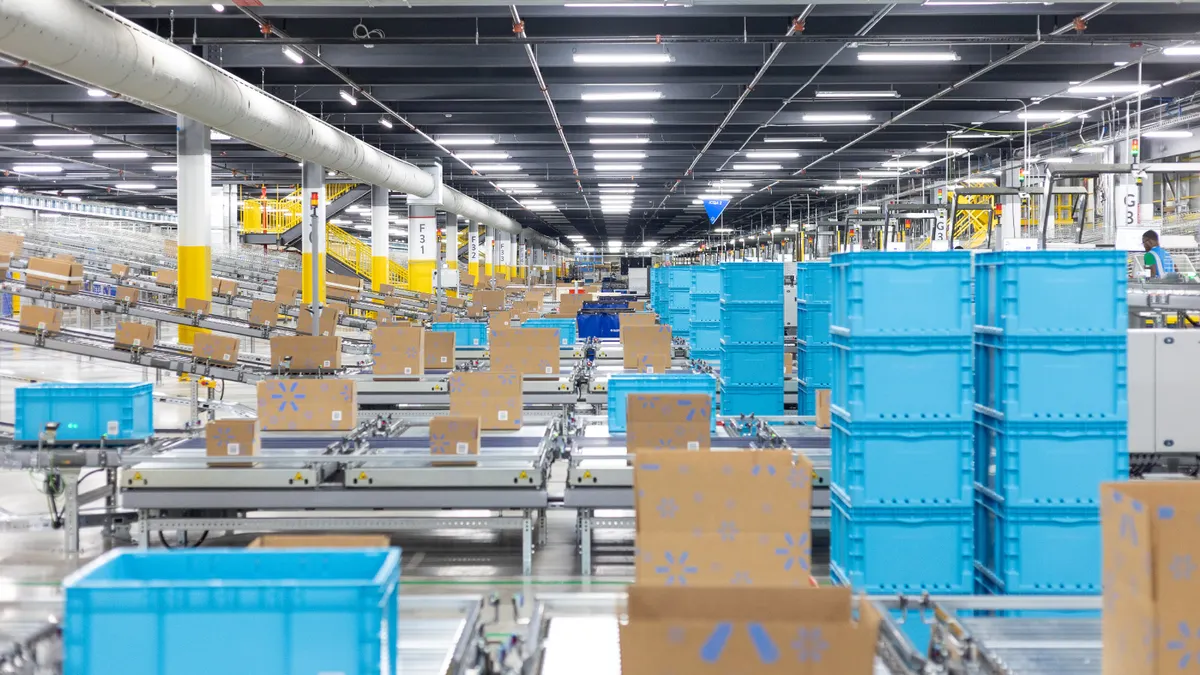
Those figures come from company communications, so they should not be read as an independently audited benchmark for the average retailer or manufacturer. They are still useful because they connect AI to problems that supply chain leaders recognize immediately: wasted product, store-level availability, and miles that did not need to be driven.
The caveat is not a footnote. Wally operates on Walmart’s unified transaction data and a retail-specific large language model, Wallaby.[4] That matters because tariff response depends on the same kind of connective tissue. If the AI agent cannot see supplier terms, product hierarchy, inventory position, lane cost, order priority, and margin exposure in a usable structure, it cannot responsibly recommend a sourcing or fulfillment change. It may still produce a plausible answer. Plausible is not enough when a planner is about to move volume away from a qualified supplier or change a customer delivery plan.
Walmart also illustrates why agentic AI in supply chain should be discussed in degrees, not absolutes. Some decisions can be automated because the downside is bounded and the data is mature. Others need human escalation because the trade-off includes customer penalties, contractual exposure, capacity risk, or commercial strategy. The same distinction appears in broader evidence on agentic AI for geopolitical risk: the question is rarely whether an agent can act, but which decisions it should be allowed to act on without another review.
The Mechanism Is Less Mysterious Than the Governance
The better vendor frameworks describe a similar sequence. C3 AI frames tariff-resilient supply chains around unified data, anticipatory planning, and real-time execution.[5] That order is right. Without unified data, anticipatory planning becomes a polished version of fragmented assumptions. Without execution links, scenario planning becomes a meeting artifact.
The first job is exposure identification. Tariff exposure is not just a country field in the supplier master. It can be buried in sub-tier inputs, origin rules, product classification, intercompany flows, contracted lanes, and customer-specific service promises. Dataiku describes this as using AI to give companies “X-ray vision” into exposure blind spots, and its Zeus example reports that inventory optimization modeling was reduced from four to five months to two weeks.[6]
That kind of modeling-time reduction is valuable because tariff response windows are often short. If a team needs months to understand which SKUs are exposed, the eventual answer may arrive after procurement has already placed orders, logistics has already booked capacity, and sales has already made commitments under outdated economics. Faster analysis does not guarantee a better decision, but slow analysis often guarantees that the real decision has already been made by inertia.
The second job is scenario comparison. A useful model does not merely say that supplier A is now more expensive than supplier B. It tests whether supplier B has capacity, whether the alternate lane increases lead time, whether the receiving site has enough buffer, whether the customer order can tolerate delay, and whether the margin recovery is worth the operational disturbance. This is where AI-supported planning earns its place in S&OP: not by replacing trade-off decisions, but by making the trade-offs visible while action is still possible.
The third job is controlled execution. A recommendation that sits outside the planning workflow is easy to admire and easy to ignore. A recommendation that creates an exception, routes it to the right owner, records the assumption set, and shows the financial and service impact has a better chance of changing behavior. This is also where organizational politics stops being soft and becomes operational. Procurement, finance, planning, and operations need to agree on decision rights before the model says something inconvenient.
Why So Few Companies Are Positioned to Capture the Value
McKinsey’s adoption numbers explain why the market can be both convinced and underprepared. If 82% of companies are affected by tariffs but only 19% deploy AI at scale in supply chain, then the limitation is not awareness.[1] Most leaders know the problem exists. Many have seen enough demos to believe the tools can help. The gap is the operating system around the tools.
Three constraints tend to surface before model sophistication becomes the decisive issue.
- Data is not unified enough for the model to compare real trade-offs across procurement, planning, logistics, inventory, and finance.
- Decision rights are unclear, so the output becomes advisory even when the time window requires action.
- Governance is weak, so assumptions, tariff classifications, supplier constraints, and approval thresholds are not trusted.
- Execution workflows are disconnected, so planners must translate model output into manual emails, spreadsheet updates, and separate system changes.
This is why cutting digital supply chain investment to fund tactical tariff response is so damaging. It may be financially understandable in the week the tariff lands. But if the response drains the very budget needed to unify data and connect planning to execution, the company is left better funded for the current fire and less prepared for the next one.
The practical evaluation question is therefore not whether the AI engine can run thousands of scenarios. It is whether the organization can act on the few scenarios that matter. A manufacturer that cannot reconcile supplier capacity, BOM exposure, product classification, and customer priority in one planning view will struggle even with a sophisticated model. A retailer with clean transaction data, clear replenishment rules, and governed exception workflows can start with narrower decisions and expand from there.
Autonomy Is the Direction, Not the Starting Point
Gartner’s March 2026 prediction gives the long arc: by 2031, 60% of supply chain disruptions will be resolved without human intervention. Gartner also cautions CSCOs to begin with low-risk decisions and build data governance now.[7] That second sentence is the one worth taking seriously first.
Autonomous tariff playbooks sound attractive until the scenario involves a strategic customer, a constrained supplier, a regulated product, or a politically sensitive sourcing shift. In those cases, the correct design is usually human-in-the-loop escalation: the system detects the exposure, ranks feasible options, quantifies the trade-offs, and routes the decision to the owner with enough context to act quickly.
Lower-risk use cases can move faster. A model may automatically flag tariff-exposed SKUs for review, refresh landed-cost assumptions, identify inventory at risk of obsolescence, or propose alternate lanes within preapproved thresholds. Monitoring systems used for other geopolitical disruptions, such as AI supply chain risk management for oil blockade fallout, point to the same pattern: detection and prioritization often mature before autonomous execution.
That staged approach is not timid. It is how companies build trust. Planners learn where the model is reliable. Finance sees how assumptions flow into margin impact. Procurement understands when supplier recommendations are capacity-aware rather than cost-only. Operations sees whether the proposed change can survive contact with the schedule. Each accepted decision makes the next one less theoretical.
The Real Constraint Is Operating Readiness
AI-powered scenario planning is no longer speculative for tariff disruption response. The evidence is not perfect, and much of the most detailed usage and outcome data comes from vendors or companies describing their own systems. But the pattern is strong enough: tariff exposure is widespread, planners are using scenario tools when political signals change, organizations are modeling mitigation, and mature data environments can connect AI to measurable operational outcomes.
For most companies, the binding constraint is not whether the algorithm can imagine a better network. It is whether the company has unified enough data, assigned enough decision rights, and built enough execution discipline for the scenario to change a supplier allocation, a purchase order, an inventory buffer, or a customer commitment before the tariff shock becomes last month’s margin variance.
References
- Supply Chain Risk Survey, McKinsey, 2025.
- Kinaxis AI tariff tool, Supply Chain Digital.
- KPMG 2026 CEO Outlook Pulse Survey, SupplyChainBrain.
- Walmart Wally AI agent corporate communications, Walmart.
- Build a Tariff-Resilient Supply Chain with C3 AI, C3 AI.
- Supply Chain Resilience with AI, Dataiku.
- Gartner Predicts 60% of Supply Chain Disruptions Will Be Resolved Without Human Intervention by 2031, Gartner, March 18, 2026.
Adjacent events
This is the only tracked event for this vendor so far
As more events are sourced and dated, they will appear here.
Spotted something inaccurate or incomplete in this entry? ChainSignal reviews corrections and additional evidence before publishing an update — this is not a public comment thread.
Flag an inaccuracy / submit evidence for this entry →