
§ 41 — Use-case analysis
Three real deployments reveal hurricane preparation AI lessons
Examining three documented AI deployments for hurricane preparedness, this analysis finds that ROI centers on demand-spike forecasting and inventory prepositioning, but success is determined by data integration depth and human-in-the-loop processes, not by vendor brand.
- Function
- demand-forecasting
- AI technique
- forecasting
- Evidence source
- ClimateAi 2023, Clearframe Labs 2026, Kinaxis 2020, RELEX 2026
Useful hurricane preparation supply chain AI tips do not start with the model name. They start with the operating question: when the signal arrived, did anyone change a purchase order, move inventory, hold transport capacity, or approve a risk trade-off early enough to matter?
Three documented deployments give a grounded answer. ClimateAi reports that a building-materials producer captured $15 million in incremental revenue around Hurricane Ian by forecasting post-storm demand spikes and prepositioning inventory regionally.[1] Clearframe Labs reports that a $180 million manufacturer cut expedited shipping costs by 22%, gained three weeks of early disruption warning, and generated $530,000 in annual savings across eight Southeast U.S. distribution centers.[2] Kinaxis reports a twofold surge in RapidResponse simulation scenarios during disruption periods, with the company citing use for hurricanes, earthquakes, and other acute events, though the publication was from 2020 and framed in the broader disruption context of that period.[3]
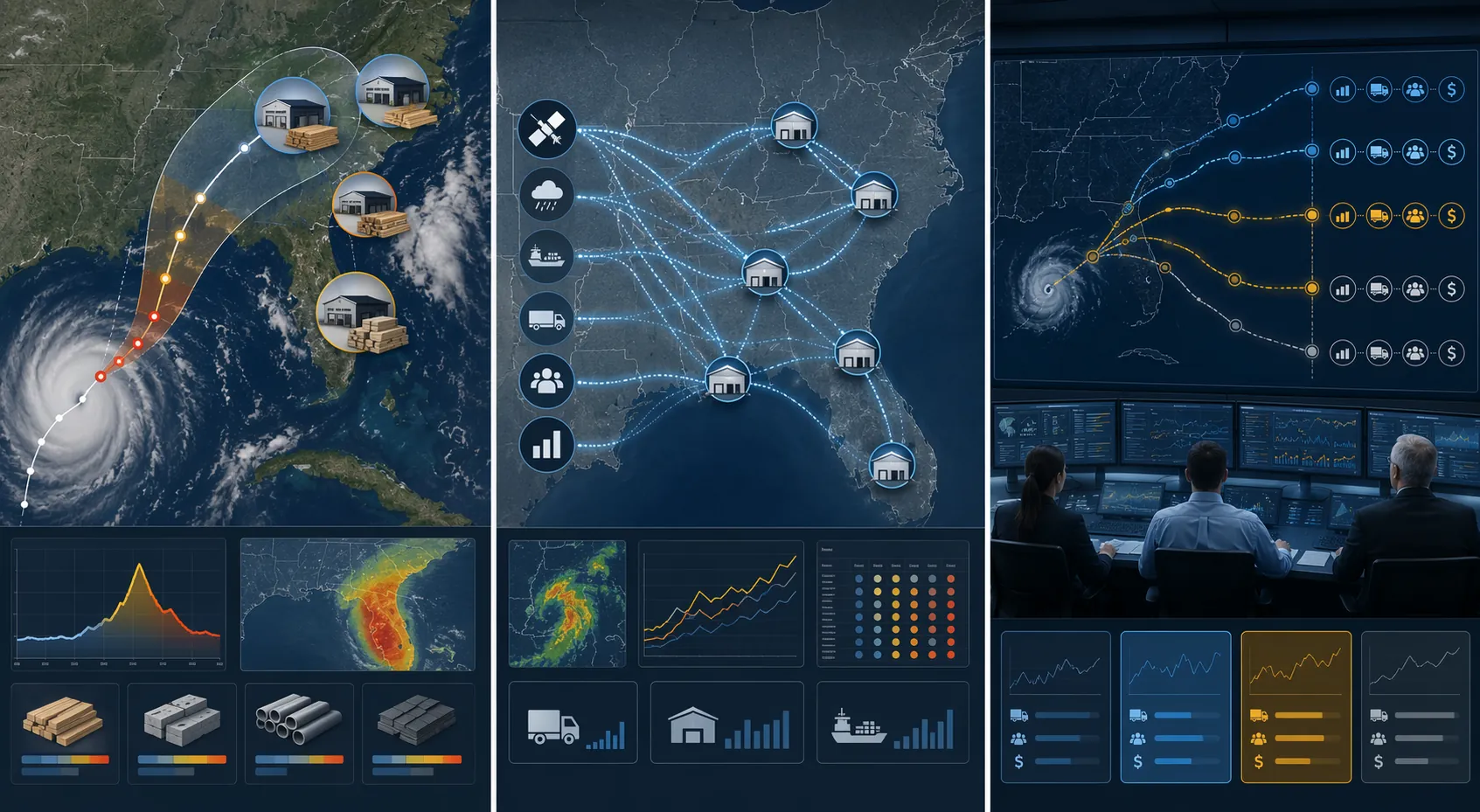
Those are not interchangeable proof points. Two are vendor-published single-client cases with commercial outcomes attached. One is a usage signal rather than a hurricane-specific ROI claim. Together, they still point to the same practical lesson: the value showed up where AI outputs were wired into planning actions, not where a dashboard merely displayed a better forecast.
| Deployment | What the AI was used for | Reported outcome | How direct the hurricane evidence is |
|---|---|---|---|
| ClimateAi + building-materials producer | Forecasting post-hurricane demand spikes and helping position inventory regionally | $15 million in incremental revenue captured around Hurricane Ian | Direct hurricane case, vendor-published, single-client evidence [1] |
| Clearframe Labs + $180 million manufacturer | Early disruption warning across Southeast distribution centers and freight-cost reduction | 22% reduction in expedited shipping costs, three-week early warning, $530,000 annual savings across eight DCs | Disaster-season and Southeast network case, vendor-published, single-client evidence [2] |
| Kinaxis RapidResponse | Higher scenario-simulation volume during acute disruption periods | Twofold surge in simulation scenarios during disruption periods | Relevant planning behavior signal, but not a hurricane-specific ROI post-mortem [3] |
The revenue case was really an inventory-positioning case
The ClimateAi case is the cleanest hurricane-specific example because it connects the weather signal to a commercial result. The reported $15 million was not created by predicting Hurricane Ian in the abstract. It came from anticipating where post-storm demand for roofing and building materials would rise, then positioning inventory so the producer could serve that demand when the market needed product.[1]
For a planning team, that distinction matters. A forecast that says a storm may affect a region is still several handoffs away from value. Someone has to translate the signal into SKU-level or product-family demand assumptions. Someone has to decide which regional facilities should hold more supply. Someone has to accept the opportunity cost of putting inventory in one place rather than another. If the storm changes track, the same people own the consequences.
That is why the case should not be read as “AI predicted a hurricane, therefore revenue increased.” The narrower and more useful reading is that AI-supported demand sensing helped the company act before the demand spike was fully visible in orders. The revenue number is compelling, but the operating mechanism is the part to benchmark: earlier signal, regional inventory action, and enough organizational confidence to move supply before the spike arrived.
The cost case was about avoiding the emergency freight trap
The Clearframe case points to a different ROI path. Instead of revenue capture after a storm, the reported value came through lower expedited shipping costs and earlier warning. The company describes a $180 million manufacturer using AI supply chain optimization to produce a 22% reduction in expedited shipping costs, three weeks of early disruption warning, and $530,000 in annual savings across eight Southeast U.S. distribution centers.[2]
Expedited freight is where weak preparation often becomes visible in the ledger. A late storm signal forces regional planners to compete for limited carrier capacity, transfer inventory after lanes are already constrained, or pay to recover service levels that could have been protected earlier. The Clearframe numbers suggest that the material planning gain was not simply “better risk visibility.” It was fewer late, expensive corrections.
The three-week warning claim also deserves attention because it is long enough to change the action set. A one-day alert may help a control tower monitor loads already in motion. A multi-week signal can affect production sequencing, replenishment timing, inter-DC transfers, and procurement escalation. Whether those actions actually occur depends on the integration layer: weather and disruption signals need to reach the planning system in a form that can be compared against inventory, open orders, supplier constraints, and transportation options.

Scenario volume is useful evidence, but it is not ROI
Kinaxis adds a different kind of evidence. The company reported a twofold surge in RapidResponse simulation scenarios during disruption periods and described the platform as being used for hurricanes, earthquakes, and other acute events.[3] That supports the idea that during disruption windows, planning teams run more scenarios rather than relying on a single forecast.
It does not prove a hurricane ROI figure. The source was published in 2020, and the disruption framing was broader than hurricanes alone.[3] The right use of this evidence is modest: acute disruptions increase scenario-planning intensity, and concurrent planning systems can help teams compare options faster. The missing piece is a public, hurricane-specific post-mortem that ties those extra simulations to a measured reduction in cost, shortage, service failure, or revenue loss.
That caveat should not make the usage signal irrelevant. In a storm-season war room, the bottleneck is often not imagination; everyone can name bad outcomes. The bottleneck is comparing enough feasible options before the decision window closes. Scenario tools are valuable when they shorten that comparison cycle and keep finance, operations, procurement, and transportation looking at the same version of the plan.
What has to be true before the ROI appears
Across the three cases, the recurring capability is not a generic AI layer. It is the connection between external disruption signals and internal planning decisions. A storm forecast has to be matched with facility exposure. Facility exposure has to be matched with inventory position. Inventory position has to be matched with demand signals, open orders, supplier lead times, and transportation capacity. Only then can the recommendation become operational rather than informational.
That is where vendor branding can overstate the easy part. A standard planning license may support scenario modeling or demand forecasting, but the hurricane use case depends heavily on which outside signals are ingested, how current they are, and whether the data model can connect them to the company’s actual operating nodes. External feeds such as NOAA weather feeds, Port of Houston congestion data, and supplier financial-health signals are the kind of inputs that matter, but the public deployment evidence does not support claiming that every named vendor has proven hurricane-specific ROI with those feeds.
The practical test is simple to state and hard to pass: can the system move from external warning to recommended action without forcing planners to rebuild the answer manually in spreadsheets? If the AI says demand will rise in a coastal region, the planner still needs to know which SKUs are constrained, which DCs can receive product, which transfers are worth making, which customers are prioritized, and what approval threshold applies. If those links are missing, the model may be impressive while the operation remains late.
- Demand-spike forecasting creates value when it changes replenishment and allocation before orders fully materialize.
- Inventory prepositioning creates value when regional facilities receive usable supply early enough to avoid last-minute transfers.
- Expedited-shipping avoidance creates value when disruption warning arrives before carrier options tighten.
- Scenario planning creates value when decision-makers can compare financially and operationally feasible options quickly.
The human approval layer is not a temporary weakness
The documented cases also fit the broader trust data. RELEX’s 2026 State of Supply Chain survey of 500 leaders found that 67% reported higher AI confidence in 2026, but only 10% trusted AI to make critical decisions autonomously; 54% preferred a human-in-the-loop model.[4]
That is not just conservative survey behavior. Hurricane preparation decisions carry asymmetric consequences. Preposition too little inventory, and service failures show up when customers are most urgent. Preposition too much in the wrong region, and working capital, warehouse capacity, and transport spend are tied up while another region may be short. Accelerate inbound supply too aggressively, and procurement may pay for a risk that never materializes. Waiting too long has its own cost.
Human-in-the-loop design should therefore be evaluated as part of the system, not as an exception path. The approval workflow needs named decision rights, not a vague “planner review” step. Regional inventory planners may approve transfers inside a certain cost band. Procurement may approve supplier changes or accelerated buys. Transportation may approve carrier commitments. Executives may need to sign off when the recommendation moves margin, service, or working capital outside normal thresholds.
The useful audit trail is not only what the model predicted. It is who approved the recommendation, which assumptions were visible, what alternatives were rejected, and what changed when the storm track or demand signal shifted. That is the difference between a defensible decision process and a dashboard screenshot.
Better weather intelligence raises the planning bar
External forecast quality still matters, even if it is not the whole ROI story. WindBorne Systems says its AI forecast improved Hurricane Ian landfall accuracy by about 200 kilometers versus the National Weather Service.[5] For a supply chain team, a shift of that scale can change which DCs are treated as exposed, which customer zones may see demand spikes, and which lanes should be protected first.
The pressure on planning teams is also unlikely to ease. Georgia Tech reported in June 2026 that Hurricane Sandy-level flooding recurrence could shrink from roughly 150 years to roughly 30 years by 2100, and that tropical cyclone damage has increased 380% since 1970.[6] Those figures are climate-risk context rather than software ROI evidence. Their operational implication is narrower: disruption assumptions based on old recurrence patterns are becoming less safe as a planning baseline.
The mistake would be to treat better external intelligence as a substitute for planning integration. A more accurate landfall forecast still has to become a supply-chain decision. If the exposed-facility map is stale, if item-location inventory is delayed, if inbound purchase orders are not visible, or if transportation constraints are handled outside the planning environment, the forecast advantage leaks away before it reaches execution.
What evaluators should press vendors on in Q3 2026
The public evidence does not support a broad ranking of hurricane AI vendors. Specific, public hurricane or disaster-readiness deployment cases for platforms such as o9 Solutions, Blue Yonder, and Anaplan were not found in the research brief. That absence should not be converted into a negative verdict on those platforms, but it does set a boundary: without named hurricane-relevant deployments and measured outcomes, the buying conversation should stay anchored in operating proof rather than category claims.
A serious evaluation should ask vendors to walk through the same chain of action visible in the stronger cases: which external feeds enter the system, how they are matched to company facilities and lanes, how the model detects demand movement, how inventory recommendations are generated, how ERP or supply chain planning systems receive those recommendations, and who approves them before execution. The answer should include data freshness, exception handling, and auditability, not just a demo of a storm layer on a map.
The benchmark is not whether the software can mention hurricanes. It is whether the team can show, before the season starts, how an alert becomes an approved inventory move, supplier action, or transportation decision. ClimateAi’s published case makes the strongest argument for post-storm demand and inventory positioning. Clearframe’s published case makes the strongest argument for earlier warning and expedited-cost reduction. Kinaxis adds a credible signal that scenario volume rises during acute disruptions, while stopping short of a hurricane-specific ROI proof.
For readers who need the broader capability map rather than the deployment evidence, ChainSignal’s guide to AI-enabled proactive hurricane supply chain planning covers demand prepositioning, logistics rerouting, and supplier-risk monitoring in a wider framework.
For procurement and planning leaders, the Q3 2026 lesson is narrower and more useful: hurricane AI ROI is most visible when it improves demand sensing, inventory placement, and disruption lead time. The buying decision should interrogate data feeds, ERP and SCP integration depth, and human-in-the-loop approval design before it gives too much credit to vendor reputation.
References
- Accurate Hurricane Forecasting Helps Roofing Materials Producer, ClimateAi, March 2023.
- AI Supply Chain Optimization Case Study 2026, Clearframe Labs, 2026.
- Keeping vital supply chains running: 2x surge in Kinaxis usage, Kinaxis, 2020.
- State of Supply Chain AI, RELEX Solutions, 2026.
- AI Forecasting Case Study: Predicting Hurricane Ian, WindBorne Systems.
- How AI-Powered Flood Forecasts Could Transform Hurricane Resilience, Georgia Tech, June 30, 2026.
§ 42 — Cited evidence
Flag an inaccuracy or submit a comparable account — Contribute or read how claims are verified in Methodology.