
§ 41 — Use-case analysis
What the Dual Chokepoint Disruption Means for Oil Supply Chains
The simultaneous disruption of the Strait of Hormuz and Bab el-Mandeb in 2026 creates a historically unprecedented risk profile for global oil supply chains, collapsing the redundancy that previously insulated markets from a single-point failure. This analysis explains how the two chokepoints impose different constraints — Hormuz as a pure oil-supply shock and Bab el-Mandeb as a broader trade-and-logistics shock — and what that means for contingency planning.
- Function
- scenario planning
- AI technique
- scenario simulation
- Failure pattern
- coupled constraint neglect
- Evidence source
- Reuters, July 2026
The uncomfortable part of the July 2026 oil-supply problem is not just that the Strait of Hormuz is under pressure. It is that one of the main ways to reduce Hormuz exposure was already pushing more crude toward the Red Sea, and that route now depends on Bab el-Mandeb behaving like a usable exit.
That is where the redundancy breaks. Reuters reported in July 2026 that Saudi crude exports from Yanbu had risen from roughly 973,000 barrels per day to more than 4 million barrels per day, as Saudi Arabia used its restored east-west pipeline capacity to move crude to the Red Sea coast rather than relying only on Gulf loading points exposed to Hormuz risk. The same reporting put the east-west pipeline’s restored capacity at 7 million barrels per day and cited Kpler tanker-tracking signals showing severe disruption around Hormuz, including only three commodity vessels transiting on July 21 and no very large crude carriers or LNG tankers running through the strait at that point.[1]
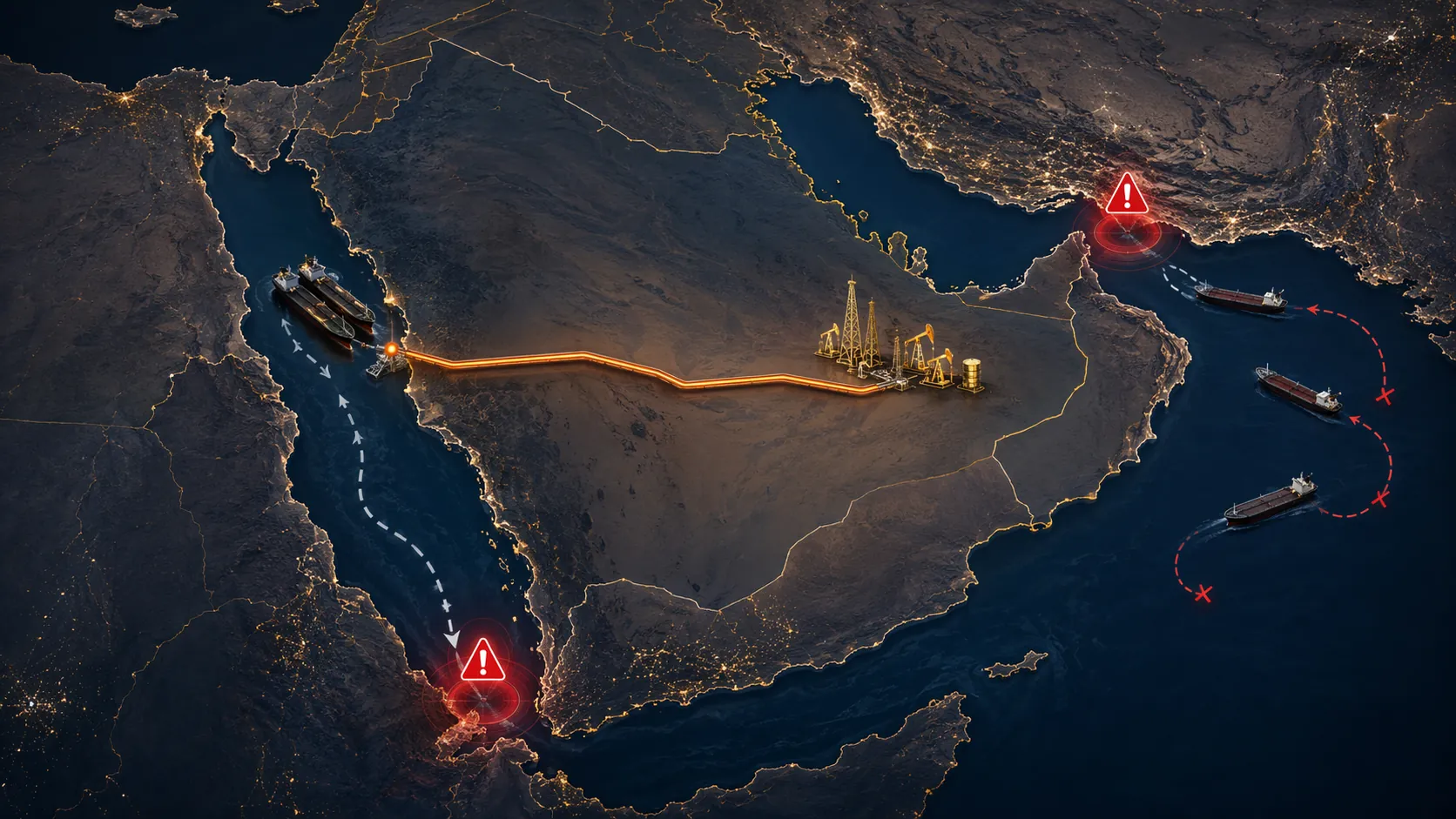
On a planning slide, that can look like diversification: Gulf terminals here, Yanbu there, pipeline in between, Red Sea optionality as the release valve. In execution, the workaround still needs a second maritime chokepoint. After the Houthi blockade announcement on July 20, 2026, the Red Sea leg stopped looking like clean redundancy and started looking like a coupled constraint.[1]
Two Chokepoints, Two Different Failure Modes
It is easy to flatten the Red Sea chokepoint oil-supply disruption impact into one regional shipping problem. Hormuz and Bab el-Mandeb both sit inside the same regional crisis, but they do not enter a supply-chain model in the same way.
Nada Sanders of Northeastern University drew the useful distinction: “Hormuz is the greater stand-alone oil shock. Bab el-Mandeb is the broader trade and logistics shock.”[2] That distinction matters because a planner who treats both as interchangeable “shipping disruption” fields will miss the way one shock changes crude availability while the other changes the viability, cost, and timing of the route that was supposed to absorb part of the first shock.
| Constraint | What It Primarily Hits | Planning Consequence |
|---|---|---|
| Strait of Hormuz | Oil and LNG exports from the Gulf | Crude availability, destination mix, tanker access, war-risk pricing |
| Bab el-Mandeb | Red Sea transit, Suez-linked flows, container and maritime commerce | Route viability, lead time, freight capacity, insurance, inventory timing |
| Both at once | Fallback routes that depend on Red Sea access after avoiding Hormuz | Collapse of assumed redundancy and need for coupled scenario triggers |
Hormuz remains the larger direct oil-supply problem. The strait carries roughly 20 million barrels per day, or about 20% of global oil. If Gulf barrels cannot move normally through Hormuz, procurement teams are not merely choosing a slower route; they may be competing for replacement barrels, altered liftings, different grades, and new delivery assumptions.
Bab el-Mandeb is different. CNBC reported that petroleum transit through the Red Sea rose from 4.2 million barrels per day in 2025 to 7.4 million barrels per day in June 2026, while also describing the Red Sea exposure as a major vulnerability for the oil market.[3] The same chokepoint also sits across a wider trade lane, with exposure framed at 15% of maritime commerce and 30% of container traffic. That means the disruption touches oil-linked supply chains even when the cargo in question is not crude: packaging resin, additives, spare parts, manufacturing inputs, retail inventory, and equipment needed to keep operations moving can all be caught in the same route reset.
Why Yanbu Became the Relief Valve
The Saudi east-west pipeline matters because it turns the dual-chokepoint issue from a map exercise into a scheduling problem. Moving crude across Saudi Arabia to Yanbu allows barrels to load on the Red Sea side rather than sailing from the Gulf through Hormuz. In a single-chokepoint Hormuz scenario, that is exactly the sort of physical optionality planners want: use pipe capacity, shift export geography, reduce dependence on the blocked maritime lane.
Reuters’ July 2026 figures show why the option became central rather than marginal. Yanbu exports did not merely tick up; they moved from roughly 973,000 barrels per day to more than 4 million barrels per day. The restored 7 million-barrel-per-day capacity of the east-west line provided a real mechanism for rerouting, even if nameplate capacity is not the same as actual daily throughput under stress.[1]
That is the kind of contingency that can survive a boardroom conversation because it is not just “find another route.” It has assets, capacity, terminals, vessel nominations, and a known export point. It also explains why planners who were already tired from the 2023–2025 Red Sea disruptions could still treat the situation as difficult but manageable. The old playbook had pain in it: longer voyages, higher freight, more exception management, less reliable arrival windows. But some routes still preserved choice.
The 2026 problem is that the relief valve was being used heavily before the downstream valve came under threat. Once crude reaches Yanbu, it still needs to move through Red Sea waters and, for many destinations, through or around Bab el-Mandeb and the Suez-linked network. If Bab el-Mandeb is constrained at the same time as Hormuz, the plan does not fail because someone forgot to name an alternate route. It fails because the alternate route inherits a second dependency.
The Red Sea Is No Longer Just the Workaround
The earlier Red Sea disruption period trained companies to think in terms of Suez diversions, Cape of Good Hope routing, longer lead times, and freight-rate volatility. Those were serious costs. They did not necessarily invalidate every Hormuz contingency, because the Gulf export lane and the Red Sea workaround were not both impaired in the same way at the same time.
The July 2026 Houthi blockade announcement changes that comparison. Reuters, citing Kpler data, reported a 30% drop in Bab el-Mandeb crossings in a single day and tankers making U-turns after the announcement.[1] That is not a theoretical update for a geopolitical dashboard. It is a trigger that affects vessel availability, arrival promises, demurrage exposure, cargo insurance, and whether the ERP date attached to a shipment still deserves to be treated as a planning input.
A company that buys petroleum-derived inputs may never contract a VLCC. It may still feel the problem through naphtha-linked costs, bunker adjustments, supplier force majeure language, or a component supplier waiting on feedstock. A manufacturer may see the first signal not as “oil shortage” but as a delayed container, a revised surcharge, or a procurement manager discovering that the alternate supplier also relies on Red Sea-connected inbound materials.
That is why Bab el-Mandeb cannot be treated as a smaller Hormuz. It is smaller as a direct oil chokepoint, based on the June 2026 petroleum transit figure of 7.4 million barrels per day versus Hormuz’s roughly 20 million barrels per day. But it is broader as a logistics constraint because it touches the route structure around Suez, container flows, non-oil cargo, and the Red Sea export logic that had become more important precisely because Hormuz risk increased.[3]
Insurance and Freight Are Confirming Signals, Not Side Color
The market is already pricing the distinction. Al Jazeera, citing S&P Global and Marsh data on July 23, 2026, reported that Hormuz war-risk premiums had risen from 1–3% of hull value to 7.5–10%. Bab el-Mandeb premiums moved from 0.1% to 0.5% of hull value in the days after the blockade announcement. Gulf-to-China tanker rates reached $77.96 per metric ton, about four times the five-year average of $18.91 per metric ton.[4]
Those numbers should not be frozen into annual planning assumptions. They are dated market readings, and the actual premium for a vessel will depend on vessel type, cargo, flag, insurer appetite, and the exact voyage. But they are useful because they show how risk is being repriced across both chokepoints at the same time. Insurance is not merely commenting on the crisis; it is changing the cost and sometimes the feasibility of execution.
A planning team does not need to become an insurance desk to use these signals. It does need to decide what happens inside the planning system when war-risk premiums cross a threshold, tanker rates detach from normal ranges, or vessel-tracking data shows turning behavior rather than only congestion. If the control tower records the event but the sourcing plan still assumes the same lead time and landed cost, the signal has not entered the operating model.
Which Assumptions Fail When Both Routes Are Constrained
The practical question is not whether oil supply will be disrupted in some general sense. The question is which assumptions fail when Hormuz and Bab el-Mandeb are constrained together. Several common assumptions now deserve to be treated as conditional rather than stable.
- The Red Sea is a fallback for Hormuz exposure. That only holds if the Red Sea leg remains navigable and insurable at workable cost.
- Pipeline capacity equals usable optionality. The Saudi east-west line’s stated 7 million-barrel-per-day capacity matters, but optionality also depends on terminal operations, vessel access, and Bab el-Mandeb risk after loading.[1]
- Prior Red Sea playbooks can be extended. The 2023–2025 pattern is a useful baseline for longer voyages and diversion costs, but it does not fully describe a situation in which the Hormuz workaround is also exposed.
- Oil shock and logistics shock can be modeled separately. Separate modeling is useful for clarity; independent modeling is dangerous when the contingency for one chokepoint depends on the other.
- A supplier’s alternate source removes the risk. An alternate source that shares the same Red Sea transit exposure may reduce contractual concentration without reducing route concentration.
This is where scenario tooling can help, if it is forced to represent the real dependency. A model that treats Hormuz as one scenario and Bab el-Mandeb as another may correctly score each event and still miss the compound failure. The useful version links the two: if Hormuz risk rises, Yanbu utilization increases; if Yanbu utilization increases, Bab el-Mandeb exposure rises; if Bab el-Mandeb crossings fall or premiums move, Red Sea-based contingency loses reliability.
For teams building or evaluating AI scenario systems, the test is straightforward. Can the system show when a mitigation action creates a new route dependency? Can it separate crude availability from logistics transit risk? Can it ingest dated market signals without pretending they are permanent constants? ChainSignal has covered adjacent use cases in AI scenario simulation for oil price shocks and AI disruption planning for Houthi-caused supply shocks, but the dual-chokepoint case raises the standard: the system has to model coupled constraints, not just detect two alerts.
How to Rebuild the Contingency Model
The response should start with route logic, not a generic crisis label. A useful planning exercise separates the flows that actually require Hormuz, the flows that shift to Yanbu or other Red Sea exits, the flows that touch Bab el-Mandeb directly, and the flows that are only indirectly exposed through suppliers, feedstocks, freight markets, or container capacity.
| Planning Input | What to Change in Q3 2026 |
|---|---|
| Lead time | Add separate lead-time assumptions for Gulf loading, Yanbu loading, Red Sea transit, and Cape diversion rather than one regional delay factor. |
| Freight rate | Tie rate scenarios to dated tanker and insurance signals, including war-risk premium thresholds. |
| Inventory policy | Recalculate safety stock for oil-linked inputs whose alternate sources share Red Sea or Gulf exposure. |
| Source mix | Identify whether alternate suppliers reduce route concentration or only contract concentration. |
| Scenario triggers | Use vessel U-turns, Bab el-Mandeb crossing declines, and premium changes as update triggers, not just news items. |
There is still uncertainty. The July 2026 blockade announcement and tanker diversions are days-old events. Ceasefire conditions remain fragile. Kpler data cited through news reporting is a tracking snapshot, not a complete operating picture. The east-west pipeline’s stated capacity is nameplate capacity, not a guarantee of sustained throughput. Insurance premiums can move by vessel and counterparty. Those caveats do not weaken the planning conclusion; they define how the triggers should be handled.
A brittle model asks whether Hormuz is open or closed, then whether the Red Sea is open or closed. A more useful model asks how much of the Hormuz workaround has been pushed through Yanbu, how much of that workaround depends on Bab el-Mandeb, what freight and insurance levels make the route commercially unattractive, and which customer commitments were built on the older assumption that these risks could be handled one at a time.
That is the operational meaning of the dual-chokepoint scenario. Hormuz and Bab el-Mandeb should be modeled as differentiated constraints because they damage different parts of the supply chain. They should also be modeled as coupled constraints because the fallback for one can become exposure to the other. The work now is to stress-test the Yanbu and Red Sea assumptions explicitly, update scenario triggers with named and dated market signals, and stop treating a reroute as redundancy until the second chokepoint has been tested too.
References
- Why are Houthis threatening to attack Red Sea shipping and what does it mean for oil? Reuters, July 2026.
- Houthi blockade of Bab el-Mandeb Strait. Northeastern University, July 21, 2026.
- Iran war oil price Strait Hormuz Bab el-Mandeb chokepoint. CNBC, June 5, 2026.
- How shipping insurance rates are rising as Hormuz, Bab al-Mandeb shut down. Al Jazeera, July 23, 2026.
§ 42 — Cited evidence
Flag an inaccuracy or submit a comparable account — Contribute or read how claims are verified in Methodology.