
§ 41 — Use-case analysis
Exposing procurement gaps in the CSU-OpenAI education deal
The $39M CSU-OpenAI deal exposes procurement governance unable to assess AI contracts for cost, data rights, or outcome quality. Contract details, assessment failures, and the HECVAT 4 framework reveal gaps every education procurement leader should address.
- Function
- procurement
- AI technique
- generative-ai
- Failure pattern
- procurement governance gap
- Evidence source
- Al Jazeera (June 2026); EDUCAUSE Review (March 2025)
The California State University-OpenAI deal is not just another campus technology announcement. It is a procurement file with unusually high stakes: an initial commitment reported at $17 million, a renewal described at $13 million a year in 2026, and a system-wide budget context that includes $144 million in cuts. Those figures come from a June 2026 Al Jazeera opinion piece citing public CSU documents and renewed contract terms, not from an independent state audit or direct CSU procurement verification, so they should be handled with that caveat visible. Even with that caution, the reported structure is large enough to make the deal a serious case study in AI in education supply-chain disruption.[1]
The usual language around these arrangements is softer than the transaction itself. Universities describe access, innovation, workforce readiness, and partnership. Vendors gain something more concrete: system scale, institutional legitimacy, and a channel through which students, faculty, and staff begin using a frontier AI platform as part of ordinary academic life. That exchange may be defensible. But it is not defensible by default, and it is not proven by a launch event.

A university system buying AI at scale is not only procuring software. It may also be supplying the vendor with users, behavioral patterns, institutional endorsement, procurement precedent, and a foothold in future budget cycles. Traditional procurement can price licenses and negotiate service terms. It is less prepared to value what the institution is giving away when the product improves, spreads, or becomes normalized through public education infrastructure.
The Deal Looks Different When Renewal Is the Starting Point
First-year access is the least revealing part of an AI platform agreement. The harder procurement question is what happens after faculty have built assignments around it, student services teams have routed work through it, administrators have announced modernization, and a renewal deadline arrives with no clean off-ramp. At that point, the institution is no longer deciding whether to experiment. It is deciding how much disruption it can tolerate if it stops.
That is why the reported CSU numbers matter. A $17 million initial commitment followed by a $13 million annual renewal would not be a casual pilot; it would be a system-scale operating dependency. Placing those figures beside reported $144 million system-wide budget cuts does not by itself prove the contract was imprudent. It does mean the burden of proof should be higher than general claims about AI literacy or future readiness.[1]
Procurement discipline should ask what the renewal is buying that the institution can measure. Are course outcomes improving, or only usage counts? Are advising backlogs falling, or only chatbot interactions rising? Are faculty saving review time, or is uncompensated verification labor being pushed into departments? Are students receiving better support, or simply faster responses with unclear accuracy? If the contract file cannot answer those questions before renewal, the university is negotiating from dependency rather than evidence.
| Procurement Question | Why It Matters After the First Year |
|---|---|
| What educational outcome triggers renewal? | Usage can rise even when learning quality, student support quality, or assessment reliability does not. |
| What data rights survive termination? | A vendor relationship may continue to create value from institutional activity after the campus stops paying. |
| What work shifts to staff or faculty? | AI systems can reduce one visible task while increasing review, correction, escalation, or appeals work elsewhere. |
| What is the cost of exit? | Curriculum, workflows, training, and student expectations can become switching costs. |
| Who owns failure response? | The public institution, not the vendor, usually faces students, parents, trustees, and the press. |
Outcome Quality Cannot Be Assumed From Model Sophistication
The strongest case for frontier AI in education usually leans on capability. These systems can draft, summarize, translate, tutor, classify, and respond at scale. Capability, however, is not the same as educational judgment. The Cambridge-led assessment evidence cited in the Al Jazeera piece cuts directly into that distinction: three frontier AI assessment systems were found to “routinely undervalue work awarded top marks by humans, or overvalue essays ranked among the lowest,” and all were described as “oversensitive to linguistic features.”[1]
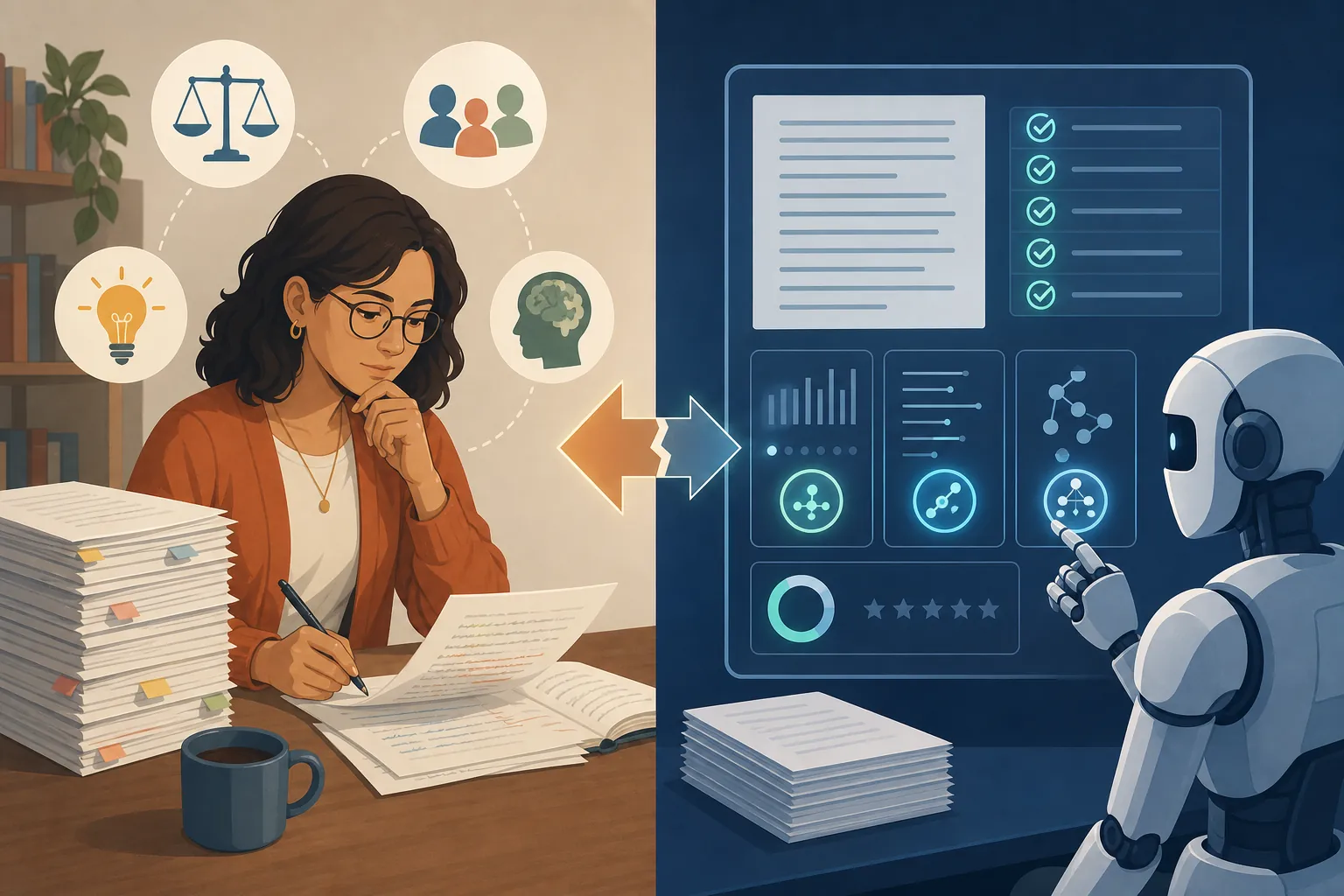
That finding does not establish that every AI education tool fails, and it does not settle every use case. It does show why procurement cannot treat “frontier” as a proxy for “fit for educational consequence.” A system that performs impressively in general language tasks may still reward polish over substance, fluency over originality, or formula over judgment when placed inside academic assessment.
For a procurement officer, the question is not whether the model is interesting. It is whether the proposed use changes the standard of review, the rights of the student, or the workload of the person who must catch errors. If an AI system drafts a campus newsletter, the risk sits in one place. If it scores writing, triages academic support, flags student conduct, or mediates access to services, the same technical failure becomes an institutional due-process problem.
This is where large education AI contracts deserve supply-chain scrutiny. In a conventional supply chain, a buyer would not accept a critical input without specifications, inspection rights, defect handling, and supplier accountability. In education AI, the “input” may be probabilistic judgment inserted into assessment, advising, communication, and administration. If quality criteria are vague, the institution has accepted an opaque supplier into core operations without the controls it would demand for less glamorous categories.
Readiness Data Points to a Governance Gap, Not Just a Budget Gap
The reported CSU economics show the scale of commitment. The assessment findings show why quality cannot be assumed. The next question is whether higher education procurement environments are prepared to evaluate AI-specific risks before those commitments harden into operating practice. EDUCAUSE and ACE surveyed 788 higher-ed respondents in November 2024, with findings published in March 2025. Only 9% said their cybersecurity and privacy policies sufficiently addressed AI risks, only 19% said they were budgeting for long-term AI costs, and 42% described their policies as only “somewhat” adequate.[2]
Those numbers are not current to Q3 2026, and the sector has moved quickly since the survey window. Still, they are recent enough to be useful as a warning about baseline capacity. AI procurement is arriving in institutions where many teams were still building the policy, budget, privacy, and cybersecurity apparatus needed to evaluate it. That is not a minor process issue. It changes who has leverage when a vendor offers scale.
A weak procurement environment does not always produce a bad contract. It does make bad defaults easier. Data-use terms may be accepted because they look like standard software language. Renewal escalators may be missed because first-year pricing is politically attractive. Cybersecurity review may focus on familiar controls while failing to ask how prompts, outputs, model interactions, training restrictions, or third-party AI integrations are handled. Privacy review may confirm compliance language without resolving whether student and employee interaction data becomes part of vendor learning, analytics, benchmarking, or product development.
That pattern is not unique to universities. ChainSignal has already examined how enterprise machine-learning deployments can advance without a documented strategy in Why 77% of Supply Chain Machine Learning Deployments Have No Strategy. Higher education adds a different exposure: the users are students, faculty, and public employees, and the institution’s credibility is part of what makes the deployment valuable to the vendor.
When “Skills Pipeline” Language Becomes a Procurement Signal
The Al Jazeera piece also cites a Cisco-sponsored paper that frames universities as “supply chains for AI-related skills.”[1] That phrase should not be inflated into proof of contractual harm. It is better read as a signal. Technology ecosystems do not only see universities as buyers. They also see them as talent infrastructure, adoption infrastructure, legitimacy infrastructure, and future demand infrastructure.
Procurement rules were not designed to price all of that. They can compare subscription tiers, uptime commitments, indemnity language, accessibility provisions, and security questionnaires. They are less comfortable asking whether a university system is becoming a distribution layer for a vendor’s market strategy. Yet that is exactly the question that large AI platform deals raise.
The asymmetry is not that vendors benefit. Vendors are supposed to benefit from contracts. The asymmetry appears when the vendor’s benefits are specific and compounding while the institution’s benefits are described in broad, hard-to-audit terms. “AI readiness” is not a renewal metric. “Innovation” is not a data governance model. “Access” is not evidence of learning gain.
Small Automation Choices Can Become Public Trust Events
Not every AI failure begins with a massive platform contract. Glendale Community College’s graduation name-reading incident, also cited by Al Jazeera, shows why even narrow automation decisions deserve operational review. An AI name-reading failure at graduation led to the president being booed; the president later called the incident “a lesson learned.”[1]
The point is not that name-reading software carries the same risk as an enterprise AI platform. It plainly does not. The point is that institutions often discover the real owner of an AI failure only after students and families experience it. A vendor may supply the system, but the college supplies the ceremony, the relationship, and the apology.
That is the procurement lesson hidden inside a public embarrassment. AI risk is not limited to data breaches or model hallucinations. It includes dignity, accessibility, language, identity, grievance handling, and institutional trust. These are operational categories, not public-relations decorations. If they are not written into requirements, testing, escalation, and acceptance criteria, they will be handled improvisedly by the staff closest to the failure.
HECVAT 4 Gives Buyers a Better Place to Start
Critique is easy if the only standard is that AI procurement should be more careful. The useful question is what a better process can actually hold in its hands before the next contract, renewal, or expansion. The EDUCAUSE article points to HECVAT 4 as a structured tool that now includes AI-specific questions across six standards: NIST AI 600-1, OWASP, MITRE ATLAS, RAFT, CISA, and NIST 800-53.[2]

That matters because procurement teams need a way to move AI review out of the realm of vendor narrative and into repeatable questions. A framework does not guarantee a good contract. It does, however, make it harder for an institution to confuse a product demonstration with a risk assessment.
For large AI education agreements, HECVAT-style review should occur before system-wide scale, before the first renewal, and before a department-level experiment becomes a campus dependency. The review should not be treated as a paperwork gate at the end of vendor selection. It should shape the requirements from the beginning: what data the vendor may use, what data it may not use, how outputs are monitored, how incidents are reported, how subcontractors are controlled, how model changes are disclosed, and what happens when the system is no longer acceptable.
The most important procurement questions are not exotic. They are the questions that become expensive when asked too late.
- Define the educational use case narrowly enough to test: tutoring, drafting support, advising triage, accessibility support, grading assistance, administrative service, or another specific function.
- Separate adoption metrics from outcome metrics: logins, prompts, and licenses are not evidence of learning, retention, equity, service quality, or staff productivity.
- Require data-use boundaries that survive marketing language: training, fine-tuning, analytics, benchmarking, support review, and product improvement should each be addressed directly.
- Model renewal and exit costs before launch: training, workflow redesign, integrations, contract termination, data return, and user transition all belong in the cost picture.
- Assign failure ownership before the failure: appeals, corrections, communications, accessibility exceptions, and student-facing remedies need named institutional owners.
The Contract Should Price What the Vendor Receives
A university buying AI at scale should not evaluate the deal as if money flows one way and value flows the other. The vendor receives value that may not appear in the invoice. It receives a large user base. It receives evidence that a public education system is willing to standardize around the product. It may receive product feedback, usage patterns, integration lessons, and reputational lift. Depending on contract terms, it may receive rights to use interaction data in ways that outlast the procurement cycle.
That does not mean every data flow is improper. It means data rights and institutional endorsement should be negotiated as assets, not treated as incidental exhaust. If a vendor wants system scale, the institution can require stronger audit rights, clearer deletion terms, better incident notification, stricter limits on secondary use, price protections at renewal, and outcome reporting tied to the use cases that justified the purchase.
Discounted first-year access can be useful, but it can also function as a low-friction path to dependency. A procurement file should therefore include the year-three question before year one begins: if the platform becomes embedded and the price rises, what evidence would justify staying? If the evidence is absent, who has authority to stop? If stopping is operationally painful, where is that pain reflected in the original decision?
A More Defensible AI Procurement File
A defensible AI procurement file for higher education would look less like a modernization announcement and more like a controlled supplier-risk decision. It would state the specific educational or administrative problem being addressed. It would show why an AI platform is necessary rather than merely available. It would identify who reviews outputs, who handles disputes, what students and employees are told, and what data is excluded from vendor use.
It would also distinguish pilots from operating infrastructure. A pilot can test feasibility with limited exposure. Infrastructure changes expectations. Once a platform is embedded across courses, advising, service desks, or administrative workflows, later decisions are made under pressure from users who have adapted around it. Procurement governance has to anticipate that pressure instead of pretending renewal will be a clean market comparison.
The CSU-OpenAI deal is important because it exposes this mismatch at a scale other institutions can understand. The public record as cited does not prove every concern, and the reported dollar figures deserve independent verification before being used as an audit conclusion. But the governance question does not depend on outrage. It depends on whether universities are prepared to evaluate AI contracts as long-term supply-chain relationships involving cost, data, legitimacy, risk transfer, and measurable educational outcomes.
If they are not, the university does not merely buy the AI system. It becomes part of the system that sells it.
References
- The university must not become a supply chain for AI, Al Jazeera, June 11, 2026.
- AI Procurement in Higher Education: Benefits and Risks of Emerging Tools, EDUCAUSE Review, March 2025.
§ 42 — Cited evidence
Flag an inaccuracy or submit a comparable account — Contribute or read how claims are verified in Methodology.