
§ 41 — Use-case analysis
Drone Attack Lessons for Supply Chain Security Plans
The July 2026 drone attack on two Wildberries warehouses killed eight and wounded 62, exposing critical gaps in warehouse aerial defense. This analysis draws tactical lessons for supply chain security planners building counter-UAS and emergency response plans.
- Function
- security
- AI technique
- computer vision
- Failure pattern
- perimeter-centric security gap
- Evidence source
- BBC report (2026)
The July 2026 strikes on two Wildberries logistics warehouses leave a hard question for anyone writing supply chain security plans for warehouse drone attacks: if drones were reportedly detected and some were intercepted, why did the worker casualty count become the central fact of the incident?
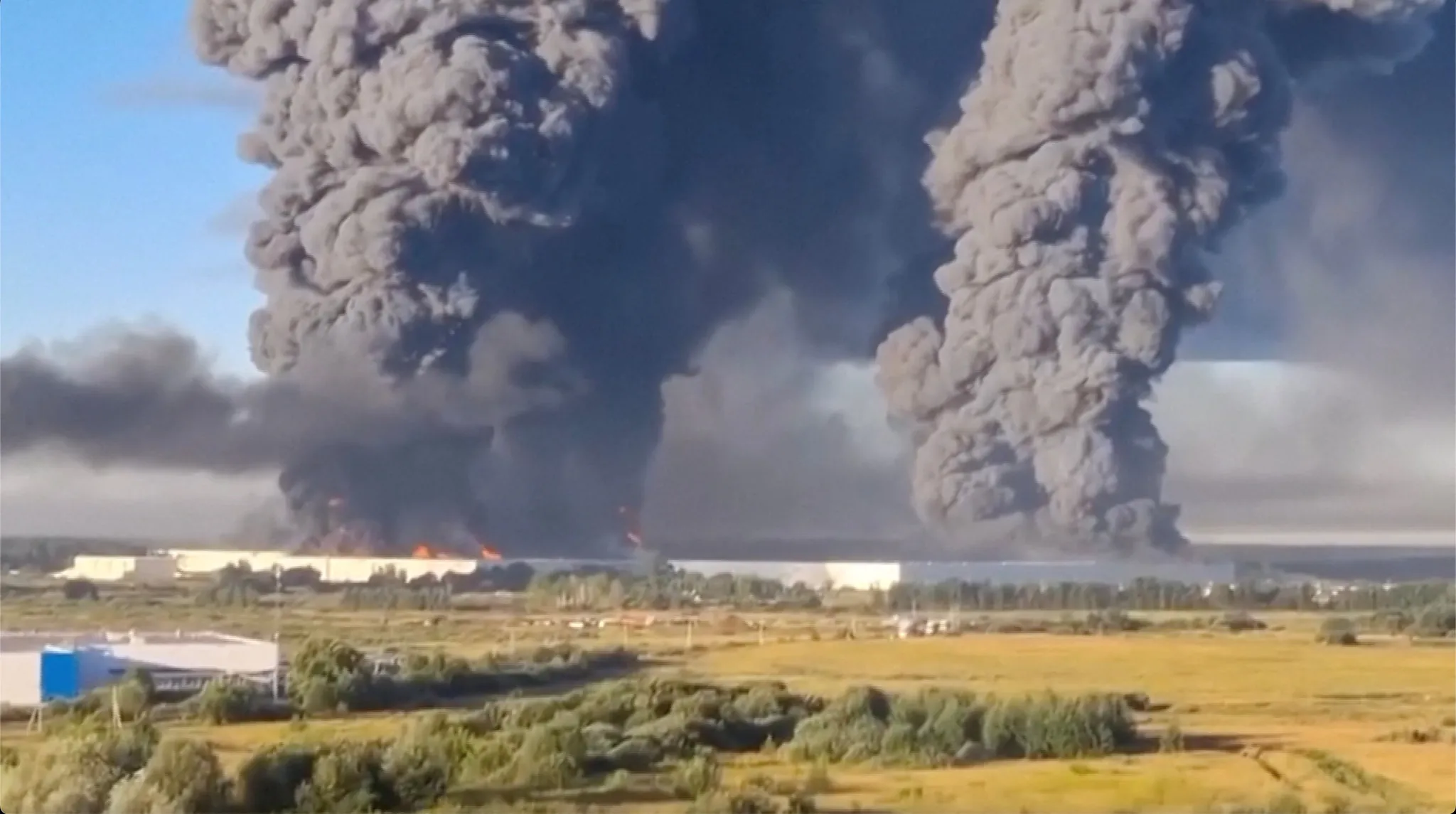
In Tambov, Russian officials reported seven people killed and 25 injured after a Ukrainian drone strike on a Wildberries warehouse; the BBC reported those casualty figures while noting they had not been independently verified. The same BBC report said more than 76 drones were deployed and that 28 were reportedly shot down in Tambov alone.[1] In Elektrostal, near Moscow, one person was reported killed and 37 injured in a separate Wildberries warehouse strike.[1]
The two sites were not random sheds in an empty industrial belt. The Guardian’s July 19 war briefing described the Wildberries facilities as logistics targets and reported the Ukrainian rationale that the company’s supply chain was being used for drones.[2] Atlantic Council analysis has separately framed Ukraine’s mid-range strike campaign as a “Logistics Lockdown” effort aimed at Russian supply chains 30 to 180 kilometers behind the front lines.[3] That context matters, but only up to a point. For a warehouse planner, the more immediate issue is what happened once the threat arrived over a building full of people.
The Incident Was Not Just a Perimeter Problem
A perimeter-centered security plan tends to ask whether the drone was seen, tracked, jammed, intercepted, or missed. Those are necessary questions. They are not enough for this case record. The reported Tambov figures include both a large inbound drone count and a substantial number of interceptions, yet the warehouse still became a mass-casualty scene for workers inside the facility.[1]
That does not prove the defenses failed in a simple way. It suggests that the plan, whatever it was, did not turn aerial warning into adequate protection for people under the roof. A drone does not have to cross a fence line like a trespasser. It can arrive above the most occupied part of the building, above the places where pickers, packers, sorters, equipment operators, drivers, and shift supervisors are already concentrated by the operating model.
A warehouse can look spacious on a site plan and still put a large share of the night shift into a few dense work zones. Packing benches, sorter induction points, outbound staging, returns processing, battery charging areas, break rooms, clock stations, and dock queues are not evenly distributed. They are clusters. If a strike affects one of those clusters, the injury pattern will not resemble a random distribution across square footage.
This is where casualty analysis becomes a planning tool. The Tambov and Elektrostal reports do not give enough detail to map exactly where every worker stood or how the damage propagated through each building. They do, however, make one conclusion difficult to avoid: supply chain security plans that treat drones mainly as objects outside the building miss the harder warehouse question, which is how to protect concentrated labor beneath broad, exposed industrial roof spans.
Why Warehouses Are Vulnerable From Above
Commercial logistics buildings are designed for movement, storage density, dock access, and fast labor flow. Their roofs are wide because the operation needs open floor plates. Their internal separations are often built around fire code, inventory control, automation cells, temperature zones, or tenant divisions, not overhead blast protection. A drone threat changes the meaning of that architecture.
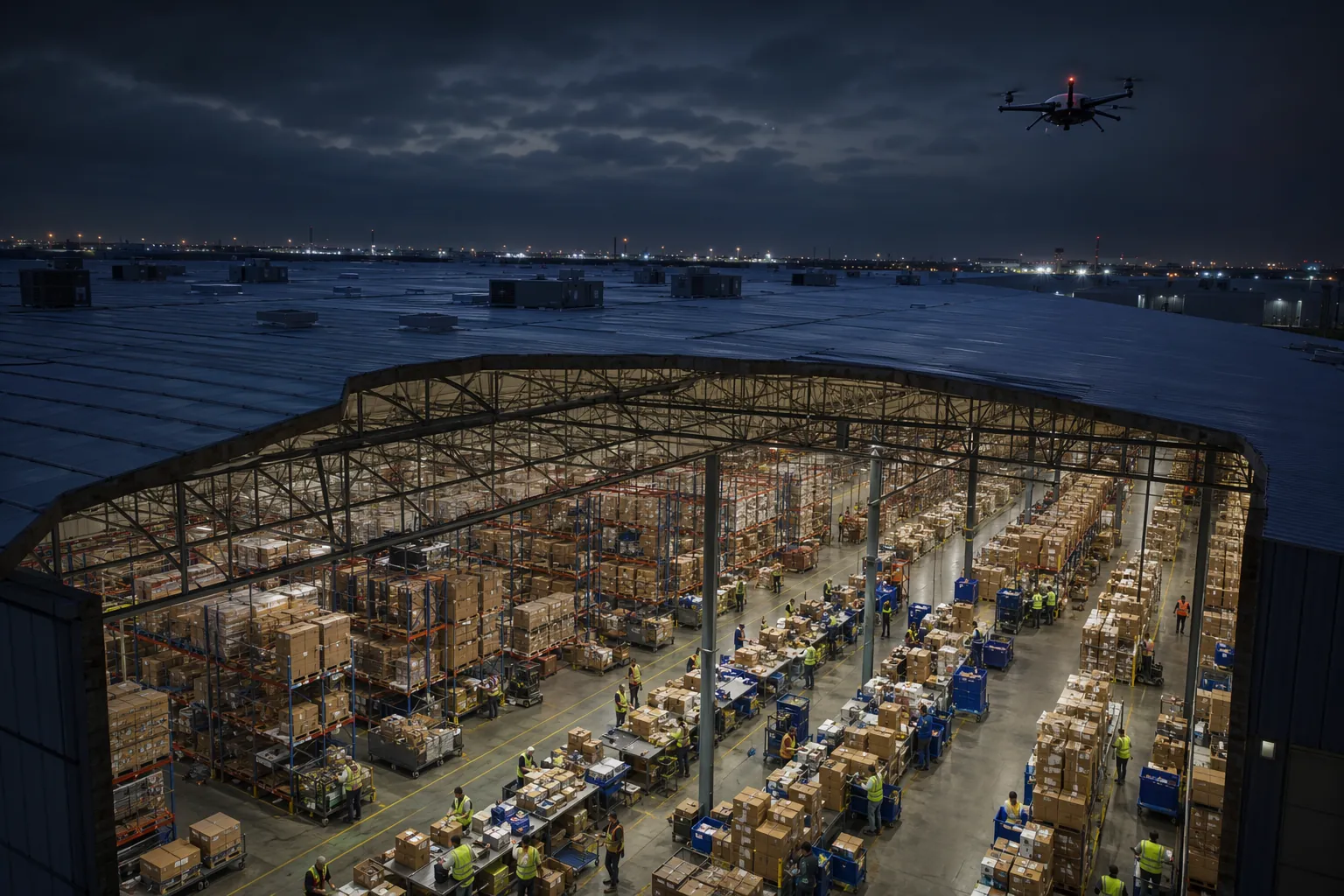
The roof is the largest exposed surface and usually the least relevant surface in ordinary guard-force thinking. Cameras watch doors. Badges control entrances. Vehicle barriers shape truck movement. Patrol routes follow the fence, yard, dock line, and office entrance. None of that is wasted, but it leaves a blind spot if the threat path is vertical and the consequence is falling debris, fire, smoke, shock, or secondary collapse inside occupied work areas.
The night shift makes this problem less visible on paper. A corporate plan may describe “reduced occupancy” after hours, while the building itself may still be running a dense fulfillment wave. The difference matters. A site with fewer office staff can still have hundreds of warehouse workers in repetitive, high-throughput positions where hearing protection, machinery noise, production pressure, scanning tasks, and conveyor flow all slow the human response to an alarm.
Even a timely aerial alert can arrive as an ambiguous instruction. Workers need to know whether to leave the building, move deeper inside, avoid dock doors, avoid roof-light areas, stay away from battery rooms, shut down conveyors, abandon forklifts, or continue moving until a supervisor directs them. If the alert simply says “drone threat” without a preassigned action by zone, the shift loses the most valuable minutes to interpretation.
Detection Only Helps If It Changes the Floor
Counter-UAS tools are often discussed as if the useful decision is the purchase decision: radar, RF detection, optical tracking, acoustic sensors, jamming, interception, or a managed service. For a warehouse, the more disciplined question is what each alert causes inside the operating environment.
| Alert or Control Point | Warehouse Planning Question |
|---|---|
| Drone detection outside the site | Who receives the alert, and can that person order a floor action immediately? |
| Drone tracking near the roofline | Which zones move, which zones shelter, and which zones stop equipment? |
| Law enforcement or authorized C-UAS notification | Who makes the call, what information is passed, and what can responders legally do? |
| Interception or shootdown nearby | Where could debris fall, and are workers being moved away from exposed areas? |
| Post-impact alarm | Who accounts for the shift, who checks trapped areas, and who controls re-entry? |
The Tambov report is a useful warning here because interception and harm appear in the same case record: 28 drones were reportedly shot down in Tambov, while seven deaths and 25 injuries were also reported at the warehouse.[1] Without more detail, that pairing cannot tell us whether interceptions reduced casualties, displaced the hazard, failed to cover the site, or occurred in parallel with successful impacts. It does show why “some drones were shot down” is not a sufficient warehouse safety metric.
The Plan Has to Start With Occupancy, Not Equipment
A serious aerial threat assessment for a logistics site should begin with a time-stamped occupancy map. Not the lease plan. Not the maximum legal occupancy. The working map: where people actually stand at 2 a.m., where the replenishment team bunches during cutover, where the outbound wave peaks, where drivers wait during yard congestion, where maintenance crews gather when automation stops, and where supervisors naturally send people during an ordinary fire alarm.
That map then needs to be laid under the roof plan. Skylights, lightweight panels, rooftop units, older roof sections, fuel-adjacent areas, high-piled storage, mezzanines, conveyor bridges, and battery charging rooms all change the consequence of an overhead incident. The question is not whether the whole warehouse is vulnerable in a general way. The question is which occupied zones combine people, exposure, and delayed egress.
From there, the planner can make choices that do not depend on buying a perfect drone-defense system. A dense packing area may need a nearby protected refuge. A returns area under a weak roof bay may need a different muster instruction than a dock team next to multiple exits. A mezzanine workstation may require a faster shutdown order than a floor-level aisle. A break room that feels safe during a fire drill may be a poor shelter if it sits directly below a vulnerable roof section.
The plan should also identify who has authority to break production. In many warehouses, the first person with real visibility is not a corporate security director but a shift supervisor, dock lead, control-room operator, or contracted guard. If that person must wait for a distant crisis team to decide whether an aerial warning is serious, the response clock is already being spent.
Evacuation Is Not Always the Safer Default
A normal emergency plan often has a strong bias toward evacuation. Fire alarms train people to leave. Drill routes send workers through marked exits to exterior muster points. That habit can be dangerous if the aerial threat is active, the exterior yard is exposed, the drone path is unclear, or debris from an interception may fall outside the building.
The better planning frame is not “evacuate or shelter” as a single sitewide instruction. It is zone-based movement. Some workers may need to move away from roof-exposed workstations into interior hardened areas. Others may need to leave a high-risk section quickly because of fire, smoke, chemicals, batteries, fuel, or structural damage. Dock personnel may need a different instruction from packing teams. Yard drivers may need a separate route that keeps them away from the building face and emergency access lanes.
- Preassign shelter areas by shift and zone, not by a generic building-wide muster point.
- Give supervisors authority to stop conveyors, freeze forklift movement, and redirect workers without waiting for corporate approval.
- Separate aerial-threat alarms from fire alarms so workers do not automatically follow the wrong drill.
- Account for hearing protection, language coverage, radio dead spots, and contractors who may not receive company alerts.
- Plan re-entry control before the incident, because damaged roof sections and unexploded debris can turn a survivable first event into a second injury scene.
The Wildberries casualty reports do not disclose exactly which of these elements were present or absent. They do not need to. The planning lesson is about the gap that appears whenever an aerial warning exists at one level of the organization while the warehouse floor receives either no instruction, a late instruction, or an instruction copied from a different emergency type.
Coordination Cannot Be Improvised During the Alarm
Most commercial operators cannot assume they have the legal authority, equipment, or training to defeat a drone themselves. That is not a side issue, even if the legal details vary by jurisdiction. It means warehouse plans must define the handoff to public authorities, site security providers, emergency services, and any authorized counter-UAS actors before the first alert arrives.
The handoff should be practical. A guard calling law enforcement with “there may be a drone” is not the same as a control room passing the drone’s direction, altitude if available, observed payload concern, last visual location, roof zones at risk, occupancy count, hazardous-material locations, access gate status, and emergency vehicle staging plan. The first call reports anxiety. The second call gives responders a working picture.
Interception planning also has to account for debris and misidentification. If an authorized party attempts to defeat a drone near a warehouse, the site still owns the problem of where workers, drivers, and guards are standing. A successful defeat above a yard, roof edge, fuel island, trailer queue, or employee exit can still create injury risk. The floor plan and the air picture have to meet.
What the Wildberries Case Can and Cannot Prove
This case should not be stretched into a universal formula. The reported casualty figures come through Russian official claims cited by the BBC, with the important caveat that they were not independently verified in the reporting available here.[1] The description of Wildberries as part of a dual-use logistics chain comes through the Guardian’s war briefing, and the broader “Logistics Lockdown” frame is Atlantic Council analysis rather than a warehouse safety investigation.[2][3]
Those limits matter. They prevent a planner from claiming that every commercial warehouse faces the same threat level, that every roof requires the same reinforcement, or that every site needs the same counter-UAS stack. A cold-storage facility near a military route, a parcel hub beside an airport, an e-commerce warehouse in a politically exposed region, and a regional parts depot in a low-threat area do not deserve identical plans.
The narrower lesson is still strong. A warehouse drone attack supply chain security plan is incomplete if it stops at detection, notification, or asset continuity. It has to explain what happens to the people concentrated under the roof: who moves them, where they go, which equipment stops, which zones shelter, which exits are avoided, who talks to authorized responders, and how re-entry is controlled after impact. The Wildberries strikes do not prove that every warehouse needs the same defenses, but they do show how a perimeter-centered plan can look complete while leaving workers beneath wide industrial roofs waiting for an instruction that has to arrive before the ceiling, smoke, debris, or panic does.
References
- BBC report on the Tambov Wildberries warehouse strike, BBC, bbc.com/news/articles/clyxlm877p2o
- Ukraine war briefing, The Guardian, July 19, 2026, theguardian.com/world/2026/jul/19/ukraine-war-briefing
- Ukrainian drones are cutting Russian logistics, Atlantic Council, atlanticcouncil.org/blogs/ukrainealert/ukrainian-drones-are-cutting-russian-logistics
§ 42 — Cited evidence
Flag an inaccuracy or submit a comparable account — Contribute or read how claims are verified in Methodology.