
§ 41 — Use-case analysis
What Waymo and Uber's autonomy deal means for logistics
The Waymo-Uber partnership spans ride-hailing, food delivery, and freight — but logistics implications are not uniform. This analysis breaks down what each mode actually delivers and what supply-chain planners should assume about autonomous trucking ahead of 2027.
- Function
- transportation
- AI technique
- computer-vision
- Failure pattern
- autonomous freight scaling failure
- Evidence source
- Waymo Via shutdown, NACFE 2024 autonomous trucking review
The Waymo-Uber autonomy story looks unified from a distance. In a logistics model, it splits into three ledgers almost immediately: urban passenger rides that are scaling, restaurant delivery that is being tested in a narrow geography, and freight automation whose original Waymo path is now paused. That distinction matters because this topic is easy to answer badly if robotaxi traction is allowed to stand in for truck capacity.
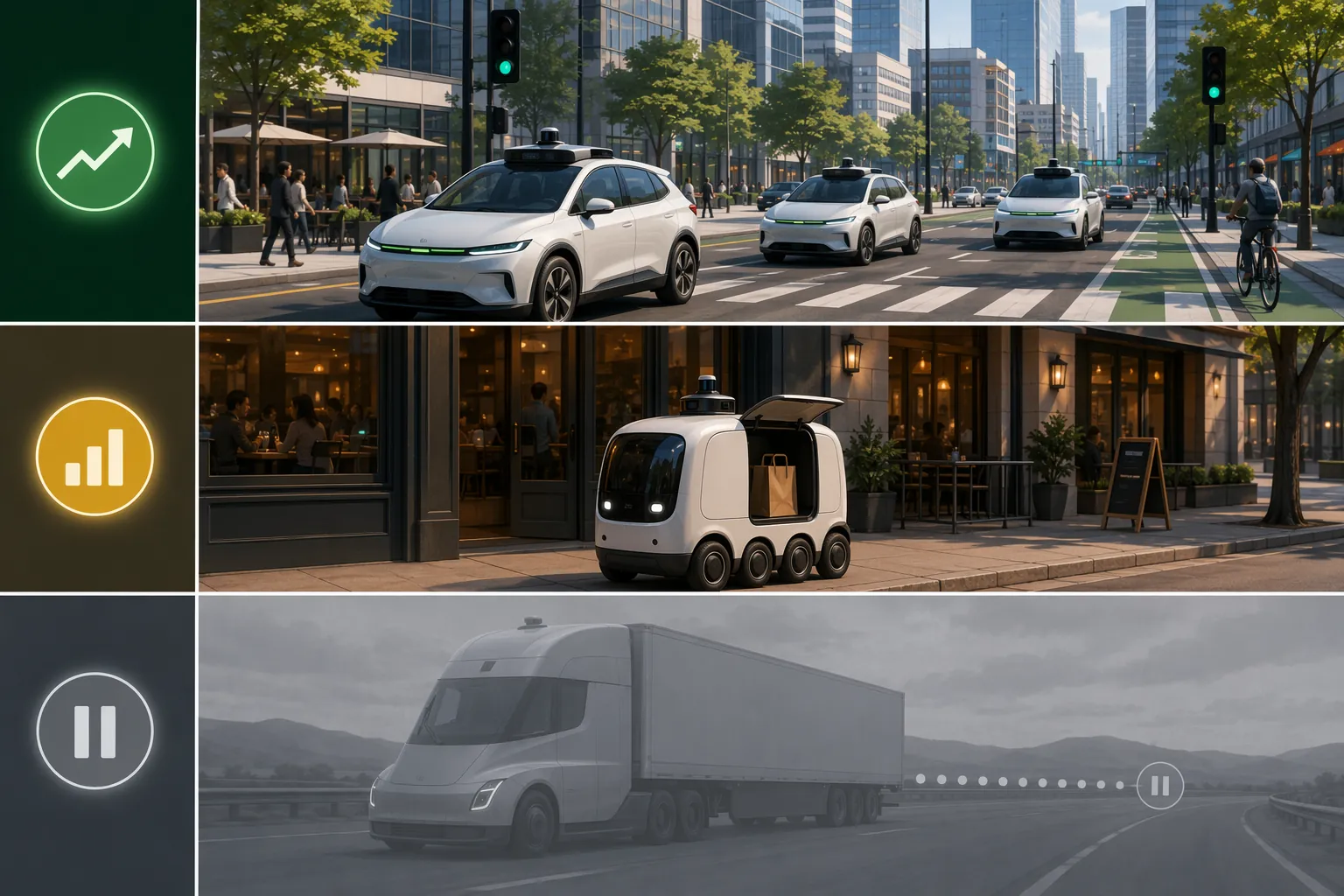
| Mode | What the Waymo-Uber relationship has produced | What logistics planners should not assume |
|---|---|---|
| Ride-hailing | Waymo reported 11 cities and more than 500,000 weekly trips by March 2026, with the Uber partnership expanding autonomous ride-hailing to Austin and Atlanta in 2025.[1][2] | That urban passenger scale does not automatically create freight lane capacity. |
| Last-mile food delivery | Uber and Waymo launched autonomous Uber Eats deliveries in Phoenix in April 2024.[3] | A Phoenix food-delivery deployment is not proof of broad parcel, grocery, or B2B last-mile transformation. |
| Long-haul freight | Uber Freight and Waymo Via announced a 2022 agreement framed around billions of autonomous freight miles.[4] | The freight program cannot be treated as a live scaled network after Waymo suspended Waymo Via in July 2023.[5] |
The first line in that table is genuinely important. More than 500,000 weekly trips is not a press-release metaphor; it is operational activity at a scale most autonomous-driving programs have not reached.[1] The Austin and Atlanta expansion through Uber also shows that Waymo is willing to use Uber’s consumer marketplace as a deployment channel rather than only building direct demand city by city.[2]
But logistics does not buy “autonomy” as a category. It buys a service level on a lane, a trailer plan, a tender process, a terminal footprint, a claims procedure, and a fallback carrier when the first plan fails. The fact that an autonomous car can complete paid passenger trips in a mapped urban service area is relevant evidence about perception, safety operations, fleet support, and public acceptance. It is not, by itself, evidence that a shipper can remove a team-driver run from a 2027 transportation budget.
The Freight Track Is Where the Story Changes
The 2022 Uber Freight-Waymo Via announcement is still the reason this question keeps coming back. The companies said they would combine Waymo Via’s autonomous truck technology with Uber Freight’s shipper and carrier marketplace, describing a path toward “billions of miles” of autonomous freight capacity.[4] That phrase did real strategic work: it made the relationship sound like more than a technology trial and invited shippers to imagine future network capacity.
The uncomfortable planning fact is that the phrase has not been matched by public evidence of delivered freight scale. In July 2023, Waymo suspended Waymo Via and shifted engineering resources toward ride-hailing, while saying it intended to return to trucking at some point without providing a date.[5] For anyone building a procurement or network-design assumption, that suspension is not a minor update. It changes the status of the freight agreement from an active capacity thesis to an option value.
Uber Freight’s behavior since then is the more useful signal. It has not treated the Waymo relationship as the only road to autonomous freight. It has kept the Waymo framework alive while also piloting commercially with Aurora, which says far more about market uncertainty than any broad claim that “autonomous logistics is arriving.” A brokered freight platform does not need theological purity on autonomy vendors; it needs optionality, lane coverage, shipper confidence, and a way to convert a test into something procurement can contract.
That is the central logistics implication of the Waymo-Uber relationship: ride-hailing momentum increases confidence that autonomous-driving systems can operate commercially in bounded urban settings, while the freight program’s own timeline tells planners not to import that maturity into long-haul trucking. The two statements can be true at the same time.
Why Robotaxi Scale Does Not Convert Cleanly Into Freight Capacity
The hardware and operating context are different before the first tender is even offered. Waymo’s fifth-generation hardware has been reported to add roughly $100,000 per vehicle, bringing a Jaguar I-PACE robotaxi to about $175,000, while a used UberX vehicle can be around $30,000.[1] Those figures are not a direct trucking cost model, but they explain why a passenger-service deployment and a freight-service deployment face different capital questions.
Autonomous trucking has a countervailing possibility: if a driver cabin can eventually be removed, NACFE has noted that autonomous truck cost could fall by about one-third.[6] That is a design-stage economic argument, not a near-term capacity guarantee. It depends on vehicle architecture, manufacturing scale, maintenance support, regulation, insurance, and whether the vehicle is actually running enough paid miles to absorb its fixed costs.
The labor context also changes. In ride-hailing, the autonomy system substitutes for a driver within an urban passenger marketplace. In trucking, the first operationally plausible model often does not eliminate human drivers from the shipment; it moves them to the ends of the route. That means the question becomes less “Can the truck drive itself?” and more “Can the network choreograph handoffs without adding enough dwell, repositioning, and exception cost to erase the benefit?”
The Surviving Freight Blueprint Is Hub-to-Hub, Not Door-to-Door
The most concrete logistics model in the available evidence is the hub-to-hub hybrid network. Human drivers handle urban first and last miles. A trailer moves through a transfer terminal. An autonomous tractor takes the highway middle mile. Another transfer terminal hands the trailer back to a human driver for final delivery.
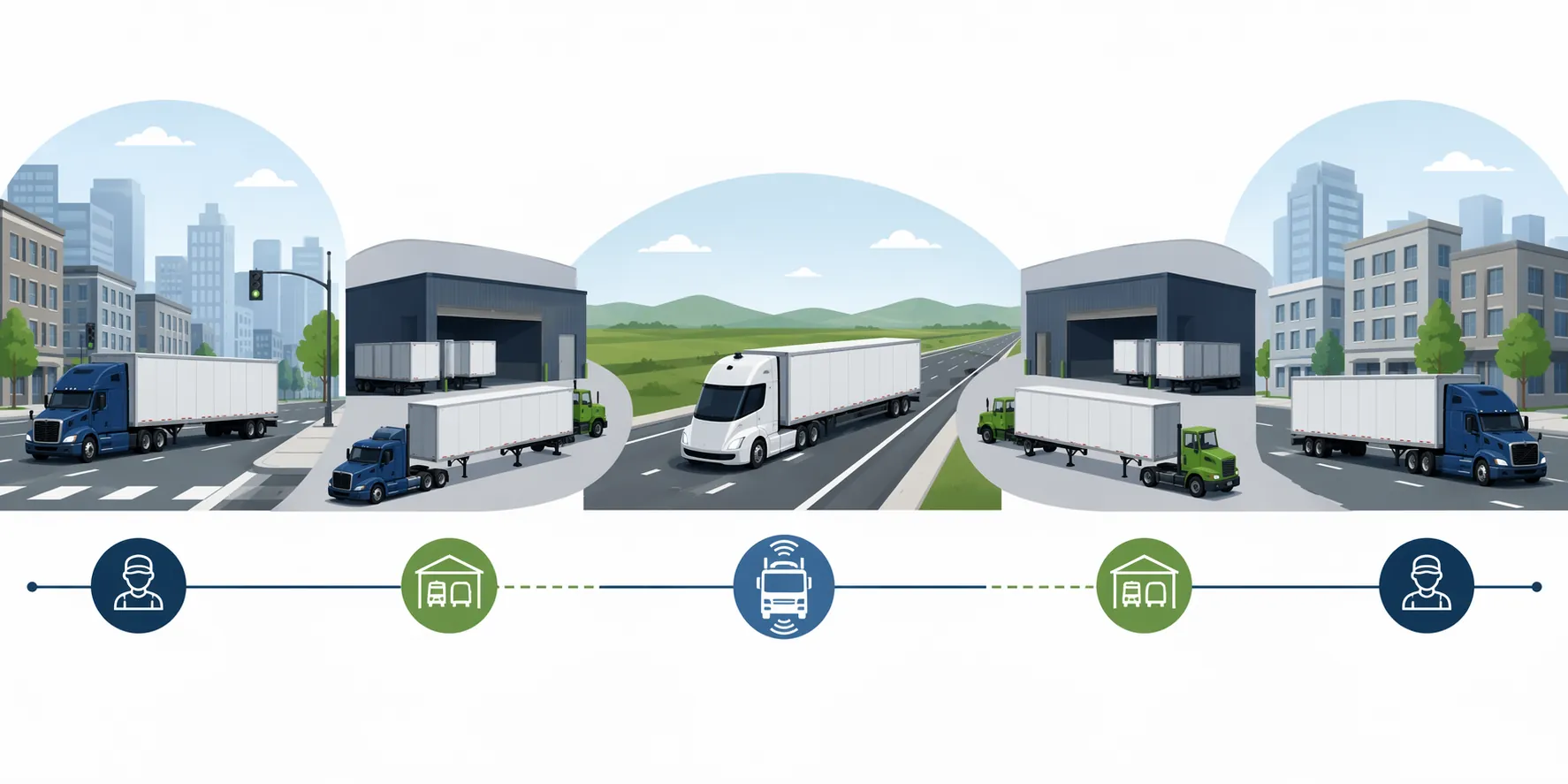
This is a planner’s model because it names the handoff points. It forces questions that disappear in broad autonomy narratives: where the transfer terminal sits, who owns the trailer pool, how late freight is recovered, whether a human driver waits, whether the autonomous tractor can be assigned another trailer immediately, and whether the shipper’s dock schedule tolerates the additional choreography.
Uber Freight’s own research gives the model a measurable boundary. Using historical carrier pricing data, it estimated an immediate addressable market of 25 billion miles of interstate dry van freight for the hybrid model. It also found that the model is feasible on 80% of lanes if autonomous middle-mile cost reaches $1 per mile, and on 40% of lanes at $2 per mile.[7] Those are conditional economics, not deployment facts.
The condition is doing most of the work. A lane that pencils at $1 per autonomous mile may not pencil at $2. A lane that looks attractive on carrier pricing may fail because the terminal is in the wrong place, the freight has tight appointment windows, the shipper requires live unload, or the trailer pool cannot keep enough equipment in circulation. The middle mile can be technically elegant and still lose to a messy human network if the handoffs are underbuilt.
NACFE’s 2024 autonomous trucking review validates the hub-to-hub concept as a serious operating model, which matters because it is not just a vendor diagram.[8] At the same time, NACFE’s financial analysis leaves several conclusions uncertain or speculative because the industry still lacks enough operational data.[6] That combination is exactly where logistics strategy often lives: the model is real enough to study, but not mature enough to hard-code into a base-case network.
What a Planner Can Actually Put in a 2027 Model
A disciplined 2027 assumption should start with lane screening, not brand extrapolation. The best candidate lanes are likely to be repeatable dry van moves with substantial interstate mileage, predictable appointment patterns, transfer-terminal access on both ends, and enough volume to justify operational setup. The wrong candidate is a fragmented route where every shipment requires a custom exception plan.
- Treat transfer terminals as capacity assets, not neutral dots on a map.
- Model trailer dwell and repositioning explicitly, especially if a pool such as Uber Freight’s Powerloop is part of the handoff.
- Separate autonomous middle-mile cost from total shipment cost; the first and last mile still require labor, scheduling, and recovery plans.
- Use autonomous lanes as scenario capacity until a provider can support contracted service levels, claims handling, exception management, and seasonal surge.
- Keep vendor assumptions multi-sourced; Uber Freight’s Aurora activity is evidence that the market itself is not waiting on a single technology partner.
This is where the suspended Waymo Via timeline should sit inside the model. It does not mean autonomous freight is dead. It means the original Waymo-Uber Freight path no longer supports a simple straight-line adoption curve. If a 2027 plan includes autonomous trucking, the assumption should be tied to specific pilot corridors, provider commitments, terminal locations, and economics at the lane level.
Uber Eats Shows Experimentation, Not a Logistics Reset
The Phoenix Uber Eats deployment deserves a smaller but still careful place in the analysis. Uber and Waymo launched autonomous deliveries there in April 2024, extending the relationship beyond passenger rides into a consumer delivery use case.[3] For logistics teams, the useful signal is not that restaurant delivery predicts freight. It is that Uber can test autonomous fulfillment inside a live marketplace with merchant, consumer, and routing constraints.
That does not make Phoenix a proxy for broader last-mile logistics. Food delivery has short routes, high consumer-app integration, and different service expectations from parcel, retail replenishment, spare parts, or B2B distribution. It can help Uber and Waymo learn about dispatching, pickup coordination, customer communication, and urban edge cases. It does not answer who handles a failed delivery attempt for a commercial shipment or how an autonomous last-mile vehicle integrates with a regional distribution center.
Long-Term Upside Is Not the Same as a Near-Term Procurement Signal
The long-term economic case for autonomous trucking can sound enormous. An Aurora-commissioned Steer Group report released in March 2026 projected a $70 billion GDP contribution, $5.7 billion in annual shipper fuel savings, $9.4 billion in safety benefits, and 490 fewer annual fatalities by 2035.[9] Those numbers belong in the conversation, but with their label intact: they are advocacy-backed projections about a 2035 outcome, not evidence that a shipper should assume broad autonomous truck capacity in 2027.
The same caution applies to regulatory and liability exposure. NACFE’s autonomous trucking review points to legal disputes in California, FMCSA draft guidelines facing state and labor opposition, and liability lawsuits in Illinois and Florida in 2024.[8] Those are not abstract policy footnotes. They affect where a carrier can operate, how quickly a corridor can expand, who accepts liability, and whether a procurement team can treat an autonomous option as interchangeable with conventional capacity.
The smarter reading is narrower. Autonomous trucking may produce meaningful savings and safety benefits if the technology, network design, regulation, and utilization all line up. The Waymo-Uber relationship does not yet prove that those conditions are lining up for freight at scale. It proves that Uber wants exposure to autonomy across marketplaces and that Waymo’s strongest public momentum is currently in passenger service.
The Planning Stance
For supply-chain planners, the Waymo-Uber partnership should not be entered into a network model as one autonomous capacity block. It should be separated by mode.
- Use Waymo-Uber ride-hailing momentum as evidence that autonomous urban passenger service is maturing commercially.
- Use Uber Eats in Phoenix as evidence of limited last-mile experimentation inside a live delivery marketplace.
- Use the 2022 Waymo Via-Uber Freight agreement as historical context, not as proof of current freight capacity.
- Use Waymo Via’s July 2023 suspension and Uber Freight’s Aurora pilot as the stronger signals for near-term freight uncertainty.
- Use hub-to-hub economics only where lane density, transfer-terminal access, trailer operations, and autonomous middle-mile cost can be tested.
That stance is neither bearish nor promotional. It simply keeps the ledgers clean. Robotaxi growth can increase confidence in autonomous-driving maturity without becoming a freight-capacity assumption. Freight autonomy remains a conditional hub-to-hub option, and its timing should be based on the suspended Waymo Via timeline, Uber Freight’s multi-vendor posture, and lane-level economics rather than extrapolated robotaxi growth.
References
- “Waymo Stats 2026: Funding, Growth, Coverage, Fleet Size & More” — The Driverless Digest
- “Waymo and Uber expand partnership to bring autonomous ride-hailing to Austin and Atlanta” — Waymo, September 2024
- “Uber and Waymo Launch Autonomous Deliveries in Phoenix” — Uber Newsroom, April 2024
- “Uber Freight and Waymo Via partner to accelerate the future of logistics” — Uber Freight, June 2022
- “Waymo Via Shutdown: The End of the Universal Driver?” — Road to Autonomy
- “The Financial Implications of Autonomous Trucking” — NACFE
- “How the hybrid network becomes a reality” — Uber Freight
- “The State of Autonomous Trucking in 2025: A Recap of 2024” — NACFE
- “Autonomous Trucking to Put $9 Billion Back in U.S. Consumers' Pockets Annually by 2035” — Aurora, March 2026
§ 42 — Cited evidence
Flag an inaccuracy or submit a comparable account — Contribute or read how claims are verified in Methodology.