
§ 41 — Use-case analysis
Check o9, Blue Yonder, Kinaxis for EU AI Act Compliance Now
With the EU AI Act transparency deadline days away, this guide walks buyers through the specific documentation, feature controls, and contractual provisions they must verify from o9, Blue Yonder, and Kinaxis to avoid compliance gaps.
- Function
- demand-forecasting
- AI technique
- forecasting
- Evidence source
- Reed Smith legal analysis
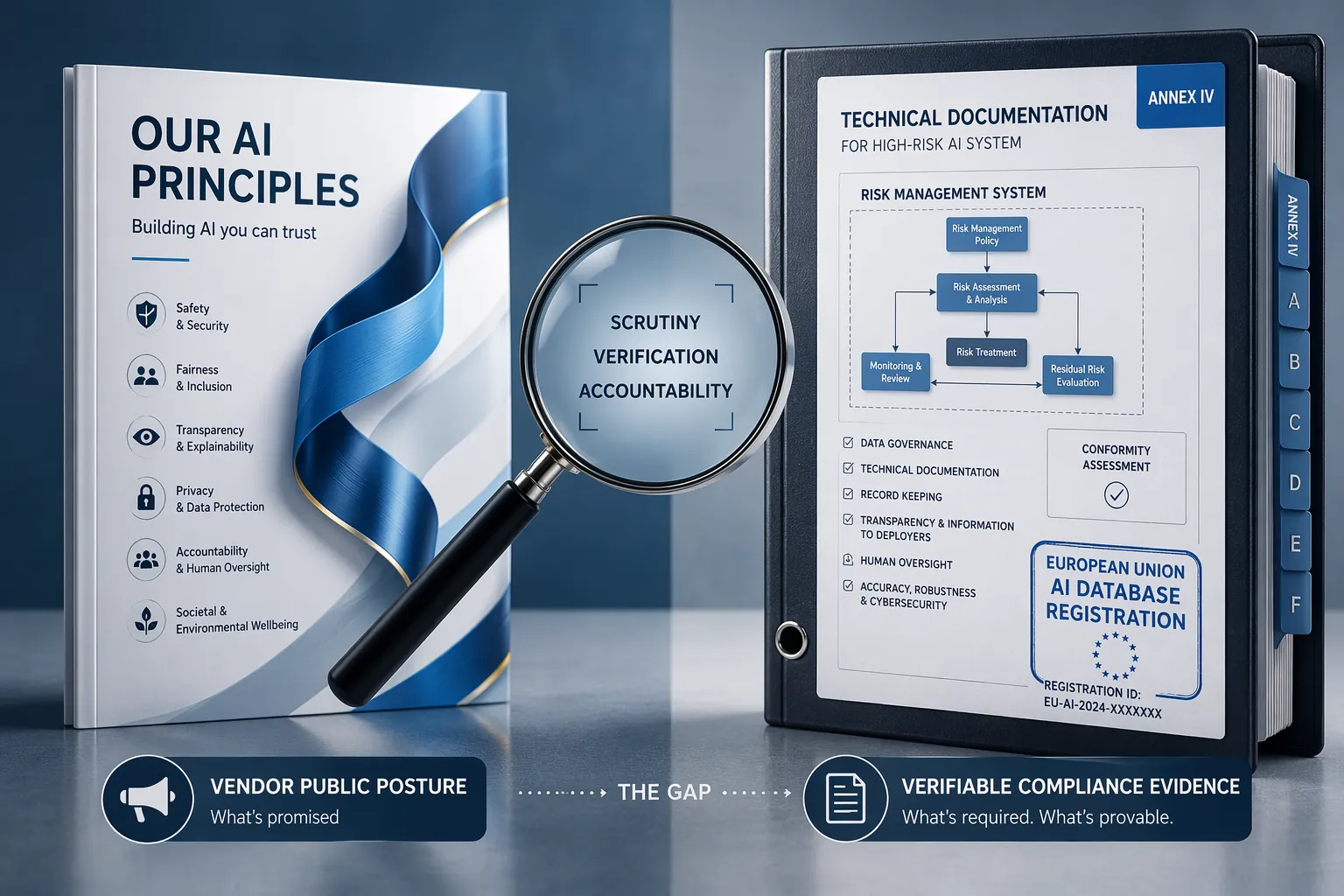
Eight days before the EU AI Act transparency deadline on August 2, 2026, a public AI principles page from o9, Blue Yonder, or Kinaxis is useful context. It is not proof that your deployment is correctly classified, documented, supervised, registered, or contractually allocated.
That distinction matters now because the impact of AI regulation on supply chain planning tools is not abstract policy for buyers. It is the sign-off question sitting with procurement, IT, legal, and planning operations: does this configuration fall into a low-risk use case, an Annex III high-risk use case, or a modified deployment where the buyer has taken on provider-style obligations?

Blue Yonder’s Responsible AI page is a good example of the line buyers need to hold. The page states the vendor’s AI posture and references alignment with the EU AI Act and GDPR, which is better than silence. But a principles page is not Annex IV technical documentation, it is not a risk management system under Article 9, it is not human oversight design evidence under Articles 14 and 26(2), and it is not proof of EU database registration where registration applies.[1]
o9 and Kinaxis should be treated the same way. The point is not to accuse any named platform of non-compliance. The point is that vendor posture and conformity evidence are different materials, and only one of them gives a buyer something defensible before go-live.
Start with the use case, not the vendor
A planning platform is not one regulatory object. Demand forecasting, inventory recommendations, production scheduling, supplier prioritization, labor scheduling, transport re-routing, and procurement award support can sit inside the same commercial suite while creating different AI Act questions.
The first document request should therefore be a use-case map. Ask the vendor to map each AI-enabled capability you intend to activate against the EU AI Act risk categories, including whether the vendor views the feature as outside Annex III, potentially high-risk under Annex III, or dependent on the buyer’s configuration. Reed Smith’s legal analysis of the Act flags supply-chain-adjacent uses that may intersect with high-risk categories such as employment, essential services, and critical infrastructure, which is enough to make a feature-by-feature map necessary rather than optional.[2]
| Planning capability | Why classification can change | Buyer evidence to request |
|---|---|---|
| Demand forecasting and replenishment recommendations | Usually less sensitive when advisory, but risk rises if outputs drive automated allocation or service decisions | Feature description, intended-use statement, human review workflow, audit logs |
| Supplier selection or procurement recommendation | May affect access to commercial opportunity and can create explainability, fairness, and audit questions | Use-case classification, model documentation, input data description, override controls |
| Workforce scheduling inside planning or fulfillment operations | Employment-related use cases are specifically sensitive under Annex III analysis | Annex III mapping, oversight design, worker-impact assessment materials where applicable |
| Critical-infrastructure planning or re-routing | The same optimization engine may have higher consequence when used for energy, transport, healthcare, or similar networks | Criticality assessment, fallback process, incident logging, escalation responsibilities |
| Autonomous execution of purchase, freight, or allocation decisions | The regulatory and liability profile changes when recommendations become actions without meaningful human review | Autonomy level, approval thresholds, kill switch, approval trail, contract allocation |
Do not accept a single answer for the whole suite unless your deployment is actually that simple. A vendor may have one answer for a forecasting assistant, another for autonomous exception resolution, and another for a workforce scheduling module. Your file needs the answer for the configuration you are buying, not the marketing family name.
Check whether customization makes you more than a deployer
The most expensive mistake is assuming the buyer is always just a deployer. SOTA.io’s Article 25 analysis warns that a company can become a provider if it substantially modifies an AI system or places that system on the market or puts it into service under its own name or trademark. In that scenario, provider obligations can follow, including technical documentation, conformity assessment, CE marking, and related responsibilities.[3]
That matters in supply chain planning because implementation rarely means switching on a generic model exactly as sold. Buyers tune optimization parameters, connect proprietary ERP and supplier data, change exception thresholds, build custom workflows, embed vendor outputs into execution systems, and sometimes rebrand an internal planning cockpit so business users experience it as the company’s own AI tool.
Not every configuration change is a substantial modification. The boundary is not settled through supply-chain-specific enforcement precedent. But the buyer should force the question before contract signature, because the remedial work after go-live will not be handled by the vendor’s public policy team. It will land with the project owner trying to explain why no one documented the role allocation.
- Ask whether the vendor considers each planned customization a normal configuration, a material change to intended use, or a substantial modification.
- Ask who is the provider, deployer, importer, distributor, or product manufacturer for each AI-enabled feature in the actual deployment.
- Ask whether rebranding an internal planning portal changes the vendor’s role analysis.
- Ask whether connecting AI recommendations directly to ERP, procurement, warehouse, or transportation execution changes the intended-use assessment.
- Ask for the answer in a contract exhibit, not an implementation meeting note.
This is the point in the evaluation where vague assurances are most dangerous. If the vendor says the buyer’s changes do not create provider obligations, the buyer needs the reasoning tied to the exact modules, data flows, autonomy levels, and branding model being deployed.
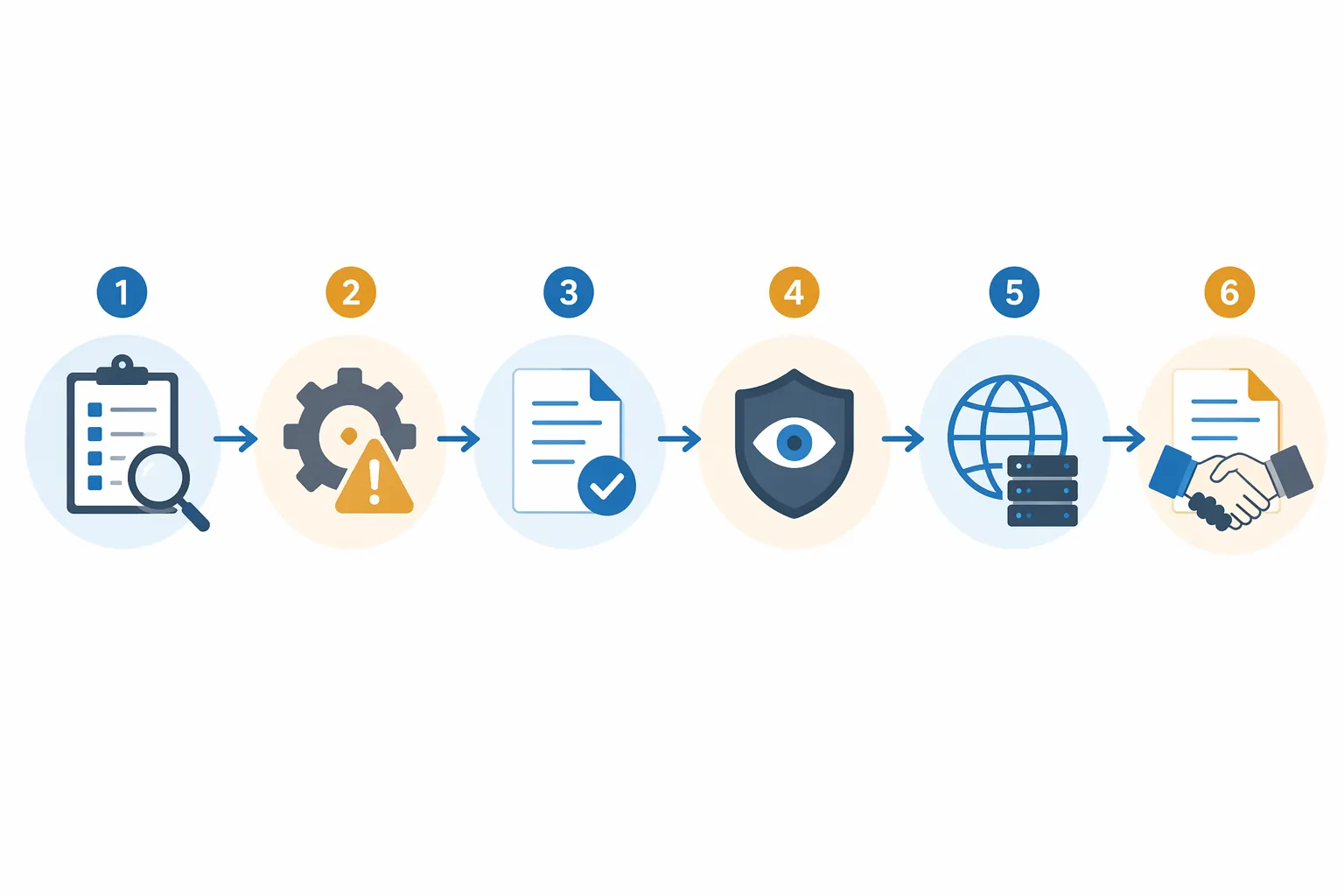
Request the evidence set before the final commercial round
The buyer’s evidence set should be boring, dated, and specific. If it reads like a trust page, it is not enough. If it cannot be attached to a procurement file, reviewed by security, challenged by legal, and used by the implementation team, it is not doing the job.
| Evidence | What it should answer | Why it matters |
|---|---|---|
| Use-case classification matrix | Which enabled features are low-risk, limited-risk, high-risk, or outside scope in the vendor’s analysis | Classification determines the rest of the compliance burden |
| Annex IV technical documentation, where applicable | How the system is designed, developed, validated, monitored, and controlled | A principles page does not substitute for technical documentation |
| Article 9 risk management materials | How foreseeable risks are identified, tested, mitigated, monitored, and updated | Risk management must be operational, not only stated |
| Human oversight design | Who can review, approve, override, stop, or escalate AI-driven outputs | Oversight has to be visible in the product and process |
| Audit logs and decision traceability | Which inputs, recommendations, actions, overrides, and approvals are recorded | Post-incident reconstruction depends on logs |
| EUAIDB registration evidence, where applicable | Whether the system is registered in the EU AI database when registration applies | Registration cannot be inferred from vendor confidence |
| Subprocessor and embedded AI disclosure | Which model providers, hosts, copilots, data vendors, or enrichment partners support the feature | The buyer’s due diligence must reach beyond the named planning platform |
Foley & Lardner’s June 2026 governance guidance is useful here because it separates AI controls by the level of autonomy: advisory, semi-autonomous, and fully autonomous. A forecasting assistant that suggests a replenishment adjustment does not need the same operational controls as a system that books expedited freight or changes allocation rules without human approval.[4]
Mondaq/Bass Berry’s July 2026 analysis makes the same procurement point from another angle: automation does not reduce the need for documented policies, testing, and audit trails. If anything, the buyer needs clearer records because the system may be acting faster and across more planning nodes than a manual process would.[5]
What to ask o9, Blue Yonder, and Kinaxis
The same request should go to each shortlisted or incumbent planning vendor. Do not ask, “Are you EU AI Act compliant?” That produces a sales answer. Ask for the evidence package tied to your exact modules.
- For each AI-enabled feature in scope, provide the vendor’s EU AI Act risk classification and intended-use statement.
- Identify any feature the vendor treats as potentially high-risk under Annex III and explain the classification basis.
- Provide Annex IV technical documentation or explain why Annex IV documentation is not required for the feature.
- Provide Article 9 risk management evidence, including testing, monitoring, incident handling, and update procedures.
- Show how Articles 14 and 26(2) human oversight obligations are implemented in product controls, workflow permissions, alerts, approvals, and logs.
- Provide EU AI database registration evidence where registration applies, or a written explanation of non-applicability.
A vendor that has done the work may not hand over every sensitive technical artifact in full. That is normal. It can provide summaries, controlled-room review, third-party attestations, contractual warranties, or regulator-facing documentation excerpts. What should not pass procurement review is a refusal to move beyond public statements.
Look inside the controls, not just the compliance folder
Documentation tells you what the system is supposed to be. The product tells you whether the buyer can actually operate it that way.
For supply chain planning, human oversight is not a generic “user remains responsible” clause. It has to appear in the workflow. A planner should be able to see why the system recommended a changed production plan, who approved an exception, whether a threshold was overridden, whether a recommendation was pushed into execution, and what fallback process exists if the model behaves unexpectedly.
- Review approval thresholds for purchases, allocations, schedule changes, freight upgrades, and supplier substitutions.
- Test whether users can distinguish advisory recommendations from automated actions.
- Confirm that overrides require a reason code where the decision has material operational or commercial effect.
- Verify that audit logs capture inputs, recommendation versions, user approvals, automated actions, and downstream system handoffs.
- Confirm that administrators can suspend or downgrade AI-enabled automation without breaking core planning operations.
The product demo should include failure behavior. If an AI-enabled planning feature produces an unusual recommendation, routes work around a constrained node, accelerates freight, or changes supplier priority, who sees it first? Is the alert routed to planning, procurement, transportation, IT, or nobody until cost variance shows up?
This is where legal analysis becomes operational. Foley & Lardner’s separate May 2026 discussion of agentic AI liability points to realistic harm categories in autonomous supply chain decisions, including excess inventory, stockouts, unnecessary freight, and re-routing damage.[6] Those are not dramatic edge cases for a planner. They are the budget line, the service failure, the expediter’s bill, and the customer escalation.
Trace embedded AI and hosting
A planning platform may be the named vendor, but it may not be the only AI supplier in the chain. TrustArc’s AI vendor due diligence framework identifies several categories that can sit behind an enterprise AI product, including foundation model providers, model hosts, synthetic data vendors, data enrichment partners, and embedded AI copilots.[7]
That matters for o9, Blue Yonder, Kinaxis, and any implementation partner because the buyer needs to know who touches training data, inference data, prompts, scenario inputs, supplier records, customer demand signals, production constraints, and user interaction logs. Subprocessor disclosure is not an administrative afterthought when the tool is producing planning recommendations that may affect procurement, inventory, labor, freight, or customer service.
- Ask for all subprocessors and embedded AI partners used for the specific modules in scope.
- Separate hosting, model operation, data enrichment, support access, analytics, and copilot services instead of accepting one undifferentiated vendor list.
- Confirm where customer data is stored, processed, backed up, logged, and accessed for support.
- Ask whether any customer data is used for model training, tuning, benchmarking, product analytics, or synthetic data generation.
- Require advance notice and objection rights for material AI subprocessor changes.
The CLOUD Act question belongs in this review, but it should be handled precisely. SOTA.io’s analysis emphasizes jurisdictional risk for SaaS and hosting arrangements, particularly where US-linked providers may be subject to US legal process; the source also has commercial context as an EU-hosted PaaS vendor, so the point should not be stretched into a blanket rejection of US-hosted platforms.[3] The procurement question is narrower: what data is hosted where, which legal entities control it, what government-access notification commitments exist, and what technical and contractual controls reduce exposure?
Turn open items into contract terms
If an AI Act issue is material enough to ask in diligence, it is material enough to allocate in the contract. Otherwise, the buyer has only an email trail and a project team memory that will fade before the first major incident.
| Contract topic | Provision to negotiate | Why it belongs in the agreement |
|---|---|---|
| Role allocation | State which party is provider, deployer, importer, distributor, or other relevant actor for each AI-enabled feature and deployment model | Prevents a late dispute if customization, rebranding, or integration changes obligations |
| Documentation delivery | Require delivery or controlled access to classification analysis, technical documentation, risk management evidence, oversight design, and registration evidence where applicable | Creates a dated record for audit and internal approval |
| Customization review | Require legal and technical review before material changes to intended use, autonomy level, data inputs, branding, or execution integration | Controls Article 25 reclassification risk |
| Human oversight | Define minimum approval, override, logging, alerting, and suspension controls for the buyer’s deployment | Connects compliance claims to product behavior |
| Subprocessors and hosting | Require disclosure, notice, objection rights, data location commitments, support-access limits, and government-access notification terms | Makes embedded AI and jurisdictional exposure reviewable |
| Incident and regulatory support | Set timelines for incident notice, documentation support, regulator inquiries, conformity evidence, and remediation cooperation | Avoids improvising during an investigation or service failure |
| Liability | Allocate responsibility for losses tied to defective AI recommendations, unauthorized autonomy, missing documentation, non-compliant modifications, or undisclosed subprocessors | Aligns commercial risk with control over the system |
Penalty exposure is not the best reason to do this work, though it is real. SCMR’s discussion of the AI regulation gap places compliance in a cost and risk context, and cites a Gartner projection that AI governance spending will reach $1 billion by 2030, up from $492 million in 2026.[8] Some of that cost will show up in subscription pricing, implementation effort, legal review, data governance, and audit support. Buyers should expect it and budget for it rather than discovering it as an unfunded workstream during deployment.
The absence of a major public enforcement case specifically against supply chain planning AI does not make the diligence optional. It just means the buyer is operating in a pre-enforcement period where legal analysis, technical documentation, and contract discipline matter more, not less.
The sign-off standard for this week
For a renewal or final vendor selection, the pass/fail question should be practical: can the buyer show, as of the approval date, what the AI-enabled planning system is intended to do, how it is classified, who carries which AI Act role, what documentation exists, how humans oversee material decisions, which subprocessors and hosting arrangements are involved, and what happens if customization changes the answer?
o9, Blue Yonder, and Kinaxis may each have serious compliance programs. That still does not let a buyer outsource its verification file to a vendor principles page. The defensible position comes from dated documentation, mapped use cases, explicit role allocation, visible oversight controls, subprocessor disclosure, registration evidence where applicable, and contract terms that say who carries which obligation when the system is customized, hosted, or allowed to make planning decisions with limited human intervention.
References
- Responsible AI, Blue Yonder
- EU's AI Act adds new compliance tasks on businesses along the supply chain, Reed Smith
- EU AI Act AI Supply Chain: When SaaS Developers Become Deployers (Art.25), SOTA.io
- 5 Steps Every Manufacturer and Supply Chain Manager Should Take to Build a Scalable AI Governance Program, Foley & Lardner, June 2026
- Supply Chain AI Needs More Than Automation. It Needs Guardrails, Mondaq/Bass Berry, July 2026
- Agentic AI Liability in Autonomous Supply Chain Decisions, Foley & Lardner, May 2026
- AI Supply Chain Risk: The New Vendor Due Diligence, TrustArc
- The AI regulation gap: Risk, cost, and competitive advantage, SCMR
§ 42 — Cited evidence
Flag an inaccuracy or submit a comparable account — Contribute or read how claims are verified in Methodology.