
§ 41 — Use-case analysis
Tidewater Telecom Cyberattack Exposed AI Planning Gaps
A DDoS attack on Tidewater Telecom knocked 23 Maine towns offline for three days, forcing cash-only retail and halting municipal services. This post-mortem traces the supply chain cascade and assesses which connectivity-aware AI planning features could have cut the recovery window by an estimated 40–60%.
- Function
- logistics
- AI technique
- exception-management
- Failure pattern
- last-mile-connectivity-blind-spot
- Evidence source
- Tidewater Telecom outage coverage (LCNME, StateScoop, NewsCenter Maine, DysruptionHub)
The Tidewater Telecom outage was easy to misfile as a local internet problem until the work stopped showing up in public counters and cash drawers. The incident was detected on Sunday, July 19, 2026, and service was restored by Tuesday, July 21, across 23 midcoastal Maine towns, according to local reporting on Tidewater’s restoration notice and the affected area.[1] During that window, the practical failure was not that every record vanished. It was that the transaction edge could not reach the systems that held or updated those records.
That distinction matters for supply-chain and logistics teams evaluating AI planning after the Tidewater Telecom cyberattack. A regional ISP outage becomes a supply-chain event when point-of-sale terminals, municipal payment counters, permit workflows, replenishment triggers, and local service desks all depend on the same last-mile connection. The system can be intact in one place and operationally useless in another.

The Outage Map Was Also an Operations Map
Tidewater described malicious traffic clogging its network, a pattern consistent with a traffic-flooding or DDoS-style attack, but public reporting also noted that the company had not formally confirmed DDoS as the classification at the time.[4] That wording is not a technicality. If the public evidence supports “consistent with DDoS,” the operational post-mortem should not pretend the upstream cyber investigation is already settled.
The downstream facts are clearer. Municipal internet service was disrupted, and town offices lost access to normal online functions.[2] In Damariscotta, officials said “the majority of town office services rely on the internet,” and the outage affected services such as permitting, payments, and licensing.[3] Nobleboro’s town office closed early, a complete public-service node failure rather than a degraded one.[2]
Retail degraded differently. Smashed Burgers and Brews in Damariscotta shifted to cash-only operations, and Jefferson Market also operated cash-only during the disruption.[3] A store that can still open its door but cannot run cards has not stopped selling food in the abstract; it has lost the transaction rail that converts demand into settled payment, clean sales history, and timely inventory signal.

There is a rural boundary condition here. Tidewater serves communities where redundant carrier options can be limited. The same outage pattern in a dense urban site with multiple carriers, cellular backup, and hardened store networks might produce a shorter or narrower disruption. But that does not make the Maine case less useful. It makes the dependency visible.
| Operational node | Observed failure | Supply-chain consequence |
|---|---|---|
| Smashed Burgers and Brews | Cash-only retail operations | Electronic payment capture and clean POS data flow degraded |
| Jefferson Market | Cash-only retail operations | Sales settlement and replenishment signals likely became less timely |
| Damariscotta town office | Permitting, payments, and licensing disrupted | Public-service transaction queue built up outside normal digital workflow |
| Nobleboro town office | Office closed early | Local administrative node stopped processing normal services |
What Breaks When Connectivity Disappears but Data Survives
Most business-continuity conversations are still too comfortable at the data-center layer. They ask whether records are backed up, whether applications can fail over, and whether core systems are redundant. Those questions matter, but they do not answer what happened at a burger counter, a market register, or a town clerk’s window.
A card reader going dark changes the work immediately. The cashier has to announce cash-only terms. Some customers leave. Others pay in cash, creating a transaction record that may be partial, delayed, or later rekeyed. The kitchen still uses ingredients. The next replenishment signal may arrive late or arrive with lower fidelity because the digital sales trail stopped matching the physical movement of goods.
Municipal workflows fail with a different texture. Permitting and licensing are not inventory in the retail sense, but they are still queues with dependencies. A resident waiting on a permit, a contractor waiting on a license action, or a clerk waiting for payment processing all become part of the same backlog. The office may possess the underlying records, yet still be unable to process the transaction in the channel the workflow assumes.
For logistics planning, the dangerous part is not the first hour of obvious outage. People can see that the internet is down. The harder part is the recovery tail: which sales need to be synchronized, which orders were delayed, which stops need new delivery windows, which local offices are open again, and which exceptions are still waiting in someone’s notebook or inbox.
The Planning Variable That Was Missing
A planning platform cannot stop malicious traffic from overwhelming a telecom network. It can, however, treat connectivity state as an operating condition rather than as an anecdote passed upward after the damage is visible.
The minimum useful signal is simple: this node is online, degraded, offline, or recovering. That signal should attach to stores, municipal counters, depots, supplier sites, payment endpoints, and carrier handoff points. Once the planning layer can see that state, it can stop assuming that a silent POS feed means normal demand and start treating silence as a possible outage condition.
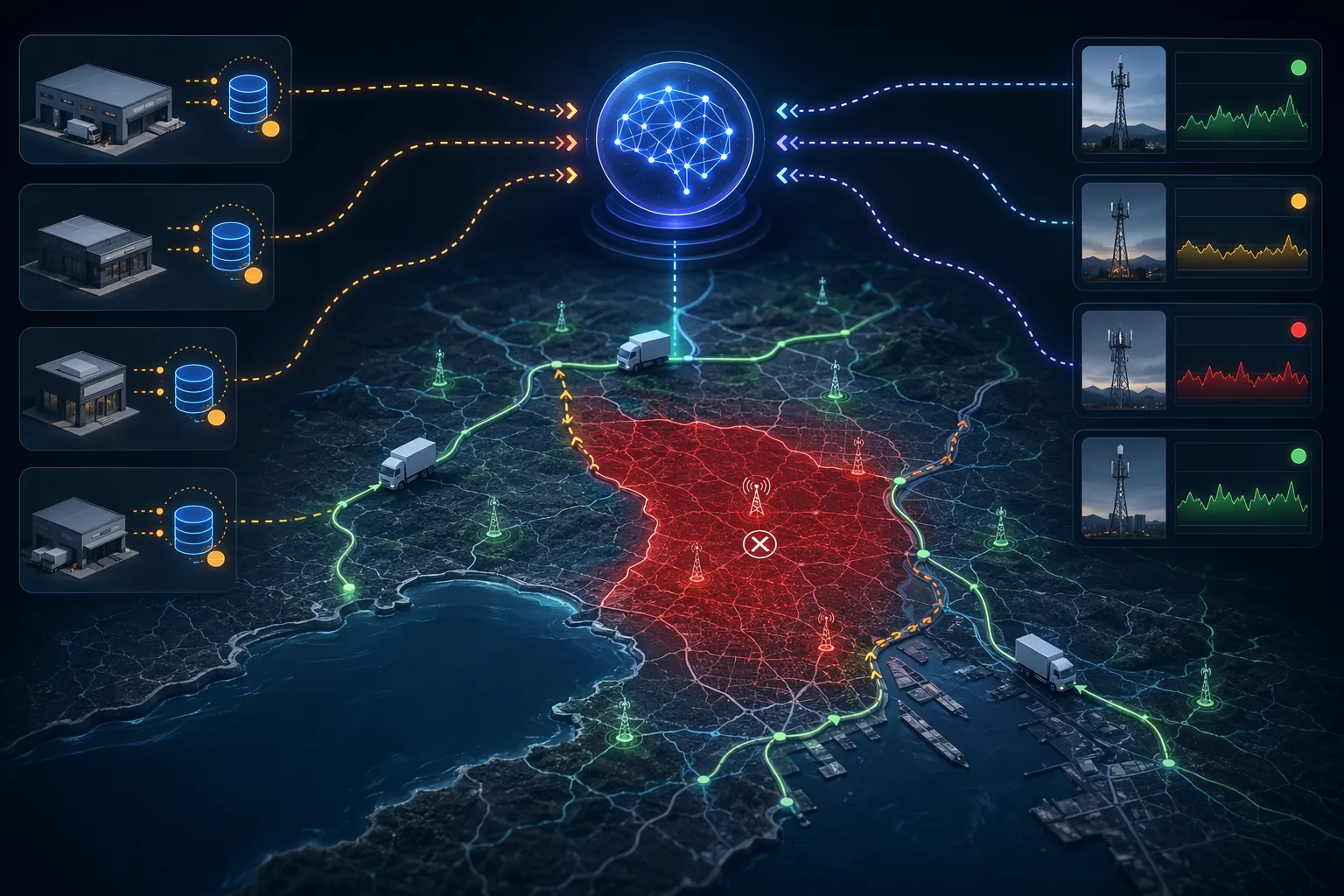
Three capabilities would have mattered most in the Tidewater pattern:
- Offline transaction capture with deferred sync, so local sales, payments, service requests, and exception notes can be reconciled when connectivity returns instead of being reconstructed manually.
- Delivery-window rerouting around affected zones, so planners can decide whether to hold, resequence, or bypass stops whose receiving or payment workflows are offline.
- Control-tower escalation triggered by ISP-status telemetry, not by a store manager, clerk, or dispatcher finally reaching someone by phone.
Those features would not turn a regional ISP into a redundant network. They would shorten the time between “something is wrong” and “the plan has changed.” In a modeled recovery scenario based on comparable AI-assisted supply-chain incident analysis, that kind of fallback and synchronization logic could compress the operational disruption tail by an estimated 40–60%. That estimate should be read narrowly: faster fallback, triage, and data reconciliation, not prevention of the upstream attack.
Fallback Logic Has to Start Before the Clerk Calls
In the Tidewater case, the public signs of disruption came from human reports: businesses posting cash-only notices, town offices explaining service limits, and local reporting assembling the timeline. That is understandable in a small-market outage. It is also too slow for supply-chain control.
A connectivity-state-aware plan would not wait for every local operator to describe the problem. It would combine ISP outage status, missing POS feeds, failed payment authorizations, delayed municipal transaction queues, and delivery execution exceptions into a single operating picture. The goal is not perfect diagnosis. The goal is to stop treating disconnected nodes as if they are merely quiet.
For a retailer, that might mean flagging affected stores for conservative replenishment assumptions rather than letting the forecast interpret missing sales as weak demand. For a food distributor, it might mean confirming whether a cash-only customer can receive and settle an order before a truck is committed. For a municipality or contractor-facing service desk, it might mean creating a dated recovery queue the moment licensing and payment channels return.
The operating question is deliberately plain: when the connection comes back, who knows what happened while the system was blind? If the answer is “the local staff will tell us,” the recovery plan is already carrying a labor bottleneck.
Where Current AI Planning Claims Need More Precision
AI planning vendors are right to talk about disruption sensing, exception management, scenario planning, and autonomous recommendations. Those are useful categories. The documentation gap is more specific: public product materials for major planning platforms do not consistently show ISP connectivity state at transaction nodes as a real-time decision variable in planning logic.
That is not the same as saying the platforms cannot be configured to ingest such signals. Many enterprise systems can absorb external telemetry with enough integration work. The narrower point is that connectivity-state-aware fallback is not yet a visibly standardized planning pattern in the way demand sensing, inventory optimization, or control-tower exception workflows are.
For buyers evaluating Blue Yonder, Kinaxis, o9, RELEX, Anaplan, or adjacent tools, the useful question is not “Do you have AI resilience?” It is: “Can your planning model change assumptions automatically when a named store, supplier, depot, port office, or payment endpoint is offline at the ISP layer, and can it reconcile deferred transactions when that node returns?”
If the answer requires a custom dashboard, a separate ITSM workflow, and manual planner interpretation, the tool may still be valuable. It just should not be credited with autonomous operational recovery for this failure mode.
The Broader Cyber Context, Kept in Its Place
The Tidewater incident sits inside a larger pattern of cyber pressure on logistics and connectivity-dependent operations. Everstream Analytics reported a 61% year-over-year surge in cyberattacks on logistics in 2025 and a 965% cumulative increase from 2021 to 2025, though the underlying report is gated and those figures should be treated as directional unless the full methodology is reviewed. IBM and Ponemon’s 2025 breach research placed the average supply-chain breach cost at $4.91 million and the average detection-and-containment lifecycle at 267 days. BCI’s supply-chain resilience reporting has also repeatedly ranked unplanned IT and telecom outages among the top disruption causes.
Gartner’s March 2026 forecast adds a useful horizon marker: it predicted that 60% of supply-chain disruptions will be resolved without human intervention by 2031, based on an October 2025 survey of 509 supply-chain leaders. That is a 2031 forecast, not proof that autonomous recovery was available or deployed in the Tidewater event.
There was also a reported Greenfield Communications DDoS attack in California the week before the Tidewater outage. That comparison is worth noting as a possible regional-ISP targeting pattern, but the public record available here does not support turning it into a second case study or using it to infer a shared actor.
The Vendor-Evaluation Question This Case Leaves Behind
The Tidewater outage did not need to destroy inventory records to disrupt local supply chains. It only had to cut the connection between the physical transaction and the digital system expected to register it. A cash-only burger shop, a market with card processing down, and a town office unable to process permits are small failures only if the planning system can see around them. If it cannot, they are blind spots.
The practical test for an AI planning platform is therefore specific: can it ingest connectivity state at transaction nodes, trigger fallback workflows before manual escalation, adjust logistics assumptions while the node is offline, and reconcile deferred activity after restoration? If that chain is missing, the platform may optimize the plan beautifully right up to the point where the last mile disappears.
References
- Tidewater Telecom Restores Internet After Cyber Attack-Induced Outages, LCNME.
- Cyberattack against Maine telecom disrupted municipal internet service, StateScoop.
- Cyber attack causes internet outage, disrupting town offices, businesses, NewsCenter Maine.
- Tidewater cyberattack disrupts internet across coastal Maine, DysruptionHub.
§ 42 — Cited evidence
Flag an inaccuracy or submit a comparable account — Contribute or read how claims are verified in Methodology.