
§ 41 — Use-case analysis
Tesla door defect reveals supply chain quality gaps
The Tesla door-handle entrapment incidents were a supply chain quality control failure, not just a design issue. This analysis shows the inspection gaps — operator fatigue, low sampling coverage, and slow lot traceability — that AI vision systems can address, using real deployment data from comparable automotive lines.
- Function
- quality_control
- AI technique
- computer_vision
- Failure pattern
- manual_inspection_gaps
- Evidence source
- iFactory case study, ACM AI QC implementation research
On July 24, 2026, NHTSA did two things that do not fit neatly into a headline: it denied a Tesla door-release defect petition, and it opened rulemaking for new door-release standards on the same day.[1] That is not a clean regulatory clearance. It is a signal that the agency did not grant the petition as filed, while still seeing enough unresolved door-release risk to move the rulebook.
For automotive procurement and quality teams, that distinction matters. A denied petition can make the issue sound closed. A new standards process says the opposite: the defect pathway is still worth examining, especially when the reported field history includes 140 entrapment incidents and Tesla has reportedly confirmed that a door-handle redesign is underway.[2][3]
The tempting explanation is simple: bad door-handle design. Some of that may be true. A release mechanism that depends on an electrical condition, a hidden manual release, or a narrow tolerance stack can create risk before the first component ever reaches a dock. But the supply-chain question is harder to excuse. If the condition was repeatable enough to show up across many incidents, why did the sourcing-to-assembly quality system not generate a louder signal earlier?
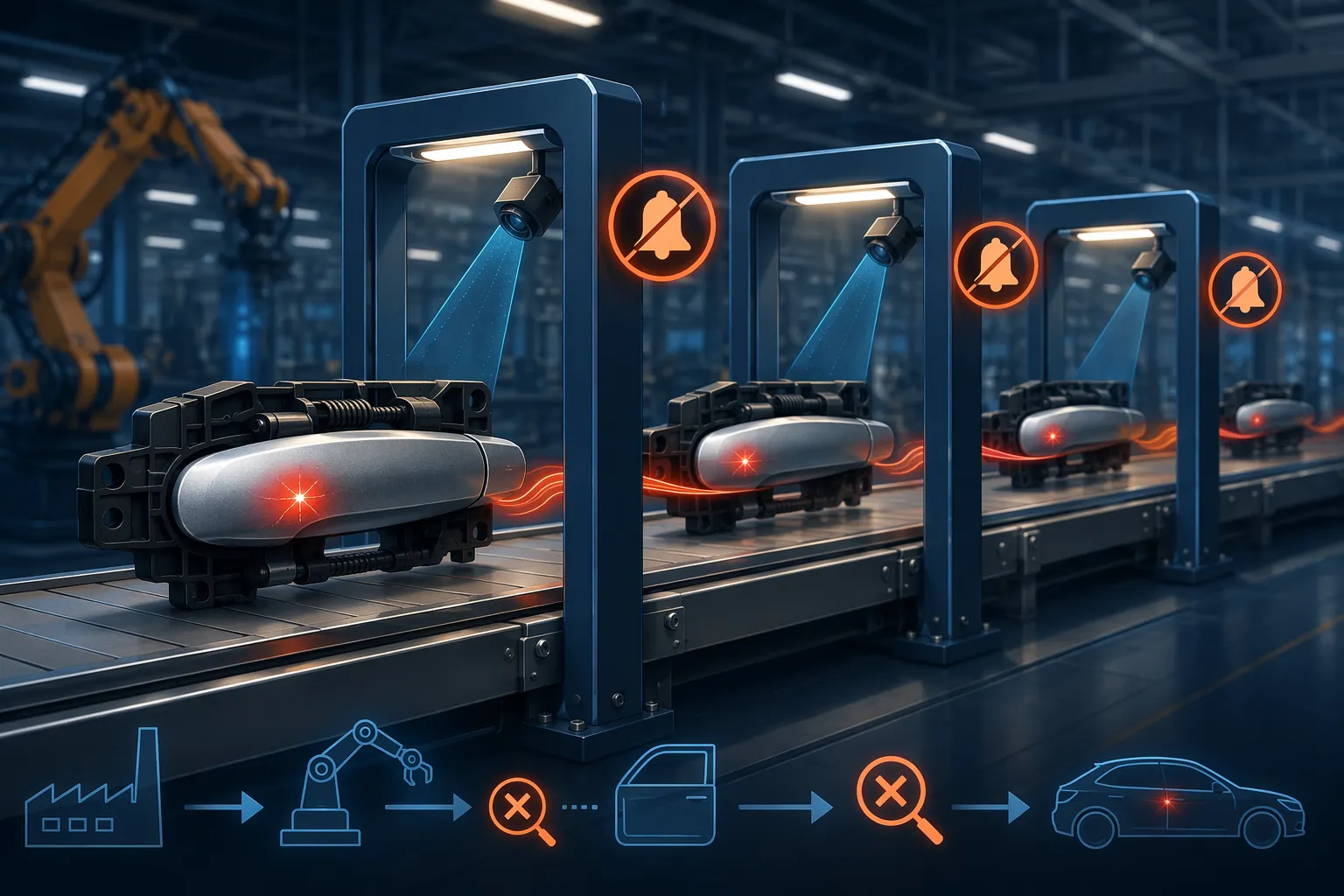
The defect was visible only after the system failed
A door-release issue moves through more than one checkpoint before a customer is trapped. The supplier builds or sources the handle assembly. Incoming quality accepts a lot. The assembly line installs and verifies the part. Final inspection checks function and fit. Warranty, service, and field-quality teams later try to connect scattered complaints back to a production window.
That chain is why the door-handle case is not really about whether a camera could have magically prevented every entrapment. It is about whether the known weak points of manual inspection—fatigue, partial coverage, slow lot tracing, and thin pass/fail records—allowed a door-release risk to remain invisible until customers supplied the evidence.
Tesla’s broader recall history is useful context, but not proof of this failure mode. BRC Legal counted 83 Tesla recalls through March 2025, an average of 15 per year from 2021 through 2024, with the largest single recall covering 2.19 million vehicles.[4] Those figures show a company operating under recurring quality scrutiny. They do not, by themselves, explain how a door-handle condition escaped inspection.
Where the inspection chain should have narrowed the risk
A workable prevention map starts before final vehicle inspection. By final gate, the plant has already paid for the part, installed it, moved the vehicle through multiple stations, and created a traceability problem if the defect turns out to be lot-specific.
| Point in the chain | What should be caught | Why the old record often fails |
|---|---|---|
| Component sourcing | Supplier variation in latch, handle, actuator, seal, or release subassembly behavior | Supplier certificates and sample checks may not preserve image-level evidence of each unit |
| Incoming inspection | Dimensional or visual anomalies before parts enter production | Sampling can accept a lot while missing low-frequency but safety-relevant variation |
| Assembly-line verification | Installation position, cable routing, connector seating, alignment, actuation force, and fit | Manual checks compete with takt time and may not capture every critical angle |
| Final gate inspection | Door operation under the plant’s defined test condition | A binary pass/fail result rarely explains why a marginal unit passed |
| Post-build traceability | Which vehicle received which suspect component lot | Manual lot tracing can take hours, delaying containment |
The key weakness is not that any one inspector failed to notice something obvious. It is that each checkpoint can be locally reasonable and still leave the organization blind. A supplier sample passes. Incoming inspection sees no out-of-family part. Assembly verifies the handle under a narrow condition. Final gate records a pass. Months later, field incidents arrive as separate events rather than as a lot pattern.
That is the unpleasant lesson of repeated escapes. Once a defect appears in the field 140 times, the issue is no longer just whether one design decision was poor. It is whether the manufacturing and supplier-quality system had enough coverage to recognize the pattern before customers did.[2][3]
Manual inspection breaks down where production is least forgiving
Manual inspection is still necessary in automotive plants. It is also over-credited in budget discussions because everyone remembers the heroic catch and forgets the production baseline. In the iFactory automotive case study and related ACM implementation research, manual inspection under production conditions is associated with a 20% to 30% miss rate, and the miss rate is reported as 2.8 times higher in the final two hours of a 12-hour shift.[5][6]
That fatigue number is not an insult to inspectors. It is a process fact. Door-handle assemblies are not inspected in a quiet lab by someone holding one part under perfect light. They move through stations where line speed, glare, repeated motion, similar-looking parts, and end-of-shift attention loss all work against the person responsible for the catch.
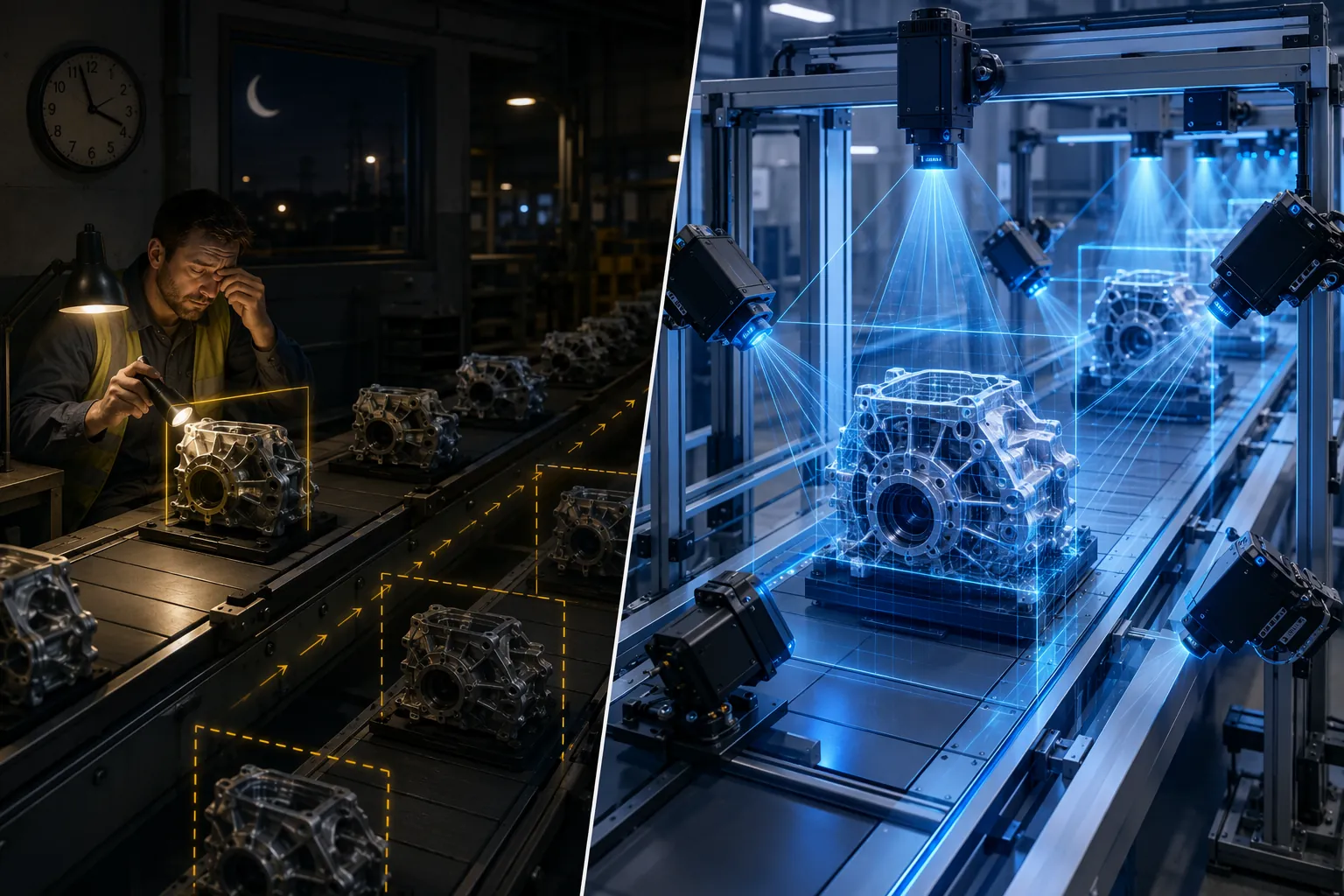
Coverage is the second failure. The same body of material reports that only 23% of vehicles receive full manual inspection at all critical gates.[5][6] A sampling plan can be statistically defensible for many defects and still be a poor defense against a safety issue that appears only under a specific component, installation, or operating condition.
Door-release defects are especially awkward for sampling because the symptom may not be a surface blemish. It may be a small alignment error, a cable or connector condition, a seal interference, a latch-actuator relationship, or a tolerance stack that passes a simple operation test but fails under a narrower state. If the check is intermittent, and the record only says pass, the quality engineer inherits a mystery rather than evidence.
What AI vision would have changed, and what it would not
AI vision is useful here only if it is tied to the failure mode. A generic “AI prevents defects” claim is not enough. For a door-handle pathway, the system has to see the component at the right angle, compare it against a trained acceptable condition, record the image, connect the result to a vehicle and lot, and escalate the exception quickly enough for containment.
The most relevant camera is not necessarily at final inspection. It may sit over the incoming component lane, at the door build station, and again after installation. It should capture handle seating, visible fastener or clip presence, gap and flush condition, connector seating where visible, cable routing where exposed, and any deformation or surface irregularity that correlates with poor actuation. If the defect is internal and invisible, AI vision alone is not sufficient; it would need to be paired with functional testing or supplier process controls.
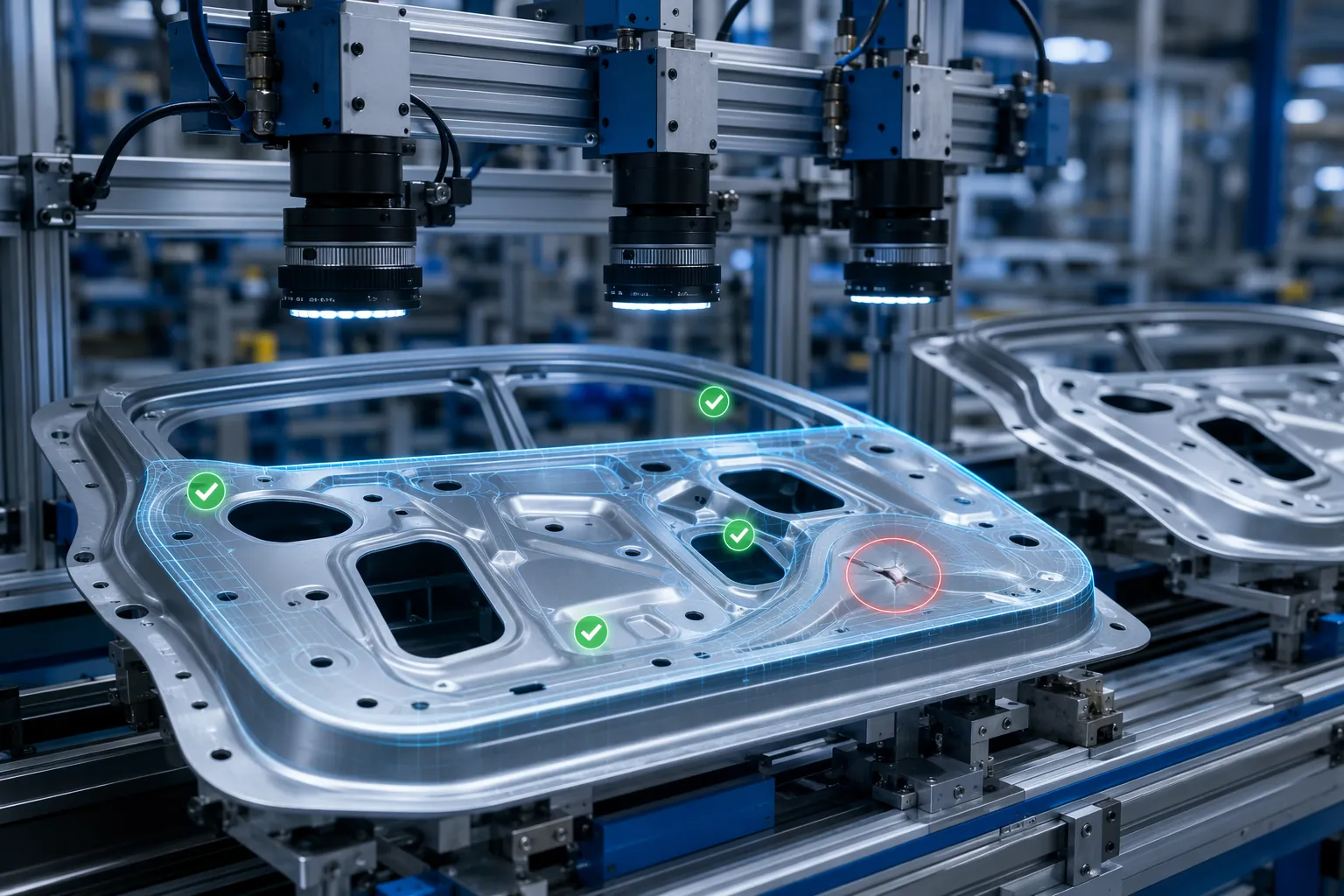
The detection gap is still material. The cited implementation research reports AI vision detection down to 0.15 mm, compared with a 2 mm to 3 mm human threshold under production conditions.[6] That does not mean every 0.15 mm variation matters. It means the plant can start measuring variation before it becomes a customer complaint, then decide which variation actually predicts field risk.
The bigger operational change is traceability. In the iFactory case study and ACM-cited implementation material, manual lot tracing that took 6 to 18 hours was reduced to under two minutes when inspection images and lot metadata were connected.[5][6] That is the difference between quarantining a suspect supplier lot during the shift and convening a cross-functional scramble after vehicles have already moved downstream.
The comparable deployment numbers answer specific gaps
The best available plant-level numbers in the research set come from iFactory, a vendor-published automotive case study. That matters: vendor case studies can select successful deployments and present economics in the most favorable frame. The figures are still useful if they are treated as documented deployment claims rather than neutral industry averages.
In that multi-line premium automotive plant case, defect escape rates reportedly fell from 3.1% to 0.4%, an 87% reduction, after AI vision cameras were deployed. The same case reports annual warranty exposure falling from $14.2 million to $2.1 million, described as an 85% reduction.[5] Those numbers map directly to the Tesla door-handle problem because the expensive event is not the defect at the station; it is the escaped defect after installation, delivery, and field use.
The same case reports 99.7% detection accuracy and a false-positive rate reduced from 4.2% to under 0.6%.[5] False positives deserve attention because a vision system that stops the line too often will be bypassed, ignored, or quietly narrowed until it no longer protects the customer. A useful system has to catch more defects without turning every shift into an escalation queue.
The ACM paper adds a separate caution and a separate benchmark. It cites unnamed manufacturer data for Tesla’s Model Y line showing AI visual inspection achieving defect rates below 0.01%, but that figure is not a direct Tesla disclosure or an audited public metric.[6] It should be read as cited research evidence that AI inspection can operate at very low reported defect levels, not as proof that Tesla’s door-handle pathway had that level of control.
The containment window is where procurement should focus
For procurement leaders, the strongest AI-quality-control argument is not the camera demo. It is the containment window. When a door-handle anomaly appears, the plant needs to know which supplier lot, which shift, which station, which vehicle identification numbers, and which inspection images are implicated. Without that, the default response is broad, slow, and politically expensive.
A useful AI inspection deployment would not simply reject a part. It would create a record that a supplier quality engineer can use: timestamped image, station, model variant, lot code, defect classification, confidence score, disposition, and downstream recheck result. That record changes the supplier conversation from “we have field complaints” to “this lot began drifting at this station under this condition.”
That also changes sourcing risk. A low-cost component supplier is not low-cost if the buyer cannot isolate a suspect lot before the issue reaches customers. The board-level cost of a safety-sensitive escape includes warranty exposure, regulatory attention, customer harm, engineering rework, service capacity, and brand damage. The purchase-price variance on a handle assembly is small next to that list.
The reported AI cost structure in the research set puts initial deployment at $100,000 to $300,000, with one manufacturer reporting 281% ROI within 12 months and typical payback in 12 to 18 months.[5] Those figures should not be copied into a capital request without local validation. They do, however, give procurement and manufacturing teams a credible range for a pilot business case when the target defect has high downstream exposure.
The design caveat still matters
There is a limit to the supply-chain reading. If a door-release architecture creates a tolerance window too narrow for normal production variation, the process team can only contain so much. Cameras can identify drift, missing features, poor seating, and visible installation errors. They cannot make an inherently fragile release strategy robust.
That is why the reported redesign matters. Redesign suggests Tesla saw some issue in the product architecture or user interaction, not merely a few bad lots.[2][3] But redesign and process control are not competing explanations. A mature response usually needs both: widen the design margin where possible, then verify that production stays inside it.
The July 2026 regulatory move puts that practical burden on the whole sector. NHTSA’s denial of the petition did not erase the concern; its simultaneous rulemaking made door-release performance a standards question.[1] For OEMs and Tier-1 suppliers, that means the next door-release quality discussion will not be limited to styling, ergonomics, or software behavior. It will include evidence of inspection coverage and traceability.
What would have been harder to explain
No responsible quality leader can say AI vision would have prevented every Tesla entrapment from the public record available. The field incidents are reported second-hand from a Bloomberg investigation, and the exact production defect pathway is not public.[2][3] The right claim is narrower and stronger: this class of safety-sensitive escape becomes harder to defend when comparable automotive lines already show lower escape rates, faster traceability, and reduced warranty exposure under documented AI inspection deployments.[5][6]
The uncomfortable part is not that a defect existed. Defects exist in every plant. The uncomfortable part is that a simple customer-facing function appears to have moved through sourcing, incoming inspection, assembly verification, final gate, and field feedback without the quality system forcing an earlier containment decision. That is a supply-chain quality-control failure, even if the design also needed to change.
References
- NHTSA denies Tesla door release defect petition, opens rulemaking, Electrek, Jul. 24, 2026.
- Tesla is redesigning its door handles, CNN, Sep. 18, 2025.
- Tesla is redesigning its door handles following safety probe, Bloomberg investigation, TechCrunch, Sep. 17, 2025.
- Tesla Recall Statistics, BRC Legal, 2025.
- Case Study: AI Vision Cameras Automotive Inspection Success, iFactory.
- AI QC Implementation Strategies, ACM, 2025.
§ 42 — Cited evidence
Flag an inaccuracy or submit a comparable account — Contribute or read how claims are verified in Methodology.