
§ 41 — Use-case analysis
The Supply Chain ChatGPT Data Privacy Blind Spot
Supply chain planning teams routinely expose commercially sensitive data — demand forecasts, supplier unit costs, and inventory buffer positions — through ChatGPT without awareness or formal assessment. This article examines documented leakage incidents and data from 2024-2025 to show why generic enterprise AI privacy policies fail supply chain operations, and what mitigations actually work.
- Function
- demand-forecasting
- AI technique
- generative-ai
- Failure pattern
- data-leakage
- Evidence source
- Cyberhaven Q4 2025
The privacy problem usually starts with a reasonable act. A planner has a messy lead-time exception file before an S&OP meeting. A procurement analyst needs supplier cost changes summarized by commodity group. An ERP administrator wants help debugging a query that joins item masters, purchase orders, and inventory positions. ChatGPT is faster than waiting three days for a dashboard change, so someone pastes the table and asks for a clean answer.
That is the practical starting point for a supply-chain-specific ChatGPT privacy check. The issue is not whether a chatbot can write a useful explanation. It can. The issue is whether the input quietly contains commercial intelligence: demand forecasts, supplier unit costs, inventory buffers, sourcing lead times, contract pricing terms, service-level exceptions, allocation rules, or customer-specific constraints.

Most enterprise AI policies do not fail because they are malicious or careless. They fail because they say “do not share confidential information” and then leave a planner to decide, under time pressure, whether a forecast variance table is confidential enough to count. In supply chain planning, that ambiguity is expensive.
The Data Being Pasted Is Not Generic Business Data
A demand forecast is not just a spreadsheet of expected units. It can reveal which customers are growing, which regions are weakening, which product lines are about to receive inventory priority, and where the company expects demand to recover before the market sees it. If a competitor sees enough forecast structure, they do not need the full operating plan to infer where sales teams are placing their bets.
Supplier unit-cost data is even more direct. A table showing part numbers, vendors, quoted prices, minimum order quantities, rebates, freight assumptions, and recent increases gives away the shape of the cost base. In a negotiation, that can matter more than the final price itself. It tells a supplier where the buyer has leverage, where substitution is difficult, and where a small cost movement will hit margin.
Inventory buffer positions create a different kind of exposure. Safety stock, reorder points, constrained locations, and expedite triggers show where the network is fragile. A supplier that learns a buyer is carrying unusually low buffer on a critical component can read urgency into the next purchase order. A competitor that learns where finished-goods inventory is thin can make more confident pricing or service promises to shared customers.
Sourcing lead-time tables also look harmless until they are combined with supplier names and item families. They can expose where a company is dependent on a slow supplier, which parts have no quick substitute, and which categories are most vulnerable to port delays, capacity shortages, or quality holds. Contract pricing terms complete the picture: escalators, volume tiers, renewal dates, rebates, and most-favored-customer language can all become negotiation leverage in the wrong hands.
| Input a planner may paste | What it can reveal | Why it matters commercially |
|---|---|---|
| Demand forecast by SKU, customer, or region | Growth expectations, product priorities, customer concentration | Competitors can infer where to attack or defend accounts |
| Supplier unit-cost sheet | Cost structure, vendor dependence, recent price movement | Suppliers and competitors can estimate margin and leverage |
| Inventory buffer or safety-stock report | Network fragility, shortage exposure, expedite pressure | Counterparties can read urgency before a negotiation |
| Sourcing lead-time exception list | Slow suppliers, constrained materials, weak substitution options | Partners can identify where delays create operational pressure |
| Contract pricing and rebate terms | Renewal leverage, escalation exposure, volume thresholds | Commercial terms can be used against the buyer in future deals |
This classification is an operating judgment, not a claim that one public study has ranked every supply chain artifact by sensitivity. But it is the judgment governance programs need to make. If the policy cannot name these artifacts, it will not stop the actual prompts.
The Leakage Pattern Is Already Visible
The strongest evidence is not a single spectacular breach. It is the steady normalization of sensitive-input behavior. Metomic cites Cyberhaven Q4 2025 research reporting that 34.8% of employee ChatGPT inputs contained sensitive data, up from 11% in 2023. The same article cites BigID’s 2025 finding that 69% of organizations named AI data leaks as a top concern, while 47% had no controls in place. Those figures should be read with their attribution intact; the Cyberhaven methodology and sample details are not independently established by the material here. Still, the direction is hard to dismiss: employee use is moving faster than control design.[1]
Supply chain teams are a natural fit for that pattern. Their work is table-heavy, exception-heavy, and explanation-heavy. They need summaries, comparisons, code snippets, mappings, variance narratives, and email drafts. These are exactly the kinds of tasks where a chatbot feels helpful and where the boundary between “just business context” and “commercially sensitive intelligence” gets blurred.
The Stanford Institute for Human-Centered AI reported in October 2025 that all six major AI chatbot developers it examined collected user inputs for training by default, and that privacy documentation was often unclear. That does not mean every enterprise configuration uses those defaults, or that every prompt becomes public. It does mean a supply chain director should not assume that ordinary consumer-style chatbot use is private simply because the user did not intend to publish anything.[2]
This is where policy language often drifts away from operations. “Do not enter confidential information” sounds adequate in a legal review. It is less useful when an analyst has a late forecast deck, an unexplained material shortage, and a CSV file that would take ChatGPT ninety seconds to summarize.
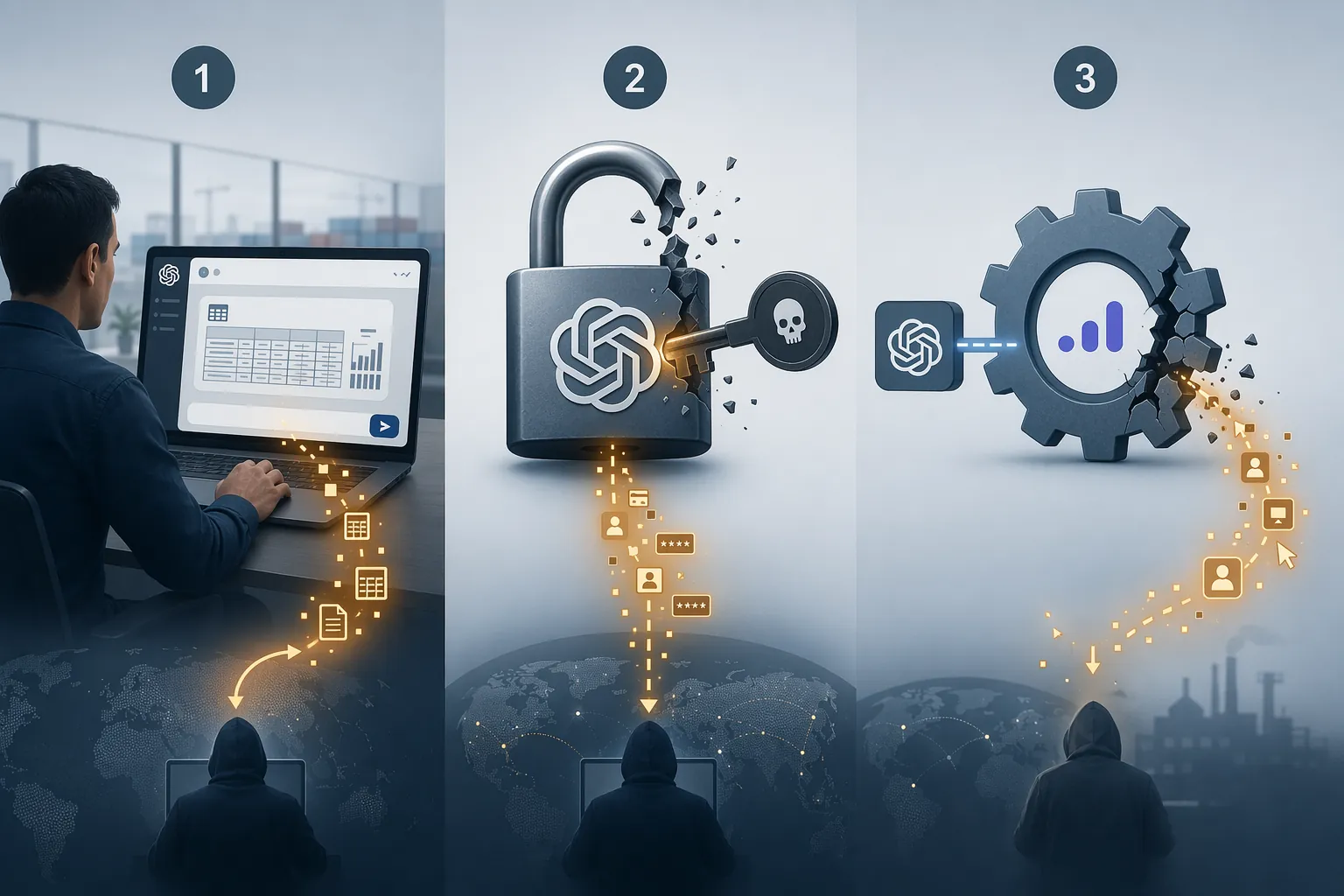
Three Failure Modes Matter More Than Abstract Warnings
Employee Prompt Leakage
The widely reported Samsung incident from 2023 remains useful because it is so ordinary. Employees reportedly pasted proprietary code into ChatGPT while using it for debugging and other work tasks. Samsung has not publicly confirmed the incident in that exact framing, so it should not be treated as a formally admitted corporate breach. But as a scenario, it is painfully plausible: a worker uses a capable tool to solve a real problem and exposes proprietary material in the process.[1]
For supply chain teams, the equivalent is not source code. It is a planner pasting a supplier-cost table and asking for variance drivers, or an ERP analyst pasting a query that includes plant codes, vendor IDs, item descriptions, and inventory status. The sensitive data is not incidental; it is the material the model needs in order to produce the useful answer.
Credential Compromise
A second path does not require the chatbot provider to misuse anything. ESET and Captain Compliance cite Group-IB’s 2024 reporting that more than 225,000 ChatGPT credentials were found on the dark web after being harvested by infostealers. The practical concern is account takeover: if a compromised account retains chat history, saved context, connected files, or access to an enterprise workspace, the prompt history becomes another data store to loot.[3][4]
That changes the way supply chain leaders should think about “private” prompts. A user may never intentionally share a forecast table beyond the chatbot session, but a stolen credential can turn that session history into an exposure path. Password reuse, unmanaged browser extensions, personal devices, weak session controls, and missing multifactor authentication are not side issues when commercially sensitive planning data is being pasted into AI tools.
Third-Party Exposure
The November 2025 Mixpanel incident is a third kind of warning. Reporting cited by Metomic and ESET describes a third-party analytics vendor breach that exposed OpenAI user session data. The important precision is that the exposed data was session-related user data, not full prompt contents. That still matters because it shows a familiar supply chain problem inside AI tooling: sensitive systems inherit risk from vendors that sit around the core service.[1][3]
Captain Compliance also cites the broader claim that 80% of data breaches involve third parties. That statistic should not be stretched into a claim about ChatGPT specifically, but it supports a basic governance point: approving an AI tool is also approving parts of its vendor ecosystem, logging architecture, analytics stack, support model, and incident notification chain.[4]
Why Supply Chain Risk Teams Should Care Now
Cybersecurity was ranked the number one supply chain risk for five consecutive quarters in Lehigh’s LRMI reporting as of Q2 2024. Lehigh also noted generative AI as an emerging concern for supply chain managers. Readers using this for current risk scoring should verify the newest LRMI release, but the Q2 2024 signal is still relevant: supply chain risk teams were already ranking cyber risk above more traditional operating disruptions before informal generative AI use matured.[5]
The reason is straightforward. Modern planning systems concentrate commercially valuable information. An ERP or planning platform does not merely store transactions; it encodes assumptions about demand, supply, price, service, substitution, constraints, and recovery. ChatGPT becomes risky when employees export pieces of that operating model into a tool that has not been classified, configured, logged, or governed for that data type.
Classic privacy programs tend to watch for personal data: names, addresses, phone numbers, employee IDs, protected health information, payment details. Supply chain exposure can happen with none of those fields present. A spreadsheet can be free of personally identifiable information and still reveal margin structure, supplier dependency, market strategy, or shortage exposure.
The Control Gap Is Operational, Not Just Legal
A useful policy starts before the prompt box. Supply chain directors and IT/ERP leads need an input classification model that tells people what they may paste, what they may paste only after redaction, and what they may not paste at all. The categories should be built around actual planning artifacts, not generic labels.
| Control category | What it should do in supply chain operations |
|---|---|
| Blocked input categories | Prohibit raw demand forecasts, supplier unit costs, contract pricing terms, customer-specific allocations, and unredacted shortage or buffer reports in unapproved chatbot sessions |
| Redaction workflow | Allow planners to remove supplier names, customer names, exact prices, item IDs, plant codes, dates, and volumes before using AI for structure, wording, or analysis |
| Approved enterprise configuration | Use settings and contracts that address training use, retention, logging, access control, administrative visibility, and support access |
| Logging and review | Record who used approved AI tools, what data class was involved, and whether blocked categories appeared in prompts or uploads |
| Credential hygiene | Require multifactor authentication, enterprise identity management, session controls, and monitoring for compromised credentials |
| Third-party risk review | Review vendors, subprocessors, analytics providers, breach notification terms, retention periods, and data residency commitments |
| Workflow alternatives | Provide approved summarization, query, and analytics paths so planners are not forced to choose between productivity and policy |
The last item is not a soft concern. If the official process cannot help a planner summarize 4,000 late purchase-order lines before the meeting, the unofficial process will. Controls that only say no, while leaving the original bottleneck intact, mostly train people to work around the control.
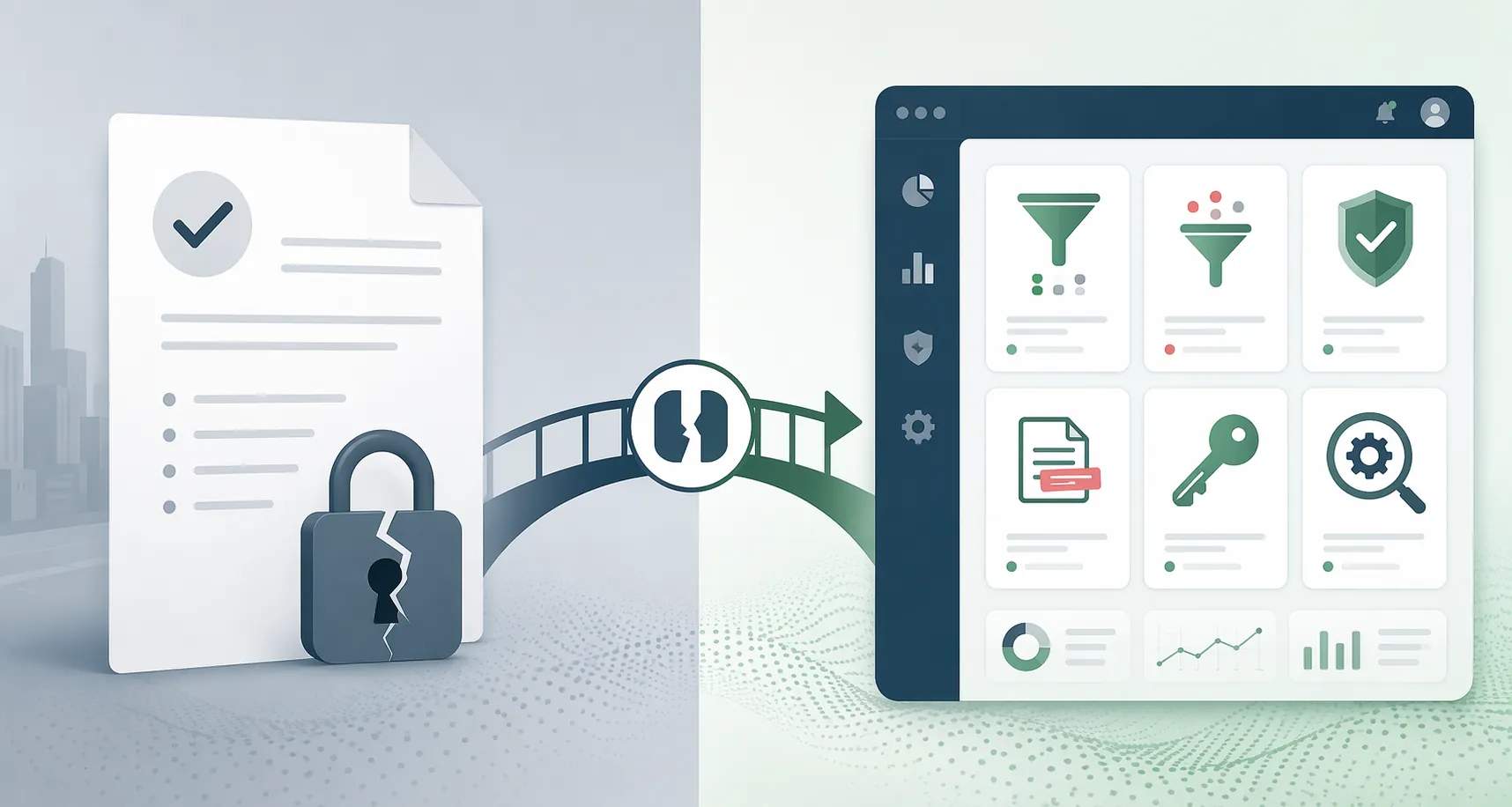
Classify Before Use, Not After an Incident
The cleanest place to classify data is where supply chain teams already recognize it: reports, extracts, dashboards, planning views, and ERP tables. A forecast export can carry a label. A supplier-cost report can carry a label. A contract-pricing extract can be blocked from upload to unapproved tools. A generic “confidential” marking is less useful than a visible rule saying: “Supplier unit costs and contract pricing terms may not be entered into public AI tools.”
The classification should also separate analytical structure from sensitive values. A planner may be allowed to ask ChatGPT for a formula, a SQL pattern, a variance-explanation template, or a generic root-cause checklist without exposing real values. They may be allowed to paste a synthetic table with fake supplier names and rounded, non-realistic numbers. They should not paste the live vendor cost file and hope that “do not share externally” in the policy covers it.
Make Redaction a Workflow, Not a Moral Test
Redaction cannot depend on every analyst remembering every sensitive field. Build redaction templates for the files people actually use: forecast variance exports, supplier quote comparisons, lead-time exception lists, inventory health reports, purchase price variance files, and contract trackers. Remove or mask exact prices, volumes, supplier names, customer names, item identifiers, plant locations, dates, and any field that turns a pattern into an identifiable commercial fact.
The goal is not to make every AI-assisted task impossible. A planner can often get help with structure after sensitive values are removed: summarize the types of variance, draft a neutral explanation, suggest a pivot-table layout, rewrite a supplier email, or check whether a SQL join is logically sound. The model does not need the actual rebate tier or constrained component number to help with those tasks.
Approve Configurations, Not Just Brands
“We use ChatGPT” is not a control statement. The relevant questions are narrower: Which edition? Which tenant? Are inputs used for training? How long are prompts and uploaded files retained? Who can review logs? Can administrators disable history? Are files scanned for restricted fields before upload? What happens when an employee leaves? Which subprocessors can touch metadata or support data?
Those questions matter because the Stanford finding about default collection for training across major chatbot developers points to a configuration problem, not a reason to ban every model in every setting. Enterprise terms, admin settings, retention controls, and data-processing commitments can change the risk profile. They do not remove the need to block sensitive supply chain inputs, but they can stop consumer defaults from becoming the operating standard.[2]
Treat Prompt History Like a System of Record
If employees paste operational data into an AI workspace, that workspace becomes part of the information estate. It needs identity controls, access reviews, retention rules, logging, incident response procedures, and offboarding. This is especially important where prompt history, uploaded files, shared conversations, or connected drives are enabled.
Credential hygiene belongs in the same conversation. The Group-IB credential exposure figure is a reminder that prompt privacy can fail through ordinary endpoint compromise. Multifactor authentication, single sign-on, managed devices, browser control, malware monitoring, and rapid token revocation are not glamorous controls, but they address a real leakage path.[3]
Review the AI Vendor Chain
Supply chain teams understand supplier risk better than most functions, but that discipline does not always get applied to software that sits outside the planning stack. The Mixpanel incident should push AI reviews beyond the primary model provider. Ask about analytics vendors, observability tools, support systems, data-processing subprocessors, incident notification timelines, encryption, access controls, and what metadata is retained even when prompt content is not exposed.[1][3]
This is not vendor paranoia. It is the same reasoning used for logistics providers, contract manufacturers, and tier-two suppliers: the party that creates the risk is not always the party whose name appears on the purchase order.
What a Planner Should Be Able to Do Safely
A workable governance model gives planners approved ways to get the help they were seeking in the first place. If the only official message is prohibition, the policy will lose to the calendar.
- Ask for a generic SQL pattern without pasting live schema names, supplier IDs, or customer-specific fields.
- Use synthetic or heavily generalized sample data to test a formula, pivot structure, or variance explanation.
- Summarize public supplier communications or non-sensitive policy text inside an approved enterprise AI workspace.
- Draft a neutral meeting explanation from redacted categories rather than exact demand, cost, or inventory figures.
- Route sensitive extracts through approved internal analytics, ERP reporting, or governed AI tools with classification and logging.
The selection criterion is simple: if the input would improve a supplier’s negotiating position, help a competitor infer cost or demand strategy, or reveal where the network is fragile, it should not go into an unapproved chatbot session. That rule is more useful to a supply chain team than a generic privacy reminder.
The Governance Line
ChatGPT use in supply chain planning is not automatically disqualifying. Used with the right configuration and clean inputs, it can help planners explain variance, structure analysis, improve queries, and move faster through low-risk work. But it cannot be governed by acceptable-use language that never names the data planners actually handle.
If a team cannot classify and block demand forecasts, supplier unit costs, inventory buffer positions, sourcing lead times, and contract pricing terms before they enter AI tools, it should assume commercially useful intelligence is leaking even when no classic data breach has been announced.
References
- Is ChatGPT a Security Risk to Your Business? Metomic
- AI chatbot privacy concerns, risks, research Stanford University, October 2025
- Is ChatGPT Safe? 2026 Guide ESET
- ChatGPT Data Security & Privacy: The Complete Guide for Users and Enterprises Captain Compliance
- Generative AI Becoming Concern for Supply Chain Managers Lehigh University
§ 42 — Cited evidence
Flag an inaccuracy or submit a comparable account — Contribute or read how claims are verified in Methodology.