
§ 41 — Use-case analysis
What Debt Levels Reveal About Supply-Chain AI Vendors
A comparison of how o9, Anaplan, Kinaxis, Blue Yonder, and RELEX fund their operations—from all-equity to leveraged buyout debt—and what those capital structures mean for financial stability and long-term vendor risk.
- Function
- supply-chain planning
- AI technique
- demand forecasting, inventory optimization
- Evidence source
- Contrary Research, Octus/Reorg, company filings
Supply-chain teams often compare o9, Anaplan, Kinaxis, Blue Yonder, and RELEX as if they sit in one clean vendor category. Functionally, that may be reasonable. Financially, it is not. The products may show up in the same selection process, but the companies behind them are funded through very different mixtures of equity, bank debt, acquisition debt, parent-company backing, and public-market disclosure.
That distinction matters more in 2026 because AI debt issuance and supply-chain vendor funding are easy to blur. The large AI debt story in the capital markets is mostly about infrastructure: Amazon, Alphabet, Meta, Microsoft, and Oracle raising or using investment-grade debt capacity to fund compute, data centers, and related infrastructure. Available market data points to more than $121 billion of such issuance in 2025, roughly 15% of investment-grade issuance, but that is not evidence that the supply-chain planning vendors discussed here are issuing their own corporate bonds.[1] For buyer diligence, the useful question is narrower: what obligations sit behind the software vendor that will be expected to support planning operations through several renewal cycles?
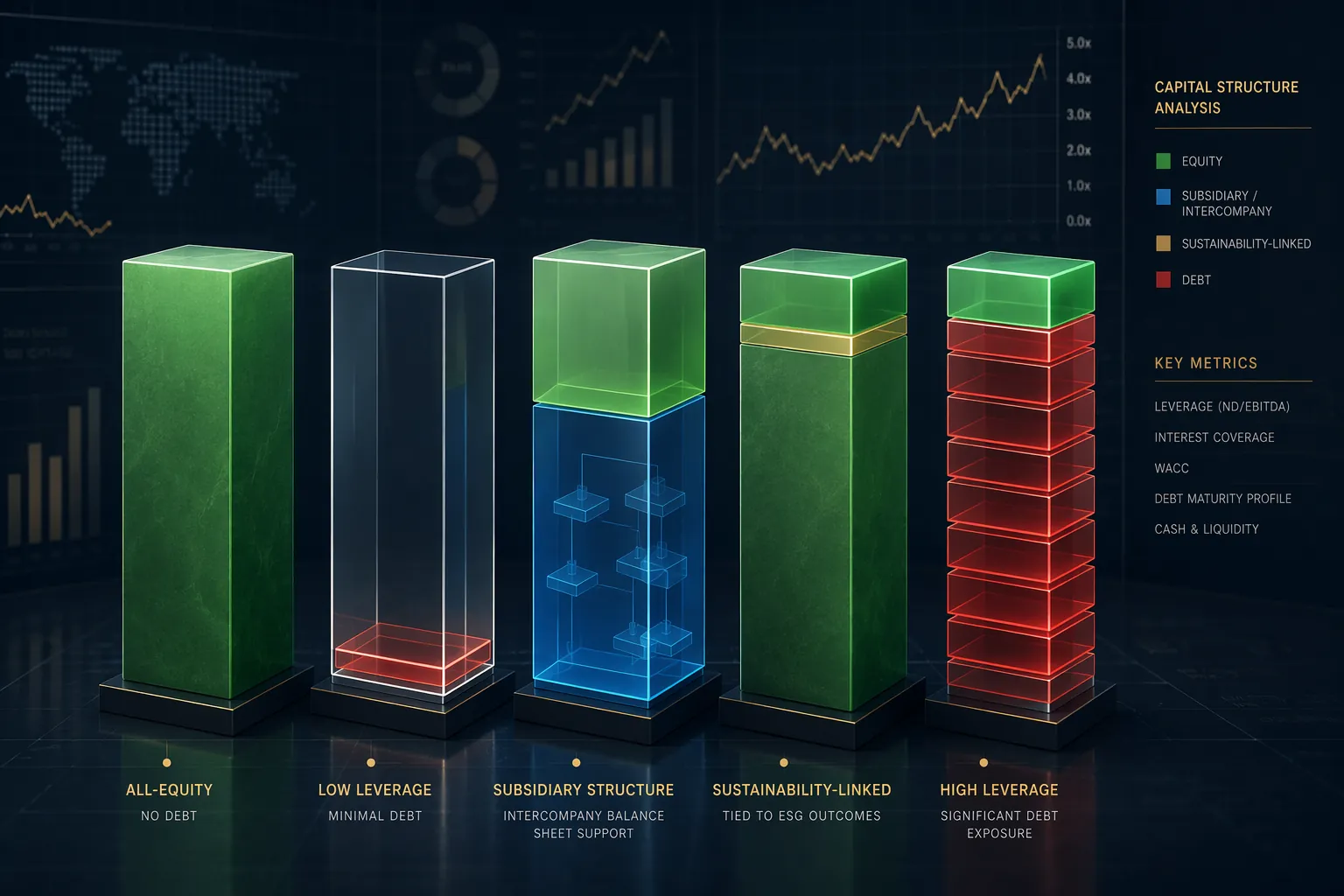
| Vendor | Funding structure visible from available sources | Debt exposure described in the research brief | Source quality | Buyer-relevant implication |
|---|---|---|---|---|
| o9 | All-equity funding path after a decade of bootstrapping | Zero reported debt; $533 million in equity across 10 rounds; $3.7 billion valuation | Mix of company press release and Contrary Research aggregator data | Least visibly constrained by debt service, while still requiring normal private-company diligence |
| Kinaxis | Public company with comparatively transparent financial reporting | $48 million long-term debt; CAD$20 million revolver at bank prime plus 0.50% | Primary financial filings plus third-party financial data sources | Best disclosure profile among the group; modest leverage relative to reported revenue |
| Blue Yonder | Subsidiary of Panasonic after acquisition | Panasonic acquisition valued at $7.1 billion including $1.5 billion of debt repayment | Panasonic investor materials, Blue Yonder company materials, Reuters reporting | Risk is filtered through parent-company support, strategy, and subsidiary performance visibility |
| RELEX | Equity-funded private vendor with a small sustainability-linked bank facility | $816 million total equity; €10 million green revolving credit facility from Nordea announced in January 2025 | Company press release plus Clay/CB Insights dossier | Appears lightly levered, but facility pricing and KPI terms are not fully public |
| Anaplan | Private-equity-owned vendor with acquisition debt | $3.065 billion in senior secured credit facilities from Owl Rock/Blue Owl Capital; reported lender exit pressure in Q2 2025 | Partial Octus/Reorg reporting and lender-redemption data | Most visible debt-related risk signal in the group |
The comparison starts with obligations, not demos
A planning platform can look durable in a demo and still be financially exposed in ways that matter to customers. Debt service can compete with product investment. Refinancing risk can arrive before a customer’s implementation is fully mature. Lender pressure can narrow management’s options. On the other hand, debt can also be ordinary, affordable, and strategically useful when the business has the cash flow and governance to support it.
The point is not to treat debt as a flaw or equity as a guarantee. The useful distinction is customer-relevant stress. If growth slows, renewals soften, or the funding market tightens, which vendor has to divert attention to interest expense, covenants, refinancing, ownership priorities, or parent-company capital allocation? The answer is different for each of these five vendors.
o9: the cleanest debt-service contrast case
o9 is the clearest contrast to the leveraged end of the market. The cited sources describe o9 as having raised $533 million in all-equity funding across 10 rounds, with a $3.7 billion valuation and zero reported debt.[2][3] The company’s story is not simply “venture-backed software vendor”; the relevant point for diligence is that the capital stack visible from the cited materials does not show customer-facing debt-service pressure.
That matters because an all-equity structure changes the nature of the buyer’s financial question. With o9, the concern is less about mandatory interest payments or debt maturities and more about private-company execution: burn rate, investor patience, hiring discipline, implementation capacity, and whether product investment remains deep enough as the company scales. Equity investors still expect outcomes. They may push for growth, efficiency, a sale, or a public listing. But the absence of reported debt removes one specific claim on cash flow that can become uncomfortable when markets tighten.
The source mix deserves a careful read. o9’s own press materials help establish company-disclosed funding events, while Contrary Research is a third-party aggregator and should not be treated like an audited filing.[2][3] For a buyer, that does not make the figures useless. It means the diligence conversation should ask o9 to confirm current debt, credit facilities, cash runway, and investor composition directly rather than relying on a secondary profile frozen at one point in time.

Anaplan: the visible leveraged-acquisition risk
Anaplan sits at the other pole of this comparison. Available reporting identifies $3.065 billion in senior secured credit facilities from Owl Rock/Blue Owl Capital tied to the private-equity acquisition structure.[4] That kind of debt does not automatically mean product weakness, but it does create a different buyer-risk profile from an all-equity vendor or a modestly levered public company.
The sharper signal is not only the size of the facilities. It is the reported secondary-market activity. Per available Octus/Reorg reporting, lenders were seeking to trade out of Anaplan exposure as of Q2 2025, while several business development companies were facing redemption pressure: Apollo Debt Solutions BDC received redemption requests equal to 16.8%, Blackstone Private Credit Fund 10%, and Blue Owl Technology Income Corp. 40.7%.[4] Exact debt-pricing details are not available here, so the careful conclusion is not that Anaplan is in a specific distress scenario. The narrower conclusion is that Anaplan has the most visible debt-related warning signal among the five vendors reviewed here.
For customers, leveraged acquisition debt can show up indirectly. It may affect how much room management has to absorb implementation overruns, keep support staffing generous, fund major product rewrites, or tolerate slower growth in a region or vertical. It can also make ownership outcomes more sensitive: refinancing, asset sales, recapitalization, or another transaction can become part of the vendor’s path even when the product roadmap says nothing about them.
This is where procurement teams should resist two bad shortcuts. The first is assuming debt equals imminent failure. The second is treating all private-equity ownership as the same. The relevant diligence is specific: debt maturity profile, interest burden, covenant headroom, lender composition, sponsor support, and whether customer-facing investment is protected if financing conditions worsen.
Kinaxis: transparency is the benchmark, not a magic shield
Kinaxis is useful in this group because it is the cleanest transparency benchmark. As a public company, it provides a more regular disclosure trail than the private vendors. The cited figures show $48 million in long-term debt, $483 million in revenue, and a CAD$20 million revolver priced at bank prime plus 0.50%.[5][6][7] On those figures, Kinaxis looks modestly levered compared with the acquisition-debt profile at Anaplan.
The public-company profile changes the diligence conversation. Buyers can review filings, compare trends over time, and ask questions against published financials rather than relying mostly on private disclosures or aggregator summaries. That does not guarantee execution. Public companies can still miss product transitions, underinvest, restructure, or make acquisitions that change their risk profile. But disclosure reduces one class of uncertainty: the buyer is not starting from a blank page on leverage and liquidity.
Kinaxis also shows why proportionality matters. A debt figure has little meaning until it is placed against revenue, cash generation, maturity timing, and available facilities. A modest revolver used for ordinary corporate liquidity is not the same diligence issue as acquisition debt that depends on refinancing markets and lender appetite.
Blue Yonder: parent-company backing, subsidiary-level opacity
Blue Yonder’s risk is structured differently because it is no longer a standalone private software vendor. Panasonic acquired Blue Yonder in a transaction valued at $7.1 billion, including $1.5 billion of debt repayment.[8][9] That acquisition changed the customer question from “can this independent vendor finance itself?” to “how committed is the parent company to this subsidiary, and how visible is the subsidiary’s operating performance?”
The available performance signal is not weak on its face. Blue Yonder reported $1.4 billion in FY2024 revenue and 101.2% net revenue retention despite post-acquisition restructuring.[9][10] Those figures suggest a business with meaningful scale and retained customer revenue. They do not, by themselves, tell a buyer how Panasonic will allocate capital across competing corporate priorities, how much autonomy Blue Yonder has for product investment, or how restructuring has affected specific support and implementation teams.
Parent-company backing can be valuable. It may lower financing pressure, provide access to a larger balance sheet, and support longer investment horizons. It can also make standalone diligence harder because the vendor’s financial story is embedded in a broader corporate strategy. For Blue Yonder, the right buyer questions are about product-investment continuity, leadership stability, integration with Panasonic priorities, and whether subsidiary-level operating metrics are available during the evaluation.
RELEX: lightly levered, with missing facility terms
RELEX appears closer to the lightly levered side of the comparison. The cited sources show $816 million in total equity funding and a €10 million green revolving credit facility from Nordea announced in January 2025.[11][12] The facility is described as sustainability-linked and tied to energy-efficiency and waste-reduction targets, not as broad acquisition leverage.[11]
A €10 million revolving facility is small in this peer context, and its green-finance purpose makes it a different signal from private-equity acquisition debt. Still, the missing terms matter. The available sources do not provide the interest-rate terms or the specific sustainability-linked KPI mechanics. Without those, the facility should be read as a limited and apparently targeted debt instrument, not as proof of either financial strength or financial strain.
For RELEX diligence, the main gap is private-company visibility. The buyer can reasonably ask for updated capitalization, cash runway, current debt facilities, and whether sustainability-linked borrowing creates any operational commitments that could affect investment priorities. The likely issue is not debt service crowding out product work; it is the ordinary opacity that comes with a large private vendor.
What the funding structure changes in vendor diligence
The same three diligence questions apply across the group, but the emphasis changes by capital structure.
| Diligence question | What to look for | Where it matters most in this comparison |
|---|---|---|
| Financial stability | Debt maturities, interest burden, liquidity, sponsor or parent support, and whether current funding depends on favorable refinancing markets | Most acute for Anaplan; most transparent for Kinaxis; least visibly debt-constrained for o9 |
| R&D staying power | Whether cash flow and ownership priorities leave room for product depth, implementation capacity, support quality, and AI infrastructure spending | Relevant to all five, but the constraint source differs: lenders, public-market discipline, parent allocation, or investor growth expectations |
| Acquisition vulnerability | Whether the capital structure makes a sale, recapitalization, divestiture, or ownership change more likely under stress | Most visible in leveraged and private structures; different for Blue Yonder because the owner is already a strategic parent |
The practical ranking from the available evidence is not a product recommendation. It is a risk-reading for 2026 diligence. o9 looks least constrained by debt service based on available reporting. Kinaxis offers the most transparent public-company profile and modest visible leverage. Blue Yonder has parent-company backing but less standalone clarity. RELEX appears lightly levered, with incomplete public terms for its green facility. Anaplan carries the most visible debt-related risk signal because of the acquisition facilities and reported lender exit pressure.
The safest way to use this comparison is as a starting point for current verification, not as a permanent scorecard. Funding events age quickly. Vendor Moves entries tied to dated funding announcements, filings, acquisition updates, and credit-market reporting should sit beside the product evaluation, especially when the selection memo assumes the vendor will remain stable long after the selection team has moved on.
References
- Macro hyperscaler AI debt issuance data, source link not provided
- Contrary Research o9 company profile, Contrary Research, source link not provided
- o9 funding press release, o9, source link not provided
- Anaplan debt-trading and BDC redemption reporting, Octus/Reorg, 2025, source link not provided
- Kinaxis financial filings, Kinaxis, source link not provided
- Kinaxis revenue data, Macrotrends, source link not provided
- Kinaxis debt and revolver data, Trading Economics, source link not provided
- Panasonic investor materials on Blue Yonder acquisition, Panasonic, source link not provided
- Blue Yonder FY2024 highlights, Blue Yonder, source link not provided
- Blue Yonder post-acquisition restructuring reporting, Reuters, source link not provided
- RELEX green revolving credit facility press release, RELEX, January 2025, source link not provided
- RELEX funding dossier, Clay/CB Insights, source link not provided
§ 42 — Cited evidence
Flag an inaccuracy or submit a comparable account — Contribute or read how claims are verified in Methodology.