
§ 41 — Use-case analysis
Can Supply Chain Trust AI for Tropical Storm Disruption Planning?
Vendors market AI weather models as capable of predicting any supply chain disruption, but peer-reviewed research reveals systematic errors in storm intensity forecasting that directly affect inventory and rerouting decisions. This analysis explains the documented limitations and what planners should ask before relying on AI for tropical storm planning.
- Function
- disruption planning
- AI technique
- forecasting
- Failure pattern
- intensity forecasting bias
- Evidence source
- Rice University study (Gori, Weng, et al., JGR Atmospheres, March 2026)
An AI forecast can be good enough to wake up a supply chain team earlier and still be the wrong basis for committing inventory, capacity, and port assumptions. That distinction matters because the first decision is often cheap and reversible: open the watch, alert regional managers, call critical suppliers, review exposed lanes. The later decisions are not. Once a planner books alternate capacity, pulls inventory forward, assumes a port will stay closed, or shifts replenishment away from a coastal node, the forecast has become money.
The useful question, then, is not whether AI weather models are impressive. Some are. The question is which part of the storm they are good at, which operational decision that part supports, and where the model output becomes too thin to carry the decision alone.
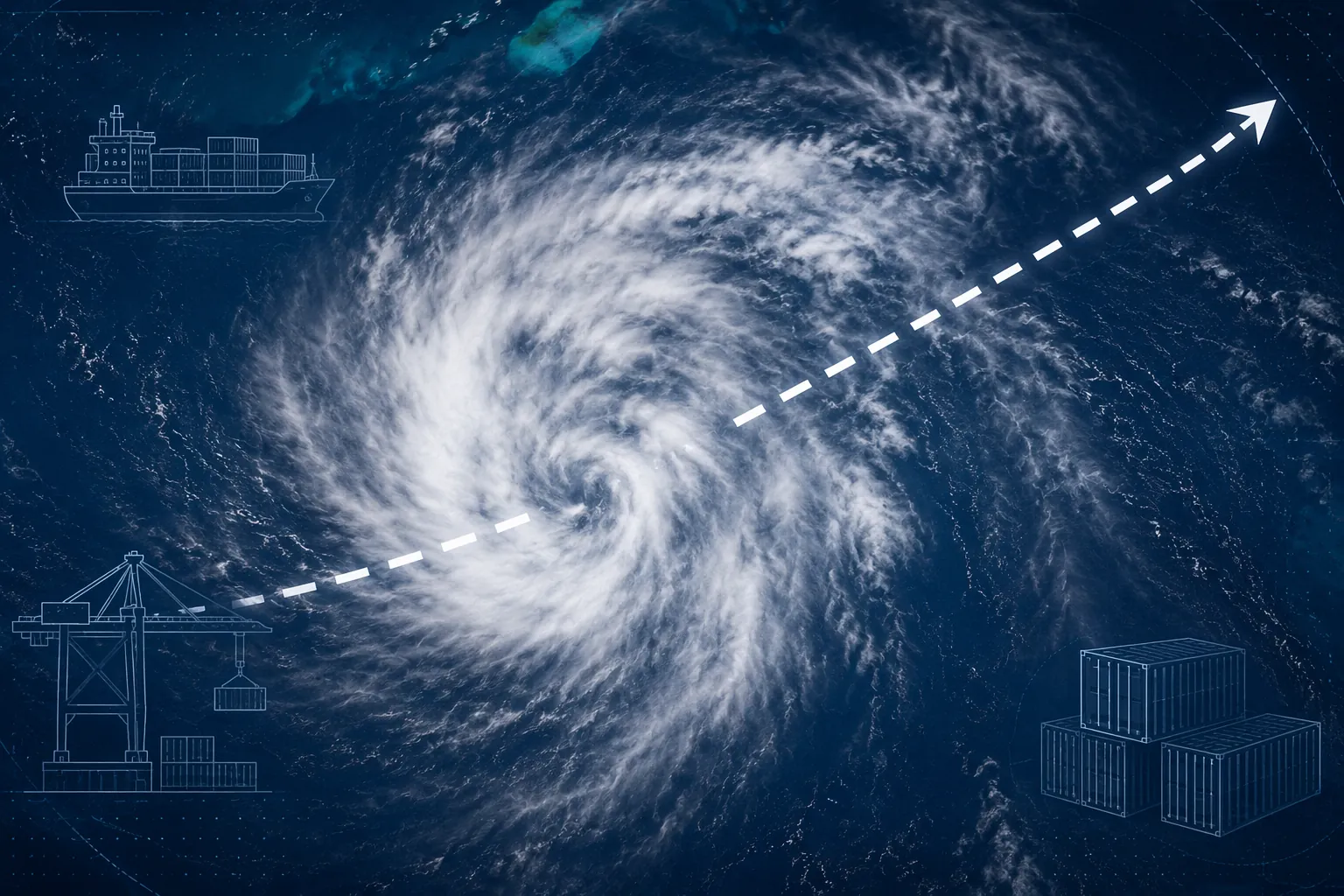
The planning stakes are real, but they do not make every forecast equally actionable
Extreme weather is no longer a side note in supply chain risk registers. Everstream Analytics’ 2026 Annual Risk Report ranked extreme weather as the No. 2 supply chain threat, at a 93% threat level, and its weather-risk analysis says tropical cyclones have caused more supply chain losses than any other weather category since 2000, based on EM-DAT data.[1]
Those figures justify scrutiny, not panic. They also do not answer the narrower operational question. A tropical cyclone can threaten a supplier, a port, a highway corridor, a distribution center, a surge zone, or labor availability. Each exposure depends on different pieces of weather information. A track forecast helps a team identify which facilities and lanes should move into watch mode. Intensity, storm structure, and near-core wind behavior help determine how severe the interruption may be and how expensive the response should become.
The volume of disruption makes the distinction more important. The Weather Company, citing Resilinc, reported that supply chain disruptions rose 38% in 2024 from the prior year, while extreme weather events jumped 119%.[2] That is the environment in which vendor promises about AI-powered disruption prediction land. Planning teams are not asking for elegant models. They are asking whether a forecast should trigger a supplier call, a buffer buy, a transportation booking, or a port-closure assumption.
What the Rice study actually found
The most useful recent evidence is not a vendor benchmark. It is a March 2026 Rice University summary of a study by Gori, Weng, and colleagues in JGR Atmospheres, which evaluated Pangu-Weather and Aurora across roughly 200 tropical cyclones in the North Atlantic and western North Pacific from 2020 to 2025.[3]
The positive finding deserves to come first: track prediction “performed remarkably well.”[3] For supply chain work, that is not a minor win. A credible early track can give procurement, logistics, and site leaders more time to identify exposed suppliers, review inbound freight, check labor and safety assumptions, and prepare evacuation-adjacent support. It can also reduce the time wasted watching assets that are unlikely to fall inside the storm’s path.
Track is the part of the forecast that often supports earlier communication. If a storm’s likely path is moving toward the Gulf Coast, the Southeast, Taiwan, Japan, or the western North Pacific manufacturing corridor, a planning team does not need perfect intensity guidance to begin basic coordination. It can ask which suppliers are exposed, which ports are on the list, which purchase orders are in flight, which customer commitments are vulnerable, and who needs an update if the storm keeps tracking toward the network.
The trouble begins when the same model output is treated as if it has equal strength across the whole storm. The Rice study found that the AI models showed “notable deviations” in gradient wind balance near storm centers, systematically overestimated inner-core size in stronger storms, and, for Pangu-Weather, exhibited “larger biases for the most intense cyclones.”[3] Those are not cosmetic meteorological details. They sit close to the part of the forecast that determines how much damage, closure time, and rerouting pressure a supply chain may face.
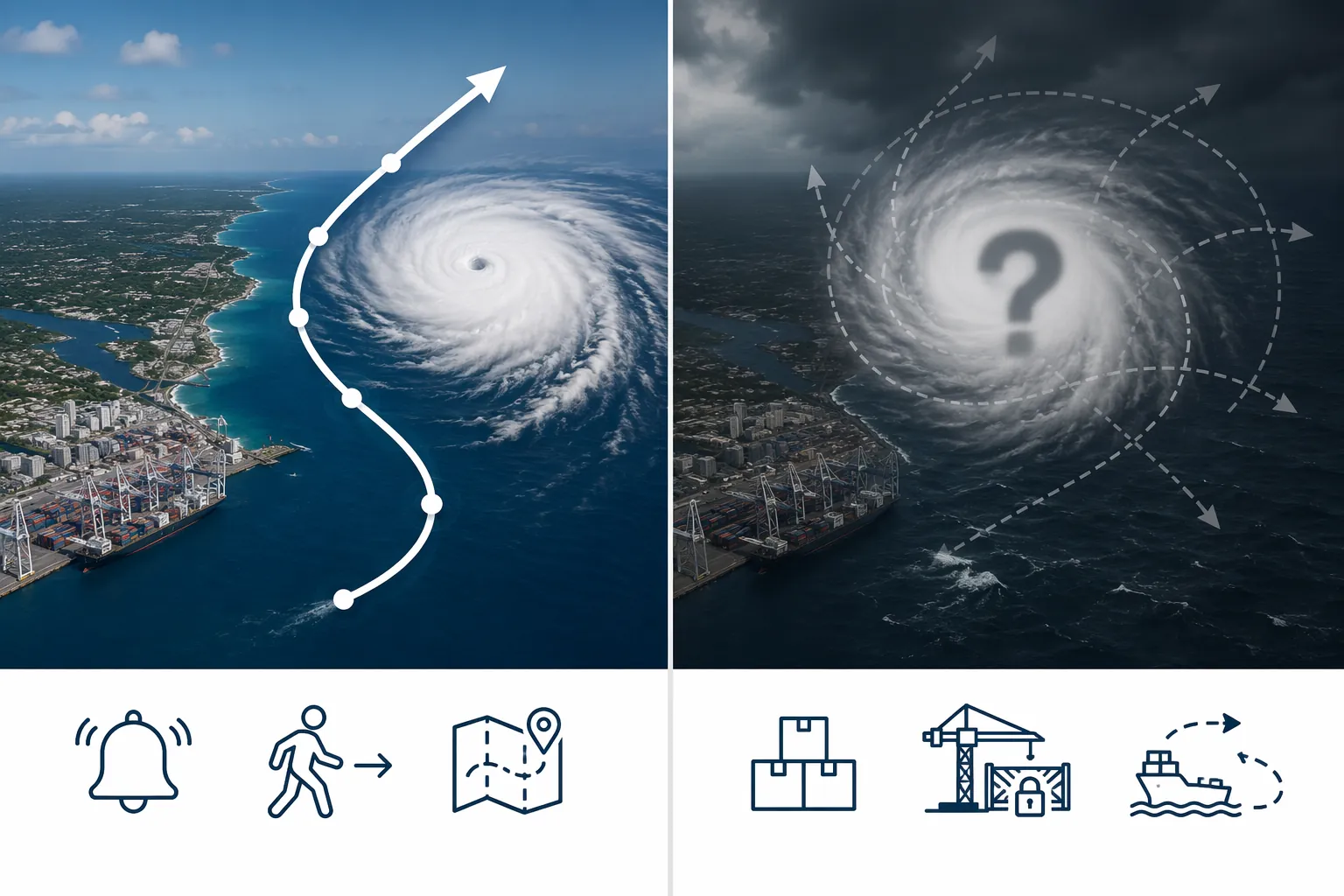
Track and intensity do different jobs in a planning room
A track forecast narrows geography. It tells the team where to look first. That is valuable when a supply chain network spans hundreds of suppliers, multiple ports, and several inland routes. The planner can move from a generic weather bulletin to a named exposure list.
Intensity and inner-core wind structure do a different job. They help shape the size of the response. A weak but well-tracked storm may justify alerts and daily monitoring. A stronger storm with damaging winds, surge exposure, and uncertain port reopening timelines may justify earlier inventory positioning, more expensive transportation reservations, or customer allocation discussions. A forecast that gets the path right but misrepresents the wind field can still lead to an operationally wrong answer.
| Forecast element | Supply chain decision it can support | Where the decision becomes costly |
|---|---|---|
| Track | Early alerts, supplier watchlists, exposed-lane monitoring, evacuation-adjacent coordination | Usually before major money is committed |
| Intensity | Inventory buffers, customer allocation planning, facility shutdown assumptions | When buffers are purchased, moved, or reserved |
| Inner-core wind structure | Port-closure duration assumptions, local damage expectations, rerouting scope | When transportation capacity and alternate routes are booked |
| Reanalysis agreement | Model validation and confidence claims | When agreement is treated as proof of observed storm accuracy |
This is where a planning spreadsheet can become misleading. A clean forecast path may populate a risk dashboard with a high-confidence storm corridor. The same dashboard may then attach operational playbooks that assume a level of wind damage, facility downtime, or port disruption that the model is less reliable in estimating. The interface can make both outputs look equally certain, even when the underlying science does not.
For a procurement lead, that difference is not academic. A supplier alert can be defended as prudent. A major pre-buy is harder to defend if the storm weakens, shifts, or produces less disruption than expected. A broad reroute can protect service, but it can also consume scarce capacity that another region needs. A conservative port-closure assumption may keep customers informed, but it can also distort allocation, freight cost, and revenue timing.
The ERA5 problem makes model confidence harder to read
One of the more awkward findings in the Rice discussion concerns the data used as ground truth. The authors emphasized that ERA5 reanalysis data, used for training and validation, “tends to underestimate peak intensity compared to observations,” which means agreement with reanalysis “does not automatically imply accuracy.”[3]
That matters because procurement and logistics teams rarely see the validation layer. They see a confidence score, a predicted impact, a color-coded asset map, or an automatically generated recommendation. If a model appears to match reanalysis well, a vendor may present that as evidence of reliable forecast skill. The Rice caveat says the comfort should be narrower: matching a reanalysis product that underestimates peak intensity is not the same as capturing the most damaging observed storm behavior.
This does not make the model useless. It changes how the model should be governed. Track confidence can justify earlier alerts. Intensity-sensitive decisions should carry separate uncertainty language, especially when the consequences include inventory dollars, transport commitments, or assumptions about how long infrastructure will be offline.
How meteorological error becomes planning error
The translation from storm model to supply chain action usually happens through categories that look operationally clean: at-risk supplier, port disruption, lane delay, inventory exposure, alternate source, expedite recommendation. The weather uncertainty does not disappear when it enters those categories. It is converted into a business assumption.
If the forecast path is strong, the team can start early. It can ask suppliers in the projected corridor about operating status, labor constraints, inbound material, and recovery plans. It can separate exposed purchase orders from orders that merely look risky because they share a region label. It can prepare customer messaging without yet promising exact delay duration.
If intensity is uncertain, the team should be more careful with committed action. Extra inventory is not just a buffer; it is working capital, warehouse space, and sometimes obsolescence risk. A port-closure assumption is not just a note; it can determine whether freight is held, diverted, expedited, or rebooked. A rerouting plan is not just resilience; it can lock in higher rates and consume capacity before the storm’s actual impact is clear.
Inner-core size is especially relevant because a broader or more intense wind field can widen the area of meaningful disruption. If an AI model systematically overestimates inner-core size in stronger storms, as the Rice-covered study found for the evaluated models, a planning system that converts that output directly into disruption radius may overstate the number of suppliers, lanes, or facilities requiring expensive action.[3] If peak intensity is understated by the validation reference, the opposite risk can also appear in certain confidence claims: the model may look more trustworthy than observed storm behavior warrants.
Both errors can hurt. Over-response is visible in premium freight, excess buffers, unnecessary supplier pressure, and capacity tied up too early. Under-response is visible in missed service, late evacuation support, stockouts, and recovery delays. The same planning leader may have to defend both possibilities: before landfall, when the forecast appears precise, and after the storm, when finance and commercial teams can see the actual cost.
Vendor claims need more separation between awareness and execution
Public product language around AI-powered weather disruption prediction often compresses several capabilities into one promise: detect the storm, predict the disruption, recommend a response. That compression is convenient for marketing and dangerous for governance. The science supports more confidence in some links of that chain than in others.
The absence of detailed limitations in public materials should not be read as proof that a vendor’s meteorologists or data scientists are unaware of them. Some may be handling these limits internally through human review, ensemble checks, conservative thresholds, or separate confidence scoring. The issue is what a buying team can see and contract around. If the public promise says “predict disruption” but the documentation does not separate track skill from intensity and wind-structure uncertainty, the customer may overestimate how much of the decision can be automated.
That gap is particularly important for teams evaluating planning platforms, risk-monitoring tools, or control-tower add-ons. The vendor may ingest weather data, AI weather-model output, third-party risk signals, human meteorological analysis, or some combination of those inputs. Without disclosure, the buyer cannot tell whether a tropical storm recommendation rests on a robust multi-source workflow or on model outputs whose known weak spots are being hidden behind a clean user interface.
The questions planners should ask before relying on AI tropical-storm forecasts
A practical evaluation should not start with whether the platform uses AI. It should start with which decision the AI is allowed to trigger. Early warning and scenario initiation can tolerate more uncertainty than inventory movement, capacity booking, or facility shutdown assumptions.
- Which weather models are ingested for tropical cyclones, and are Pangu-Weather, Aurora, or other AI models used directly in disruption scoring?
- Does the product separate track confidence from intensity confidence, or does it collapse both into a single disruption score?
- How does the workflow represent uncertainty in inner-core wind structure, wind-field size, and peak intensity?
- Does the vendor document ERA5-related limitations or other ground-truth limitations used in model validation?
- Where does human meteorological review enter before the system recommends inventory buffers, rerouting scope, or port-closure duration?
- Can customers set different approval thresholds for alerts, supplier outreach, inventory movement, and transportation commitments?
The last question is often the most useful in implementation. A system that can automatically open a watch, draft a supplier check-in, and flag exposed purchase orders may be ready for broad use. The same system should not automatically push a team into expensive execution unless the uncertainty around intensity and wind structure is visible to the people approving the spend.
Trust the early signal, govern the expensive decision
The Rice study’s own bottom line is appropriately restrained: AI tools still depend on field expertise and should be used as a complement to, not a replacement for, human expertise.[3] That is not a rejection of AI weather forecasting. It is a boundary around its current use.
Supply chain planners can trust AI weather models more for early tropical-storm awareness than for autonomous disruption execution. A strong track forecast can buy time, focus attention, and improve coordination before a storm reaches the network. The harder calls come when the forecast is asked to price the response: how much inventory, how wide a reroute, how long a port closure, how severe a supplier interruption.
For those intensity-sensitive decisions, the safest position is neither dismissal nor blind adoption. Use the AI signal to start the planning clock. Require separate treatment of track, intensity, and wind-structure uncertainty before committing money. Keep meteorological expertise in the workflow where the forecast stops being an alert and becomes an operating decision.
References
- The Impact of Extreme Weather on the Supply Chain, Everstream Analytics.
- Managing supply chain weather risks with predictive analytics and real-time insights, The Weather Company, September 2025.
- AI weather models show promise for hurricane forecasts, but new Rice study finds key physical limitations, Rice University News, March 2026.
§ 42 — Cited evidence
Flag an inaccuracy or submit a comparable account — Contribute or read how claims are verified in Methodology.