§ 41 — Use-case analysis
Why AI Aftermath Planning Depends on Execution Speed
This use-case analysis challenges the assumption that better AI prediction is the key to faster disruption recovery. Drawing on evidence from the Blue Yonder ransomware attack, Resilinc data, and vendor surveys, it shows that decision latency — the time to execute a coordinated response across fragmented systems — is the binding constraint in post-storm recovery.
- Function
- aftermath planning
- AI technique
- forecasting
- Failure pattern
- decision latency
- Evidence source
- Blue Yonder ransomware, Resilinc, Logistics Viewpoints, RELEX
The useful lesson from the Blue Yonder ransomware attack is not that supply-chain platforms are vulnerable. Everyone running shared planning infrastructure already knows that. The harder lesson is what happens downstream when the platform that carries the plan, the exception logic, and the workflow is suddenly impaired.
Blue Yonder disclosed a ransomware incident in November 2024 that disrupted services for some managed services customers. Press reporting tied the outage to visible operational workarounds: Starbucks reportedly reverted to manual, pen-and-paper employee scheduling, while UK grocer Morrisons faced warehouse management disruption affecting roughly 500 stores. Cybersecurity Dive reported in December 2024 that recovery would take “several weeks,” a timeline that should be treated as approximate because it comes from press coverage rather than a full public post-incident report. BlackFog later reported that the Termite ransomware group claimed about 680GB of data had been exfiltrated.[1][2]
That is a better stress test for AI supply-chain storm aftermath planning than another demo showing earlier warning signals. Once a platform is unavailable, the question is no longer whether a model could have predicted disruption risk. The question is whether replenishment, labor, transportation, warehouse execution, procurement, and finance can still move through a coordinated recovery path when the shared system of record or workflow layer is degraded.
In that kind of incident, knowing the problem exists is the easy part. Store teams know schedules are broken. Warehouse leads know orders are not flowing normally. Transportation knows the priority list is changing. The delay comes from reconciling data, deciding which exceptions matter, getting approvals, issuing manual overrides, and making sure the new decision actually lands in the next system that has to execute it.
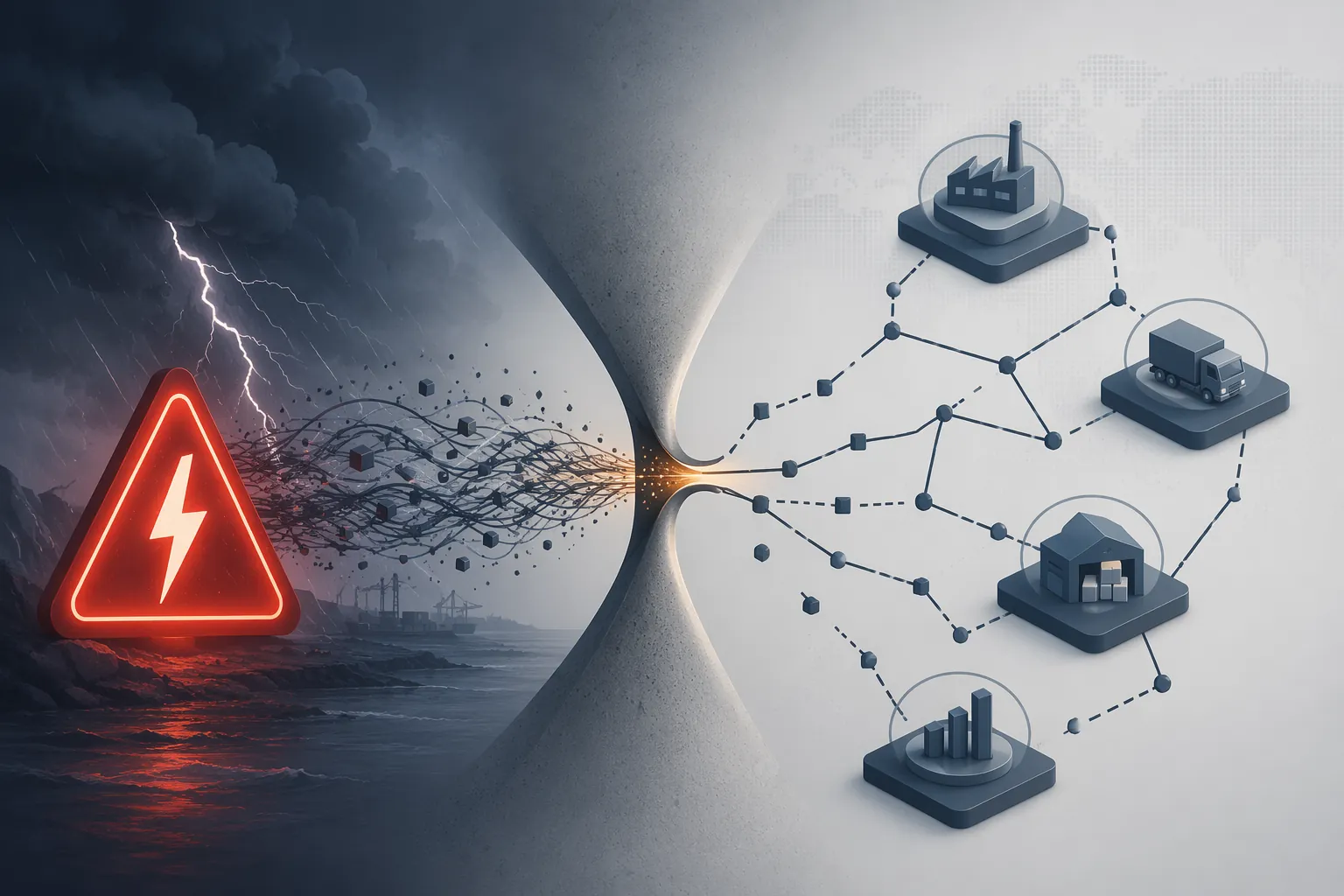
The storm after the storm is the handoff
The word “storm” belongs here in both senses. Hurricanes, floods, and heat events create physical disruption. Ransomware, tariff changes, supplier failures, and regulatory shocks create a different kind of storm inside the operating model. In both cases, the aftermath is judged by elapsed time: how long it takes to reallocate inventory, rebook transportation, authorize substitutions, adjust labor, and communicate the new plan to the people who have to carry it out.
The pressure on that operating model is increasing. Resilinc reported that its EventWatchAI disruption notifications rose 38% year over year in 2025, with cyber events up 64% and regulatory-change events up 92%.[3] Those figures do not prove that any one company is recovering more slowly, and they do not prove that AI improves recovery. They do show why planning teams are seeing more exceptions arrive faster than the old meeting-and-spreadsheet response path was built to absorb.
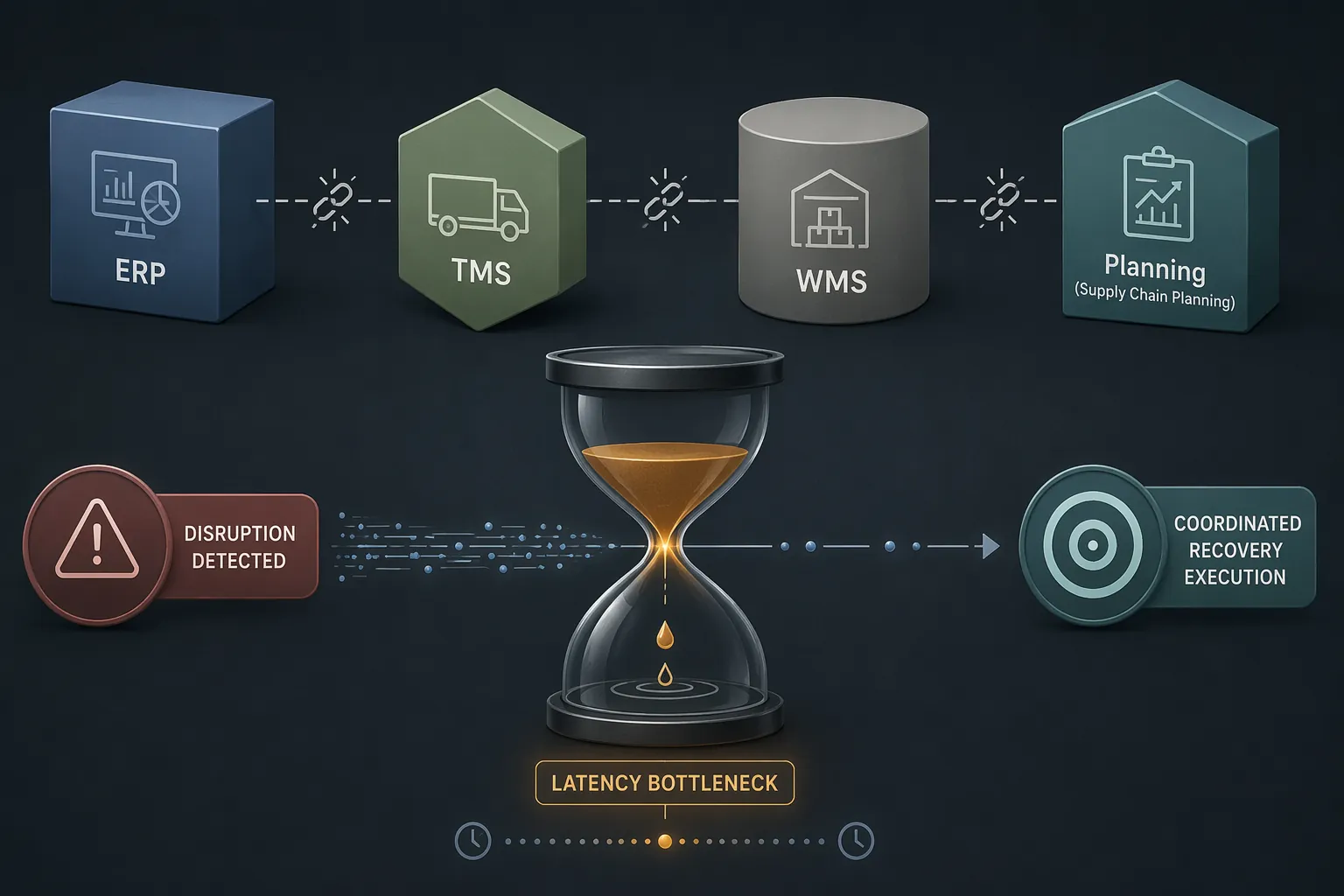
The constraint is not the alert. It is the handoff after the alert. A planning system can flag a shortage, but the ERP may own the purchase order. The TMS may own the carrier change. The WMS may own wave release and labor impact. Finance or procurement may own the emergency approval. If those steps are not connected, the organization can have good visibility and still lose a day waiting for the decision to become executable work.
Decision latency is not a dashboard problem
Logistics Viewpoints put the mechanism plainly in Q1 2026: “decision latency — the time required to recognize a disruption, align stakeholders, and execute a coordinated response — is now a primary driver of both cost and service performance.” The same analysis noted that most supply-chain technology environments remain fragmented across ERP, TMS, WMS, and planning systems.[4]
That definition matters because it separates detection from recovery. Recognition is only the first segment. Alignment is where priorities get argued: which customers are protected, which orders are delayed, which DC gets scarce inventory, which supplier substitution is acceptable, which carrier premium is worth paying. Execution is where those decisions either enter the operational systems cleanly or become another set of emails that somebody has to translate into work.
| Aftermath stage | Typical failure point | What slows recovery |
|---|---|---|
| Recognize | The disruption is visible, but impact is not mapped to orders, sites, or customers | Teams spend time reconciling which plan version is real |
| Align | Planning, logistics, procurement, finance, and operations disagree on the next-best action | Escalations wait for human approval without clear thresholds |
| Execute | The approved decision does not flow into ERP, TMS, WMS, or store/warehouse workflows | Manual rekeying, overrides, and disconnected queues create new delay |
| Monitor | The response is launched, but teams cannot see whether it worked | Exceptions are rediscovered at the next handoff |
This is where many AI evaluations get too comfortable. A model that improves a forecast, predicts a disruption, or ranks supplier risk may still leave the recovery path untouched. If the emergency buy requires procurement approval outside the planning tool, if the WMS cannot consume the revised allocation, or if transportation learns about the new priority after the dock schedule is already set, the model has not shortened the operational clock by much.
The Blue Yonder incident shows an even harsher version of the same point. When the platform carrying key workflows is impaired, the organization needs a degraded operating mode that still preserves decision rights, priority rules, and execution handoffs. Manual scheduling at Starbucks and warehouse disruption at Morrisons were not abstract “lack of visibility” problems; they were signs that people had to keep operations moving while normal digital workflows were unavailable.[1]
Autonomy is the ambition; approval design is the current work
There is a real argument for more autonomous response. Gartner projected in March 2026 that 60% of supply-chain disruptions will be resolved without human intervention by 2031. But the same Gartner announcement advised chief supply chain officers to start with low-risk decisions and build the required data and governance foundations first.[5] That is not a description of an operating norm already in place; it is a target state with prerequisites.
Current trust levels explain why. A RELEX survey of 514 supply-chain leaders found that only 10% currently trust AI to make fully independent decisions, while 54% prefer AI recommendations with humans retaining final say.[6] That gap is not a minor adoption detail. If most organizations still want human signoff, then recovery speed depends on how the tool routes the decision, frames the trade-off, captures approval, and pushes the result into execution.
A human-in-the-loop process can be fast, but only if it is designed as an operating path rather than a courtesy notification. The planner should not have to assemble screenshots for a cross-functional call. The warehouse should not wait for a revised allocation in a separate inbox. Finance should not discover the premium freight decision after the carrier is already booked. Procurement should not block a substitute supplier because the system cannot show which policy threshold has been crossed.
This is also where “agentic” language can get ahead of the work. Market interest is clearly there: ABI Research reported that 65% of supply-chain professionals rate AI or generative AI as important for technology purchasing decisions, and 77% are considering or beginning mobile automation. ABI also noted that C-level executives view AI agents as tactical rather than strategic.[7] That posture is telling. Executives may be willing to let agents prepare options, summarize exceptions, or trigger bounded workflows before they are willing to let them independently reroute material, spend money, or change customer commitments.
What executable AI aftermath planning looks like
The more useful AI cases are the ones where the system changes an action before the bottleneck forms. ClimateAi published a Hurricane Ian example involving a building-materials company that used AI-enabled risk signals to pre-position Florida-code-approved inventory ahead of demand. ClimateAi said the company captured an incremental $15 million in sales; the same post cited Hurricane Ian’s total economic loss at $112.9 billion.[8]
That case should be handled carefully. It is vendor-published, not an independently audited recovery study, and the $15 million outcome should not be treated as proof that the software category works in general. Operational readiness, supplier availability, inventory policy, and customer demand all matter. Still, the case is useful because the AI-supported decision was tied to an executable move: position compliant inventory before the surge, not merely warn that a hurricane might disrupt demand.
That distinction is the practical line for buyers. A storm-risk signal that never changes purchasing, allocation, transportation, or warehouse work is just another alert. A recommendation that arrives with approved substitution rules, service-impact trade-offs, inventory availability, and a route into the systems that execute the change has a better chance of reducing recovery time.
The vendor question is narrower than the sales deck makes it
The evidence here does not support ranking o9, Blue Yonder, Kinaxis, RELEX, Anaplan, or adjacent planning suites as the winner for aftermath recovery. A vendor can have strong forecasting, scenario planning, control tower, or optimization capabilities and still leave a customer exposed if approvals, integrations, fallback procedures, and execution handoffs are weak in that customer’s environment.
The better Q3 2026 evaluation question is more specific: after the disruption is known, does the platform reduce decision latency?
- Can it translate an exception into actions across ERP, TMS, WMS, and planning systems without requiring planners to manually reconcile each step?
- Can it show who has authority to approve emergency sourcing, substitution, allocation, or premium freight decisions?
- Can it preserve human final approval where trust or policy requires it without turning every exception into a meeting chain?
- Can it operate in a degraded mode if one platform, integration, or workflow layer is unavailable?
- Can warehouse, store, transportation, procurement, and finance teams see the same recovery priority quickly enough to act on it?
Those questions are less glamorous than asking which platform has the most advanced forecast model. They are also closer to where recovery time is actually lost. The Blue Yonder aftermath did not become operationally painful because retailers lacked a theory of disruption. It became painful because normal workflows were interrupted and teams had to keep moving anyway.
Prediction can buy warning time. It can sharpen risk sensing and give planners a cleaner view of what may happen next. But after the storm has arrived, recovery is governed by the speed and resilience of the response path: who decides, who approves, which system receives the decision, and whether the people on the floor can execute it before another day is gone.
References
- Blue Yonder says recovery from ransomware attack to take several weeks, Cybersecurity Dive, Dec. 2024
- Ransomware Meets Retail: Blue Yonder Attack, BlackFog
- Supply Chain Disruption Is Accelerating into 2026, Resilinc
- Supply Chain Disruptions in 2026: Decision Latency and the Need for Integrated Response, Logistics Viewpoints, April 1, 2026
- Gartner Says 60% of Supply Chain Disruptions Will Be Resolved Without Human Intervention by 2031, Gartner, March 18, 2026
- RELEX Report: AI Moves Into Core Supply Chain Decisions, RELEX Solutions
- Supply Chain Disruptions 2026, ABI Research
- Three Ways AI Can Help Companies De-Risk Supply Chains, ClimateAi
§ 42 — Cited evidence
Flag an inaccuracy or submit a comparable account — Contribute or read how claims are verified in Methodology.