
§ 41 — Use-case analysis
Space data center environmental claims ignore supply-chain costs
Vendors pitch orbital data centers as a sustainability solution for AI compute, but their numbers exclude launch emissions, hardware replacement cycles, and reentry pollution. When the full supply chain is included, space-based compute has a higher carbon intensity than any national grid on Earth.
- Function
- environmental sustainability
- AI technique
- generative AI
- Failure pattern
- lifecycle boundary omission
- Evidence source
- Impakter (Mar 2026) and Carbon Trust (May 2026)
The cleanest version of the space data center pitch is easy to understand. Put AI compute where sunlight is continuous, beam the work through orbital infrastructure, and relieve terrestrial grids, land markets, and water-stressed communities from another wave of data center build-out. For a supply-chain AI team already watching GPU demand collide with power constraints, that sounds less like science fiction than a procurement option arriving early.
The accounting problem starts when the pitch becomes an environmental claim. Starcloud-style assertions that orbital compute can be “10× cleaner” count the energy advantage in orbit, while the Saarland University ESpaS model cited by Impakter puts full-lifecycle orbital data center carbon intensity at 800-1,500 gCO2e/kWh, worse than any national grid on Earth.[1] Those two numbers are not just disagreeing. They are drawing the system boundary in different places.
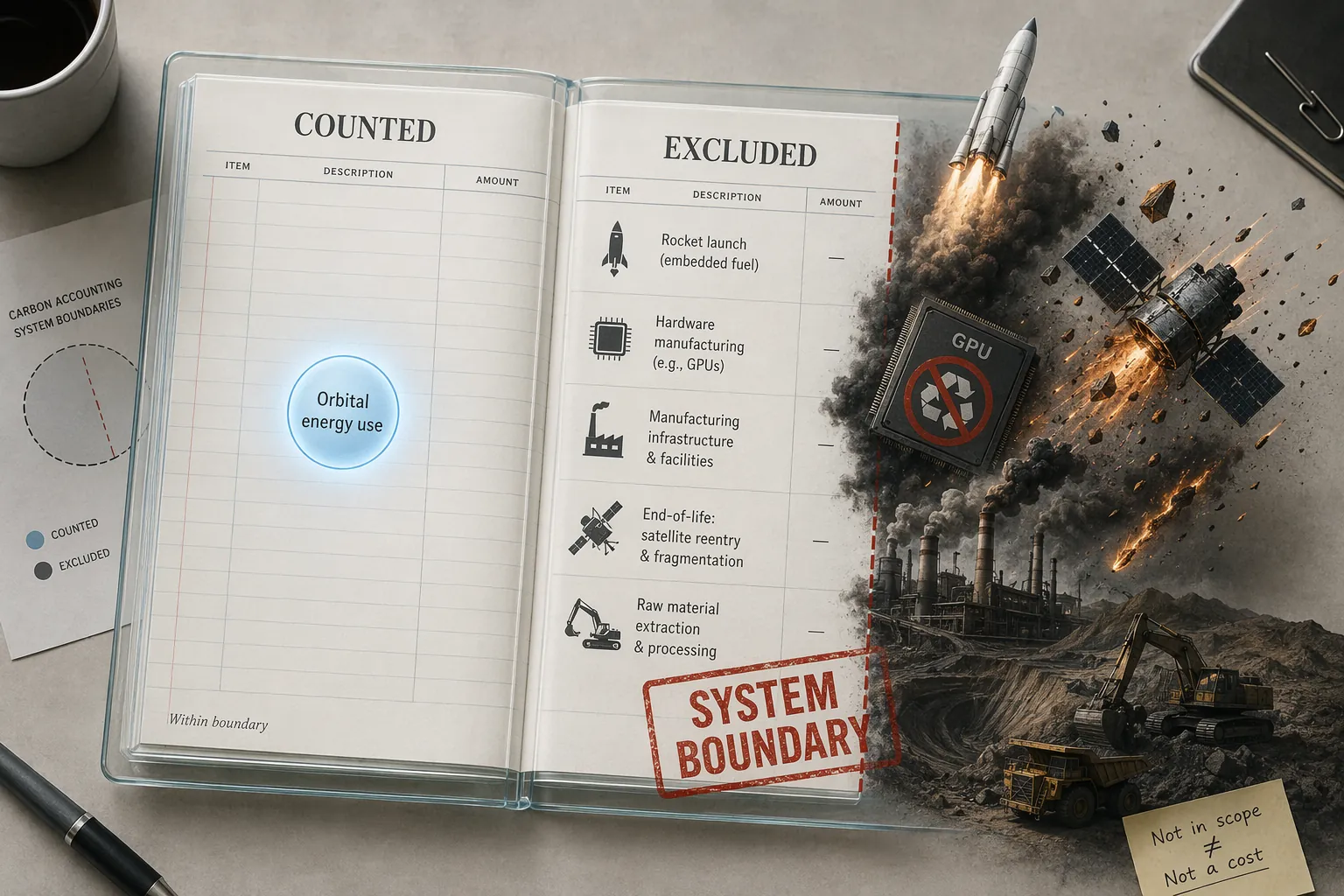
That matters for the people who have to sign off on infrastructure. A planning director or IT lead cannot buy only the orbital sunlight. They inherit the launch logistics, hardware refresh plan, integration risk, end-of-life treatment, and the ESG explanation when someone asks why a “clean” AI compute strategy begins with rockets.
The pitch counts orbit; the supply chain starts earlier
Operational energy is the flattering part of the orbital story. In space, solar exposure is abundant, cooling assumptions differ, and the facility is not competing with local utilities for land and water in the usual way. Those are real design advantages. They are not a lifecycle assessment.
The missing stages are the supply chain itself: critical-mineral extraction, semiconductor and server manufacturing, launch emissions, assembly and replacement payloads, networking infrastructure, failed hardware, reentry pollution, and e-waste. Some of those costs are hard to model cleanly because no single peer-reviewed study yet traces an orbital AI data center from extraction through reentry. That uncertainty does not make the costs vanish. It makes any narrow “cleaner” claim less decision-grade.
This is where the ESpaS estimate is useful. It does not settle every unresolved lifecycle question, but it forces the discussion out of the slideware boundary where only orbital power is visible. Once launch and infrastructure are included, the carbon intensity estimate moves into a range that no procurement team would confuse with renewable-powered terrestrial compute.[1]
| Accounting boundary | What it includes | What it tends to leave outside |
|---|---|---|
| Orbital energy claim | Power generation and use once the facility is operating in space | Launch, manufacturing, replacement payloads, reentry, e-waste, mineral extraction |
| Lifecycle supply-chain view | Manufacturing, launch, orbital operations, refresh cycles, end-of-life impacts | Still uncertain where full extraction-to-reentry data is unavailable |
Launch emissions are not a rounding error
The launch threshold is the first hard handoff. ESA’s ASCEND work, as summarized by Impakter, indicates launch vehicles would need to reach roughly 1.9 kg CO2 per kg of payload for orbital computing to match renewable-powered terrestrial alternatives. Current rockets are reported at 10-25 times above that level.[1]
That single comparison does more than puncture a marketing line. It identifies the dependency the orbital model cannot control by architecture diagram: a space data center’s environmental case is only as good as the launch system that places and replenishes it. If the rocket layer is still an order of magnitude away from the necessary threshold, then the sustainability claim is borrowing credibility from a future supply chain.

The practical procurement question is not whether rockets may become cleaner. It is whether a 2026 infrastructure decision can book those improvements as if they already exist. For supply-chain AI operators, that is the same mistake as evaluating an AI planning rollout only on the demo environment and assigning the integration backlog to someone else’s budget.
A 5GW orbital facility turns the claim into a replenishment problem
Scale is where the clean boundary breaks hardest. Carbon Trust’s May 2026 analysis modeled a single 5GW orbital facility and estimated that deployment would require about 2,000 Starship launches, producing around 7 million tonnes CO2e, equivalent to the annual emissions of 1.7 million petrol cars.[2] That is before treating orbital compute as an operating estate that must be refreshed.
AI hardware does not age on the same schedule as a space station concept rendering. GPU cycles are measured in years, not decades. The reported replacement window of 1-3 years is the part that should make infrastructure buyers slow down: the launch burden is not only an opening act, because useful AI compute capacity depends on repeated payload replacement and upgrade paths.
This is not a small operational wrinkle. In terrestrial data centers, hardware refresh is already a capital planning, supply assurance, firmware, cooling, and e-waste problem. Moving the facility to orbit adds launch scheduling, payload constraints, failure recovery, orbital servicing assumptions, and end-of-life disposal. The hard question becomes who owns the emissions and waste ledger each time yesterday’s accelerator is no longer competitive for tomorrow’s model workload.
Carbon Trust’s scenario also usefully separates adoption from effectiveness. A 5GW orbital plan can be technically imaginable and still fail as a near-term environmental strategy if its deployment and refresh cycle create an emissions pulse that terrestrial alternatives do not require. The burden is on the vendor to show the whole replacement model, not only the first elegant facility in sunlight.
The checklist a buyer should ask for
- Launch emissions per kg of payload, with the launch vehicle named and the calculation date stated.
- Expected GPU and server replacement interval, including failed payloads and spares.
- Manufacturing footprint for compute, solar, thermal, communications, and structural hardware.
- End-of-life pathway for every major component: reuse, servicing, controlled reentry, or debris risk.
- A carbon-intensity comparison against named terrestrial regions, not a generic “Earth data center” baseline.
Reentry is an environmental pathway, not a disposal method
End of life is often treated as a fade-out in orbital computing discussions: the asset deorbits, burns up, and leaves the accounting conversation. The atmospheric chemistry is not that tidy. Impakter cites a 2024 NASA Technical Memorandum indicating that about 887 tonnes per year of material are already being injected into the atmosphere through reentry, with projections exceeding 30,000 tonnes per year by 2040.[1]
The same synthesis reports that anthropogenic reentry now dominates atmospheric injection of 24 specific chemical elements, including catalytically active metals associated with accelerated ozone destruction.[1] That does not mean every orbital data center proposal has a quantified ozone impact ready to plug into a spreadsheet. It does mean reentry cannot be waved away as environmentally neutral disposal.
For supply-chain teams, the immediate relevance is governance. If a vendor cannot explain what happens to failed or obsolete compute hardware at end of life, the environmental claim is missing a disposal stage that every terrestrial data center operator would be expected to address.
The terrestrial alternative is imperfect, but it is actionable this decade
The right comparison is not orbital perfection against terrestrial failure. Terrestrial AI infrastructure has serious impacts: energy use, water demand, land pressure, equipment waste, and geographic concentration all matter. UNU-INWEH’s June 2026 material warns that AI’s environmental costs threaten water, land, and climate, and cites 2.5 million tonnes of e-waste in its wider assessment of the sector.[3]
But terrestrial data centers also have levers available to buyers now. Cornell’s November 2025 coverage of a Nature Sustainability roadmap reports modeled reductions of about 73% in carbon and 86% in water through smart siting, grid decarbonization, and operational efficiency, including attention to Midwest and windbelt states.[4] Those are scenarios, not guaranteed savings. They depend on execution, grid conditions, procurement discipline, and local constraints.
That caveat is exactly why they are more useful than a narrow orbital energy claim. A terrestrial plan can be tied to a specific grid mix, power purchase agreement, cooling design, utilization target, water basin, hardware refresh policy, and local permitting record. It gives an infrastructure team something to audit before the purchase order, not a promise that another industry’s future decarbonization will make the numbers work later.
The pro-orbital narrative promoted in forums such as the World Economic Forum is still worth watching because it names real pressures: AI demand is growing, data centers are stressing infrastructure, and conventional build-out has limits.[5] The gap is that “space” is being asked to solve environmental constraints before the space supply chain has shown that it can carry its own environmental load.
What a procurement-grade answer looks like in Q3 2026
A defensible answer does not need to ridicule orbital compute. It should keep the category visible in the Vendor Moves feed, especially as Starcloud, Google Project Suncatcher, launch providers, and chipmakers test whether the economics and engineering can mature. There may be specialized workloads or future infrastructure regimes where orbital compute earns a serious role.
That is different from treating it as a sustainability solution for supply-chain AI infrastructure today. In Q3 2026, the available evidence supports a narrower conclusion: claims based on orbital operating energy exclude too much of the supply chain to guide capital allocation, ESG reporting, or resilience planning.
The standard should match the one used in serious Post-Mortems of AI deployments: judge the system at scale, during refresh, under integration pressure, and at the handoffs where costs usually appear. For space data centers, those handoffs are launch, hardware turnover, reentry, and waste. Until vendors account for them with named-source lifecycle numbers, the more actionable path is terrestrial siting, grid decarbonization, efficiency, and harder procurement questions about every AI compute claim that sounds clean because the dirtiest stages have been left outside the frame.
References
- Data Centres in Space: Can They Solve AI's Sustainability Problem?, Impakter, Mar 2026.
- Data centres in space: Leave the planet to save the planet?, Carbon Trust, May 2026.
- AI's environmental costs threaten water, land and climate, UNU-INWEH, June 2026.
- 'Roadmap' shows the environmental impact of AI data center boom, Cornell University, Nov 2025.
- How data centres in space sustainably enable the AI age, World Economic Forum.
§ 42 — Cited evidence
Flag an inaccuracy or submit a comparable account — Contribute or read how claims are verified in Methodology.