
§ 41 — Use-case analysis
The traceability challenge the Snapchill coffee recall exposed
The Snapchill coffee recall affected 148 roasters but was triggered by a process compliance failure at a single co-packer that no brand-level lot-tracking system would have detected. This article examines what supply chain planners must look for in traceability platforms to avoid similar blind spots in co-manufacturing networks.
- Function
- procurement-automation
- AI technique
- optimization
- Failure pattern
- co-manufacturing compliance blind spot
- Evidence source
- FDA Snapchill recall notice; SafetyChain; Food Logistics; Blue Yonder
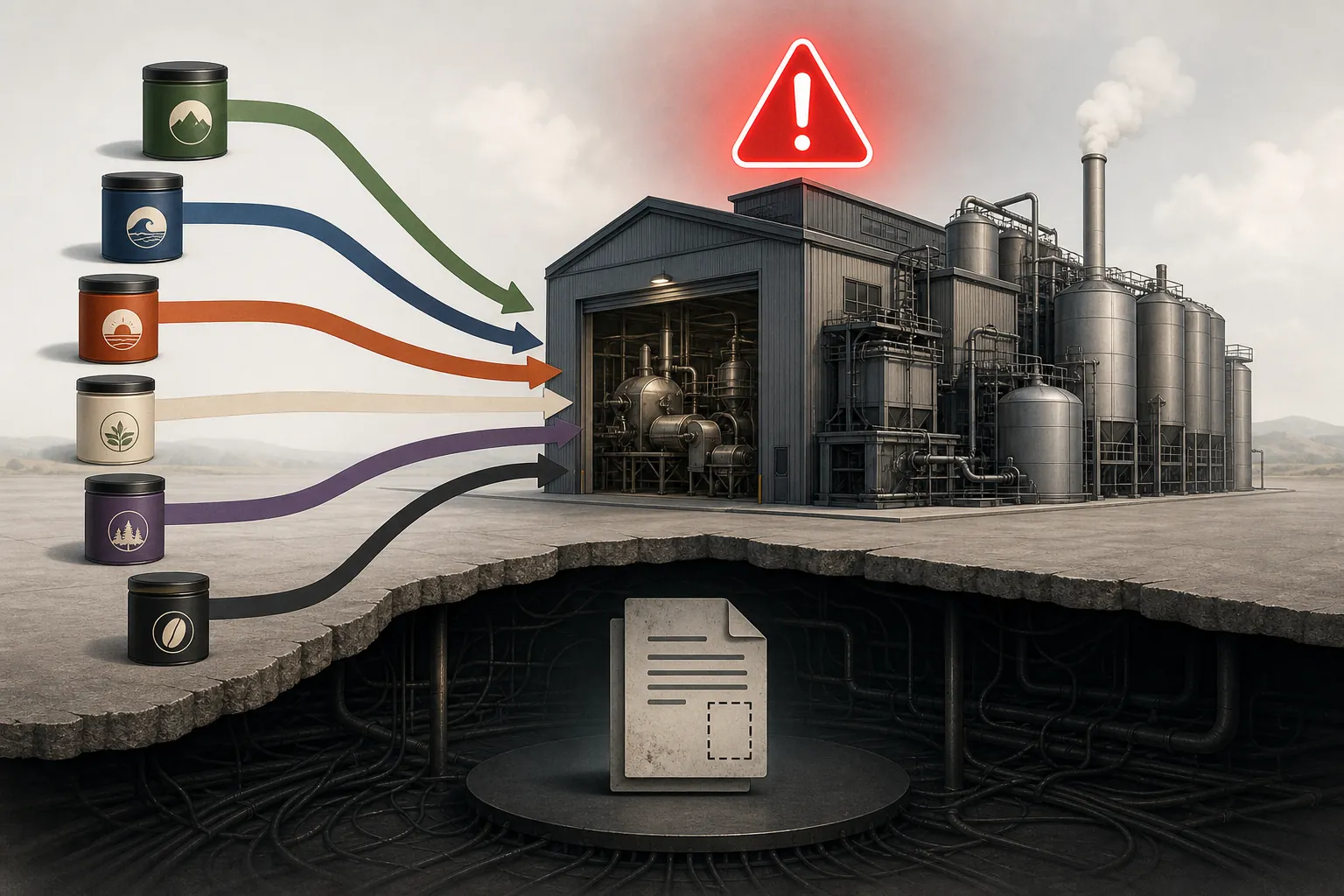
The Snapchill coffee recall looked, from the outside, like a sprawling finished-goods problem: 549,146 cans, more than 250 products, 148 roaster brands, distribution across the United States and into Canada, and a product list that ran from black coffee to coffee with oat milk and other formulations.[1][2] The trigger was much narrower. FDA said Snapchill initiated the recall after the agency notified the company that its process for manufacturing low-acid canned foods had not been filed with FDA, raising the possibility that the products could support the growth and production of botulinum toxin.[2]
That distinction matters for anyone trying to understand coffee recall supply chain traceability challenges. This was not a case where a brand’s lot system failed to find its own cans after a bad test result. It was a shared-processor compliance gap that became public only after the regulator identified the missing process filing. A roaster could know its SKU, lot, retailer exposure, and customer list and still have no ordinary finished-goods signal telling it that the co-manufacturer’s low-acid canning process had not been filed.
Scale Was Visible; The Failure Point Was Not
The recall’s public footprint came from the co-manufacturing model. Snapchill canned products for many roasters, so a single processor-level issue propagated through many brand names. FDA’s recall notice listed affected products sold under numerous coffee brands and in can sizes ranging from 7 oz to 12 oz.[2] The same list also showed formulation variation across black coffee, coffee with non-dairy creamer, coffee with oat milk, teas, and related categories.[2]
For recall execution, that variation is not cosmetic. Different labels, can sizes, product names, and retail channels mean more notices, more inventory checks, more customer-service scripts, and more reconciliation between what the processor shipped and what each brand believed was in market. FDA later classified the event as a Class II recall, a category used when exposure may cause temporary or medically reversible adverse health consequences or when the probability of serious adverse health consequences is remote.[3]
The operational burden still landed widely. The brands were the names consumers recognized, the labels retailers pulled, and the customer inboxes that had to answer questions. Yet the underlying issue described by FDA sat at Snapchill’s process-filing layer, not inside a single roaster’s demand plan or warehouse record.[2]
Why Lot Traceability Can Work and Still Miss the Real Risk
A brand-level traceability system usually becomes useful after a triggering event. It can answer which lots were produced, where they shipped, which retailers received them, which purchase orders are implicated, and what inventory remains under company control. Those capabilities matter. Faster identification can reduce the scope and duration of a recall when the problem is already known.
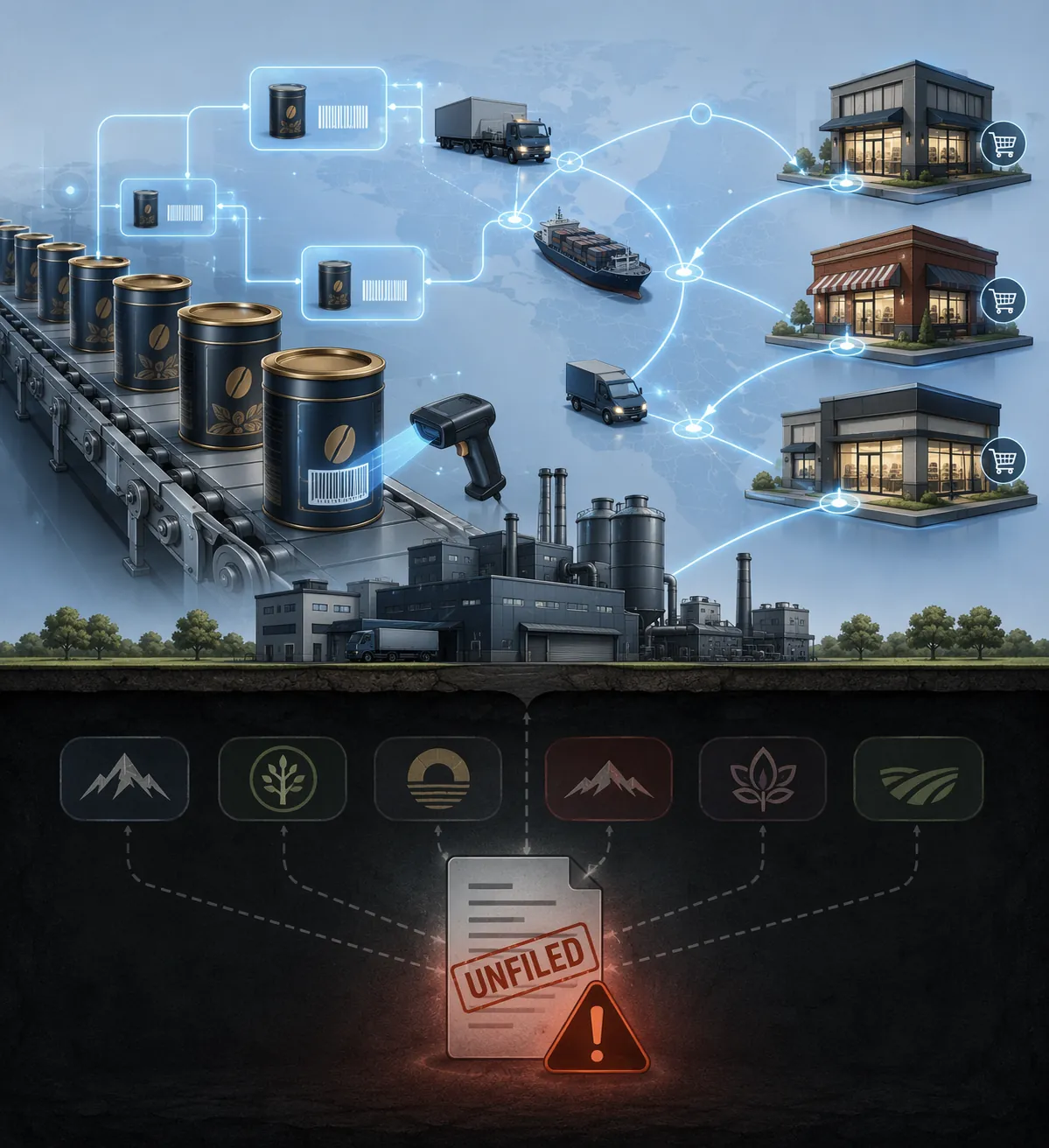
But the Snapchill case sits one layer upstream from that workflow. The question was not simply, “Which cans went where?” It was, “Were the process conditions that made those cans commercially acceptable properly filed before the cans existed?” A finished-goods lot record does not necessarily contain the answer. A pallet scan does not prove a scheduled process filing exists. A retailer shipment notice does not verify that the co-packer’s regulatory file is current.
This is the traceability category error the recall exposed. Product movement, batch genealogy, formulation management, and process-compliance status are related, but they are not the same record.
| Record Type | What It Can Show | What It May Not Show |
|---|---|---|
| Finished-goods lot tracking | Which cans, cases, or pallets moved through warehouses and customers | Whether the co-manufacturer’s required process filing existed before production |
| Batch genealogy | Inputs, production dates, and links between materials and outputs | Whether a regulatory filing obligation was met for the shared process |
| Formulation records | Which recipe or product category a SKU belongs to | Whether the filed process, if any, covered that formulation and package format |
| Supplier or co-packer approval | Whether a partner passed onboarding or periodic review | Whether compliance status changed or was incomplete for a specific process |
| Processor-level compliance evidence | Whether required filings, validations, and process artifacts are current | Downstream shipment exposure unless linked to product and planning data |
A mature recall team could have executed quickly once FDA’s notice arrived and still have been blind before it arrived. That is not a contradiction. It means the system was designed around recall response, not around independent visibility into a shared processor’s compliance conditions.
The Co-Manufacturer Is the Common Node
In a single-brand plant, a missing process filing would still be serious, but the exposure map is simpler. One company controls the facility, the regulatory relationship, the production schedule, the affected labels, and the customer notification path. In a co-manufacturing network, those elements split across contracts.
Snapchill occupied the common node. Each roaster may have had its own product information, retailer relationships, and customer records. None of that automatically creates visibility into every processor-level regulatory artifact. Unless the contract, audit program, or traceability platform requires that evidence to be associated with the actual product-process combination, the brand is relying on a trust layer that does not behave like traceability.
The breadth of the FDA product list shows why the common node matters. A shared facility can turn one process-compliance issue into dozens of outward-facing recall tasks. The brands look separate to consumers, but operationally they are exposed through the same manufacturing dependency.[2]
What the Product List Says About Recall Execution
The affected products were not one uniform canned coffee under different labels. FDA’s list included multiple product descriptions and categories, including black coffee, coffee with non-dairy creamer, coffee with oat milk, and teas.[2] That matters because product variation complicates the matching work after a notice: which UPCs are affected, which product names appear on distributor files, which pack sizes sit in which warehouse, and whether a retailer’s item master uses the brand’s naming convention or the co-packer’s.
Can-size variation adds another layer. A 7 oz product and a 12 oz product may sit in different planograms, cases, replenishment rules, or ecommerce listings. The recall still traces back to the same processor-level problem, but the work of removing affected product happens through many small commercial records that were never designed to explain a low-acid canning filing.
Fast Recall Lookup Is Useful, But It Is a Different Promise
Traceability vendors often emphasize speed, and there is a real operational reason for that. SafetyChain describes manual trace exercises that can take more than five hours compared with digital traceability processes completed in under ten minutes, based on its published customer examples.[4] Food Logistics, citing International Trade Centre material via KEZZLER, reported that strong traceability programs can reduce recall scope by 50% to 95%.[5] The same Food Logistics article cites an FMI/GMA joint study placing the average direct cost of a recall at $10 million.[5]
Those figures support the case for better traceability, but they should not be stretched beyond what they measure. Faster lookup can reduce time spent identifying affected product after a problem is known. Better serialization or lot control can reduce the amount of product swept into a recall when the affected population is precise. Neither claim proves that a brand can see an unfiled co-manufacturer process before FDA points to it.
For procurement and planning teams, this is where vendor demos can become too comfortable. A platform can show a beautiful backward trace from can to batch to ingredient and a forward trace from lot to customer. That may still leave the co-manufacturer’s process-compliance file outside the data model, attached to a contract folder, a supplier portal, or an annual audit PDF that never blocks production planning.
The Planning Question Hidden Inside Traceability
Traceability becomes materially more useful when it connects to planning and execution controls. Blue Yonder describes its Chain of Custody approach as connecting item-level traceability with supply chain planning, including the ability to identify affected inventory and support actions such as inventory lockdown when a batch is flagged.[6] That is the right neighborhood of capability for recall execution: planning systems need to know not only what happened, but what to stop, reroute, allocate, or release.
The Snapchill case asks a harder question than batch lockdown. Could the system represent the co-manufacturer’s process status as an operational condition before product is made? Could it associate a specific regulatory artifact with the product category, package format, facility, and production process? Could an expired, missing, or unverified artifact block a production order, raise a procurement hold, or warn a planner that multiple brands share the same exposure?
Without that connection, the planning system acts only after someone flags the batch or processor. That is still valuable. It is not the same as detecting the condition that makes the batch recallable.
What to Ask Before the Next Co-Packer Contract
A procurement review that stops at “Can we trace lots?” is too narrow for shared manufacturing. The better questions sit at the boundary between supplier qualification, regulatory evidence, and planning controls:
- Can the co-manufacturer’s required process filings, validations, and regulatory artifacts be linked to the actual product-process-package combination, rather than stored as general supplier documents?
- Can the platform show every brand, SKU, and lot exposed to the same facility, line, or process condition when a processor-level issue appears?
- Can missing or unverified compliance evidence create a planning hold before production, shipment, or replenishment?
- Can the brand see status changes during the contract period, or only at onboarding and annual audit time?
- Can recall execution use the same data model that monitors processor status, or does the company discover the compliance issue in one system and chase inventory in another?
These questions do not turn brand owners into regulators, and they do not remove the co-manufacturer’s responsibility for its own filings. They do change the evidence standard. A certificate in a folder is not the same as a controlled condition in the planning and traceability environment.
The Gap the Recall Leaves Behind
The Snapchill recall exposed a mismatch between how supply chains talk about traceability and where co-manufacturing risk can sit. The visible recall was enormous because 148 roasters and more than 250 products depended on one processor.[1][2] The triggering failure described by FDA was narrower: an unfiled low-acid canned food process.[2]
For planners and procurement leaders, the lesson is not that lot tracking is unimportant. It is that lot tracking is incomplete when the recallable condition lives at the shared processor’s compliance layer. The buying question is no longer only, “Can we trace our coffee cans?” It is, “Can we see the processor-level conditions that make those cans recallable before the regulator tells everyone else?”
References
- Coffee Recall Update as FDA Sets Risk Level — Newsweek — July 2024 — link
- Snapchill LLC Recalls Canned Coffee Products Due to Potential Clostridium botulinum — U.S. Food and Drug Administration — June 2024 — link
- Coffee recall: FDA classifies Snapchill recall as Class II — NewsNation — July 2024 — link
- Why Recalls Take Hours: The Hidden Cost of Manual Traceability — SafetyChain — link
- How Strong Traceability Programs Reduce Risks of Food Recalls — Food Logistics — 2022 — link
- What Is Supply Chain Traceability? — Blue Yonder — link
§ 42 — Cited evidence
Flag an inaccuracy or submit a comparable account — Contribute or read how claims are verified in Methodology.