
§ 41 — Use-case analysis
How USDA Program Changes Are Reshaping School Lunch Supply Chains
USDA regulatory mandates, persistent cost pressures, and a proven AI proof point are converging to make K-12 school lunch a structural opportunity for supply-chain planning technology. This analysis examines the intersection of program changes, manual process gaps, and vendor opportunity.
- Function
- procurement-automation
- AI technique
- computer-vision
- Evidence source
- Camaréna (2022) Frontiers in Sustainable Food Systems
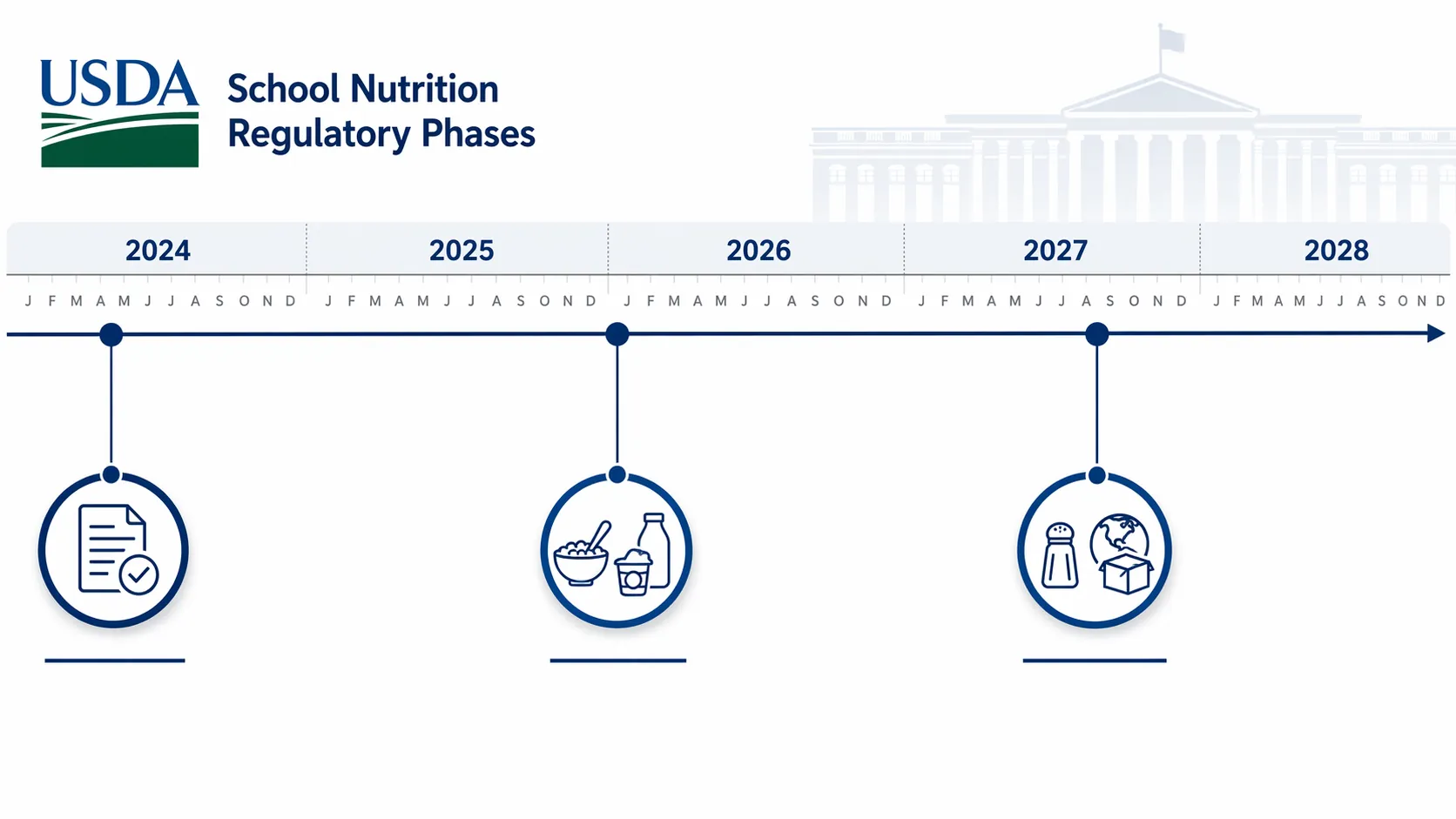
The school lunch supply chain program changes now moving through USDA rules are not just nutrition targets. They are procurement-data requirements with a compliance clock attached. Under the April 2024 final rule, added sugars limits for cereals, yogurt, and flavored milk begin in school year 2025-26; sodium must fall by 10% at breakfast and 15% at lunch by school year 2027-28; and each school food authority faces a 5% cap on non-domestic food purchases by school year 2027-28.[1]
That means a district cannot simply buy the same case of product and hope the menu works. Someone has to know which supplier sheet contains added sugar data, which grain item helps or hurts the weekly sodium calculation, which domestic-origin claim counts toward the Buy American threshold, and whether the bid file can prove it later. The work lands less like a policy announcement and more like a new set of required fields in a system many districts still do not have.
The Buyer Is Not USDA
One reason this market is easy to misread is that the federal government writes much of the rulebook, but it does not behave like a single enterprise buyer. The operating channel is thousands of local purchasing environments. A FoodService Director analysis described school foodservice as an $18-20 billion annual market, with about $10 billion in annual food purchases across more than 14,000 districts; roughly 80% of procurement was commercial product rather than USDA commodity items.[2]
The age of that $18-20 billion figure matters. It comes from a 2014 market backgrounder, so it should not be treated as a clean 2026 market-size estimate. It is still useful for the shape of the channel: fragmented buyers, commercial suppliers, reimbursement-dependent budgets, and a purchasing process that has to convert federal program rules into local bid language, product evaluation, receiving records, and menu compliance.
For planning vendors used to clean enterprise accounts, that structure is both the attraction and the warning label. There is plenty of recurring operational work. There is also no obvious single buyer that can standardize the data model for everyone else.
Cost Pressure Makes Manual Compliance Harder to Defend
The new requirements would be easier to absorb in a well-staffed back office with modern product data feeds and budget room. That is not the condition the sector is reporting. In the School Nutrition Association’s school year 2025-26 trends coverage, based on 1,240 respondents, 99% of school nutrition directors said they needed more funding, 98% faced food cost challenges, 95% faced labor cost challenges, 95% faced equipment cost challenges, and 93% said they needed more staff, training, equipment, and infrastructure to reduce ultra-processed foods.[3]
USDA’s School Food Authority Survey III points in the same direction from another angle: 95% of school food authorities reported at least one supply-chain challenge in school year 2023-24, and 40% reported increased labor costs, up from 31% in school year 2022-23.[4] That is not proof that every district needs an AI product. It is proof that the administrative room for extra manual checking is thin.
A sodium reduction target, for example, does not only affect menu design. It changes substitution risk. If a supplier shorts one product and offers another, the district needs to know whether the substitute still fits the weekly pattern. A non-domestic purchase cap does not only affect procurement preference language. It creates a tracking problem across line items, suppliers, and invoices. These are planning problems before they are dashboard problems.
The Manual Baseline Is the Market Signal
LINQ’s 2023 nutrition survey found that more than 70% of school districts still conduct manual back-office nutrition tasks. Among districts with fewer than 1,000 students, 48% operated all or mostly manually.[5] For a vendor, that number should not be read as a simple adoption opportunity. It is also a clue about why adoption has been slow: the buyer may need the product most where staff capacity, integration capacity, and procurement sophistication are weakest.
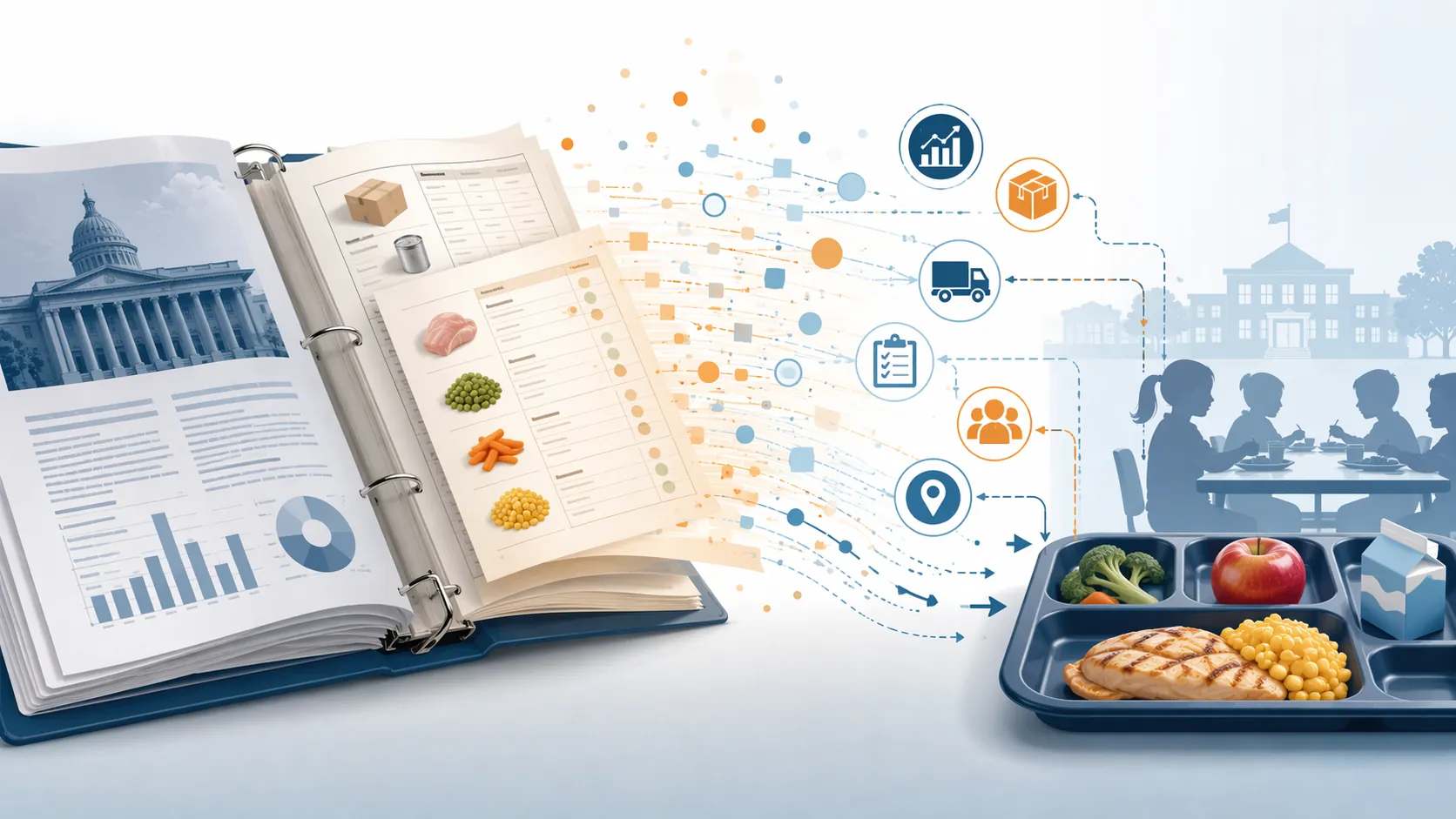
The paperwork is not ornamental. Product formulation statements, nutrition facts panels, Child Nutrition labels, ingredient lists, allergen statements, country-of-origin claims, bid specifications, and distributor substitutions all have to be reconciled against meal-pattern rules and budget constraints. A spreadsheet may be adequate when the menu is stable, supplier data is clean, and the compliance question is narrow. It becomes brittle when the district must compare more attributes across more products under tighter targets.
This is where the market differs from a generic foodservice technology sale. The immediate pain is not only forecasting demand for pizza or milk. It is extracting usable product attributes from supplier documents that were not designed to be machine-readable, then maintaining that data as products, bids, and regulations change.
The AI Proof Point Is Specific, and That Is Why It Matters
The strongest evidence for automation in this channel is not a vendor promise about generative AI. It is a peer-reviewed 2022 case study by Camaréna in Frontiers in Sustainable Food Systems. The deployment used advanced OCR, natural language processing, image recognition, and machine learning to process more than 37,000 non-standard supplier specification sheets. It reported 70-80% time savings compared with manual extraction and sustained 95-98% accuracy across 30 mandatory and 50 optional data fields.[6]
Those details matter because the hard task was not a polished planning scenario. It was the dirty feeder problem: turning inconsistent supplier PDFs and product documents into structured data that school nutrition programs could use. In many vertical software markets, the attractive workflow demo begins after the data has already been cleaned. This case begins where the district’s administrative burden actually sits.
| Operational Problem | What the Evidence Shows | What It Does Not Prove |
|---|---|---|
| Supplier data arrives in non-standard formats | The Camaréna case processed 37,000+ non-standard specification sheets with AI-assisted extraction.[6] | It does not prove that all suppliers will provide cleaner data or that every district can deploy the same system. |
| Manual extraction consumes staff time | The case reported 70-80% time savings versus manual extraction.[6] | It does not establish a sectorwide ROI benchmark. |
| Compliance depends on many product attributes | The system sustained 95-98% accuracy across 30 mandatory and 50 optional fields.[6] | It does not remove the need for review, governance, or updates when regulations and products change. |
The limitation is just as important as the result. The case uses pseudonyms, including Rayfood Solutions and LPB Ltd, so the underlying organizations cannot be fully evaluated from public materials.[6] It is a credible proof point for a difficult workflow, not evidence that a packaged product has already crossed the K-12 market.
It also points to the implementation question that usually gets hidden in market slides: who maintains the product data after the first extraction? A model can accelerate document processing, but somebody still has to decide how exceptions are reviewed, how supplier changes are captured, how bid-cycle updates flow into menus, and how the district proves compliance when auditors or state agencies ask.
Why This Has Not Become an Obvious Planning Vendor Land Grab
From a distance, the ingredients for a vertical planning opportunity are visible: recurring demand, regulatory deadlines, supplier complexity, labor pressure, and a documented AI use case. Up close, the channel resists a standard enterprise expansion motion.
- The buyer base is fragmented across more than 14,000 districts rather than consolidated into a small set of national accounts.[2]
- Budgets are tied to reimbursement, local funding, and political scrutiny, which changes the buying case for software.
- Small districts may have the most manual workflows but the least capacity to implement and maintain a sophisticated planning layer.[5]
- The supplier-data problem is upstream of planning optimization; without structured product attributes, better algorithms have little to plan against.
- Procurement cycles, bid rules, and compliance documentation create a slower route to renewal than a pure commercial foodservice account.
That does not make the market unattractive. It changes the product and channel thesis. A vendor entering this space would need more than demand forecasting, replenishment logic, or a menu-planning interface. The defensible wedge may be supplier-document ingestion, attribute normalization, compliance tracking, and exception review, with planning functions layered on once the data foundation is trusted.
As of Q3 2026, the available evidence does not show major supply-chain planning vendors such as o9, Blue Yonder, Kinaxis, RELEX, or Anaplan specifically targeting K-12 school lunch as a channel. That is an absence of public evidence, not proof of absence inside private sales pipelines. Still, for market intelligence purposes, it keeps the conclusion narrow: demand signals are documented, but scaled vendor entry is not.
The Policy Noise Still Matters
The regulatory calendar is not the only uncertainty. A reported 20-state lawsuit over USDA funding conditions and USDA reorganization activity underway as of July 2026 could affect the funding and administrative environment around school meal programs. Those issues should not take over the supply-chain analysis, but they do matter for timing. A district facing unresolved policy and budget questions may delay software decisions even when the operational case is obvious.
That is the uncomfortable shape of the opportunity. USDA’s school lunch supply chain program changes are creating real data requirements. Cost and labor pressure make manual processes harder to sustain. LINQ’s survey gives the manual baseline, and the Camaréna case shows that the hardest supplier-specification task can be attacked with AI at meaningful scale.[5][6] What remains unproven is not whether the work exists. It is whether a vendor can package, sell, implement, and support the solution across a fragmented public-sector channel without underestimating the paperwork.
References
- School Nutrition Standards Updates, USDA Food and Nutrition Service.
- The complex world of K-12 purchasing, FoodService Director.
- School Nutrition Association once again calls on Congress to increase funding for school nutrition programs, FoodService Director.
- School Food Authority Survey III on Supply Chain Disruption, USDA Food and Nutrition Service.
- Automating K12 Nutrition to Solve Rising Costs and Staff Shortages, LINQ.
- Camaréna (2022), Frontiers in Sustainable Food Systems, Frontiers in Sustainable Food Systems, 2022.
§ 42 — Cited evidence
Flag an inaccuracy or submit a comparable account — Contribute or read how claims are verified in Methodology.