
§ 41 — Use-case analysis
Why PJM Grid Delays Break AI Supply Chain Planning
PJM's 8+ year interconnection timelines, first-ever capacity auction failure, and transformer lead times exceeding 160 weeks create a structural power deficit that standard AI supply-chain planning models fail to capture. This article explains why energy availability is now the binding constraint for GPU and ASIC procurement, capacity forecasting, and deployment scheduling.
- Function
- capacity planning
- AI technique
- forecasting
- Failure pattern
- power as delay variable
- Evidence source
- Data Center Knowledge, Introl, GEP
The failure in AI supply-chain planning is no longer hidden in the chip line item. A model can still optimize GPU and ASIC purchase timing, supplier allocation, colocation reservations, and depreciation curves, then produce a deployment plan that looks coherent. In PJM territory, that plan can still be wrong at the most basic level: the racks may not be energizable when the model says capacity comes online.
The uncomfortable part is that the constraint is not a vague energy-transition problem. It has dates, queues, auction results, and equipment lead times attached. Projects entering service in 2025 spent about three years reaching an interconnection agreement and then roughly four more years waiting after approval, according to Data Center Knowledge’s May 2026 reporting on PJM-related delays.[1] PJM’s December 2025 capacity auction procured 145,777 MW, 6,625 MW below the 20% reserve-margin target, in what Introl described as the first such failure in PJM history.[2] Large power transformer lead times exceeded 160 weeks by 2026, up from about 50 weeks in 2021, based on Wood Mackenzie analysis cited by Data Center Knowledge and separately echoed by GEP.[1][3]
Those numbers do not describe one bottleneck. They describe a cascade. An interconnection agreement arrives late. The project then waits on transmission upgrades, substation capacity, and utility-side work. Transformer procurement sits inside the same calendar, not outside it. By the time the energy path is ready, the chip plan, server integration plan, construction draw schedule, and customer capacity forecast may all be describing a facility that procurement has funded but operations cannot fully use.
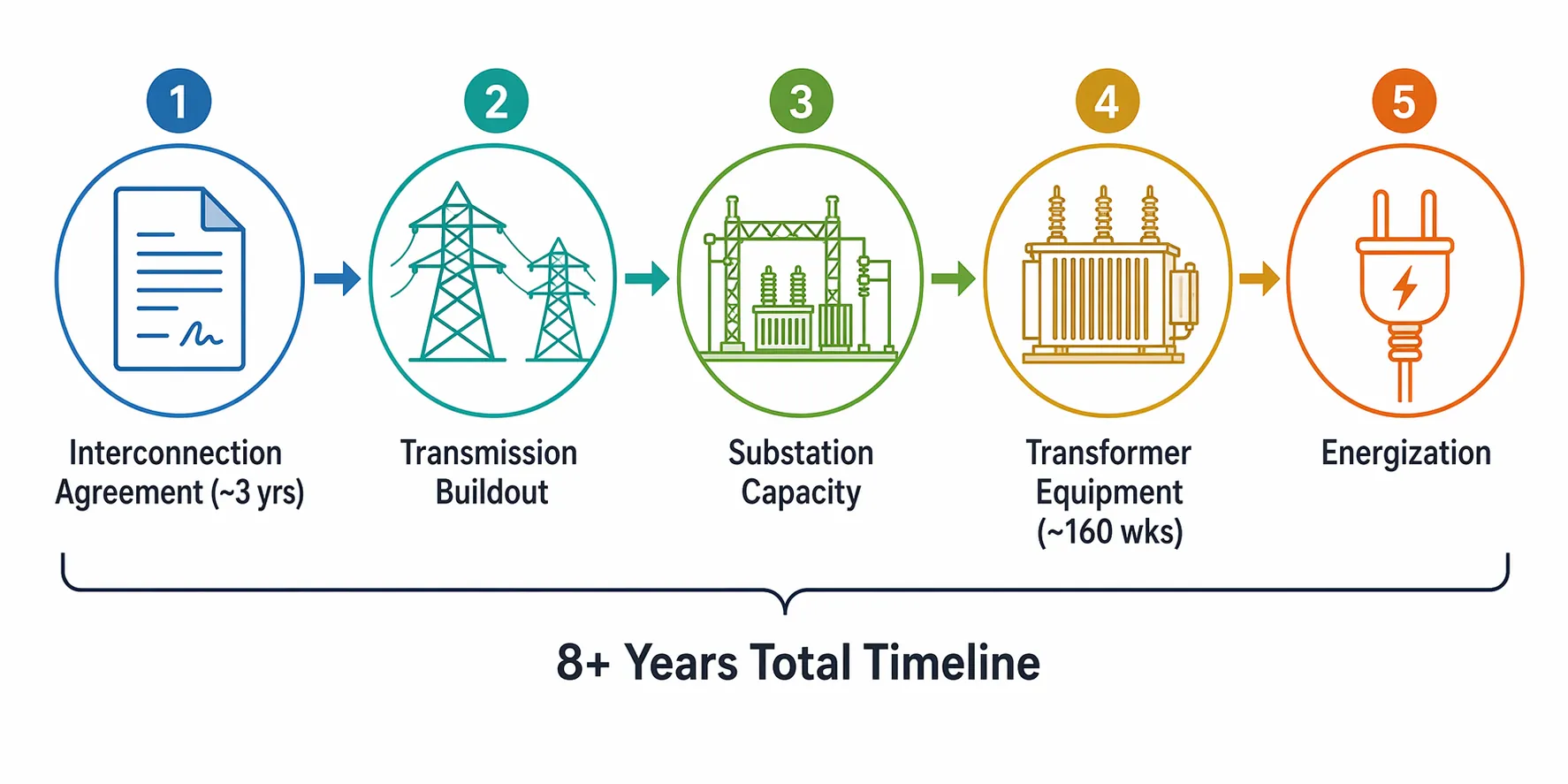
The Planning Error Is Treating Power Like a Delay Variable
Most AI infrastructure planning models are comfortable with constrained supply. They can represent a delayed GPU allocation, a more expensive ASIC package, a longer liquid-cooling installation window, or a supplier whose output must be split across regions. Those are painful inputs, but they remain negotiable in the model: add cost, add time, rebalance demand, change the vendor mix.
PJM data center power access behaves differently. When interconnection, transmission, substation, and transformer capacity do not exist, there is no procurement premium that turns purchased compute into usable compute on the same schedule. The missing variable is not “higher power risk.” It is the maximum energizable capacity available to the deployment plan.
That distinction matters because a probabilistic delay can be smoothed across a portfolio. A hard capacity gate cannot. If the model assumes a campus will receive enough power to absorb a new accelerator tranche in a given quarter, the downstream plan will behave as if the capacity exists. It will schedule hardware deliveries, reserve integration labor, book customer capacity, and recognize revenue assumptions against a physical input that may be unavailable for years.
The legacy PJM process is the warning sign. Data Center Knowledge reported that the time to reach an interconnection agreement had grown from less than two years in 2008 to more than eight years for some projects under the legacy queue process, with the downstream wait after approval becoming a major source of delay.[1] PJM reforms may shorten future agreement timelines under the cluster process, but the operational question is not whether a queue reform exists. It is whether the energization date feeding the supply-chain model is constrained by actual transmission, substation, and equipment availability.
PJM’s Signals Are Already Showing Up in System Outcomes
The December 2025 capacity-auction result is useful because it moves the problem out of anecdote. PJM did not merely warn that load growth might become difficult. Its auction failed to procure enough capacity to meet the 20% reserve-margin target, coming in 6,625 MW short.[2] For a planning team, the important point is not the market-design detail. It is that the system-level buffer a data center implicitly depends on is no longer something to round away.
The cost signal moved at the same time. PJM total market settlements rose 56% in one year, from $51.7 billion in 2024 to $80.5 billion in 2025, while capacity costs rose 285%, from $2.69 billion to $10.39 billion, according to Utility Dive’s April 2026 coverage citing EnerKnol analysis.[4] A cost increase of that size does not prove that any particular AI campus will be delayed. It does show that the constraint is visible in market clearing, not just in utility interconnection paperwork.
The load-growth arithmetic is the part that should make a capacity plan uncomfortable. Introl’s 2026 analysis framed PJM’s data-center-driven demand additions at roughly 5 GW to 7 GW per year against about 2 GW to 3 GW per year of new generation additions.[2] Even if those figures move, the shape of the problem is clear enough for planning purposes: the gap compounds. A one-year miss does not stay inside one year when the next year’s load arrives before the last year’s infrastructure catches up.
| Planning Input | Common Model Treatment | PJM-Specific Problem |
|---|---|---|
| Interconnection timeline | Risk-adjusted delay or milestone assumption | Legacy timelines can run beyond eight years, with post-approval waits after agreement |
| Transformer availability | Procurement lead-time variable | Large transformer lead times exceeded 160 weeks by 2026 |
| Capacity market buffer | Background market condition | December 2025 auction came in 6,625 MW below the 20% reserve-margin target |
| Data-center load growth | Demand forecast input | Estimated additions of 5 GW to 7 GW per year exceed 2 GW to 3 GW of new generation additions |
The Cascade Runs Through More Than the Queue
It is tempting to talk about the interconnection queue as if it were the bottleneck. That is too clean. The queue is the first visible planning failure, but the later stages are where schedules often lose their last remaining slack.
After a project clears the agreement stage, someone still has to build or upgrade the path that lets power reach the site. Transmission work must be studied, permitted, sequenced, and built. Substation capacity must exist. Utility equipment must be available. The large transformer is not a commodity part a data center operator can simply pull forward by asking a server supplier to expedite a shipment.
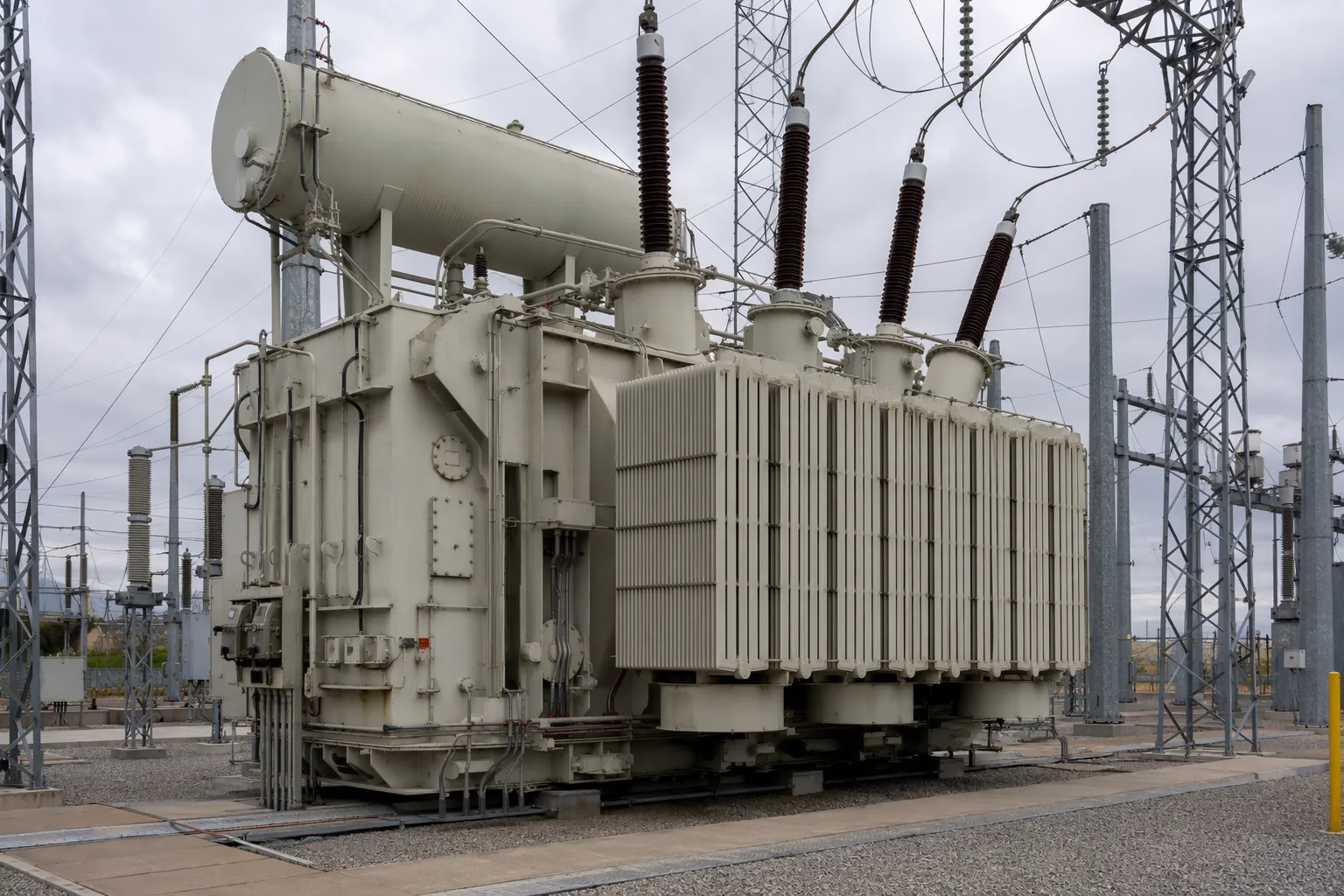
The transformer number is worth keeping close to the model assumption. Lead times exceeding 160 weeks mean the equipment calendar can consume more than three years before installation, testing, and energization are finished.[1][3] GEP also estimated that each month of delay costs about $3.1 million per 100 kW rack in lost revenue, a figure that should be treated as an external estimate rather than a universal accounting rule.[3] The value is not in pretending every rack has the same economics. The value is in forcing the model to stop treating the delay as administratively small.
Supplier behavior is pointing in the same direction. Knowledge at Wharton described GE Vernova’s $5.3 billion acquisition of full ownership of Prolec GE as a signal that transformer capacity has become strategically important in the AI infrastructure supply chain.[5] That is not independent proof of a PJM-specific shortage by itself. It is a useful confirmation that the chokepoint is serious enough for a major equipment supplier to vertically integrate around it.
Why the GPU and ASIC Plan Breaks Downstream
A chip procurement plan usually starts with demand: training demand, inference demand, enterprise reservations, cloud region forecasts, model roadmap assumptions, and price-performance targets. From there it backs into accelerator quantities, server build schedules, network gear, power and cooling density, and deployment windows. The plan may include energy costs. It may include construction milestones. Too often, it does not make energizable megawatts the governing constraint.
That creates a false agreement across functions. Procurement sees a supplier-backed hardware plan. Finance sees a capital plan tied to expected capacity. Sales or internal platform teams see capacity becoming available in a named quarter. Construction sees a facility path. But if the grid-side assumptions are soft, the agreement among those plans is cosmetic. They are all inheriting the same unverified power date.
The physical mismatch is harshest when chips are ordered against capacity that cannot be energized. Accelerators have delivery windows, warranties, financing costs, integration requirements, and opportunity costs. If they arrive before usable power, the operator is not merely waiting on a utility milestone. It is carrying high-value compute inventory, shifting deployment labor, renegotiating customer capacity, and possibly redirecting hardware to a less optimal site.
Reports of idle or stranded GPU inventory should be handled carefully. GEP and Enki AI both describe market signals that some technology firms are holding chips they cannot deploy because of power constraints.[3][6] Public reporting cited here does not include named company disclosures or quantified volumes. That makes the claim useful as a warning signal, not as a verified company-level fact. A planning team should not cite it as proof that a specific hyperscaler has idle inventory. It should use it to ask whether its own hardware plan is tied to a dated, sourced energization assumption.
The National AI Framing Is Less Useful Than the Capacity Gate
There is no shortage of broad language about AI competitiveness. Some of it is warranted. CSIS concluded in March 2025 that “electricity supply is the most acutely binding constraint on expanded U.S. computational capacity and, therefore, U.S. AI dominance.”[7] Wharton’s Morris Cohen called energy infrastructure “the most consequential supply chain decision of this generation” in Knowledge at Wharton’s 2026 discussion of AI’s supply-chain problem.[5]
Those statements are valuable because they move electricity from facilities management into supply-chain strategy. But for an infrastructure planning meeting, the more useful question is narrower: which megawatts are real, at which site, by which date, under which interconnection status, with which equipment already secured?
A planning model that answers that question can force uncomfortable tradeoffs early. A model that does not answer it will keep producing capacity curves that look precise because the uncertainty has been pushed into a facility milestone no one has permission to challenge.
Workarounds Are Signals, Not a General Solution
The clearest workaround signal is xAI’s use of portable gas generators in Memphis, which GEP cited as an example of AI infrastructure operators seeking power outside the normal utility interconnection path.[3] The point is not that every operator can or should copy that approach. Portable generation raises its own permitting, emissions, fuel, community, cost, and reliability questions. Its planning value is simpler: when a compute operator brings generation to the site, the normal assumption that grid power will arrive in time has already failed.
Other workarounds have similar limits. Operators can shift workloads, lease capacity in another region, pursue behind-the-meter generation, reserve colocation space, or adjust training schedules. Those moves may reduce the damage from a missed energization date. They do not turn a PJM-constrained site into usable capacity on the original chip deployment calendar.
The Reforms Matter, but They Do Not Remove the Planning Ceiling
PJM has not ignored the problem. Its move toward a cluster-based interconnection process is intended to process projects more efficiently, and new projects under Cycle 1 may receive agreements in one to two years. That is a real caveat to the eight-plus-year legacy timeline. It would be wrong to model every future project as if the old process remains unchanged.
It would also be wrong to treat a faster agreement as the same thing as faster energized capacity. RMI’s November 2025 work on PJM’s “speed to power” problem emphasized that large-load growth is stressing not just interconnection administration but the ability to connect new demand to the grid quickly enough.[8] The queue still has to be worked through. New applications still arrive. Transmission and substation upgrades still have to be built. Transformers still have to be manufactured and delivered.
There is also forecast uncertainty on the load side. Large-load queue figures can include speculative or duplicative applications, sometimes called phantom load. Ascend Analytics warned in May 2026 that data-center-driven large-load interconnection queues create a difficult screening problem for U.S. grid operators.[9] That uncertainty cuts both ways. Some requested load may never materialize, which would reduce pressure. But if the model cannot distinguish committed, financed, utility-studied load from speculative requests, it still cannot produce a reliable power availability date.
The Assumption That Has to Change
For AI supply-chain planning in PJM, the decisive change is not adding another risk percentage to the energy line. The model has to treat energy availability as the capacity gate. That means the compute plan should not be allowed to exceed dated, sourced, site-specific energizable capacity unless the excess is explicitly labeled as unpowered inventory or contingent deployment.
This is a stricter standard than many planning models currently use. It requires the interconnection assumption to carry source, date, queue status, expected agreement timing, post-agreement work, substation dependency, transformer status, and energization dependency close to the capacity forecast. It also requires the chip plan to show what happens if accelerators arrive before power: where they sit, whether they can be redirected, who absorbs the financing cost, and which customer or internal workload waits.
The PJM evidence does not say every AI data center project will fail or that every GPU order is stranded. It supports a narrower and more useful conclusion: in PJM, through at least the current planning horizon implied by legacy interconnection timelines and equipment lead times, energy availability is structurally inelastic enough to break supply-chain models that treat it as a minor risk factor. Any AI capacity plan that does not date, source, and constrain its interconnection assumptions is likely producing false precision.
References
- Why AI Data Center Projects Face Years of Delays After Approval, Data Center Knowledge, May 2026
- PJM Grid 6GW Shortfall: 2027 Data Center Power Crisis, Introl
- AI Growth Hits a Wall: Power, Not Chips, Limits Scale, GEP, Mar 2026
- Capacity cost explosion: What PJM's $80B bill means for the AI buildout, Utility Dive/EnerKnol, Apr 2026
- AI's Supply Chain Problem, Knowledge at Wharton, 2026
- The AI Power Wall 2026: Why Grid Access Halts Chip Demand, Enki AI, 2026
- The Electricity Supply Bottleneck on U.S. AI Dominance, CSIS, Mar 2025
- PJM's Speed to Power Problem and How to Fix It, RMI, Nov 2025
- Can US Interconnection Queues Survive Data Center-Driven Load Growth?, Ascend Analytics, May 2026
§ 42 — Cited evidence
Flag an inaccuracy or submit a comparable account — Contribute or read how claims are verified in Methodology.