
§ 41 — Use-case analysis
What OpenAI President's Philanthropy Reveals About AI Adoption
OpenAI's $40.5M People-First AI Fund shows that nonprofits stall on trust, literacy, and local relevance — the same organizational barriers that cause friction in enterprise supply-chain AI rollouts. This use-case analysis extracts adoption patterns relevant to supply-chain planning directors.
- Function
- supply-chain planning
- AI technique
- generative AI
- Failure pattern
- organizational barriers (trust, literacy, relevance)
- Evidence source
- OpenAI People-First AI Fund grantees page and Inside Philanthropy analysis
The most useful fact about OpenAI’s People-First AI Fund is not that it moved a large amount of money. It is that $40.5 million in unrestricted grants went to 208 nonprofits across all 50 states, selected from about 3,000 applicants, and many of those organizations were not already AI operators trying to scale a known workflow.[1] Most recipients had annual budgets between $500,000 and $10 million, and Inside Philanthropy reported that the fund intentionally included organizations with no prior AI experience.[2]
That makes the People-First AI Fund more interesting as an adoption case than as a ceremonial funding announcement. These grantees are not hiding behind an ERP integration roadmap, a mature data lake, or a procurement transformation office. They have to answer a more basic question first: will staff, community members, and local partners trust the technology enough to learn where it is useful?
The scale still matters. OpenAI’s December 2025 disbursement represented a 440% year-over-year increase in grantmaking, from $7.5 million in 2024 to $40.5 million in that single round.[1] But scale is only the opening condition. The operational lesson sits in the fund’s design: unrestricted money, a recipient base that included AI novices, and three focus areas that sound less like software deployment categories than readiness work — AI literacy, community-led innovation, and economic opportunity.[1][2]

Why This Fund Looks Like Discovery, Not Deployment
In enterprise planning teams, “AI adoption” often arrives as a tool decision. A vendor is shortlisted, a pilot is scoped, data owners are summoned, and the organization discovers late that no one has agreed on what judgment the model is allowed to influence. The People-First AI Fund starts from the opposite end. It funds organizations that may still be forming their first practical understanding of AI, then asks them to explore literacy, local relevance, and economic opportunity before use cases harden into procurement requirements.
The listening process matters here. OpenAI’s Nonprofit Commission Report says the fund was shaped by listening sessions with more than 100 organizations and more than 500 individuals.[3] That does not prove the grants will produce successful adoption. It does show that the program design treated community interpretation as an input rather than an afterthought.
For supply-chain planning directors, that distinction is not cosmetic. AI projects stall when planners do not understand the system’s limits, when commercial teams do not trust the recommendation logic, or when procurement has not settled who is accountable for vendor, data, and model risk. The blockers are often organizational long before they are mathematical.
The fund’s recipient profile is useful because it strips away a common excuse. If a nonprofit with no prior AI experience has to build literacy and trust before deciding what the technology is for, then a global manufacturer or retailer cannot treat those same tasks as soft change-management garnish. They are part of the operating system of adoption.
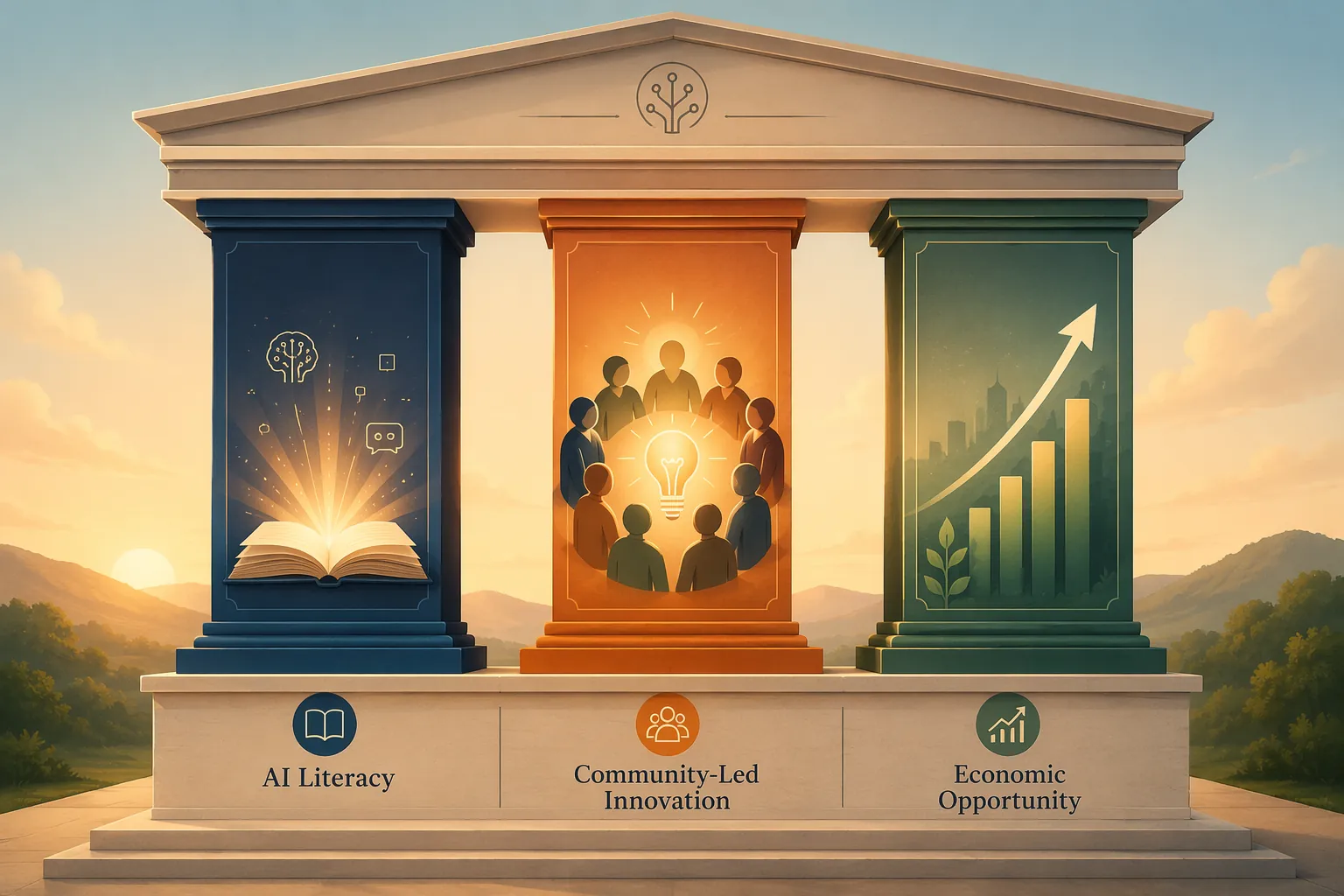
The Three Focus Areas Are an Adoption Architecture
AI literacy, community-led innovation, and economic opportunity can sound broad enough to dissolve into philanthropy language. Read operationally, they form a sequence of adoption conditions.
| People-First AI Fund focus area | What it tests in community organizations | Supply-chain planning parallel |
|---|---|---|
| AI literacy | Whether staff and communities can understand capabilities, limits, and appropriate use | Whether planners, buyers, and legal teams share a working view of model limits and decision rights |
| Community-led innovation | Whether use cases come from local needs rather than imported technology narratives | Whether AI pilots address real planning friction instead of vendor-demo workflows |
| Economic opportunity | Whether AI use can connect to durable participation, work, or access rather than one-off experimentation | Whether productivity gains, reskilling needs, and accountability are planned before automation pressure arrives |
AI literacy comes first because a person who cannot distinguish a plausible answer from a reliable one cannot safely delegate judgment to a model. In a nonprofit, that may affect how staff communicate with clients or how a community organization explains AI to residents. In a supply-chain setting, it affects whether a planner knows when to challenge a demand forecast, whether a buyer understands what data may enter a chatbot, and whether a manager can tell the difference between adoption and mere usage.
This is where procurement governance becomes part of adoption rather than paperwork. ChainSignal’s coverage of CSU’s OpenAI procurement governance gaps shows the enterprise version of the same problem: institutions can move toward AI access before contract structures, data rules, and operational responsibilities are fully legible to the people expected to use the tools.
Community-led innovation is the second condition because a use case selected outside the operating context usually creates theater. A nonprofit serving a neighborhood, a patient population, or a worker group has a closer view of where trust is thin and where a tool might reduce friction. A planning team has the same kind of local knowledge inside a business: the true pain point may be exception triage, supplier communication, allocation disputes, or a weekly meeting where no one trusts the baseline forecast.
Economic opportunity is the hardest of the three to evaluate early because it points beyond access. Giving an organization an AI grant is not the same as proving that AI improves wages, services, or participation. The narrower, supportable conclusion is that the fund is asking grantees to connect AI exploration to material opportunity rather than treating experimentation as its own endpoint.[1]
What the Health Grants Show — and What They Do Not
As of July 25, 2026, the public 2026 evidence is narrow. OpenAI had announced a $50 million renewal, with applications open from June 15 to July 15, 2026, but the broader 2026 grantee slate had not yet been published.[4] The public second wave was a $9.5 million set of board-directed health grants.[5] Those grants are useful as examples of problem selection, not as proof that the 2026 round has already produced measurable adoption outcomes.
The health recipients show the range of “community-led innovation” when the phrase is tied to concrete constraints. Every Cure received support for AI-enabled drug repurposing work spanning 3,000 drugs and 18,500 diseases.[5] Dollar For was listed for work tied to eliminating $1 billion in medical debt.[5] CareMessage was described as reaching 22 million low-income patients, and OCHIN as supporting more than 2,200 care sites.[5]
Those are not interchangeable use cases. Every Cure sits close to scientific and clinical discovery. Dollar For sits closer to administrative burden and access to financial relief. CareMessage and OCHIN point toward communication, care delivery infrastructure, and existing trusted channels. The common thread is not a single AI capability. It is that the problem definition starts from a population, a bottleneck, or an institution that already has a reason to care about the outcome.
That is the adoption signal supply-chain leaders should notice. A retailer testing AI for inventory allocation, a manufacturer testing supplier-risk summarization, and a logistics team testing customer-service automation should not expect the same readiness plan just because all three tools use generative AI. The use case inherits the trust boundaries, data sensitivities, and accountability structure of the workflow it enters.
Health also makes the risk of overclaiming obvious. A public grant announcement can identify organizations and intended work. It cannot yet tell us whether patients received better care, whether staff trusted AI-mediated processes, or whether model-supported decisions improved outcomes. Treating the June 2026 health wave as evidence of proven impact would confuse selection with effectiveness.
The Enterprise Analogy Is Strongest at the Friction Points
Nonprofits and enterprise supply chains are not the same operating environment. Their funding models, risk tolerances, data systems, and accountability structures differ. The useful comparison is narrower: both can mistake tool access for adoption readiness.
In supply-chain planning, the first friction point is trust. A model recommendation changes the meeting. If it suggests pulling forward purchase orders, reallocating constrained inventory, or revising a forecast, someone has to defend that decision to finance, sales, operations, or suppliers. Trust is not created by an accuracy chart alone. It is created when users know what the system saw, what it ignored, when it should be challenged, and who owns the override.
The second friction point is literacy. A planning director does not need every buyer or scheduler to become a model engineer. They do need enough shared vocabulary to prevent two dangerous behaviors: blind acceptance of confident outputs and reflexive rejection of anything machine-generated. The People-First AI Fund’s inclusion of AI-inexperienced organizations makes that literacy layer visible because the program cannot assume a ready user base.[2]
The third friction point is relevance. Supply-chain organizations already have plenty of dashboards, alerts, and exception queues that people work around because they do not match the real decision rhythm. AI will join that pile if the first use cases are selected for demo appeal rather than operational fit. The strongest community-grant examples point the other way: start with a problem that people already experience as costly, confusing, or unfair, then test whether AI can reduce that burden.
The fourth friction point is exposure. Enterprise AI adoption adds vendor, data, and dependency risk that community grant language may not foreground. ChainSignal’s analysis of the commercial sensitivity of ChatGPT use in supply chains and the LiteLLM breach dependency-chain exposure covers the less generous side of adoption: even well-intended AI use can create new leakage paths when teams do not understand where data travels.
That risk context is larger than OpenAI. The debate around AI vendors, state capacity, and strategic dependency — including ChainSignal’s coverage of Palantir and AI nationalization risk for supply chains — is a reminder that adoption decisions do not stay confined to the application layer. Philanthropic programs can teach readiness; procurement teams still have to price dependency.
Unrestricted Grants Change the Adoption Signal
The unrestricted nature of the December 2025 grants deserves more attention than it usually gets. Restricted funding often forces organizations to perform certainty: define the project, name the deliverables, commit to the metrics, then learn only inside the approved box. Unrestricted grants give recipients more room to discover where AI is appropriate and where it is not.[1]
That flexibility is especially important when many recipients had not previously used AI.[2] For an AI-mature organization, a grant can accelerate an existing roadmap. For an AI-inexperienced organization, the first serious work may be staff training, community listening, risk assessment, data cleanup, or deciding not to automate a sensitive interaction. Those activities are easy to underfund because they do not look like deployment.
Enterprise AI budgets often have the same distortion. Licenses, pilots, and integrations are visible. Trust-building meetings, workflow mapping, red-team exercises, policy writing, and planner education are treated as overhead. Then adoption fails in the meeting: sales does not trust the forecast, procurement will not put supplier notes into the tool, legal slows the rollout, or operations quietly reverts to spreadsheets.
The People-First AI Fund does not solve that problem for enterprises. It simply makes the pattern hard to ignore. When OpenAI funds organizations that may need to learn what AI is before they decide what AI should do, it acknowledges a truth many corporate programs try to skip: readiness is work.
Do Not Blend the Numbers
Clean boundaries matter because AI funding announcements can become a fog of impressive totals. The People-First AI Fund’s 2026 renewal was another $50 million, with the application window running June 15 through July 15, 2026.[4] That is separate from broader OpenAI Foundation commitments described elsewhere; it should not be blended into a larger institutional number when evaluating what this specific fund has done.
The same discipline applies to outcomes. The December 2025 round tells us who was selected, how much funding was distributed, and what focus areas structured the program.[1] Inside Philanthropy adds useful detail about recipient size and intentional inclusion of AI-inexperienced organizations.[2] The June 2026 update identifies a health-focused second wave and examples of recipient work.[5] None of that yet supports a claim that the broader 2026 renewal has produced measurable adoption outcomes across the field.
For procurement leaders, that restraint is not pedantry. It is the same discipline needed when a vendor presents reference customers, benchmark metrics, pilot anecdotes, and roadmap commitments in one slide. Each item may be useful. They do not measure the same thing.
What Supply-Chain AI Programs Should Borrow
The enterprise lesson is not to copy a philanthropic grant program. A planning director does not have the same mandate as a foundation, and a procurement leader cannot run vendor selection like community grantmaking. The useful borrowing is design logic.
- Fund discovery before rollout: give teams time and budget to map workflows, data boundaries, user concerns, and override rules before committing to a tool-centered pilot.
- Treat literacy as infrastructure: train planners, buyers, analysts, and managers on what the system can and cannot support, not just where to click.
- Let use cases come from operating friction: prioritize decisions that already waste time, create disputes, or expose risk, rather than choosing the use case that makes the cleanest demo.
- Separate adoption evidence from access evidence: licenses issued, users onboarded, and prompts submitted do not prove that decisions improved.
- Keep vendor and data governance visible: trust in AI recommendations will collapse quickly if users later learn that sensitive commercial data moved through channels they did not understand.
The uncomfortable part is that these steps slow the visible start of a program. They make the acquisition phase less dramatic. They also reduce the chance that a planning team spends six months proving that people will not use a system whose purpose, limits, and consequences were never locally settled.
OpenAI’s People-First AI Fund is still early evidence. Its strongest contribution, as of Q3 2026, is not proof of impact at scale. It is a sharper view of adoption conditions. Whether the user is a nonprofit staff member serving a community or a planner balancing supply, demand, and risk, AI becomes operational only after people trust the process, understand the limits, and recognize the problem as their own.
References
- People-First AI Fund grantees, OpenAI, December 2025, https://openai.com/index/people-first-ai-fund-grantees/
- A Look Under the Hood of the OpenAI Foundation’s People-First AI Fund, Inside Philanthropy, https://www.insidephilanthropy.com/home/a-look-under-the-hood-of-the-openai-foundations-people-first-ai-fund
- OpenAI Nonprofit Commission Report, OpenAI, July 2025, https://cdn.openai.com/pdf/016dcd99-2a6c-476c-a6b4-0a976b1c1ca1/the-openai-nonprofit-commission-report.pdf
- $50 million fund to build with communities, OpenAI, 2026, https://openai.com/index/50-million-fund-to-build-with-communities/
- Update on the People-First AI Fund, OpenAI Foundation, June 2026, https://openaifoundation.org/en-US/news/update-on-the-people-first-ai-fund
§ 42 — Cited evidence
Flag an inaccuracy or submit a comparable account — Contribute or read how claims are verified in Methodology.