
§ 41 — Use-case analysis
Phone unlocks as passive heart-rate monitors for well-being
This article examines whether a deep-learning model that estimates heart rate from routine smartphone front-camera video can deliver accurate, passive cardiovascular monitoring at population scale, and what the evidence shows about its readiness for well-being applications.
- Function
- well-being monitoring
- AI technique
- computer vision
- Evidence source
- Nature (2026) Passive heart-rate monitoring during smartphone use
The appealing version of passive phone-based well-being monitoring starts with an ordinary nuisance-free moment: someone lifts a smartphone, looks at the screen, unlocks it, and moves on. During that brief front-camera view, an AI model estimates heart rate from subtle color changes in the face. No wearable has to be charged. No app has to be opened. No participant has to remember that a wellness program wants another datapoint.
That matters because many population-health tools fail before their analytics can matter. They ask people to wear something, log something, sync something, or care enough to keep doing all three. A passive phone-unlock measurement does not eliminate every participation problem, but it changes the operational burden: the health signal is collected inside behavior people already perform.
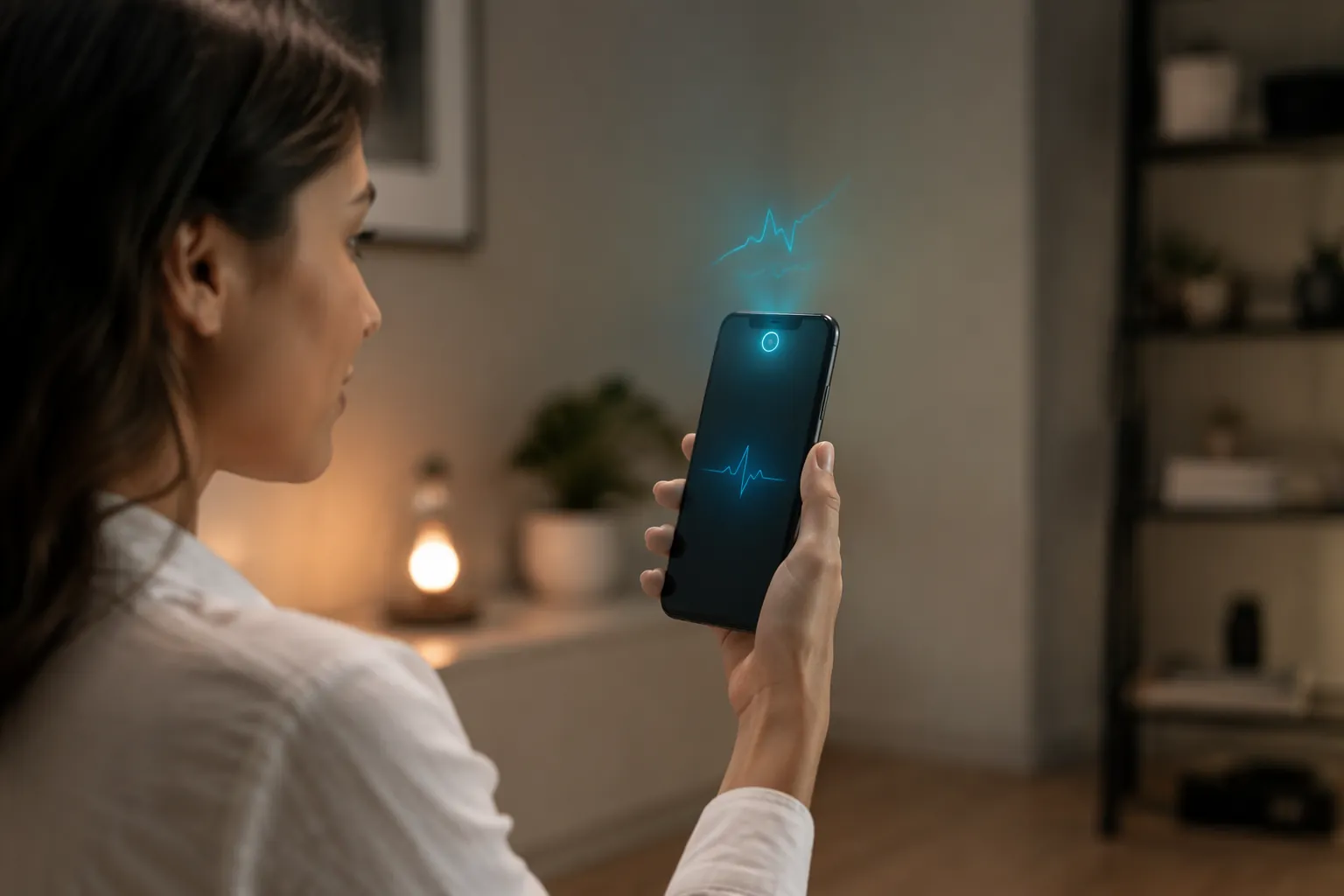
The strongest evidence for this idea is a June 2026 Nature paper from Google Research and the University of Washington on Passive Heart-Rate Monitoring, or PHRM, during everyday smartphone use. The study reports a deep-learning model trained on 192,353 recordings from 485 people and tested on 162,546 recordings from 211 individuals, using 8-second front-camera videos captured during routine unlocks and comparing estimates against reference heart-rate measurements. The DOI is 10.1038/s41586-026-10507-6, and the authors report releasing the model and study dataset to support further work on privacy-conscious heart-rate monitoring.[1]
What the phone actually measured
The study is not about a phone making a broad judgment that someone is stressed, improving fitness, or predicting disease. It is about whether short front-camera videos can estimate heart rate and resting heart rate with enough accuracy to make passive monitoring credible.
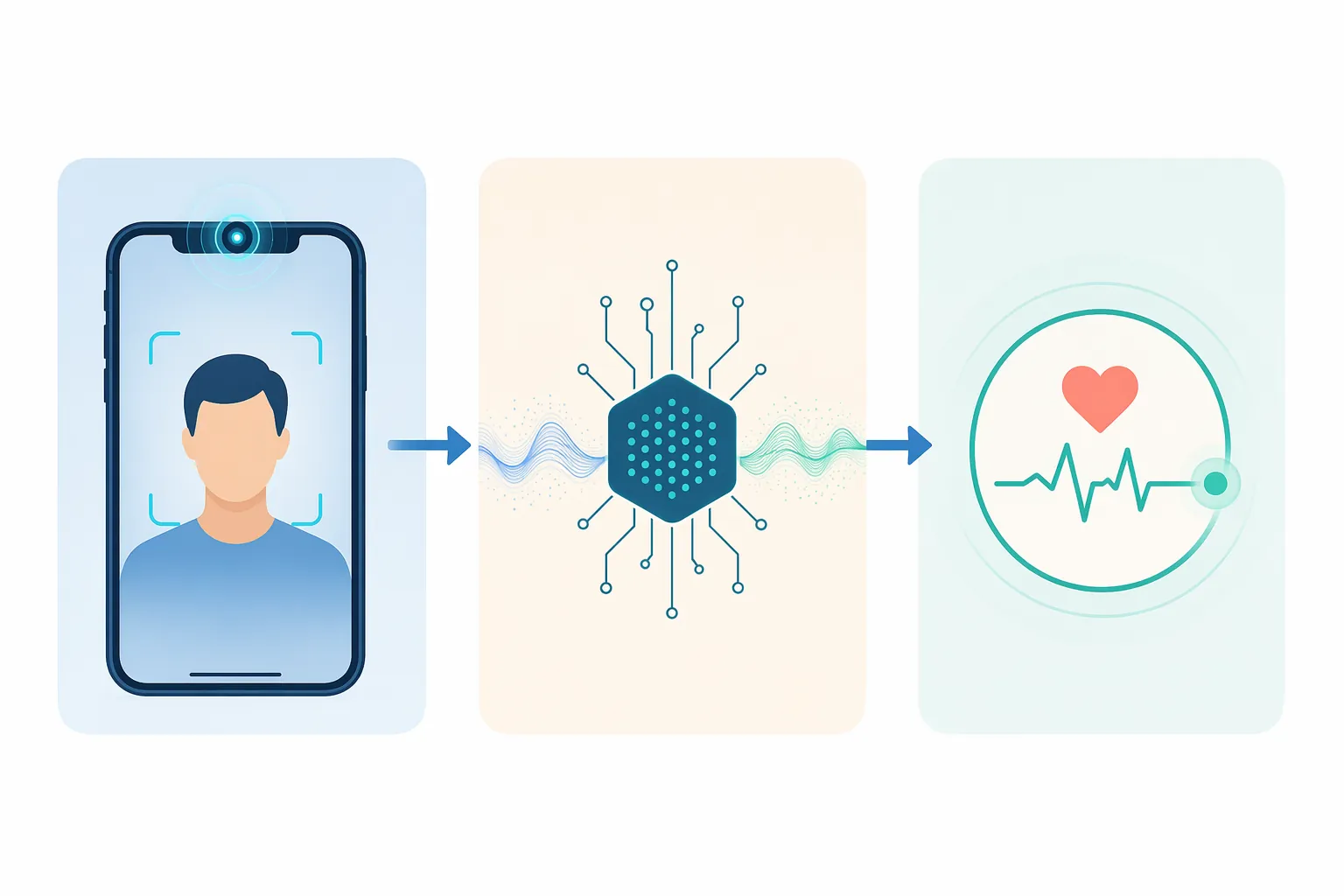
The mechanism is remote photoplethysmography: the camera records tiny changes in reflected light from the face, and the model infers pulse-related signals from those changes. The important feature here is not that rPPG exists; it is that the study tested rPPG during routine smartphone unlocks, including free-living conditions rather than only clean laboratory clips.[1]
| Claim | What the Nature study supports |
|---|---|
| Passive capture | 8-second front-camera videos during routine smartphone unlocks were used as input. |
| Heart-rate accuracy | Mean absolute percentage error was below the 10% consumer heart-rate monitor threshold across all three Monk Skin Tone groups. |
| Daily monitoring | Daily mean absolute error was below 5 bpm overall. |
| Resting heart rate | Smartphone-derived resting heart-rate measurements were more consistent day to day than conventional one-time checks and correlated with BMI and cardiorespiratory fitness. |
| Well-being impact | Stress reduction, behavior change, fitness improvement, and health-outcome gains were not tested as intervention outcomes. |
That last distinction is where buyers need to stay disciplined. The model can estimate cardiovascular signals. It does not, by itself, prove that a wellness program using those signals will reduce stress, increase activity, lower risk, or improve employee well-being.
The accuracy result is stronger than a demo claim
For a sensing paper, the validation is unusually relevant to real deployment. The test set included 162,546 recordings from 211 individuals across ages, sexes, body sizes, and skin tones measured with the Monk Skin Tone scale. The authors evaluated the model in controlled and free-living conditions, and they report mean absolute percentage error below 10% across all three Monk Skin Tone groups, the threshold used in the paper for consumer heart-rate monitors.[1]
Daily performance is the more useful number for a well-being program. A single noisy pulse estimate is rarely the point; trend stability is. The study reports daily mean absolute error below 5 beats per minute overall, and smartphone-derived resting heart-rate measurements were more consistent day to day than conventional one-time resting heart-rate checks.[1]
The authors also compared PHRM with 15 prior rPPG models and report that it outperformed them. That comparison supports the claim that this is not merely a generic camera-pulse method repackaged for smartphones. It is a model tuned and tested for the messier context of everyday phone use.[1]
The result should still be read as accuracy against reference measurements, not as a head-to-head trial against commercial wearables. The study does not establish that PHRM is better than, equal to, or worse than WHOOP, Oura, Apple Watch, or any other named device under the same conditions. It establishes that the phone-based model met the paper’s consumer-monitor accuracy threshold and performed well across its own validation setup.[1]
Why passive resting heart rate is the more plausible well-being signal
Heart rate during a random unlock can be useful, but resting heart rate is where the well-being use case becomes more plausible. Resting heart rate can move with fitness, stress, illness, recovery, medication, sleep disruption, and other factors. It is not a diagnosis, and it is not a mood score. But it can be a low-friction signal that something has changed.
The Nature study reports that smartphone-derived resting heart rate correlated with known cardiovascular risk markers, including BMI and cardiorespiratory fitness.[1] That is useful evidence, but it is still correlational. A population-health dashboard built from those signals could identify patterns worth reviewing; it could not claim, from this paper alone, that its alerts prevent disease or improve well-being.
Skin-tone performance is not a footnote
Any optical pulse technology has to answer an equity question early. Camera-based and light-based measurement can perform differently across skin tones, and a population-health program that quietly works better for some participants than others is not a neutral tool.
The PHRM study used the Monk Skin Tone scale and reports mean absolute percentage error below 10% across all three skin-tone groups. That is the reassuring part. The less comfortable part is that the authors observed an initial accuracy gap for the darkest skin-tone group. With confidence-based filtering, performance converged from day 3 onward.[1]
Both facts matter. The initial gap means an enterprise deployment should not wave away skin-tone risk because the aggregate result is strong. The later convergence means the model is not obviously unusable for darker skin tones within the study conditions. The practical question is whether a real implementation would monitor the same issue continuously, disclose when measurements are rejected, and audit performance across the population actually being served.
Confidence-based gating is part of that answer. The study describes filtering out low-quality videos rather than forcing every unlock clip into a heart-rate estimate.[1] In a wellness setting, that is technically responsible, but it creates a second operational issue: unusable videos are not random inconvenience if they cluster by lighting, device position, skin tone, disability, job setting, or work schedule.
What this enables, and what it does not validate
For well-being programs, the attraction is obvious. Passive heart-rate and resting-heart-rate monitoring could support stress tracking, fitness motivation, early warning of physiological changes, and population-level monitoring without requiring a wearable. That is a real opening because smartphones are far more common than dedicated health devices.
But the study did not test those program outcomes. It did not randomize participants into a stress-management intervention. It did not show that passive alerts improve sleep, reduce burnout, increase exercise, or lower medical risk. It did not test whether employees trust the system enough to participate honestly, or whether managers use aggregate signals responsibly.
A responsible buyer can treat the paper as evidence that passive smartphone heart-rate sensing is technically credible. Treating it as proof of a well-being intervention would skip several steps.
- Stress tracking would still need validation against stress measures and user-reported experience.
- Fitness motivation would still need evidence that participants change behavior when shown the signal.
- Early-warning workflows would still need clinical review rules, escalation policies, and false-alarm management.
- Population dashboards would still need aggregation thresholds, privacy controls, and safeguards against individual surveillance.
The deployment bar is higher than the model benchmark
The most sensitive part of this system is not the heart-rate estimate; it is the repeated front-camera capture. Even if the final output is just beats per minute, the raw input begins as a face video. That makes consent, processing location, storage, access control, and deletion policy central to whether the use case is acceptable.
The researchers explicitly identify on-device processing, explicit consent, and secure storage as prerequisites for privacy-conscious monitoring.[1] Those should not be treated as nice-to-have implementation details. In an employer or insurer-adjacent program, they are the difference between a low-friction health signal and a surveillance system with a health label.
A serious pilot would also need to decide what is never collected. If a model can operate on-device, the program should not retain face video unless there is a narrow, disclosed, and separately consented reason. If confidence scores reject a clip, the rejected clip should not become a data asset by default. If a participant opts out, the phone should behave like an ordinary phone.
Battery performance is another unresolved deployment issue. The study establishes sensing accuracy, but battery optimization remains unaddressed. A system that quietly drains devices will become another compliance tax, even if it avoids wearables.
What a monitored pilot should require
- On-device processing by default, with no routine transfer of face video.
- Explicit opt-in consent that separates heart-rate measurement from any broader wellness-program participation.
- Confidence-based gating with reporting on rejected measurements by device context and participant subgroup.
- Secure storage for derived heart-rate data, with short retention periods unless participants choose otherwise.
- Equity monitoring across skin-tone groups in the actual deployment population, not only reliance on the published validation set.
- Independent replication outside Alphabet/Google-funded work before broad enterprise rollout.
The funding source matters here. Alphabet/Google Research funded the study, and Google Research is one of the institutions behind the work.[1] That does not invalidate the findings. It does mean the paper should be treated as a high-quality single study with a potential commercial context, not as settled independent consensus.
The practical verdict
PHRM makes passive smartphone heart-rate monitoring credible in a way most wellness-tech pitches do not. The study uses a large validation set, tests routine unlock videos, reports daily error below 5 bpm overall, evaluates performance across Monk Skin Tone groups, and releases the model and dataset for further scrutiny.[1]
That is enough to justify monitored pilots for passive cardiovascular sensing. It is not enough to justify broad claims that phone unlocks improve well-being. The intervention layer still has to prove itself: whether people understand the monitoring, whether they consent freely, whether alerts help more than they worry, whether darker-skin performance holds in messy deployments, and whether independent teams reproduce the result. Enterprise adoption should wait for privacy-preserving implementation, equitable real-world performance checks, and replication beyond the Alphabet/Google-funded research.
References
- Passive heart-rate monitoring during smartphone use in everyday life — Nature, June 2026. DOI: 10.1038/s41586-026-10507-6.
§ 42 — Cited evidence
Flag an inaccuracy or submit a comparable account — Contribute or read how claims are verified in Methodology.