
§ 41 — Use-case analysis
How Palantir's AI Fits Karp's Wealth Gap Warning
Palantir CEO Alex Karp warns that AI will concentrate wealth away from middle-class workers — his own platform's supply chain deployments deliver exactly that pattern. This article examines how Palantir Foundry's 5-10x ROI flows to capital holders while exposing planning workforces to the inequality Karp himself calls 'the biggest problem in this country.'
- Function
- supply chain planning
- AI technique
- demand forecasting
- Evidence source
- Fortune, Business Insider, Object Edge, Palantir Impact, Ethicrithm, Equitable Growth
Alex Karp has made the uncomfortable part of enterprise AI unusually explicit. In July 2026, the Palantir CEO warned that AI could create a “complete decoupling of unimaginable wealth and normal wealth,” saying he might become far richer while middle-class workers see much smaller gains; Fortune reported his comparison as a move from roughly $15 billion to $300 billion, while middle-class salaries might only double.[1] Business Insider separately reported Karp calling AI-driven wealth inequality “the biggest problem in this country.”[2]
That warning lands differently when the product being sold is not a chatbot on the edge of a desk job, but an operating layer inside supply chain planning. Palantir’s supply-chain story is built around the same mechanics Karp is worried about: decisions become faster, exceptions become visible, working capital leakage gets cut, and the resulting savings are measured in payback periods, avoided stockouts, and return on investment. The question is not whether those gains are real enough to matter. The question is where they go after the model, the ontology, and the planning team produce them.

The Operational Savings Are the Starting Point, Not the Ending Point
Palantir’s supply-chain value proposition is not vague. Object Edge, a commercial source with a Palantir partnership relationship, says Palantir demand-planning deployments can produce 5x to 10x ROI within six months, up to 70% cost reduction, and 50% to 75% user time savings.[3] Those are vendor-aligned claims, so they should not be treated like independent audit results. But they are still useful because they show how Palantir’s own ecosystem frames the business case: not as a small productivity aid, but as a rapid financial conversion machine.
The named supply-chain cases point in the same direction. Palantir’s impact materials cite General Mills and Wendy’s as generating $40,000 per day in savings from a partial network deployment, which annualizes to about $14.6 million if sustained every day for a year. The same Palantir page cites Heineken preventing $4.9 million in stockouts in the first year.[4] These are not trivial dashboard improvements. They are material operating gains, and they are exactly the kind of numbers that make an executive sponsor willing to push through integration pain.
Ethicrithm, another consulting-oriented source rather than a neutral public agency, cites a Forrester Total Economic Impact study finding Palantir Foundry produced 315% ROI over three years, a 10-month payback period, and 35% faster decision-making.[5] Again, the label matters. TEI studies are often commissioned or vendor-adjacent business-case instruments, not randomized field experiments. But for a supply chain leader, the business meaning is still plain: the platform is being justified through capital returns, not through a promise that planning labor will automatically share in the upside.
| Claim | What It Measures | Source Quality |
|---|---|---|
| $40,000 per day in savings for General Mills/Wendy’s partial network deployment | Reported operating savings from a supply-chain deployment | Palantir-published impact case |
| $4.9 million in Heineken stockout prevention in the first year | Avoided stockout impact, not necessarily labor savings | Palantir-published impact case |
| 5x to 10x ROI within six months; up to 70% cost reduction; 50% to 75% user time savings | Commercial deployment economics and user productivity claims | Vendor-aligned Object Edge article |
| 315% three-year ROI; 10-month payback; 35% faster decision-making | Enterprise AI business-case economics as cited from Forrester TEI | Consulting source citing Forrester TEI |
A clean deployment can absolutely make planners’ weeks better. Anyone who has watched demand planners reconcile ERP extracts, promotion calendars, inventory positions, and customer service escalations knows that some “work” is just brittle systems forcing professionals to become human middleware. If Palantir reduces spreadsheet archaeology, narrows the exception queue, or lets a planner see inventory risk before the Monday meeting, that is not fake value.
But the value does not remain suspended in the planning room. A $40,000 daily saving is booked somewhere. It can become margin expansion, lower working capital, avoided revenue loss, customer-service improvement, reduced overtime, lower consulting spend, or a smaller planning team than the business would otherwise have hired. Those are not morally equivalent outcomes for the workforce, even when they all look good in the same ROI slide.
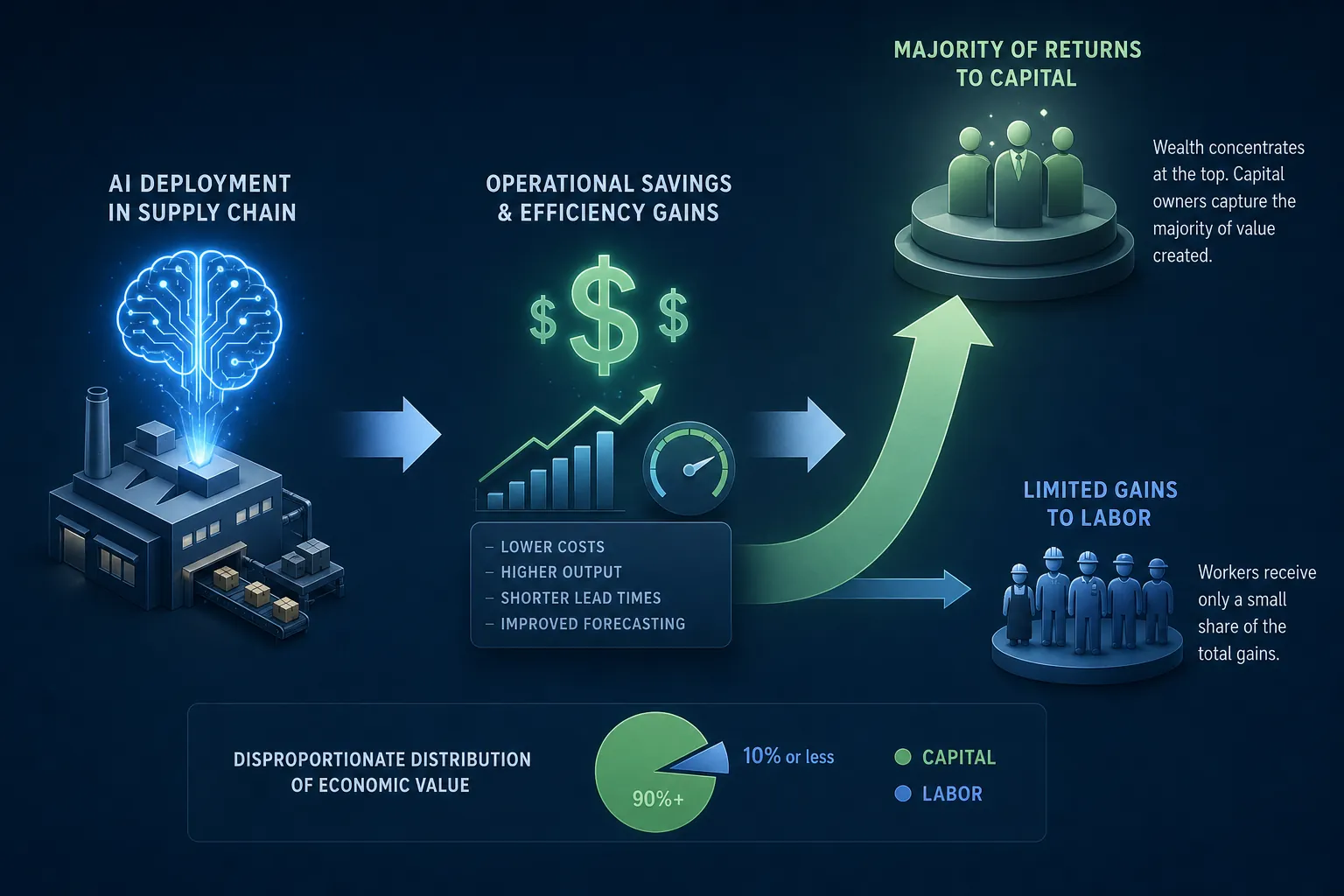
How an AI Planning Gain Becomes a Wealth-Distribution Question
Supply-chain AI does not need to fire a planner to change the labor bargain. It can change the amount of judgment the company expects from each planner, the number of sites one planner covers, the tolerance for manual review, and the evidentiary burden when a human disagrees with the system. The formal headcount line may stay flat while the work intensifies, narrows, or becomes easier to audit from above.
This is where Karp’s wealth-gap warning becomes more than a quote about billionaires. Palantir’s platform can plausibly convert planning know-how into repeatable decision infrastructure. Once that happens, the company owns more of the process memory. The planner may still be needed, but the planner’s leverage changes if the system captures the exception logic, the escalation paths, and the cross-functional tradeoffs that previously lived in meetings, emails, and local habit.
The honest version of the Palantir case is not “AI replaces planners.” It is more specific: AI can reduce the amount of planning labor required per dollar of revenue, per SKU, per facility, or per exception reviewed. Whether that becomes layoffs, slower hiring, higher planner wages, better service levels, or retained margin depends on governance choices made by the buyer. The deployment economics alone do not answer that distributional question.
The Workforce Evidence Points to a Middle Zone
The strongest independent map in the available evidence does not study Palantir specifically. Equitable Growth’s July 2025 analysis of generative AI exposure in the U.S. logistics workforce finds that adoption will affect jobs unevenly across logistics roles. It reports more than 90% task susceptibility for logistics managers, 100% for dispatchers and customer service representatives, near-zero susceptibility for truck mechanics, and a logistics workforce scope of 6.6 million U.S. workers.[6]
That evidence should not be stretched into a claim that Palantir alone creates those exposure levels. It says something narrower and more useful: logistics contains a large middle-skill layer where the tasks are information-heavy, coordination-heavy, and therefore more exposed to AI than physical repair work. Supply chain planning sits in that layer, even if it is not identical to dispatching, customer service, or logistics management.
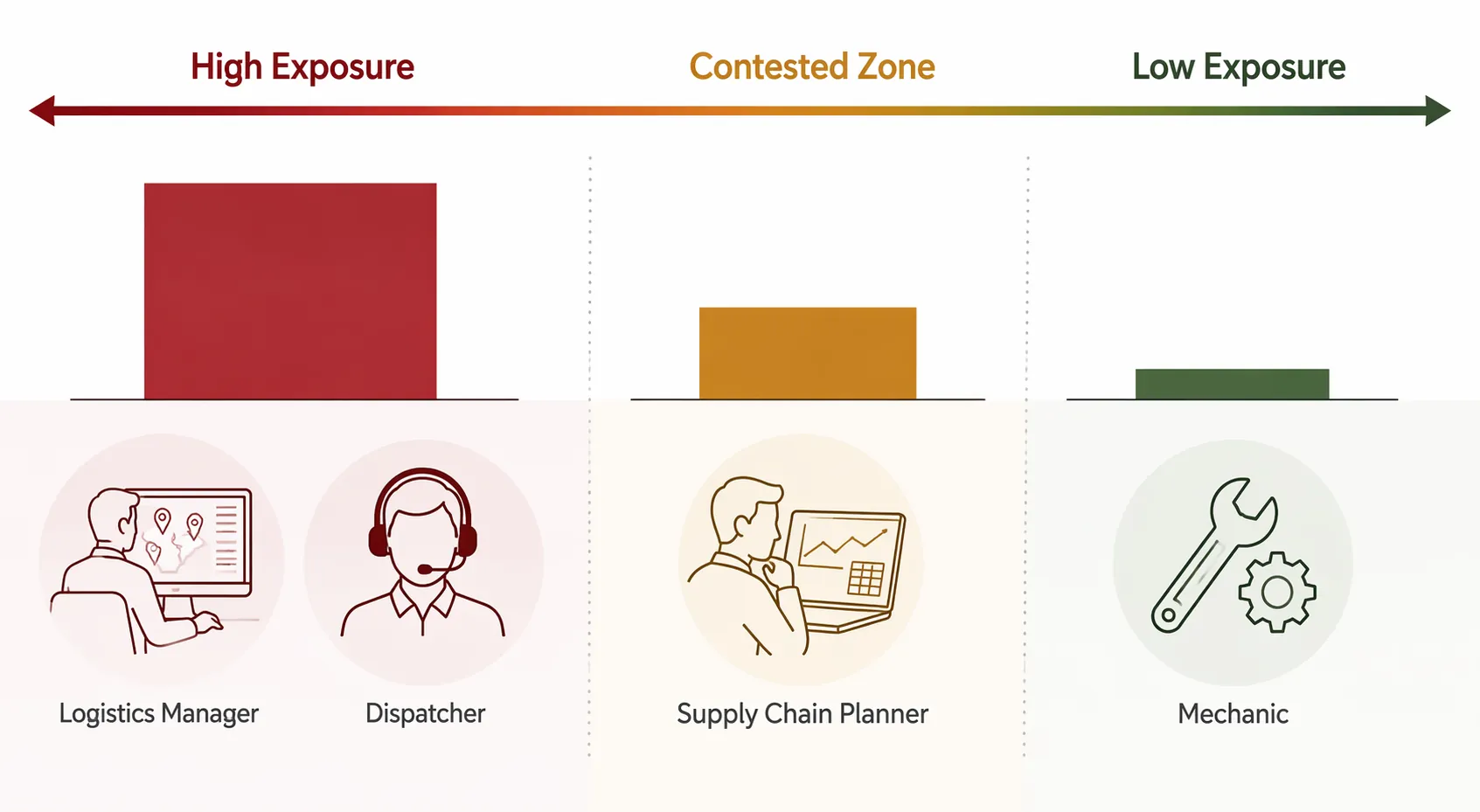
Planners are not clerks waiting for a model to arrive. They decide when demand history is lying, when a customer escalation should override the clean forecast, when a supplier’s promise is not credible, and when a service-level commitment is politically impossible even if the math says it should work. Much of that work is tacit and organizational. Much of it is also exactly the kind of repeated judgment that an enterprise AI system tries to structure, observe, and accelerate.
That is why Karp’s vocational-training optimism does not settle the matter. His argument that vocationally trained workers may fare better than some knowledge workers has force when the comparison is between a mechanic and a text-producing analyst. It becomes less clean when the worker is a supply planner whose job combines analytics, negotiation, exception triage, and system maintenance. Planning is not a trade in the truck-mechanic sense. It is also not a generic desk job whose output can be judged only by words on a screen.
The Citi Case Shows the Multiplier, With an Important Boundary
Palantir’s impact page includes a Citi case in which account opening went from nine days to seconds and a 50-person team was reduced to one person.[4] This is not supply chain planning evidence. It is wealth management, and it should not be treated as if it proves what happens to a demand-planning department after a Foundry deployment.
It is still relevant as a bounded analogy. Enterprise AI does not merely speed up the person already doing the work. In some processes, it changes the staffing ratio. It can turn a team-based workflow into a supervised exception process. Supply chain has many workflows that could move in that direction: allocation review, order promising, shortage escalation, promotion impact checks, supplier-risk triage, and customer-service prioritization. The size of the effect will vary, but the pattern is not exotic.
The safer conclusion is also the more serious one. Palantir’s supply-chain cases show large operational gains; the Citi case shows that Palantir-enabled automation can, in at least one non-supply-chain process, produce a dramatic headcount multiplier; Equitable Growth shows that logistics coordination roles are highly exposed to AI task substitution or augmentation. Put together, they justify concern about planning labor’s bargaining position. They do not justify pretending that every planner is about to be replaced by one operator watching a console.
Compressed Deployment Timelines Shrink the Adaptation Window
Palantir’s AIP Bootcamp messaging matters here because it compresses the time between executive curiosity and working prototype. Palantir describes AIP Bootcamp as moving from concept to production in under five days.[4] That does not mean a global supply-chain transformation is finished in a week. It does mean the proof point that changes budget politics can arrive before the planning organization has had time to define new roles, training paths, review rights, or escalation rules.
That speed is operationally attractive. It is also organizationally dangerous if workforce design is treated as an afterthought. A planning director can find herself with a successful pilot, a CFO asking for the full-year run-rate benefit, and a team wondering whether “time savings” means better work or fewer people. At that point, the distribution of value has already started to harden.
This is the part of AI governance that supply-chain buyers often under-specify. They will debate ERP integration, data refresh rates, role-based access, model explainability, and vendor security. They are less likely to write down what happens when a tool saves 50% of a planner’s weekly analysis time. Does the planner take on more product lines? Does the company reduce contractor support? Does the team move from manual reconciliation into scenario design? Does any of the financial gain show up in compensation, promotion paths, or staffing relief?
What Supply Chain Leaders Should Decide Before the ROI Arrives
The buyer’s uncomfortable responsibility is to make the labor allocation explicit before the platform proves itself. If the business case assumes savings from faster decisions, fewer stockouts, lower inventory buffers, and reduced manual effort, then the implementation plan should say who owns each category of gain. A planner-led improvement fund is different from a headcount reduction target. A redeployment plan is different from a hiring freeze. A productivity target attached to service improvement is different from one attached only to SG&A reduction.
- Separate operating savings from labor savings in the business case, rather than letting both disappear into one ROI percentage.
- Define which decisions remain planner-owned, which become system-recommended, and which can be automated after review.
- Track saved planner time as a workforce metric, not only as a financial benefit.
- Decide whether productivity gains fund upskilling, expanded planning scope, compensation, service improvement, or headcount reduction.
- Require source-quality discipline when comparing vendor-aligned ROI claims with independent workforce exposure research.
None of this argues against using Palantir. The supply-chain cases are strong enough to deserve attention, and the problem they address is real: large companies have planning processes trapped between aging ERP layers, local spreadsheets, fragmented data models, and exception queues that punish the people most capable of resolving them. A tool that makes those systems more usable can be worth buying.
But Karp’s own warning should remove the excuse that wealth concentration is an accidental side effect nobody saw coming. If Palantir helps a manufacturer prevent millions in stockouts, reduce decision latency, and save thousands of dollars a day, the default path is that most of that gain accrues to the enterprise and its capital holders. The planning workforce may receive better tools, but better tools do not automatically produce better bargaining power.
For supply-chain planning, the real impact of Alex Karp’s AI wealth inequality warning is not a prediction that planners vanish. It is a demand for ownership. If a deployment captures the judgment embedded in planning work, accelerates the process, and converts that acceleration into capital returns, then buyers need to govern the next step: who gets the saved time, who carries the increased scope, who retains decision authority, and who shares in the value created.
References
- “Palantir CEO Alex Karp predicts he will get 20x richer from AI—but middle-class workers will get left behind,” Fortune, July 17, 2026
- “Palantir CEO Says AI Wealth Inequality Is a Big Problem for Society,” Business Insider, July 2026
- “Palantir for Demand Planning: Transforming Supply Chain Management,” Object Edge
- “Impact,” Palantir
- “Palantir ROI: A Strategic Framework for Measuring Enterprise AI Impact in 2026,” Ethicrithm
- “Adoption of generative AI will have different effects across jobs in the U.S. logistics workforce,” Equitable Growth, July 2025
§ 42 — Cited evidence
Flag an inaccuracy or submit a comparable account — Contribute or read how claims are verified in Methodology.