
§ 41 — Use-case analysis
What 2026 Oil Price Disruption Means for AI Supply Chain Planning
The 2026 Strait of Hormuz crisis tested whether major AI supply-chain planning platforms could model oil-price-driven volatility. This use-case analysis reveals that while platforms handled cost pass-through, they systematically underweighted demand destruction, petrochemical dependency, and inventory burn-down — adding a new criterion for post-crisis platform evaluations.
The awkward finding from the 2026 oil shock is not that AI planning platforms failed. It is that, as of Q3 2026, the public record still does not contain a named, numbers-backed customer post-mortem showing how a major planning platform was used during the Strait of Hormuz crisis. For buyers evaluating AI for oil price disruption supply chain planning, that gap matters more than another polished demo. A model can calculate a gross-margin hit and still miss the decision that keeps a plant running next Thursday.
The best available evidence is therefore indirect: vendor playbooks, scenario-planning demonstrations, oil-market data, and disruption-modeling literature. Read together, they show a split. Platforms appear comfortable with cost pass-through. They are much less proven on three crisis dimensions that mattered during the oil shock: petrochemical dependency below Tier 1, demand destruction when fuel inflation changes buying behavior, and inventory-cover burn-down measured in production days rather than dollars.
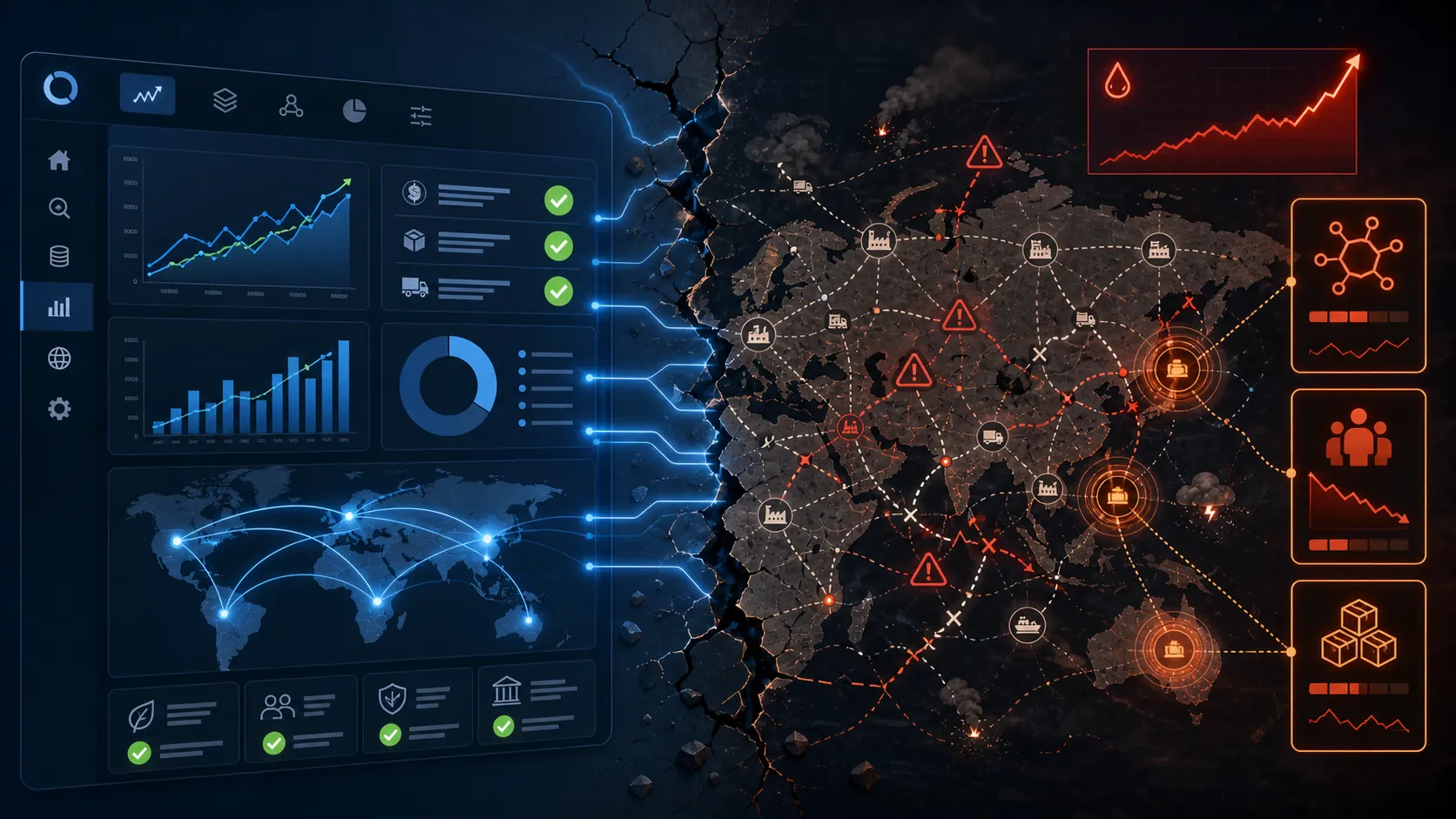
The Public Evidence Is Strongest Where the Operational Proof Is Weakest
o9 Solutions published the most useful vendor-side Hormuz document I found: a July 20, 2026 crisis-timeline article that walks through early warning, supplier mapping, inventory review, transport rerouting, and scenario response for a Strait of Hormuz disruption. It is practical in the way S&OP teams need practical: it names the sequence of decisions, flags Tier-2 and Tier-3 exposure, and treats substitution as a qualification problem rather than a line item in a sourcing spreadsheet.[1]
But it is still a prescriptive framework, not a disclosed customer outcome. The article does not say that a named manufacturer used o9 during the crisis, cut a decision cycle by a stated number of days, preserved a stated amount of production, or avoided a stated cost. That distinction is not nitpicking. In an oil shock, the hard part is not describing the right workflow. The hard part is proving the platform had the data, governance, and model structure to run that workflow while commercial, logistics, and procurement teams were all revising assumptions at once.
The oil-price environment in the U.S. Energy Information Administration’s July 7, 2026 Short-Term Energy Outlook was severe enough to expose that difference. The EIA described Brent moving from about $69 per barrel to $119 per barrel and estimated 1.2 million barrels per day of demand destruction in 2026 while the Hormuz situation was still unfolding.[2] That is not just an input-cost story. It is also a consumption story, a substitution story, and, for energy-intensive supply chains, a timing story.
Cost Pass-Through Is the Part the Platforms Already Know How to Show
The most demo-friendly version of an oil shock is clean: crude rises, transport costs rise, resin or packaging costs rise, gross margin falls, and the planner compares price increases, alternate sourcing, expedited freight, or allocation. Existing planning platforms can speak that language.
o9’s own tariff scenario-planning material, presented around its aim10x Europe context, shows the platform projecting more than $500 million in cost impact and double-digit margin declines under a tariff scenario.[3] Tariffs are not oil shocks, but the capability marker is real: the model can absorb a structured external cost change, propagate it through financial and supply-chain views, and let executives compare response options before they commit.
Anaplan appears in a similar bucket through Tridant’s oil-price what-if webinar. The important caveat is that the public material demonstrates a partner-implemented oil-price scenario-planning capability, not a verified native Anaplan customer result during the 2026 Hormuz event.[4] Still, it confirms that enterprise planning environments can be configured to test oil-price changes against budgets, forecasts, and operating plans.
That matters. Finance does need to know whether a margin bridge is breaking because diesel, bunker fuel, energy contracts, petrochemical inputs, or supplier surcharges moved. Procurement does need a fast way to compare bids under different commodity assumptions. Scheduling tools, including systems positioned around rapid planning and rescheduling, also have obvious relevance when logistics lead times and production constraints move together.
But cost pass-through is the easiest crisis behavior to turn into a dashboard. It is also the most dangerous one to mistake for resilience. A planner who sees a $14 million gross-margin exposure still has to answer whether the alternate supplier is qualified, whether customers will keep buying at the new price, and whether the plant has eleven production days left or thirty.
The Crisis Required Four Different Models, Not One Bigger Cost Model
Oil-price disruption did not enter supply chains through a single door. It came through freight, energy, petrochemical feedstocks, customer demand, and working-capital pressure. The vendor material is strongest on the first two and thinnest on the rest.
| Crisis dimension | What a planning platform can visibly model | What remains under-proven in public evidence |
|---|---|---|
| Cost pass-through | External cost changes flowing into margin, price, budget, and scenario views | Whether modeled impacts led to verified operational outcomes during the Hormuz crisis |
| Petrochemical dependency | Supplier mapping and exposure analysis, especially when lower-tier data exists | Whether substitute resin, chemical, or packaging suppliers were already qualified and capacity-ready |
| Demand destruction | Forecast overrides and scenario demand assumptions | Whether oil-price-specific elasticity was modeled instead of manually imposed |
| Inventory-cover burn-down | Inventory value, supply availability, and replenishment options | Whether stock was translated into days of production under disrupted supply and demand assumptions |
The table is deliberately uneven. Cost pass-through has public demonstrations. Petrochemical dependency has a credible vendor playbook but little outcome evidence. Demand destruction has macro evidence but almost no public platform evidence. Inventory cover is often present somewhere in planning systems, yet the crisis test is whether the platform burns it down against constrained production calendars, not whether it displays inventory value.
Petrochemical dependency is a qualification problem
The o9 Hormuz article is most convincing when it leaves executive abstraction and gets into supplier-tier language. It explicitly points to Tier-2 and Tier-3 exposure and the reality that substitution is rarely pre-planned at those levels.[1] That is exactly where a lot of AI scenario planning gets too smooth. The model can identify that Supplier B is outside the affected region. It may not know that Supplier B’s resin grade has not passed validation, that the packaging line needs a changeover test, or that quality has not signed off on the substitute.
For petrochemicals, this distinction changes the clock. A qualified alternate can be a scenario lever. An unqualified alternate is a project. If the platform treats both as interchangeable supply, the scenario is optimistic even if the math is clean.
Bramwith Consulting’s 2026 sector discussion gives a useful sense of why this mattered beyond direct fuel spend: it pointed to fertilizer exposure of 100% to 150% and transport costs representing up to 20% of crude price in some contexts.[5] Those figures are sector signals, not universal coefficients. They do, however, make the same planning point: oil-price volatility travels through input categories at different speeds and with different commercial consequences.
Demand destruction is not a forecast override
The EIA’s 1.2 million-barrel-per-day demand-destruction estimate is the piece that should make planning buyers uncomfortable.[2] Most platform demos handle the supplier-cost side of an oil shock more fluently than the customer-behavior side. They let a planner raise input costs, add surcharges, or test freight alternatives. Public evidence is much thinner on whether the same models estimate how demand changes when fuel-driven inflation hits consumers, distributors, and industrial customers.
A demand planner can manually enter a lower forecast. That is not the same as oil-price-specific demand modeling. In a real crisis, the question is not simply whether demand falls. It is which demand falls first, which products become unaffordable, which customers delay orders, and which regions absorb price increases without volume loss. A platform that requires the business to guess those effects before the scenario starts is not modeling demand destruction; it is accepting it as an input.
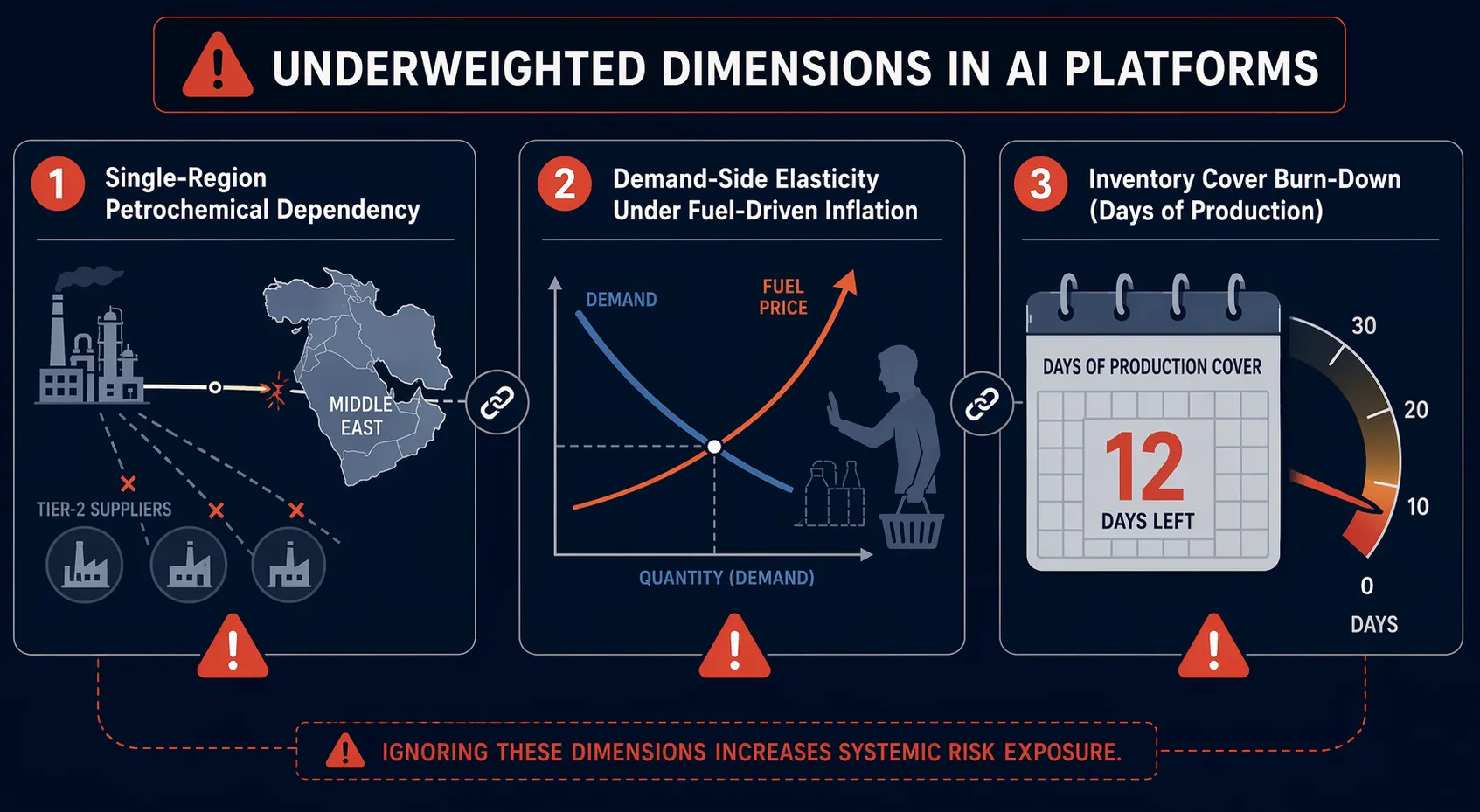
Inventory cover has to become production time
Inventory value reassures finance faster than it reassures a plant manager. During an oil-price disruption, the sharper measure is days of production left under the constrained plan. The difference is practical: $8 million of a critical input can be plenty in one production sequence and dangerously thin in another.
A useful crisis model should burn inventory down against the actual production calendar, supplier lead-time risk, customer allocation rules, and substitute-material status. If it only reports stock value or weeks of supply under a normal demand plan, it is answering the wrong question. The oil shock made the unit of analysis smaller and harsher: not inventory dollars, but production days.
Concurrent Shocks Break the Comfort of Single-Variable What-Ifs
The modeling literature reinforces the concern. A Nature Scientific Reports study used Monte Carlo simulation and mixed-integer linear programming across 50 disruption scenarios and found that concurrent shocks could increase downstream oil transport costs by up to 45% in the modeled network.[6] The study modeled a single oil-importing country’s downstream network, so the 45% result should not be lifted as a global rule. Its value is the shape of the finding: simultaneous disruptions can produce nonlinear cost increases that a single-variable what-if can understate.
That is the uncomfortable fit with Hormuz. Oil price, vessel availability, port congestion, substitute sourcing, supplier qualification, and demand changes do not politely arrive one at a time. They overlap. If a platform lets planners move Brent by $10, then freight by 8%, then demand by 3% as separate sliders, it may still be useful. It is not necessarily capturing the interaction effects that decide whether downstream transport costs, production constraints, and customer allocations compound.
This is where polished scenario planning can become misleading. Fast model runs are good. Dependency graphs are good. Constraint-aware planning is good. The missing test is whether the platform can recognize when a scenario has stopped being additive.
Normal-Market Procurement Wins Do Not Prove Oil-Shock Resilience
Arkestro’s published oil and gas procurement outcomes are worth reading, but they belong in the right lane. The company reports 16% average savings and says a Fortune 10 oil company reduced bid cycles from 12 weeks to 4 weeks.[7] Those are meaningful procurement metrics. Faster bid cycles and better commercial predictions can create real value when markets are functioning.
They are not evidence that a platform modeled the 2026 Hormuz oil shock. Savings in normal-market sourcing do not prove demand elasticity, substitute-material readiness, or production-day inventory burn-down under crisis conditions. Procurement AI can make the buying process sharper and still leave the planning organization exposed if the model cannot see which categories become operational bottlenecks when oil moves violently.
The same discipline should apply to every vendor in this space. A tariff demo proves a tariff demo. A webinar proves an implemented what-if pattern. A scheduling platform proves scheduling relevance. A crisis playbook proves that the vendor understands the workflow it wants customers to follow. None of those, by itself, proves Hormuz-specific resilience.
What Post-Crisis RFPs Should Ask Differently
The next buyer evaluation should not ask only whether a platform supports scenario planning for oil-price volatility. Almost every serious planning vendor can say yes to that. The better question is what the platform treats as endogenous to the scenario and what it asks the business to supply manually.
- Can the model translate an oil-price path into demand changes by product, region, customer segment, or channel, rather than waiting for planners to enter a lower forecast?
- Can it distinguish a commercially available substitute from a qualified substitute that production and quality can actually use?
- Can it show inventory cover in days of production under the disrupted plan, not just inventory value or normal weeks of supply?
- Can it model concurrent shocks without assuming that freight, supply, demand, and production impacts remain additive?
- Can the vendor provide a named, numbers-backed post-mortem from an oil-price disruption, with the customer’s actual decisions and measured outcomes?
The ChainSignal recommendation is narrower than a general platform scorecard: add demand-destruction modeling to the RFP. Specifically, ask whether the platform can model oil-price-specific demand destruction, not just cost pass-through. This is a proposed evaluation standard, not an established industry benchmark. It is also the criterion most exposed by the public evidence now available.
Until named customer post-mortems appear, the safest posture is to test vendors against the parts of the crisis they have underweighted in public: demand elasticity, petrochemical substitution, and production-day inventory burn-down. Let them show the margin impact. Then ask who stops buying, which supplier is actually qualified, and how many days the plant can run.
References
- The Hormuz Rollercoaster: What Supply Chain Leaders Learn from the Back and Forth — o9 Solutions, July 20, 2026.
- Short-Term Energy Outlook: Global Oil Markets — U.S. Energy Information Administration, July 7, 2026.
- Building Resilience with AI-Powered Scenario Planning — o9 Solutions.
- From Oil Price Shocks to Smart Decisions: Real-Time Scenario Planning with Anaplan — Tridant.
- Oil Price Surge: What It Means for Supply Chains, Logistics and Procurement in 2026 — Bramwith Consulting, 2026.
- Nature Scientific Reports Monte Carlo/MILP study — Nature Scientific Reports.
- How Oil & Gas Leaders Are Transforming Procurement with AI — Arkestro.
§ 42 — Cited evidence
Flag an inaccuracy or submit a comparable account — Contribute or read how claims are verified in Methodology.