
§ 41 — Use-case analysis
NHTSA's Door Egress Rule Rewrites AI Compliance for Car Supply Chains
NHTSA's July 2026 rulemaking mandating robust door egress systems and the EU AI Act's high-risk compliance obligations are creating a structural double bind for automotive supply-chain AI systems. This use-case analysis explains how procurement teams managing AI-powered compliance tracking must reconcile two independent regulatory clocks with measurable cost and timeline impact.
- Function
- procurement
- AI technique
- document classification
- Evidence source
- SiliconValley.com, Supply Chain Management Review
Two clocks started running almost on top of each other. On July 23, 2026, NHTSA granted a rulemaking petition to mandate what the petition called a “robust and obvious door egress system,” a move reported as the first new federal motor vehicle safety standard activity on door hardware since the 2007 amendments to FMVSS 206. The petition mattered because Bloomberg had documented 15 deaths across a dozen Tesla crash incidents in which occupants or rescuers could not open doors after power loss.[1] From August 2026 onward, EU AI Act obligations begin moving into enforcement phases for systems that may fall into higher-risk categories, with penalties reported at up to €35 million or 7% of global annual turnover and accountability extending across suppliers and partners.[2]
That timing is the uncomfortable part for automotive procurement teams. A door-egress redesign is not just a handle swap. It creates new part numbers, validation packages, supplier attestations, low-voltage failure scenarios, service instructions, and evidence trails. Many OEMs and Tier-1s will use AI-enabled compliance tools to sort that evidence faster. But when the AI system is used to track, classify, escalate, or approve safety-critical compliance evidence, the tool itself stops looking like a harmless dashboard and starts looking like another governed object.

The safety trigger is electrical before it is stylistic
Flush handles and hidden releases are easy to argue about as design taste. The supply-chain issue is less forgiving: NHTSA’s September 2025 investigation into Model Y door failures covered 174,000 vehicles, and the agency found the failure “appears to occur when the electronic door locks receive insufficient voltage from the vehicle.”[3] That sentence moves the problem out of the showroom and into the low-voltage battery, wiring, latch, lock actuator, switch, trim, emergency-release access, and diagnostic chain.
A procurement team reading that finding does not get to stop at “door handle supplier.” It has to ask which component loses function first, which supplier owns the failure mode, which drawing revision includes the fallback path, which test procedure simulates insufficient voltage, and which software or electrical condition creates the locked-door state. It also has to ask whether the evidence arrives as a structured data feed, a PDF from a Tier-2 supplier, a lab certificate, a warranty claim pattern, or a late engineering change notice.
Amy Broglin-Peterson, a Michigan State supply-chain professor, put the problem plainly: “any time you have design changes, that messes up other things,” especially given the component density inside a modern vehicle door.[4] That is not a generic warning about complexity. It is a practical description of what happens when one visible part depends on several hidden systems that were qualified under a previous assumption.
What the rulemaking does to the procurement workflow
NHTSA has not published the final technical text, so no one should be treating the July 2026 action as a finished design manual. The phrase “robust and obvious door egress system” points toward the objective, not the final compliance architecture.[1] Still, the procurement workflow that follows is already visible because door hardware has to be bought, tested, documented, and released through supplier systems long before a final build reaches a customer.
| Procurement stage | What changes when door egress becomes a rulemaking issue | Why AI compliance tools get pulled in |
|---|---|---|
| Supplier qualification | Door, latch, wiring, battery, trim, and emergency-access suppliers need evidence that their parts support the required egress behavior. | The tool has to map which suppliers touch the regulated function, not just which supplier sells the visible handle. |
| Component change management | Engineering changes can affect drawings, materials, seals, connectors, service access, and diagnostic behavior. | The system has to detect whether a small part revision invalidates existing safety evidence. |
| Documentation capture | Attestations, test reports, lab data, and failure-mode analyses arrive from multiple tiers and formats. | AI can classify and link documents, but the classification logic needs review when the subject is safety-critical. |
| Exception escalation | Late or conflicting evidence can block sourcing, production release, or jurisdictional approval. | Automated prioritization needs a human checkpoint before a supplier exception becomes an accepted risk. |
| Contract and liability review | Responsibility has to be allocated across OEMs, Tier-1s, software providers, data providers, and AI tool integrators. | The AI vendor may influence compliance decisions without owning the physical component. |
The hard part is not collecting more documents. It is proving that the right document is attached to the right component revision for the right market at the right time. A supplier can provide a clean attestation for a latch, while the door module fails under a low-voltage condition created elsewhere. A Tier-2 can change a connector material that does not alter the sales description but does alter performance under heat, water intrusion, or crash deformation. An AI tool may flag the file as complete because the required fields are populated, while the unresolved risk sits in the relationship between fields.
That is where procurement systems begin to carry safety logic. If a platform such as o9, Kinaxis, Blue Yonder, Anaplan, or an internally built compliance layer is used to route evidence, score supplier readiness, predict delay, or recommend acceptance of a deviation, its output can shape regulated decisions. The system may not design the door, but it can determine whether a risky door package moves forward.
For Tesla-specific readers, the useful question is not whether Tesla’s broader supply-chain AI posture is unusual. It is which door-related evidence streams would need to be mapped if the company, its suppliers, or its regional manufacturing sites have to prove egress behavior across vehicle lines. ChainSignal’s internal analysis of how Tesla builds an AI-first supply chain in 2026 is relevant only to that narrower point: AI speed helps if the underlying component relationships and approval rights are traceable.
The AI system now needs its own file
The EU AI Act does not need to name “door-component compliance tracking” for procurement teams to have a problem. If an AI system is used in a safety-critical automotive compliance workflow, the responsible parties need to assess whether the use case approaches high-risk-style obligations: documented risk management, data governance, technical documentation, logging, transparency, human oversight, accuracy, robustness, and cybersecurity. That is an inference from the Act’s structure, not a use-case-specific regulator interpretation.
The consequence is a second evidence trail. One trail proves the redesigned door can be opened under defined failure conditions. The other proves the AI-supported compliance process is governed well enough to be trusted. Procurement usually wants the first trail automated because supplier evidence arrives late and unevenly. Legal and compliance will increasingly ask for the second trail because automation changes who saw what, who relied on which recommendation, and who had authority to override it.
- The model inventory has to identify which AI functions touch door-egress evidence, not just which tools carry the AI label.
- The data lineage record has to show where supplier attestations, test reports, exceptions, and revision histories entered the system.
- The human-oversight point has to be placed before safety-significant exceptions are accepted, not after the sourcing decision is effectively locked.
- The audit log has to preserve why a supplier was cleared, delayed, escalated, or overridden.
- The contract has to say who is responsible when an AI-generated classification, summary, or risk score is wrong.
Most organizations are not yet operating at that level of comfort. Foley & Lardner reported in June 2026 that only 37% of operations leaders were comfortable assigning AI agents to end-to-end processes, and it recommended tiered controls based on the autonomy level of the agent. The same Foley discussion cited a PwC 2026 survey finding that only 27% of operations leaders had fully embedded AI strategy across business units.[5] Those figures do not prove that automotive compliance teams are failing; they show that the governance layer is still catching up with the workflows it is being asked to manage.
Supply Chain Management Review reported Gartner’s projection that global AI governance spending will reach $1 billion by 2030.[2] That number is useful because it confirms what supplier-quality teams are already seeing in smaller ways: governance is becoming a budget line, not a policy memo. Door-egress compliance simply gives that budget line a concrete safety use case.
Three regulatory clocks, one supplier base
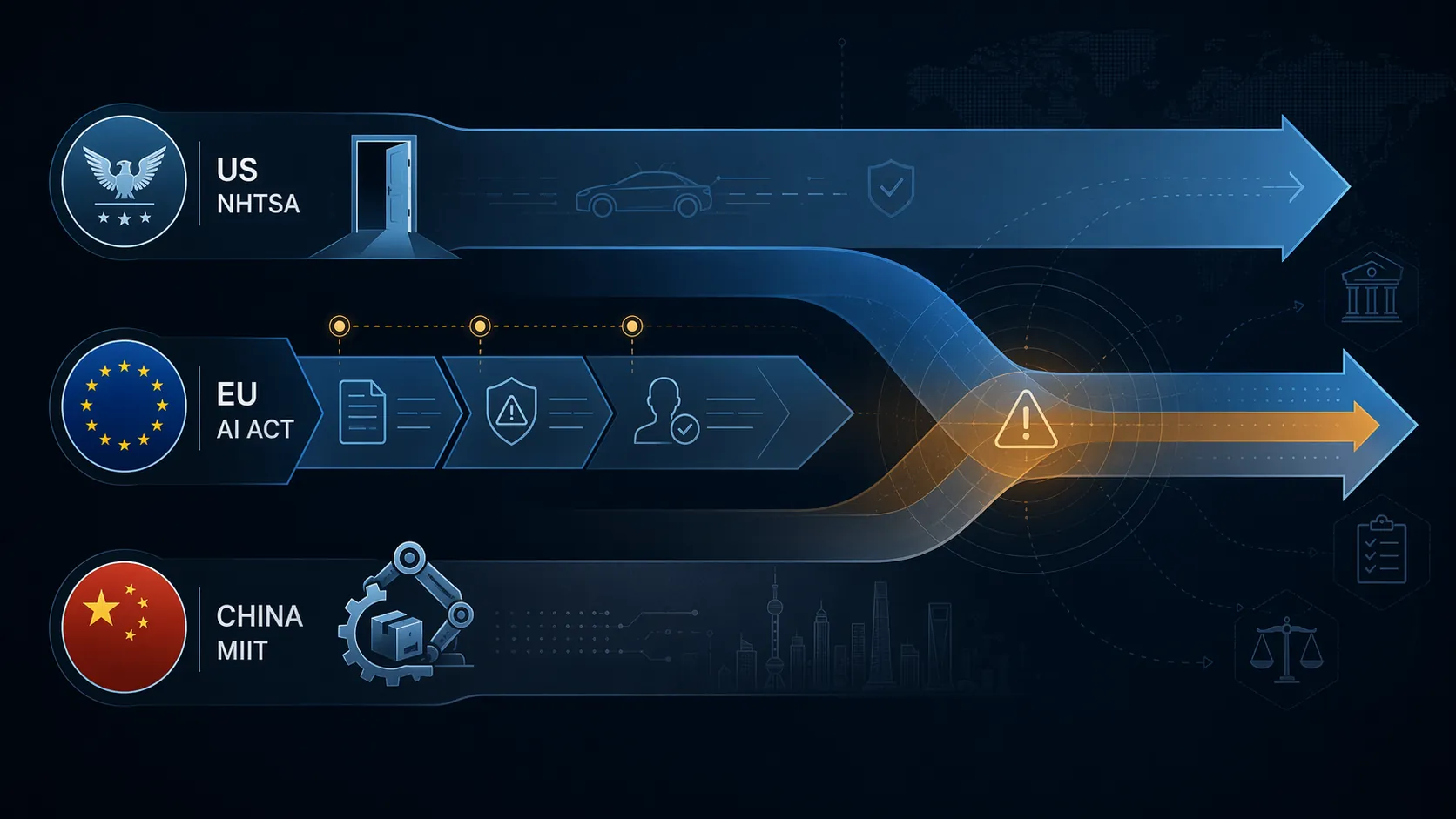
The US clock is now open but not final. Center for Auto Safety executive director Michael Brooks projected that a final compliance date could arrive “before 2030” even with swift rulemaking, but that is an analyst projection, not a codified NHTSA deadline.[6] Procurement teams should treat it as a planning signal, not as a substitute for the final Federal Register text.
China’s clock is more immediate for suppliers serving vehicles built for that market. China’s MIIT proposed rules in December 2025 that would require mechanical release inside and outside every door, with an effective timing described at roughly mid-2027.[4] For suppliers tied to Giga Shanghai or other China-market programs, that means the same door-egress redesign work may have to satisfy a nearer mechanical-release requirement while the US rule is still moving toward final form.
The EU clock is different because it attaches to the AI governance layer rather than the door mechanism itself. Its phased obligations begin sooner than many hardware redesign programs will close, and reported penalties can reach €35 million or 7% of global annual turnover.[2] A supplier-quality director therefore has to run the physical compliance program and the AI-system governance program at the same time, even though the regulators, evidence types, and liable parties do not line up cleanly.
| Jurisdictional pressure | What is known now | What remains uncertain |
|---|---|---|
| United States | NHTSA granted rulemaking on July 23, 2026 to mandate a robust and obvious door-egress system.[1] | The final technical standard, phase-in dates, and exact mechanical-release requirements are not yet published. |
| China | MIIT proposed inside and outside mechanical-release requirements in December 2025, with roughly mid-2027 timing reported.[4] | Final implementation details and supplier-specific obligations still need to be checked against the enacted rule text. |
| European Union | EU AI Act enforcement phases begin from August 2026 onward, with high penalties and supplier-accountability implications reported.[2] | A door-component compliance-tracking system has not been named in a published use-case-specific interpretation. |
The mistake would be to assign these clocks to separate teams and hope the program management office reconciles them later. A latch supplier may be on the US evidence list, a China mechanical-release deadline, and an EU AI-governed compliance workflow at the same time. If those obligations sit in separate systems, the first real integration test may be a blocked sourcing gate or an audit request.
Contract language has to catch up with tool behavior
The AI compliance vendor does not normally warrant the physical door. The Tier-1 does not normally control the OEM’s model configuration, risk scoring, or approval workflow. The OEM may not control every data field generated by Tier-2 and Tier-3 suppliers. That is the gap Morgan Lewis highlighted in May 2026 when it described liability allocation among AI developers, integrators, data providers, and end users as a key unresolved contractual challenge in automotive.[7]
Door-egress compliance makes that contract problem less theoretical. If an AI system summarizes a supplier test report and misses a limitation, who owns the miss? If a supplier uploads stale documentation against a revised latch, is that a supplier breach, a data-governance failure, or an OEM review failure? If an AI agent closes an exception because a similar part was previously accepted, who approved the analogy? These are not philosophical questions once the workflow controls a safety release.
The procurement response should be specific. Supplier agreements need obligations to provide machine-readable evidence where possible, maintain dated revision histories, disclose sub-supplier changes that affect egress behavior, and preserve test data tied to the exact part revision. AI vendor and systems-integrator agreements need audit rights, logging commitments, model-change notification, data-retention terms, human-override support, and responsibility for implementation defects. Internal approval matrices need to name the human who can accept an exception when the AI system recommends clearance.
Tesla is the trigger, not the boundary
Tesla’s door incidents brought urgency to the rulemaking, but the procurement effect will not stay inside Tesla’s supplier base. Once a federal door-egress rule takes shape, competitors, Tier-1s, and shared sub-suppliers will have to decide whether to redesign narrowly for one program or standardize a more obvious mechanical fallback across platforms. Volkswagen CEO Thomas Schäfer’s description of flush handles as “terrible to operate” and his statement that VW would not use them going forward is a compact signal that the industry is already walking away from at least some versions of the design choice.[4]
Tesla’s earlier redesign comments should be handled carefully because they predate the July 2026 rulemaking. They may indicate direction, but they do not answer the procurement questions that now matter: whether existing vehicle lines are included, which regions move first, how low-voltage failure testing is rewritten, and how supplier evidence will be governed across US, China, and EU-facing programs.
For shared suppliers, the practical burden may come from harmonization. A supplier that sells latch assemblies or door modules to several OEMs will not want separate evidence packs for every interpretation of “obvious” and “robust.” It will push for common test formats, reusable attestations, and standardized documentation portals. OEMs will push back where brand architecture, vehicle electrical design, or market exposure differs. AI compliance systems will be asked to normalize that mess, and then prove how they normalized it.
What procurement can infer before the final NHTSA text
The final NHTSA standard will decide the binding technical obligations. Until then, procurement teams should avoid freezing designs around headlines. But waiting for final text before mapping exposure is also risky because supplier data architecture changes slowly. The affected systems are already identifiable: product lifecycle management, supplier quality management, contract lifecycle management, sourcing, compliance documentation, AI model inventory, data governance, and audit logging.
- Map every supplier and sub-supplier that touches door egress, including low-voltage components and emergency-access interfaces.
- Tag existing evidence by part revision, vehicle program, jurisdiction, test condition, and approval owner.
- Identify where AI systems classify, summarize, prioritize, approve, or escalate door-related compliance evidence.
- Add human-review gates before AI-supported exception acceptance on safety-significant components.
- Review supplier, AI vendor, and systems-integrator contracts for logging, auditability, data accuracy, model changes, and liability allocation.
The near-term judgment is narrow but important. Procurement teams do not yet know NHTSA’s final technical requirements or phase-in dates. They can already see that door hardware redesign will expand the compliance data surface, and that using AI to manage that surface will require its own controls, dated evidence trails, human oversight, and supplier-accountability language. The next file to watch is the final NHTSA text; the next system to map is the one that will claim it can make the evidence manageable.
References
- NHTSA door-egress rulemaking coverage, SiliconValley.com, July 24, 2026.
- Supply-chain AI governance and EU AI Act compliance coverage, Supply Chain Management Review, June 2026.
- NHTSA investigation into Tesla Model Y door failures, Reuters, September 2025.
- Automotive door-handle safety and China mechanical-release rule coverage, WIRED.
- AI agent readiness in operations, Foley & Lardner, June 2026.
- NHTSA door-egress rulemaking and projected compliance timing, Automotive World.
- Automotive AI liability allocation analysis, Morgan Lewis, May 2026.
§ 42 — Cited evidence
Flag an inaccuracy or submit a comparable account — Contribute or read how claims are verified in Methodology.