
§ 41 — Use-case analysis
How New York's data center moratorium tests supply chain AI planning
New York's EO 62 redirected billions in AI infrastructure investment and exposed eight simultaneous category shortages. This use-case analysis examines why regulatory volatility must now be a first-class variable in supply chain planning — and whether platforms like Kinaxis, o9, and Blue Yonder can simulate a policy-driven demand redirection.
- Function
- demand-forecasting
- AI technique
- forecasting
- Failure pattern
- regulatory volatility as non-first-class variable
- Evidence source
- AI Consulting Network
On July 14, 2026, New York Gov. Kathy Hochul signed Executive Order No. 62, halting Department of Environmental Conservation permits for data centers above 50 MW for up to one year while the state develops a Generic Environmental Impact Statement. The order explicitly exempts manufacturing and research facilities, which means the same state can pause large data center permitting while semiconductor manufacturing projects continue to move through a different lane.[1]
That is the operational trigger behind the supply chain impact. The immediate problem is not only whether a New York project loses months. It is whether committed load, equipment reservations, construction sequencing, chip allocations, financing assumptions, and utility interconnection work can be moved elsewhere without breaking a plan that was already tight before the order arrived.
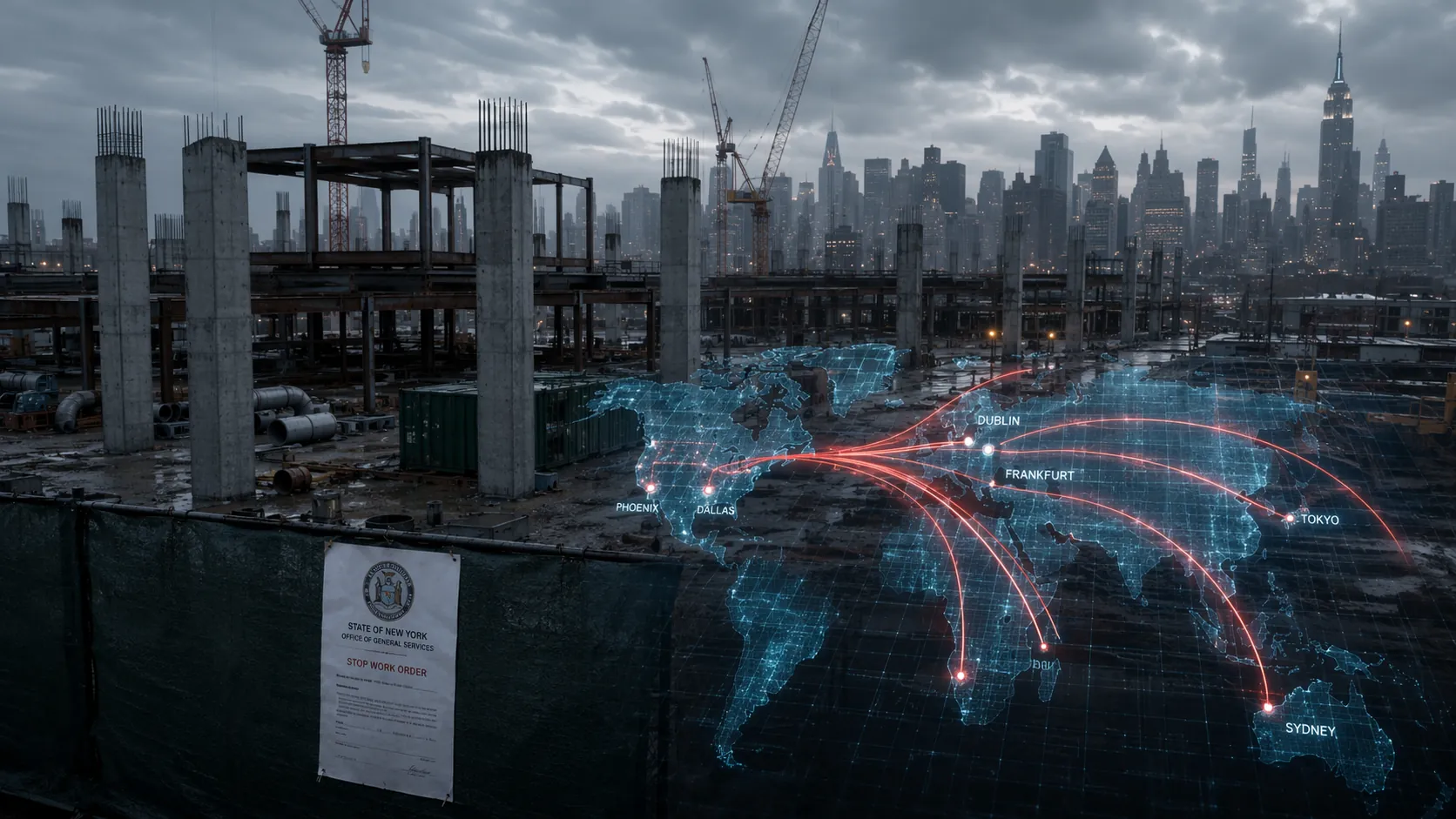
The load does not vanish because Albany has paused a permit category. New York already had roughly 12 GW of data center load in the NYISO interconnection queue, and developers, hyperscalers, equipment suppliers, EPC firms, and utilities have made commitments around that demand. If a project cannot proceed in New York on its prior schedule, the capital case starts looking for another geography. That is where a permitting action becomes a supply chain event.
The investment figures should not be blended into one large headline number. The New York Times reported $156 billion across 48 data center projects in 2025.[2] Separately, Data Center Watch, cited by AI Consulting Network, said more than 140 local groups had blocked or delayed over $60 billion in data center investment in just over a year.[3] Those are different time windows and different project universes. Together, they show why even a state-level pause can force national reallocation work rather than a local schedule update.
New York also has real economic exposure on the other side of the decision. Data Center Coalition figures cited by Data Center Knowledge said data centers supported 227,000 jobs, $49 billion in state GDP, and $5.1 billion in state and local tax revenue in 2024.[4] None of that proves a particular project should be permitted. It does explain why the moratorium matters to boards and supply chain teams as more than a community-zoning headline.
The moratorium lands on a shortage stack, not a clean slate
EO 62 did not create the AI infrastructure shortage. It exposed how many shortages now have to be solved at the same time. The planning mistake is to keep saying “GPU bottleneck” when the practical blocker may be a transformer, an 800G transceiver, an ABF substrate film allocation, a liquid cooling component, a PCB slot, helium availability, or a specialized logistics move that cannot be substituted by ordinary freight capacity.
| Constraint | Most recently published shortage signal | Why it matters when NY demand redirects |
|---|---|---|
| GPUs | 36-52 week waits reported in Q1-Q2 2026 shortage data | Compute allocation cannot simply follow a site move if the delivery slot is tied to a larger deployment plan. |
| Power transformers | 128-week lead times, with prices up 77% since 2019 | A new receiving region still needs high-voltage equipment before the building can become useful load. |
| 800G transceiver modules | 36-50 week lead times | Networking becomes a gating item for cluster buildout even when chips are available. |
| PCBs | Lead times doubled from 8-12 weeks to 20-30 weeks | Server, switch, and power electronics schedules inherit board-level delays. |
| HBM | Fully allocated before 2026 began, with high-teen-to-low-twenties percentage price increases | AI accelerator supply is constrained by memory allocation, not only by package or wafer output. |
| N3 wafers, T-glass, ABF substrate film, power management ICs, liquid cooling components | Reported among active constraints in the same shortage environment | The bottleneck can move across semiconductor packaging, power delivery, and thermal infrastructure. |
| Helium | 70-100% spot price surge after Ras Laffan strikes | A materials disruption can hit chip and component production upstream of the data center project itself. |
| Project logistics | Specialized heavy-lift, rigging, and transformer logistics remain non-fungible | A rerouted project still needs the right crew, permits, route studies, and equipment-handling capacity. |
The specific lead-time figures come from the most recently published comprehensive shortage data available in the cited sources, covering Q1-Q2 2026 conditions rather than a July 25, 2026 real-time market print.[5] That timing matters. A planner should not treat every number as frozen. But the pattern is hard to dismiss: the shortage is multi-category and coupled.
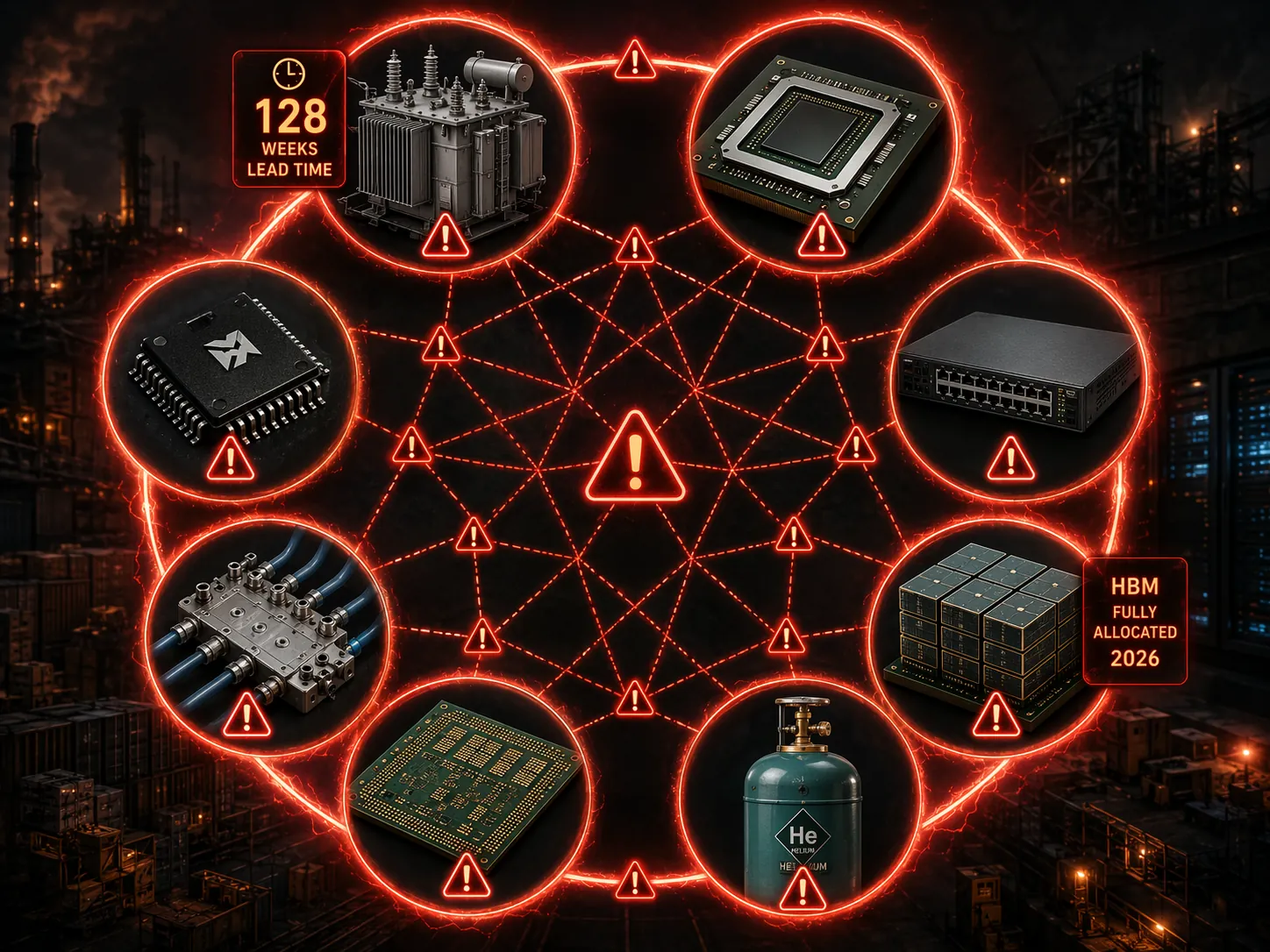
The coupling is the uncomfortable part. A GPU slot without HBM is not a deployable accelerator. A server rack without switch capacity is inventory, not a cluster. A completed shell without energized utility service is stranded capital. A transformer reservation without route clearance, heavy-lift capacity, and receiving-site readiness becomes another date that slips through the Gantt chart. The policy shock changes geography, but the supply chain impact shows up as dependency collisions.
This is why a one-line risk register entry for “permitting delay” is not enough. The useful model has to ask which already-allocated items were tied to New York-destined projects, which are contractually movable, which are physically movable, which can be reassigned without breaching another customer commitment, and which require a construction resequence at the destination site.
Redirected demand runs into receiving-region limits
The obvious alternate geographies are not blank spaces on a map. Texas, Arizona, Georgia, and Virginia are already competing for power infrastructure, cooling capacity, labor, grid studies, and long-lead equipment. Redirected New York demand would arrive into queues that have their own constraints rather than into spare execution capacity.
PJM is a useful warning, even when the specific New York load does not automatically move into PJM territory. In December 2025, PJM was 6,600 MW below reserve targets, and Accuris / SupplyChainConnect reported that 94% of load growth came from data centers.[6] That is not a universal grid condition, and it should not be treated as proof that every receiving region is equally constrained. It does show that data-center-driven load growth can consume reserve margins faster than infrastructure can be added.
Power infrastructure is especially unforgiving because it is not a software allocation problem. Transformers at 128-week lead times do not become available because a demand forecast changes state. Gas turbines booked into the late 2020s cannot be accelerated by moving a data center project from one permitting jurisdiction to another. The destination may be more politically receptive, but the physical system still has to interconnect, energize, cool, and maintain the load.
This is where many scenario plans become decorative. They can change the demand node from New York to Texas. They can increase a lead time assumption. They can mark a supplier as constrained. But can they make those changes at the same time, propagate them through inventory commitments, purchase orders, construction milestones, interconnection queues, freight capacity, and contract penalties, and then show the tradeoff by Monday morning?
What a real concurrent planning model has to carry
For a supply chain planning director evaluating Kinaxis, o9, Blue Yonder, or Anaplan in Q3 2026, the relevant demo is not a polished demand-sensing screen. The relevant demo is a policy-driven demand redirection event with legal scope, geography, equipment allocation, interconnection status, and construction dependency in the same model.
- Legal scope: the model distinguishes data centers above 50 MW from exempt manufacturing and research facilities, rather than applying a generic New York disruption to everything.
- Geography: the model moves load and project demand into alternate states while preserving grid, tax, permitting, labor, and logistics differences by region.
- Equipment allocation: the model knows which GPUs, transformers, transceivers, cooling systems, PCBs, and power components are committed, movable, substitutable, or effectively locked.
- Construction sequencing: the model connects component dates to site readiness, interconnection milestones, commissioning order, and liquid-cooling installation windows.
- Logistics capacity: the model treats heavy-lift, rigging, transformer moves, route permits, and project cargo expertise as constrained resources rather than generic transportation.
- Financial consequence: the model shows what slips, what can be reallocated, who waits, and which committed assets become stranded or penalty-bearing.
That is a high bar, but it is the bar the event sets. Single-tenant ERP and MRP systems can record the purchase order, the supplier, the warehouse, the project code, and the promised date. They usually struggle when the question becomes simultaneous: if a New York permit is frozen, can transformer A move to Georgia, can switch allocation B move to Arizona, can GPU allocation C remain useful without HBM timing D, and does the Texas site have interconnection progress sufficient to absorb any of it?
The word “concurrent” earns its keep only if the model lets those variables fight each other in one environment. Demand redirection without supply scarcity is a map exercise. Supply scarcity without policy scope is a shortage report. Inventory visibility without construction dependency is a warehouse view of assets that may not be deployable. The planning value comes from seeing which constraint becomes binding after every other constraint is respected.
A practical stress test for vendor claims
Kinaxis has already acknowledged that the AI infrastructure boom creates a new supply chain challenge requiring scenario-capable planning.[9] That acknowledgment is useful because it marks the problem as visible to the planning-software market, not just to project teams. It does not settle whether any given implementation can handle EO 62 as more than an after-the-fact exception.
The same standard should apply to o9’s Digital Brain positioning, Blue Yonder’s cognitive planning claims, Anaplan’s connected planning story, and any other platform being evaluated for infrastructure-heavy high-tech planning. The question is not which vendor has the best phrase for scenario planning. The question is whether the configured model can carry the ugly details: jurisdictional thresholds, non-fungible assets, queue position, constrained components, site-by-site sequencing, and logistics resources that cannot be created by changing a parameter.
A reasonable evaluation scenario would start with NY-destined projects above the 50 MW threshold, freeze permitting for up to one year, preserve manufacturing and research exemptions, and then force the model to reallocate demand toward two or three candidate states. The output should not be a single optimized answer. It should expose the binding constraint by option: transformer lead time in one case, interconnection readiness in another, cooling component allocation in a third, or project cargo capacity across several.
The integration work matters as much as the planning engine. A system cannot simulate what it cannot ingest or relate. Permit status may live outside ERP. Interconnection queue data may be managed by utility and development teams. Transformer reservations may sit in procurement files. GPU and HBM allocations may be governed by supplier commitments that are not visible at the same granularity as construction milestones. The hard part is not naming the shock; it is connecting the operational objects the shock changes.
The policy wave is wider than New York
New York is not an isolated planning anomaly. More than 12 states had moratorium bills in 2026, Maine passed the first ban, and New York became the first statewide ban signed into law, according to AI Consulting Network’s tracking.[3] Politico reporting cited by ConstructLaw said that, as of May 2026, 28 of 38 states offering data center tax incentives were reconsidering them.[7] The landscape may have shifted by late July, but the direction is clear enough for planning purposes: regulatory availability is no longer a static site-selection assumption.
There are legitimate reasons states are scrutinizing data centers: grid pressure, water and land use, community opposition, tax-incentive value, and environmental review. A planning model does not need to adjudicate those politics. It does need to represent the fact that a statehouse vote, agency order, or incentive change can move capital faster than physical infrastructure can follow.
The Micron contrast makes the planning problem sharper. New York has supported a semiconductor megafab with approximately $5.5 billion in combined CHIPS Act and state incentives, according to Dr. Robert Castellano’s analysis, while EO 62 blocks large data centers that would consume the kind of chips the broader AI buildout depends on.[8] The exact incentive total depends on vesting conditions and is not independently verified here from a full public transcript, so it should be treated as approximate. Still, the distinction between exempt manufacturing and paused compute infrastructure is exactly the kind of legal boundary a model must carry correctly.
The planning judgment for Q3 2026
EO 62 is best understood as a live stress test for supply chain AI planning. It joins a clear regulatory trigger to a multi-category shortage stack and then asks whether the system can re-optimize across geography, equipment, construction, power, and logistics without pretending those constraints are separate exercises.
For platform evaluations, the practical test is direct: regulatory volatility has to be modeled as a first-class variable alongside demand, supply, and inventory. If the moratorium can only be pasted into a risk register after the demand plan, supply plan, and construction plan have already been produced, the model is not solving the problem this event exposes.
References
- Executive Order No. 62: Establishing a Temporary Moratorium on Data Centers in New York While the State Develops a Generic Environmental Impact Statement, Governor of New York, July 14, 2026
- New York data center moratorium Hochul, The New York Times, July 14, 2026
- Data Center Moratorium Bills: What States & CRE Investors Need To Know In 2026, AI Consulting Network
- New York Data Center Moratorium: State Pauses Projects Over 50 MW, Data Center Knowledge
- Supply chain constraints are curbing US data center development, Rabobank
- The 2026 Supply Chain Supercycle: Why AI Infrastructure Shortages Run Deeper Than The Chip, SupplyChainConnect
- Policymakers Consider Temporary Pause on AI Data Center Construction: What Stakeholders Need to Know, ConstructLaw, May 14, 2026
- New York Wants Micron’s Chips. Why Is It Blocking the Data Centers That Use Them?, Dr. Robert Castellano Substack
- AI infrastructure boom creating new supply chain challenge, Kinaxis
§ 42 — Cited evidence
Flag an inaccuracy or submit a comparable account — Contribute or read how claims are verified in Methodology.