§ 41 — Use-case analysis
What Neuromancer Reveals About AI Lock-In in Supply Chains
Neuromancer's Tessier-Ashpool SA is the literary archetype of closed, proprietary AI — a model that maps directly to today's risk of single-vendor lock-in in supply chain planning. The article explains why this dependency is structural, not just data-related, and outlines governance strategies planners can deploy now to preserve platform optionality.
- Function
- supply chain planning
- AI technique
- agentic AI
- Failure pattern
- vendor lock-in
- Evidence source
- Viewpoint Analysis 2026, Gartner 2025, Lumenova AI 2026, SCMR 2026, Deloitte 2026
Apple TV+'s Neuromancer teaser arrived on July 6, 2026, with the series slated to premiere on January 22, 2027, so the usual searches are already forming around the Neuromancer cast, AI, supply chain themes, and whether the adaptation will preserve the novel's machinery of corporate control.[1][2] The useful supply-chain question is not whether the show gets the neon right. It is whether Tessier-Ashpool SA still gives buyers the clearest metaphor for what happens when intelligence is enclosed inside a private system.
In Neuromancer, Tessier-Ashpool is not just a wealthy family or a cyberpunk backdrop. It is a closed corporate dynasty that controls advanced AIs as proprietary assets, with access, purpose, and continuity held inside the house.[3] That is why the analogy travels so cleanly into supply-chain AI. A planning platform can begin as software, then become the operating layer through which demand, procurement, allocation, transportation, and exception handling are interpreted. Once that happens, the buyer no longer depends only on a vendor's tables and interfaces. It depends on the vendor's learned decision regime.

The Supply-Chain Version of Tessier-Ashpool
The contemporary version is not a cryogenic family fortress. It is a single AI planning layer that stretches across sales and operations planning, inventory positioning, supplier decisions, logistics execution, and exception management. The buyer still owns contracts, warehouses, lanes, SKUs, and supplier relationships. But the interpretation of trade-offs increasingly sits inside a proprietary optimization environment.
That environment may be excellent. Large vendors often win for good reasons: integration capacity, implementation partners, domain templates, uptime commitments, security reviews, and enough support coverage to survive a global rollout. A procurement lead choosing a suite is not automatically surrendering strategic autonomy. The problem begins when the evaluation treats AI as a feature category rather than as the future control surface for operating decisions.
The 2026 buyer landscape is already concentrated enough to make the question practical. Viewpoint Analysis names Blue Yonder, Kinaxis, o9 Solutions, SAP IBP, RELEX, and Anaplan among the supply-chain AI and planning software options buyers are actively comparing, while also describing a market shift toward AI-native planning.[4] Gartner's 2026 Magic Quadrant context, as summarized in that buyer guide, places Blue Yonder, Kinaxis, o9 Solutions, and SAP IBP among the Leaders.[4] This does not prove those vendors have equivalent lock-in risks, and the available public material does not compare their audit trails, agent authority boundaries, or model-portability provisions feature by feature. It does show that buyers are making platform decisions in a market where a small group of vendors can plausibly become the intelligence layer for large operating networks.
Gartner has also predicted that half of supply chain management solutions will include agentic AI capabilities by 2030.[5] That matters because agentic capability changes the switching discussion. A dashboard can be replaced with pain. An embedded agent that has been allowed to recommend, route, prioritize, escalate, or trigger workflow has a different kind of institutional footprint.
Why Data Export Is the Small Part of Lock-In
Most platform-switching conversations start with data migration because data is visible. You can count tables, map fields, cleanse vendor masters, reconcile lead times, and argue over the archive. Those tasks are expensive and tedious, but at least they are legible. AI lock-in is harder because the most important dependency is not the data sitting in the system. It is the organization's adaptation to how the system thinks.
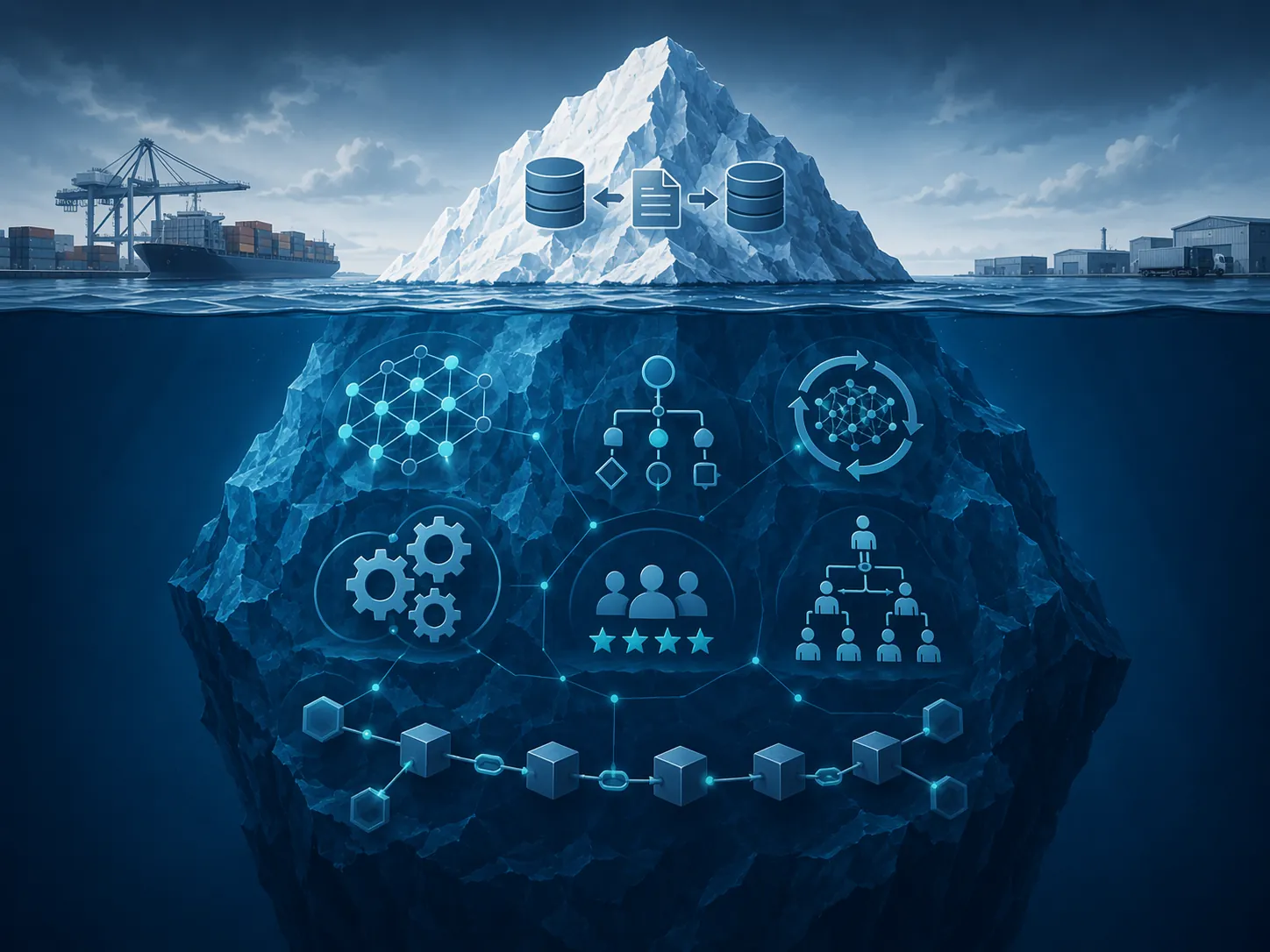
A supply-chain AI does not merely store demand history and supplier records. It encodes optimization priorities. It learns which service-risk thresholds matter, which constraints get softened, which exceptions deserve planner attention, and which trade-offs are acceptable when inventory, cost, service, and capacity collide. Two systems can ingest similar data and produce different recommendations because their objective functions, training histories, constraint handling, and user-feedback loops differ.
That is where the switching cost becomes operational. After several planning cycles, users stop judging each recommendation from first principles. They learn the system's tendencies. A planner knows when the model is too conservative on a promotion. A procurement manager learns how it interprets supplier unreliability. A logistics team learns which alerts are noise and which ones precede a missed ship window. Those habits are not documentation. They are tacit operating knowledge built around one model's behavior.
When the organization changes platforms, it does not only re-map data. It re-learns the decision personality of the new system. Which recommendations should be trusted immediately? Which require override? Does the new engine optimize for working capital more aggressively? Does it defer too much to historical seasonality? Does it surface supplier risk early enough for procurement to act, or late enough that expediting becomes the default answer? These are not abstract AI ethics questions. They determine who carries inventory, who misses revenue, who absorbs premium freight, and who explains the service failure.
Infrastructure economics reinforce the dependency. David Haberlah's Neuromancer-at-40 analysis argues that the largest language models require thousands of GPUs and significant energy consumption, favoring well-funded incumbents and making Gibson's zaibatsu model newly relevant to AI infrastructure.[6] Supply-chain planning models are not identical to frontier language models, and the source does not prove a one-to-one market structure. But the direction is familiar: expensive compute, scarce expertise, proprietary training pipelines, and integration depth all reward vendors that can spread infrastructure costs across many customers.
The market-growth numbers should be treated as directional, not prophetic. Körber Stellium cites an AI logistics and supply chain management market projection of $84.94 billion by 2034 from Market Data Forecast, and also frames agentic AI in supply chain as moving from about $7.8 billion today to $52 billion by 2030.[7] Even if the exact endpoints shift, the commercial signal is clear enough for buyers: more money will flow into AI planning layers, and vendors will have strong incentives to make those layers harder to displace once adopted.
The Hidden Layers Buyers Inherit
The buyer who signs a supply-chain AI contract is often not the person who will live with the second-order dependency. That burden falls to the planning director trying to explain why recommendations changed after a retraining cycle, the procurement lead discovering that supplier-risk logic is harder to extract than supplier records, or the IT integration owner asked to run a parallel cutover without disrupting order promising.
The lock-in layers tend to accumulate in ordinary implementation choices:
- Model behavior: the vendor's system develops recognizable tendencies in forecast adjustment, constraint relaxation, inventory balancing, and exception ranking.
- Optimization priorities: service, cost, working capital, supplier continuity, and capacity utilization are weighted through configurations and model logic that may not transfer cleanly.
- Workflow redesign: teams change approval paths, meeting cadences, escalation rules, and exception ownership around the platform's recommendations.
- User trust: planners learn when to accept, challenge, or ignore the system, and that judgment is specific to the model they have lived with.
- Agent authority: once AI agents can trigger actions or route decisions, the organization must know who authorized the agent, who reviews it, and who is accountable when it acts badly.
- Integration dependency: downstream systems, supplier portals, warehouse processes, and analytics layers begin to rely on the platform's data structures and event logic.
The most dangerous sentence in a demo is not an exaggerated accuracy claim. It is the casual assurance that the customer can always export its data. That may be true and still miss the point. The buyer needs to know whether it can export decision history, policy logic, scenario assumptions, override patterns, agent-action logs, ontology mappings, and performance evidence in a form another system can use.
A hypothetical example makes the difference plain. Suppose a manufacturer uses one planning AI for demand sensing, supplier allocation, and transportation exception handling. After two years, planners have tuned the system around a preference for service protection in strategic accounts, procurement has built supplier conversations around the platform's risk scores, and logistics has automated some expedite approvals for high-margin orders. If the company later switches vendors, the difficult question is not whether order, item, and supplier tables can be moved. It is whether the new platform can reproduce, explain, or deliberately revise the old decision logic without weeks of manual rediscovery.
Agentic AI Makes Governance Less Optional
Agentic AI pushes the issue from recommendation quality into operating authority. A planning copilot that suggests actions can be governed one way. An agent that creates a replenishment proposal, escalates a supplier disruption, shifts allocation, or initiates a workflow needs a different control model. It needs defined decision rights, accountability, data discipline, and auditability before the organization lets it become routine.
Many organizations are not there yet. Lumenova AI reported in May 2026 that roughly 80% of organizations piloting agentic AI lacked governance infrastructure, with decision rights undefined, accountability unmapped, and data discipline absent.[8] That figure describes a governance gap, not a measured failure rate for supply-chain deployments specifically. Still, it is the right warning for procurement and IT teams: pilots can normalize agent behavior before the organization has decided who owns the consequences.
This is where vendor evaluation has to become more exact. The buyer should not ask only whether the AI is accurate, explainable, or embedded. It should ask what the AI is allowed to do, where its authority stops, how exceptions are reviewed, what logs survive contract termination, and whether the organization can compare the model's recommendations against an external policy baseline.
| Evaluation Area | Question That Exposes Lock-In |
|---|---|
| Portability | Can decision histories, configuration logic, scenario assumptions, and override patterns be exported in usable form? |
| Auditability | Can a reviewer reconstruct why an AI recommendation or agent action occurred after the fact? |
| Decision rights | Which decisions can the agent recommend, route, approve, or execute without human approval? |
| Data ownership | Which customer data, derived signals, embeddings, or learned patterns remain available after termination? |
| Interoperability | Can specialized agents or external optimization engines operate against the same data layer without forcing all logic into one suite? |
What Optionality Looks Like Before the Platform Hardens
The alternative to Tessier-Ashpool is not a fantasy of total independence. Most companies will still buy major platforms. They will still depend on vendor roadmaps, implementation partners, cloud infrastructure, and support contracts. Optionality means designing the architecture so one vendor's AI is not the only place where supply-chain knowledge can live.
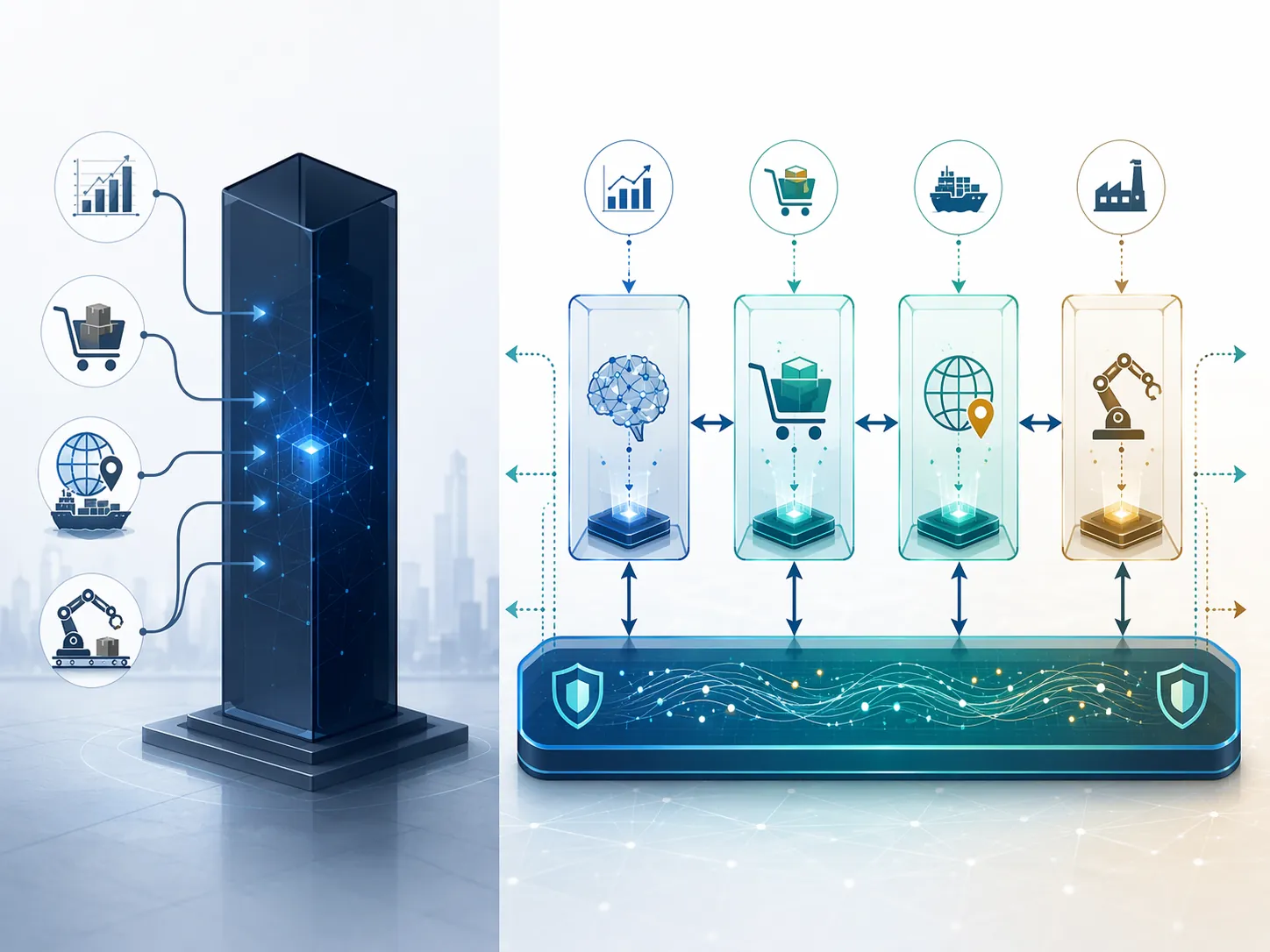
SCMR's February 2026 reset on underperforming AI-agent pilots recommends that multi-agent architectures replace monolithic designs in supply-chain automation.[9] The practical point is not to scatter agents everywhere. It is to avoid making one opaque system responsible for every planning, procurement, logistics, and execution decision. Separate agents can specialize, contest, and be replaced more easily when they operate against shared data and explicit process boundaries.
A procurement-risk agent, for example, should not have to live inside the same proprietary decision layer as a transportation exception agent. They may need to exchange signals: a supplier disruption changes allocation, allocation changes freight demand, freight constraints change customer-service promises. But exchange is different from enclosure. The architecture should let those signals travel through governed interfaces rather than requiring every domain to submit to the same vendor's internal logic.
Deloitte's March 2026 work on the agentic supply chain points in the same direction through a four-layer foundation that includes data architecture supported by ontology and knowledge graph capabilities.[10] This is the less glamorous work that often determines whether a buyer keeps leverage. A vendor-neutral data layer gives the enterprise a persistent representation of products, sites, suppliers, customers, constraints, events, and policies that can outlive any single planning platform.
The ontology matters because supply-chain terms are not self-explanatory. A supplier can be a legal entity, a manufacturing site, a broker, a qualified source for one material, or a risk node shared across several bills of material. A lane can be a contract route, an observed flow, or a contingency option. If those meanings exist only inside a vendor's application schema, the buyer's operating knowledge becomes harder to move. If they exist in a governed semantic layer, applications can be changed without forcing the company to rediscover its own supply-chain language.
Knowledge graphs help for a related reason. They make relationships inspectable: which parts depend on which supplier sites, which customers are exposed to which logistics constraints, which policies affect allocation when capacity tightens. When an AI agent recommends an action, the organization can compare the recommendation against an enterprise knowledge structure rather than accepting the platform as the only available source of context.
The Questions to Ask While the Contract Is Still Negotiable
The lock-in conversation belongs before signature, not during renewal. By renewal time, users may already trust the recommendation engine, workflows may already assume its exception logic, and adjacent systems may already depend on its event model. The buyer's leverage is highest while the vendor still has to explain how portability, auditability, and interoperability will work in practice.
The questions do not need to be hostile. A strong vendor should be able to answer them precisely:
- What decision artifacts can we export besides raw transactional and master data?
- Can we retain recommendation history, override history, scenario parameters, and agent-action logs after termination?
- Which model behaviors are configurable by us, which are vendor-managed, and which are opaque?
- Can external agents or optimization engines read from and write to a shared data layer without degrading support?
- How are agent permissions defined, reviewed, revoked, and audited?
- What happens to derived signals, embeddings, learned patterns, or customer-specific tuning if we leave?
These questions also protect the vendor relationship. They force implementation teams to define authority boundaries before the system is blamed for decisions no one formally assigned to it. They clarify which recommendations remain advisory and which actions require approval. They make retraining cycles visible to the people who will explain changed behavior to business users.
The available public material does not justify ranking o9, Blue Yonder, Kinaxis, RELEX, Anaplan, or SAP IBP by these governance characteristics. A serious buyer would need contract language, product documentation, security and audit evidence, reference calls, and hands-on proof. The point is narrower and more useful: the evaluation must include these questions because the market is moving toward embedded agentic capability, and embedded capability is much harder to unwind than a standalone planning module.
Why the Neuromancer Analogy Still Works
Neuromancer remains useful here because Tessier-Ashpool makes enclosure visible. The family does not merely use intelligence. It contains intelligence, restricts access to it, and makes it serve a private continuity. That is the caution for supply-chain buyers staring at polished AI-planning demos in 2026. The issue is not whether the interface is impressive or whether the optimization engine can find value. The issue is whether the enterprise is building an operating model that can still change its mind.
Supply-chain buyers are not trapped in that world yet. The market is still forming, governance practices are still being written, and architecture choices are still available. A company can choose suite consolidation for speed and accountability while still insisting on decision logs, agent boundaries, exportable policy artifacts, a vendor-neutral data layer, and room for specialized agents. The time to design that optionality is before the dominant AI layer becomes the organization's learned decision logic.
References
- ‘Neuromancer’ finally gets a teaser trailer and release date - here's our first look at Callum Turner in Apple TV+'s new sci-fi series — TechRadar — https://www.techradar.com/streaming/apple-tv-plus/neuromancer
- Neuromancer (TV series) — Wikipedia — https://en.wikipedia.org/wiki/Neuromancer_(TV_series)
- Tessier-Ashpool S.A. — LitCharts — https://www.litcharts.com/lit/neuromancer/terms/tessier-ashpool-s-a
- Supply Chain AI Software Options 2026: Our Buyer Guide — Viewpoint Analysis — https://www.viewpointanalysis.com/post/supply-chain-ai-software-options-2026
- Gartner Predicts Half of Supply Chain Management Solutions Will Include Agentic AI Capabilities by 2030 — Gartner — May 21, 2025 — https://www.gartner.com/en/newsroom/press-releases/2025-05-21-gartner-predicts-half-of-supply-chain-management-solutions-will-include-agentic-ai-capabilities-by-2030
- Gibson's Neuromancer at 40, and the AI Revolution it Predicted — Medium — January 2025 — https://medium.com/@haberlah/gibsons-neuromancer-at-40-and-the-ai-revolution-it-predicted-82f5840700c0
- Agentic AI in Supply Chain: Moving from Pilots to Production — Körber Stellium — 2026 — https://koerber-stellium.com/agentic-ai-in-supply-chain/
- The Agentic AI Governance Gap of Early 2026 — Lumenova AI — May 2026 — https://www.lumenova.ai/blog/agentic-ai-governance-gap/
- After AI agent pilots underperformed: Resetting supply chain automation — SCMR — February 2026 — https://www.scmr.com/article/after-ai-agent-pilots-underperformed-resetting-supply-chain-automation-for-operational-impact
- Resilient by design: The agentic supply chain — Deloitte — March 2026 — https://www.deloitte.com/us/en/insights/industry/manufacturing-industrial-products/agentic-supply-chain-artificial-intelligence-manufacturing.html
§ 42 — Cited evidence
Flag an inaccuracy or submit a comparable account — Contribute or read how claims are verified in Methodology.