§ 41 — Use-case analysis
How the LiteLLM Breach Exposes AI Supply Chain Risk
The March 2026 Mercor-LiteLLM attack chain shows how a compromised open-source library cascaded into data breaches at Meta and OpenAI. This article maps that dependency risk to supply chain planning AI vendors and explains why traditional SOC 2 and ISO 27001 assessments fail to surface it.
- Function
- supply chain risk management
- AI technique
- generative AI
- Failure pattern
- dependency chain compromise
- Evidence source
- Cycode, StrikeGraph
The useful way to read the LiteLLM incident is not as a generic warning that “AI is risky.” It is a dated dependency chain: a compromised Trivy vulnerability scanner, stolen PyPI publish tokens, poisoned LiteLLM releases, a downstream breach at Mercor, and reported exposure affecting Meta and OpenAI data. That sequence matters because it did not begin with a planning application, a chatbot prompt, or a model provider. It began in the connective tissue.
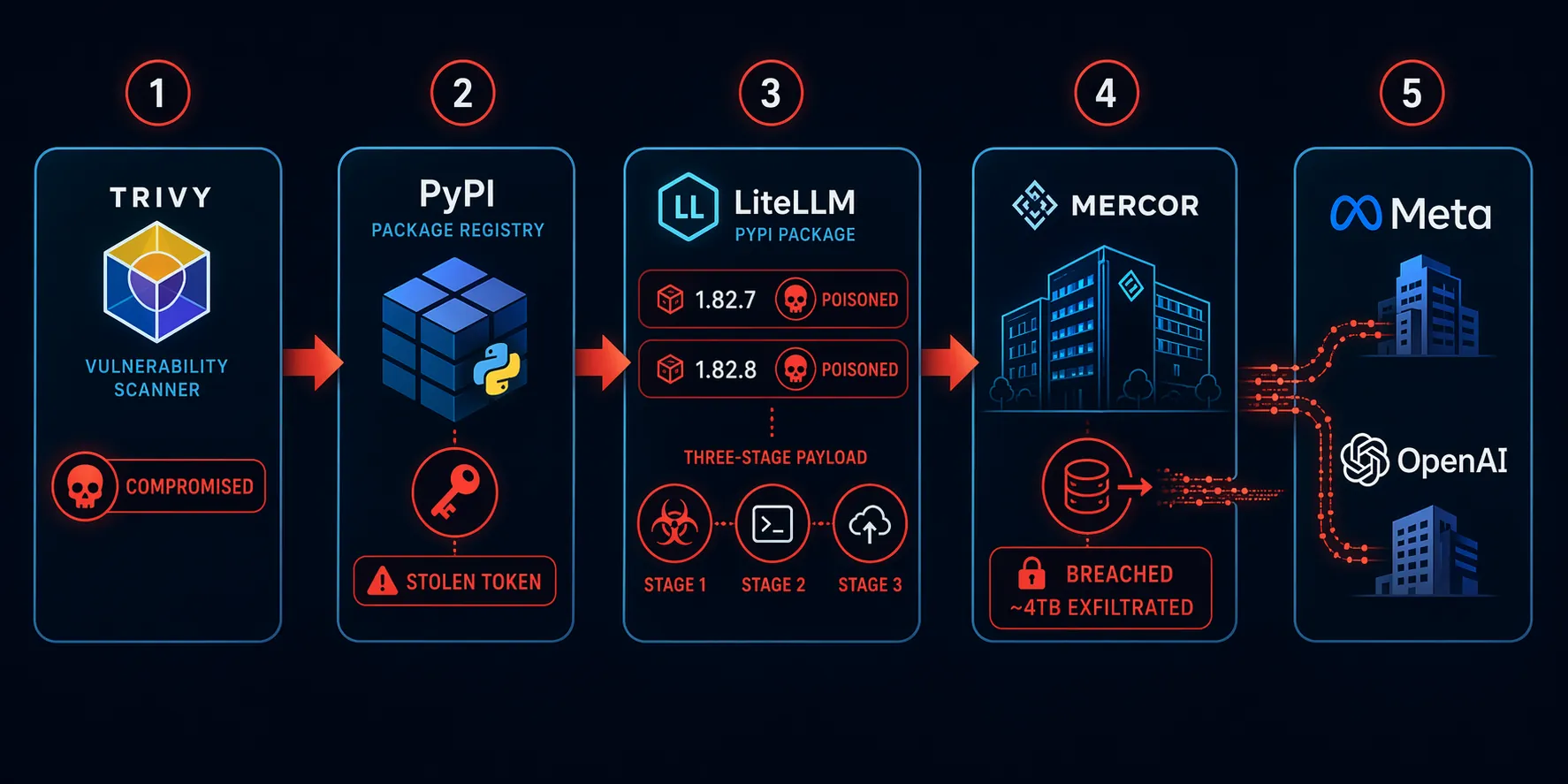
Cycode reported that malicious LiteLLM versions 1.82.7 and 1.82.8 were published to PyPI after attacker access to publishing credentials. The poisoned releases included a multi-stage payload and command-and-control infrastructure, and the affected package window was short enough to look almost harmless on a calendar: roughly 40 minutes to three hours, depending on the version and repository state described by the researchers.[1] In modern deployment pipelines, that is not a harmless window.
StrikeGraph’s account of the downstream incident says Mercor, described as a $10 billion AI training startup, was breached after the LiteLLM compromise, with approximately 4TB of data exfiltrated and Meta and OpenAI among the affected customers.[2] Kiteworks later framed the same chain as a pattern for AI supply chain compromise rather than an isolated vendor failure.[3] The responsible conclusion is narrower than “every AI vendor is exposed,” but stronger than “this was just one startup’s problem”: an open-source AI orchestration layer can become the entry point into companies that never made that layer visible to their own buyers.
The breached layer was not a side library
LiteLLM is an AI API gateway proxy. That sounds like plumbing, which is exactly why it deserves attention. A gateway proxy can sit between an application and multiple model providers, normalizing calls, routing requests, handling credentials, logging usage, or making it easier to swap one model endpoint for another. In a planning workflow, that kind of layer may touch demand signals, supplier notes, purchase-order context, service-level exceptions, SKU attributes, and internal commentary that never belongs in a public incident headline.
The practical appeal is obvious. A startup building a forecasting copilot does not want to hard-code every model provider separately. A procurement intelligence tool may want to route a low-risk summarization task to one provider and a higher-value reasoning task to another. A logistics exception assistant may need a framework that connects retrieval, prompts, tools, and model calls without rebuilding the entire stack. LiteLLM, LangChain, LlamaIndex, Hugging Face packages, and similar components make that work faster.
Speed is not the problem. Treating the orchestration layer as invisible is the problem. If a poisoned package is auto-pulled into a service that can read environment variables, call internal APIs, or relay prompts and responses, the attacker does not need to defeat the ERP directly. The attacker can wait in the middleware that the ERP-adjacent application already trusts.
| Chain element | Operational significance for a supply-chain AI buyer |
|---|---|
| Compromised scanner or build tool | Security tooling can become a credential access path rather than a control. |
| Stolen package publishing token | The attacker can ship code through a trusted registry identity. |
| Poisoned AI proxy or orchestration package | The malicious layer may sit close to prompts, API keys, model routing, logs, and workflow context. |
| Downstream AI startup breach | Customer data exposure can arise from dependency compromise, not only from the vendor’s own application code. |
| Customer and contractor fallout | The event moves from engineering incident to vendor-risk escalation, legal review, and possible disclosure analysis. |
Why the short exposure window still mattered
The temptation is to discount a malicious package that was live for only minutes or hours. That would be a mistake in environments where builds, containers, serverless functions, notebooks, and CI/CD jobs can install dependencies automatically. Cycode noted the narrow publication window; StrikeGraph, citing Wiz Research, reported that LiteLLM had about 95 million downloads per month and appeared in roughly 36% of cloud environments.[1][2]
Those adoption figures should be handled carefully. The 36% cloud-environment figure is second-hand in the available source chain, attributed by StrikeGraph to Wiz Research rather than independently verified here.[2] It is still directionally important for risk review: the relevant measure is not how long the malicious versions were available, but whether automated systems had enough time to fetch them before maintainers and defenders contained the issue.
That distinction matters for supply-chain planning systems because many AI features are not deployed like old quarterly ERP releases. They may be wrapped in microservices, feature flags, notebooks, private APIs, managed jobs, and hosted copilots that evolve quickly. A dependency update can reach a recommendation engine or document-processing workflow before the customer’s quarterly vendor review even knows the component exists.
What this implies for planning vendors, without pretending they were breached
There is no source in the available record documenting a LiteLLM-related breach of o9 Solutions, Blue Yonder, Kinaxis, RELEX, Anaplan, or any other named supply-chain planning platform. They should not be described as compromised on the basis of the Mercor incident. The relevant point is architectural, not accusatory.
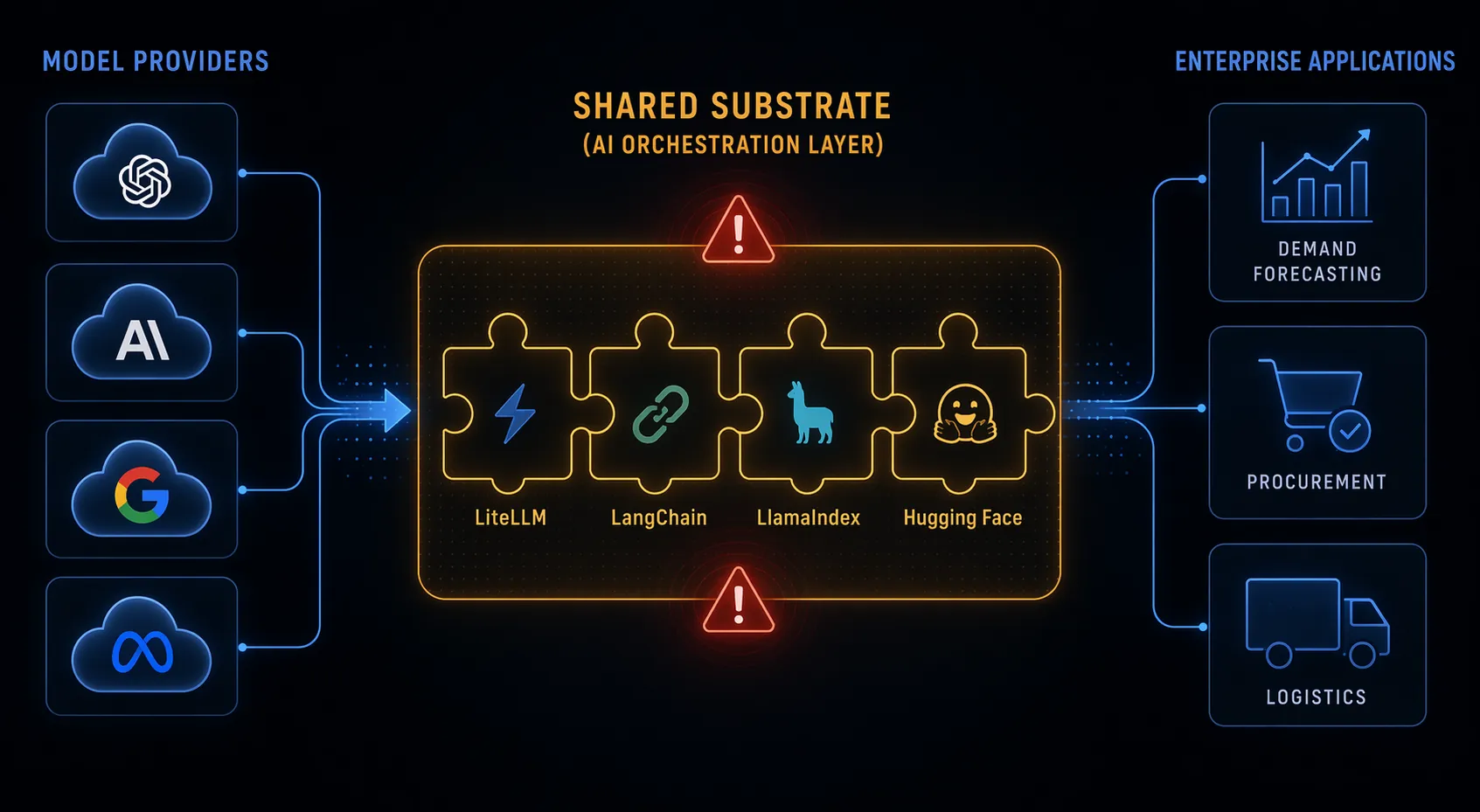
Many supply-chain AI products now need the same category of capability that made LiteLLM useful: model routing, prompt orchestration, retrieval, tool calling, provider abstraction, and usage telemetry. Whether a vendor uses LiteLLM, LangChain, LlamaIndex, Hugging Face components, proprietary middleware, or a mix of all of them, the customer’s question is the same: which layer actually touches the operational signal?
For demand planning, that signal may be a forecast adjustment, promotional assumption, inventory position, or planner override. For procurement, it may be supplier risk commentary, contract text, purchase-order history, or recommended allocation. For logistics, it may be shipment exceptions, carrier communications, lane performance, or service-level recovery decisions. A compromised orchestration package does not need to understand the business process perfectly to create material risk. It only needs access to credentials, request payloads, logs, or downstream systems that were granted trust for legitimate reasons.
That is why buyers should not look only for model jailbreaks or prompt injection demos when they evaluate AI startup cybersecurity risk in the supply-chain stack. Those risks exist, but the LiteLLM chain points to a more ordinary and more durable failure mode: trusted software updates moving through trusted automation into trusted integrations.
The vendor review probably asked the wrong question
SOC 2 and ISO 27001 evidence can still be useful. They can show whether a vendor has access controls, change-management discipline, incident response procedures, audit trails, and a security management system. None of that is trivial. The gap is that a conventional review often stops at the vendor’s control environment instead of following the AI execution path through its package registries, maintainers, service accounts, framework dependencies, and model-routing layer.
A procurement packet may say the vendor encrypts data in transit and at rest. It may include a penetration-test summary, a SOC 2 report, an ISO certificate, a data-processing addendum, and a subprocessor list. A careful buyer can read all of that and still not know whether a hosted planning copilot auto-installs minor package updates from PyPI, whether model gateway images are rebuilt from lockfiles, whether publish tokens are protected against maintainer compromise, or whether a dependency with prompt and credential visibility is monitored as a privileged component.
The missing questions are specific enough to be answerable:
- Which open-source AI orchestration frameworks, API gateway proxies, agent frameworks, retrieval libraries, and model-provider SDKs are used in production customer workflows?
- Are those dependencies pinned, locked, mirrored, allowlisted, scanned, and promoted through a controlled build process, or can new upstream releases be pulled automatically?
- Which of those components can read prompts, responses, environment variables, model API keys, customer identifiers, planning data, or system-to-system tokens?
- How are package publishing credentials, maintainer access, CI/CD secrets, and registry tokens protected and rotated?
- What telemetry would show that a model-routing or orchestration layer started exfiltrating data, calling unexpected domains, or loading an unapproved version?
- If a dependency compromise is discovered, what is the customer notification threshold and who decides whether the incident is material?
These are not exotic questions for a vendor handling forecast data, supplier records, or logistics exceptions. They are the same questions buyers already ask about ERP connectors and integration-platform service accounts, applied to the AI middleware that now sits beside them.
Business risk arrived faster than the postmortem
The Mercor reporting also shows how quickly a dependency incident can become a business event. StrikeGraph reported five contractor lawsuits against Mercor within one week and said Meta paused work with the startup indefinitely after the breach.[2] Those are not abstract reputational effects. They are contract management, legal hold, customer assurance, procurement re-review, and executive escalation.
For a publicly traded customer, a serious downstream compromise may also trigger materiality analysis under the SEC’s four-business-day cybersecurity disclosure rule. The rule does not make every vendor incident reportable, and the available sources do not establish how it applied to every customer in the Mercor chain. The point for planning and IT leaders is more practical: if an AI vendor touches operationally sensitive supply-chain data, the customer needs enough dependency visibility to decide quickly whether the incident is contained, material, or reportable.[2]
The EU AI Act adds another reason to avoid vague architecture answers. Forbes discussed the AI-era supply-chain cybersecurity problem in the context of evolving AI regulation, and August 2026 is the relevant enforcement timing for obligations tied to high-risk AI classifications and transparency.[4] A planning system will not become high-risk merely because it uses an open-source library, but regulated buyers will have less patience for vendors that cannot explain where AI processing occurs, what components mediate it, and how those components are controlled.
What a defensible buyer position looks like
A reasonable buyer does not need to ban open-source AI frameworks. That would be unrealistic and, in many cases, counterproductive. The defensible position is that AI orchestration dependencies are part of the vendor’s attack surface and must be reviewed directly, especially when they sit near planning data, workflow automation, or ERP-connected services.
The procurement language should move from generic assurance to named dependency control. Ask for a production software bill of materials covering AI gateway, agent, retrieval, model-provider, and framework packages. Ask which packages are customer-data-path components rather than developer-only tools. Ask whether the vendor uses a private package mirror, signed artifacts, dependency pinning, egress monitoring, and emergency rollback for AI middleware. Ask how quickly the vendor can identify whether a specific package version ran in a customer tenant or shared service.
The answer does not have to be perfect to be useful. A vendor that can show dependency ownership, version control, restricted tokens, runtime observability, and tenant-impact analysis is in a different risk posture from a vendor that says “we are SOC 2 compliant” and treats its model-routing stack as implementation detail.
For teams already building a broader AI security file, this incident belongs next to model-layer and credential-layer risks, not inside a miscellaneous open-source footnote. The companion analysis on AI model security incidents in supply chains covers the wider incident landscape, while retail account takeover risk is a useful reminder that credential theft and dependency compromise often meet in the same integration estate.
The LiteLLM breach chain does not prove that every supply-chain AI platform is unsafe. It proves something more actionable: when an AI startup routes operational work through popular orchestration frameworks, those frameworks are no longer background tooling. They are part of the system that moves the forecast, the order signal, the supplier recommendation, or the logistics exception, and they deserve the same scrutiny as any other trusted integration layer.
References
- LiteLLM Supply Chain Attack: What Happened and How to Respond, Cycode, March 25, 2026
- The Mercor breach exposed Silicon Valley's fragile AI supply chain, StrikeGraph, April 8, 2026
- AI Supply Chain Breach: Why Mercor-LiteLLM Is Just the Start, Kiteworks, updated May 27, 2026
- The Growing Cybersecurity Risks To The Supply Chain In The AI Era, Forbes, May 22, 2026
§ 42 — Cited evidence
Flag an inaccuracy or submit a comparable account — Contribute or read how claims are verified in Methodology.