
§ 41 — Use-case analysis
How Inference Chip Startups Build Supply Chain Moats
Identifies which inference chip startups have architectures that sidestep the CoWoS and HBM bottlenecks, and examines the trade-offs buyers must weigh when evaluating supply chain security over raw performance.
- Function
- supply-chain
- AI technique
- generative-ai
- Evidence source
- TrendForce, February 2026
The useful question in the AI inference chip startup market is not which accelerator produces the prettiest slide. It is which one can be built, packaged, cooled, integrated, and replenished while the industry is still fighting over the same few scarce inputs. In 2026, those inputs are no mystery: CoWoS-class advanced packaging, HBM, and the most contested TSMC advanced-node capacity.
That baseline is ugly enough before any startup enters the conversation. Oplexa reported that NVIDIA reserved the majority of TSMC’s CoWoS capacity, while CoWoS expansion from 35,000 to 130,000 wafers per month remained effectively sold out.[1] CNAS, citing SemiAnalysis and Bloomberg, described the same pressure in operational terms: Google reportedly cut 2026 TPU production by about 25%, from 4 million to 3 million units, because of packaging constraints.[2] Gartner-linked HBM and DRAM data cited in the same supply-chain discussion put HBM prices up 600% in 2025 and forecast DRAM prices rising 125% in 2026.[2]
TSMC’s own timing does not make this a short inconvenience. The company’s CEO said supply would not meet demand until 2027, and 2nm capacity was reported as booked through 2028.[1] That is why a startup’s supply-chain claim deserves more weight when the architecture physically removes HBM or CoWoS from the design, and much less weight when it merely promises better throughput while standing in the same allocation line.

The Moat Is in the Bill of Materials
There are two very different ways to challenge NVIDIA in inference. One is to claim better performance per dollar, better latency, or better utilization. That may matter later. The other is to avoid the components and packaging steps that make procurement teams wait. The second is rarer, and in 2026 it is the more interesting kind of claim.
A chip that still needs HBM, CoWoS, and an N4/N5-class slot at TSMC may be clever, but it has not escaped the most congested part of the system. It has joined it with a different logo. A chip that stores weights in mask ROM, keeps memory on a wafer-scale SRAM fabric, or uses older-node SRAM through a non-TSMC route changes the procurement discussion. It may still fail on flexibility, capacity, software, or economics. But at least the constraint has moved.
| Company / chip | Supply-chain exposure | What the architecture changes | Main caveat |
|---|---|---|---|
| Taalas HC1 | No HBM, no CoWoS, standard TSMC N6 | Llama 3.1 8B weights embedded directly in mask ROM | Model is physically locked until a new chip revision |
| Cerebras WSE-3 | No HBM or CoWoS, but still TSMC advanced-node dependent | Wafer-scale on-chip SRAM replaces external HBM path | Not insulated from advanced-node foundry tightness |
| Groq LPU | Samsung 14nm, SRAM-first, US fabrication and packaging | Avoids TSMC advanced nodes and CoWoS | NVIDIA acquisition changes the forward-looking independence case |
| Positron, SambaNova, Etched | Appears more exposed to HBM, CoWoS, TSMC N4/N5-class paths, or undisclosed packaging | Compete mainly through performance or specialization | Delivery risk may resemble the incumbent bottleneck |
Taalas: The Bluntest Escape From HBM
Taalas is the cleanest supply-chain thought experiment because the HC1 does something almost impolite by modern accelerator standards: it embeds the model weights directly in mask ROM. TrendForce reported that the chip stores Llama 3.1 8B weights in mask ROM, uses no HBM, no CoWoS, and no SRAM for weight storage, runs on TSMC N6, and is air-cooled at 250W.[3]
That matters because most inference hardware treats model weights as something to be pulled from expensive, high-bandwidth memory. Taalas turns the weights into a physical feature of the chip. If the model is already in the silicon, the product no longer needs HBM stacks to feed it. If it does not need those HBM stacks, it does not need the same CoWoS-style packaging path used to bring logic and memory together. That is not a benchmark trick. It is a bill-of-materials deletion.
The attractive part is obvious for a fixed inference workload. A buyer serving one approved model at high volume can stop paying for flexibility it does not use on every token. TrendForce reported Taalas’s claimed cost at $0.75 per million tokens versus $3.79 per million tokens for NVIDIA’s B200.[3] That number should not be treated like audited operating cost across all deployments. Taalas is pre-revenue, and the performance data is self-reported. Still, the supply-chain mechanism behind the claim is more concrete than the usual startup graph.
The cost is just as physical. A mask-ROM model is not a software checkpoint that an infrastructure team swaps on a Friday night. TrendForce said Taalas can turn a new model into a physical chip in about two months by modifying two mask layers.[3] That is fast for silicon and slow for model operations. A customer whose model changes frequently, whose safety tuning is still moving, or whose product roadmap depends on shifting model families has to account for that delay before treating HBM freedom as a universal advantage.
The right comparison is not “Taalas versus NVIDIA” in the abstract. It is a narrower procurement question: does this workload have stable model weights, enough volume to justify fixed-function silicon, and enough pain from HBM or CoWoS exposure to accept chip-level model rigidity? If yes, Taalas’s oddness is the point. If no, the same architecture becomes a cage.
Cerebras Removes the Memory Package, Not the Foundry Problem
Cerebras deserves a more careful label than “independent.” The WSE-3 uses a wafer-scale design with 44GB of on-chip SRAM and 21PB/s of bandwidth, eliminating the need for HBM and CoWoS entirely, according to TrendForce and Polaris Market Research.[3][4] That is a genuine architectural bypass of the memory-packaging bottleneck.
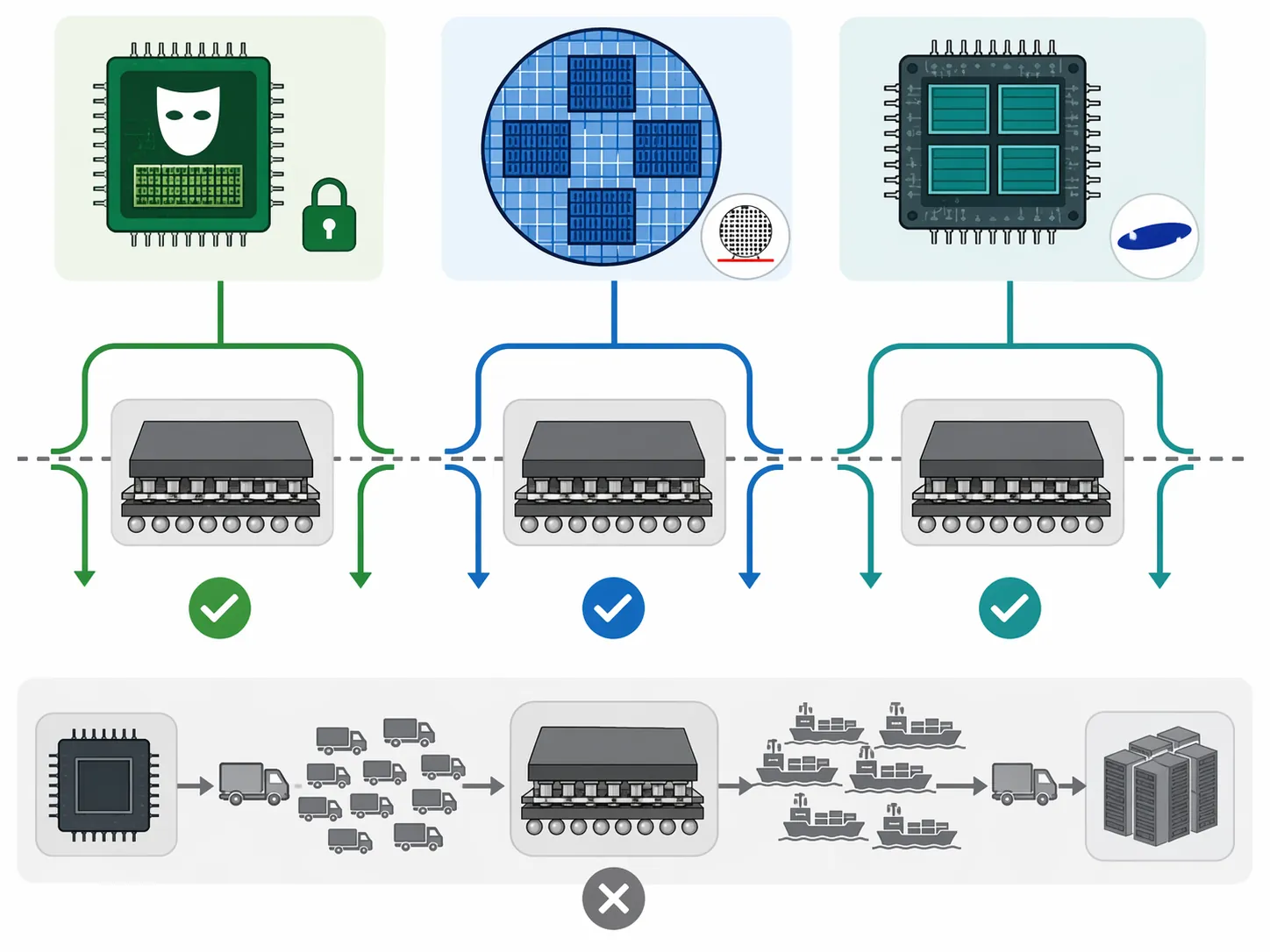
The WSE-3 makes the memory bottleneck visible by refusing to externalize it. Instead of stacking HBM beside a logic die and fighting for advanced packaging, Cerebras puts a large SRAM fabric across a wafer-scale processor. For large inference systems, that changes the integration problem. The scarce memory package is not the center of the design.
But wafer-scale silicon is not a magical escape from semiconductor capacity. Cerebras still depends on TSMC advanced-node manufacturing, and those nodes are themselves constrained. The company can credibly say it is CoWoS- and HBM-independent; it cannot credibly be treated as fully insulated from the broader foundry crunch. That distinction is the difference between an architecture advantage and a procurement guarantee.
The demand signal is substantial. Polaris reported a compute partnership with OpenAI valued at more than $20 billion and 750MW of capacity reserved.[4] That gives Cerebras more than a lab-story profile. It also means buyers should not assume availability just because the architecture avoids HBM. A supplier can bypass one queue and still create another.
For procurement teams, Cerebras is strongest where the infrastructure plan can absorb a system-level commitment rather than treat accelerators as drop-in replacements. The SRAM and wafer-scale approach attacks the HBM/CoWoS constraint directly. The trade-off is that capacity, yield, and node access still concentrate around a very specific manufacturing route.
Groq’s Older Node Choice Was the Supply-Chain Story
Groq’s LPU is less exotic than mask-ROM and less visually dramatic than wafer-scale silicon, but from a sourcing perspective it may have been the most structurally decoupled of the group. Revenant Research, drawing on Groq and SemiAnalysis, described the LPU as using hundreds of megabytes of SRAM as primary weight storage rather than cache, built on Samsung 14nm, and fabricated and packaged in the United States.[5]
That combination breaks several assumptions baked into the accelerator market. It does not chase the newest TSMC node. It does not require CoWoS. It does not organize the design around HBM. The supply-chain moat is not that 14nm is glamorous; it is that 14nm is not where the most desperate AI capacity auction is happening.
SRAM-first design still has limits. On-chip memory is finite, and finite memory shapes the models and batching patterns a system can serve. The advantage is workload-dependent: when the model fits the architecture, Groq can avoid a lot of contested supply. When it does not, no sourcing argument fixes the mismatch.
There is also a corporate caveat that did not exist in the same way before December 2025. TrendForce reported NVIDIA’s $20 billion acquisition of Groq that month.[3] That may validate the strategic value of Groq’s architecture, but it also complicates any forward-looking claim about independence. Pre-acquisition fabrication and packaging arrangements do not automatically describe how capacity, customer allocation, or product priorities behave once the company sits inside NVIDIA.
Performance Challengers Can Still Inherit the Bottleneck
Positron, SambaNova, and Etched are useful here because they mark the boundary of the supply-chain thesis. They may have strong product arguments. They may win certain workloads. But a performance challenge is not automatically a supply-chain moat.
Tom’s Hardware reported Positron’s Atlas claims against NVIDIA’s H200 and described a product path tied to TSMC Arizona N4/N5-class manufacturing with 32GB of HBM.[6] Arizona manufacturing may reduce some geographic concentration risk, but HBM exposure remains HBM exposure. If advanced packaging is also required, the chip is still near the congested part of the map; the public materials do not justify treating it as a clean CoWoS bypass.
SambaNova’s SN50 sits in a similar category for this discussion. The public supply-chain read points toward TSMC-linked, cloud-scale inference rather than an obvious architectural deletion of HBM or CoWoS.[4] That does not make the chip weak. It means the sourcing claim should be evaluated separately from performance and software claims.
Etched’s Sohu is the sharpest warning against getting too excited about specialization by itself. Tech Times and Polaris described Etched as having raised more than $800 million and signed $1 billion in orders, while the chip is built around a hard-wired transformer ASIC on TSMC N4P.[4][7] The exact CoWoS usage is not publicly confirmed in the provided materials, so it should be treated as inferred rather than established. But the known TSMC N4P dependence is enough to keep it out of the clean bypass bucket.
That distinction matters when buyers compare alternatives to incumbent GPUs. A startup can be less exposed to NVIDIA’s allocation priorities while still being exposed to the same HBM vendors, the same advanced packaging capacity, or the same TSMC node pressure. Those are different risks, and procurement plans fail when they are collapsed into one reassuring phrase.
What Buyers Should Actually Separate
The practical evaluation is not a league table. It is a separation exercise. First, identify whether the accelerator removes HBM from the system, reduces HBM dependence, or merely uses HBM more efficiently. Second, identify whether it avoids CoWoS-class packaging or depends on an undisclosed advanced package. Third, identify whether it can be manufactured away from the most contested TSMC nodes. Only after that does it make sense to argue about tokens per watt or cost per million tokens.
- A mask-ROM design can be compelling when the model is stable and volume is high, but it turns model updates into silicon events.
- A wafer-scale SRAM design can remove HBM and CoWoS, but it can still depend on constrained advanced-node foundry capacity.
- An older-node SRAM design can avoid the fashionable bottlenecks, but model fit and post-acquisition allocation can matter more than the architecture slide.
- A high-performance ASIC using HBM and advanced TSMC nodes may be a product competitor without being a supply-chain escape route.
This is also where internal capacity planning has to be honest. A workload with a fixed model, stable request patterns, and high utilization can rationally value supply security over model flexibility. A product team still changing models every few weeks cannot pretend that a physically locked or memory-constrained accelerator is interchangeable with a general-purpose GPU fleet. The procurement win only holds if the workload is narrow enough to fit the hardware without contortions.
For broader HBM pressure, How AI's HBM Demand Is Reshaping the Semiconductor Supply Chain is the better baseline. For CoWoS allocation and TSMC competition, RTX Spark's Supply-Chain Calculus Points to Tight Supply covers the kind of allocation math that makes these bypass architectures worth examining in the first place.
The Narrow, Defensible Conclusion
Taalas, Cerebras, and Groq show that an inference chip startup can build a real supply-chain moat by changing the architecture rather than merely tuning the benchmark. Taalas removes the external weight-memory problem most aggressively, at the price of model rigidity. Cerebras removes HBM and CoWoS through wafer-scale SRAM, while keeping exposure to advanced TSMC manufacturing. Groq’s older-node SRAM route was the strongest decoupling case, though NVIDIA ownership changes how future independence should be read.
That does not make any of them the “best chip.” It makes them less fragile fits for defined inference workloads where supply security outranks model flexibility. The buyer’s job is to decide whether the workload is fixed enough, the supplier mature enough, and the integration burden tolerable enough that avoiding HBM and CoWoS is worth the constraints that come with the escape.
References
- Why Advanced Chip Packaging (CoWoS) Is the Real AI Bottleneck in 2026, Oplexa
- American AI Companies Can't Get Enough Chips, CNAS
- The Inference Economy Arrives, TrendForce, February 2026
- AI Chip Startups Challenging NVIDIA in 2026, Polaris Market Research
- Groq AI Chip Supply Chain Audit, Revenant Research
- Positron AI says its Atlas accelerator beats Nvidia H200, Tom's Hardware
- Etched coverage on funding and signed orders, Tech Times
§ 42 — Cited evidence
Flag an inaccuracy or submit a comparable account — Contribute or read how claims are verified in Methodology.