
§ 41 — Use-case analysis
Ford Rehired 350 Engineers After AI Missed Bronco Fire Defects
Ford's AI quality systems missed wiring-harness defects that led to 565,691 Bronco recalls and 15 engine fires, prompting the automaker to rehire 350 technical specialists. This case examines what supply-chain leaders should demand from AI quality-control vendors.
- Function
- quality-control
- AI technique
- computer-vision
- Failure pattern
- domain-expertise-gap
- Evidence source
- Yahoo Finance/Moneywise, Car and Driver, NHTSA, Supply Chain Management Review, Worldmetrics
The useful lesson from Ford’s Bronco engine-fire recall is not that artificial intelligence caused a defect. That would be too neat, and the available facts do not support it. The harder lesson is that Ford had made a serious push into AI-enabled quality work, then in June 2026 acknowledged that the push had fallen short without experienced technical people in the loop. Charles Poon said the company had “mistakenly thought” that introducing AI and feeding it design requirements would produce a high-quality product, and Ford rehired about 350 experienced technical specialists after concluding that the systems were not enough on their own.[1]
One month later, the Bronco case put a very physical defect next to that admission. Ford recalled 565,691 Bronco and Bronco Raptor vehicles built from September 2020 through June 2026 because insufficient abrasion protection on a wiring harness could lead to engine-compartment fires; Car and Driver, citing the NHTSA Part 573 safety recall report for recall 26V468, reported 15 confirmed engine fire incidents and owner notification planned for August 2026.[2]
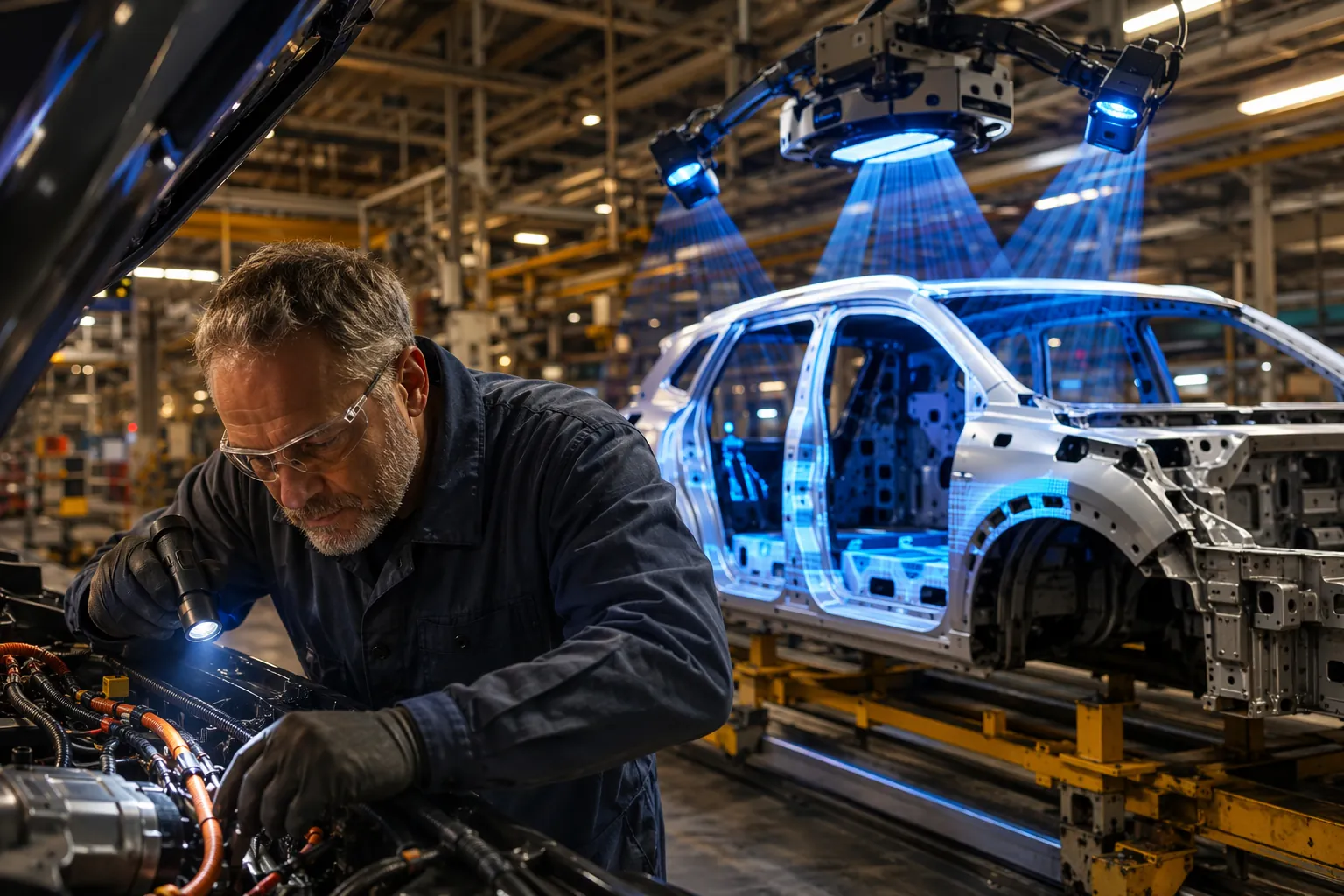
That sequence matters because a wiring harness abrasion problem is not an exotic statistical anomaly. It is the kind of failure mode that production engineers, supplier-quality engineers, and field technicians learn to respect because vehicles are not CAD files after they leave the screen. Harnesses move. Brackets vary. Assembly paths drift. Heat, vibration, service access, and “acceptable” tolerances can turn a design that looks clean into a rubbed-through part.
So the Bronco recall should not be used as proof that AI quality control is useless. It is more specific than that, and more useful. Ford’s AI quality push did not prevent a long-running, production-adjacent, known-type physical defect from reaching hundreds of thousands of vehicles. For anyone buying AI inspection, quality analytics, or supply-chain risk tools, that is the point worth sitting with.
What Ford Actually Admitted
Poon’s comment is unusually plain for a large manufacturer discussing a quality correction. He said AI “is only as good as the information you use to train it,” and described Ford’s earlier assumption as the belief that introducing AI and ingesting design requirements would be enough to produce quality.[1] That is not an anti-AI statement. It is a training-data statement, and in manufacturing it is a serious one.
Design requirements are necessary. They tell a system what the product is supposed to be. They do not automatically teach the system where a harness gets pinched when an operator routes it a few millimeters differently, where a supplier’s covering material behaves differently over time, or which combination of heat, vibration, and access constraints tends to show up three years later as a fire complaint.
The rehire is the important part. Market forecasts are cheap. Accuracy claims are cheaper. Bringing back about 350 experienced technical specialists is an organizational correction with cost, friction, and managerial embarrassment attached.[1] Companies do not usually do that because a dashboard needs more polish. They do it because something important is not being represented in the way work is being judged.
Ford’s public quality language had already been moving toward prevention. In a 2025 company update, COO Kumar Galhotra framed the shift as moving from “find and fix” toward preventing issues before they occur.[3] That is the right ambition. But prevention is where tacit knowledge becomes hardest to automate, because the most valuable person in the room is often the one who says, before the data set is large enough to prove it, “that routing is going to rub.”
The Bronco Recall Is A Quality-Control Test Case, Not A Causation Claim
The cleanest way to read the Bronco recall is by separating confirmed facts from interpretation. The confirmed facts are the recall scope, the production window, the wiring-harness abrasion concern, and the 15 confirmed engine fire incidents reported by Car and Driver from the NHTSA-linked recall material.[2] The interpretation is that this kind of defect should make AI-quality buyers ask whether their systems are being validated against physical failure modes that experienced engineers already know how to fear.
| Point | What The Available Material Supports | What It Does Not Prove |
|---|---|---|
| Ford’s AI quality initiative | Ford acknowledged in June 2026 that AI quality systems fell short without veteran technical expertise and rehired about 350 specialists. | It does not prove every Ford recall was caused by AI use. |
| Bronco recall 26V468 | 565,691 vehicles built September 2020-June 2026 were recalled over insufficient wiring-harness abrasion protection tied to 15 confirmed engine fire incidents. | It does not prove AI directly inspected and approved the specific defective harness condition. |
| Supply-chain lesson | AI quality systems need domain experts in training, validation, escalation, and field-failure feedback loops. | It does not prove AI inspection has no value. |
That distinction matters. If the claim becomes “AI caused the fires,” the argument outruns the evidence. If the claim is “a major manufacturer’s AI-heavy quality approach did not prevent a familiar physical failure mode from escaping into the field,” the evidence is strong enough to be uncomfortable.
The discomfort increases because the Bronco recall sits inside a broader quality burden. Ford recorded 152 recalls in 2025, breaking GM’s 2014 record of 77 recalls, according to CBT News.[4] A recall-statistics page from Hearn Law Firm reports that electrical-system defects were Ford’s leading recall cause from 2022 through 2026, with 57 recalls in that category.[5] Those figures do not make the Bronco harness defect inevitable. They do show why an electrical, harness-adjacent fire risk should not be treated as a surprising edge case.
Ford has also argued that high recall activity can reflect more proactive issue identification. That is not a frivolous defense; earlier detection is better than late denial. But for a supply-chain leader evaluating AI quality-control software, the harder question is not whether recalls are always bad signals. It is whether the system detects the right failure modes early enough, while the affected population is still small.
Scale is the quiet punishment in quality. Supply Chain Management Review, discussing 2025 recall lessons, cited an increase in average recall scope from 26,600 vehicles per event in the first half of 2025 to 41,900 in the second half.[6] Once a defect crosses enough production dates, plants, suppliers, and service populations, the technical issue becomes a logistics problem, a customer-confidence problem, and a capital-allocation problem.
Why Training Data Is Not Shop-Floor Knowledge
AI quality-control tools are often very good at seeing what they have been taught to see. That is valuable. A camera system that catches a missing fastener, a misapplied label, a surface blemish, or a dimensional anomaly before a tired inspector reaches the station can reduce waste and protect people from repetitive inspection work. The problem begins when that usefulness is quietly converted into a broader claim: that the system understands quality.
Quality is not just conformance to the visible requirement at one moment. In a vehicle, it is also the behavior of an assembly over time. A harness can pass routing checks and still be vulnerable if its protective sleeve is insufficient in a contact zone. A clip can be present and still allow movement. A design can meet a requirement and still be fragile under real production variation.
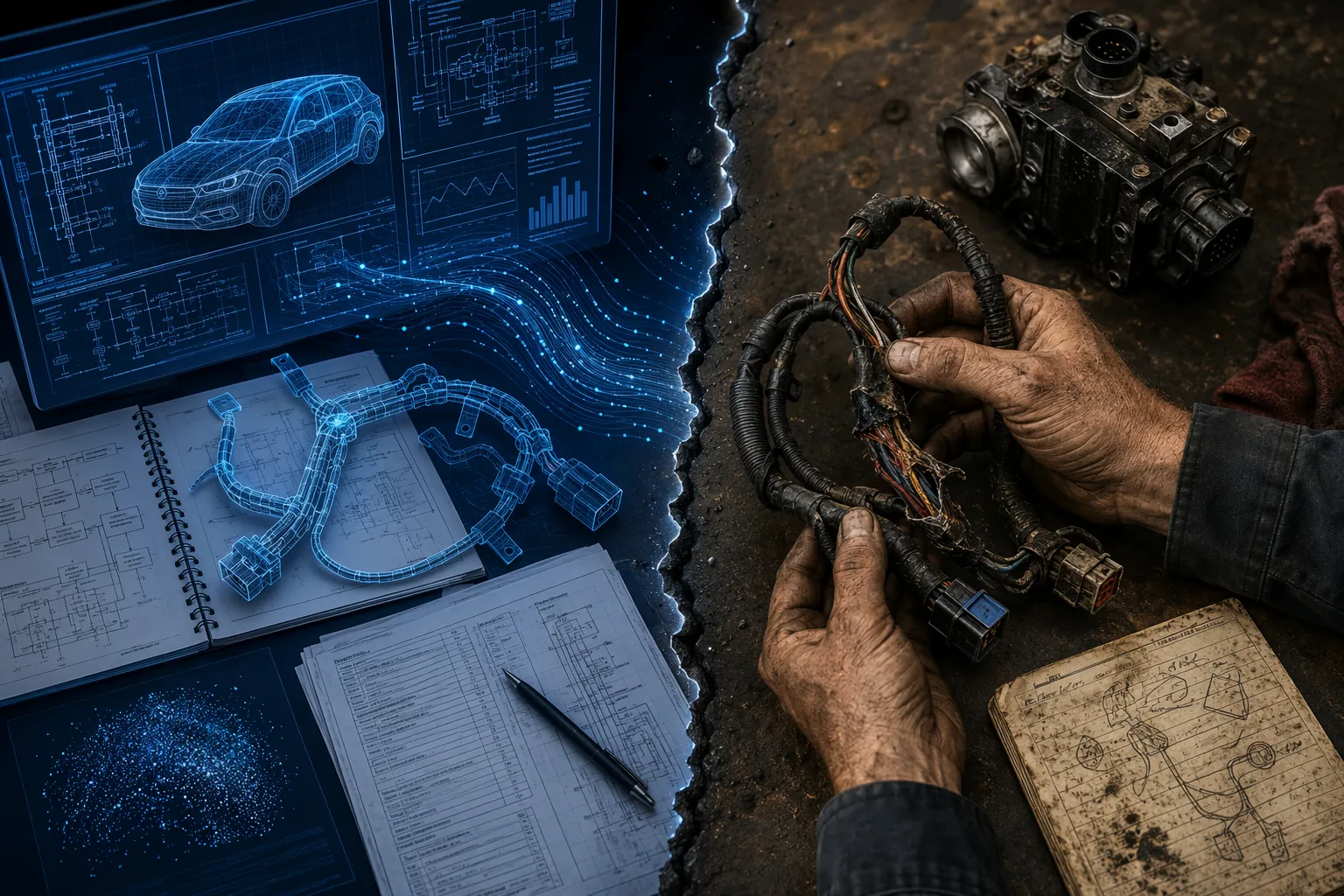
That is why Poon’s phrasing is so useful. “Ingesting the design requirements” sounds like the dream version of AI quality: feed the system the rules, then let it enforce them.[1] But experienced manufacturing people know that a requirement is not the same as a failure-mode memory. The memory lives in warranty returns, teardown rooms, launch reviews, supplier deviations, operator workarounds, and the engineer who remembers that a similar harness rubbed through on a different platform.
A procurement team should be especially careful with any vendor demonstration that starts from clean examples. In a demo, the defect is usually present, labeled, and visually legible. In production, the more dangerous question is often whether the system knows which non-obvious variation deserves escalation before it becomes a confirmed defect.
The Bronco recall points toward a validation gap that is easy to underprice: historical failure modes. Before an AI inspection model is accepted, buyers should ask whether it has been tested against the company’s own past escapes, including low-frequency but high-severity events. Not just “can it find defects?” but “can it find the defects we have already paid for once?”
Treat Vendor Promises Differently From Recall Evidence
Supply-chain buyers are not hearing modest claims from the AI-quality market. Worldmetrics, aggregating BCG-, Deloitte-, and McKinsey-style material, reports figures such as 98% defect-detection accuracy for AI visual inspection, 70% manufacturer adoption of AI for quality control, 28% defect-rate reduction, 22% warranty-claim reduction, quality-control cost reductions of up to 45%, and a $3.26 billion AI quality-inspection market in 2026 growing at roughly 22% CAGR.[7]
Those numbers may describe real improvements in some settings. They should not be treated as equivalent to recall evidence. The Worldmetrics figures are aggregated from vendor-adjacent consulting and industry research, not independent post-implementation audits of every deployed model across messy production environments.[7] A 98% detection-accuracy claim also depends on what was in the test set, how defects were labeled, how ambiguous cases were handled, and whether the system was tested on the specific failure modes that matter most to the buyer.
Vendor content makes the promise narrative even cleaner. Blue Yonder, for example, frames automotive supply-chain transformation around better visibility, predictive capability, and reduced blind spots.[8] Those are reasonable goals, and the industry does need better sensing across suppliers, plants, logistics, and field performance. But a vendor blog is not evidence that a buyer’s harness abrasion risk, coating inconsistency, torque drift, battery weld issue, or supplier process change will be caught in time.
This is where procurement discipline matters. Adoption is not effectiveness. A high average detection rate is not protection against a high-severity false negative. A reduction in defects in one environment is not proof that the same model will understand another plant’s fixture wear, another supplier’s material substitution, or another vehicle program’s packaging constraint.
What Buyers Should Demand Before Signing
The Ford episode should change the vendor conversation from “what accuracy can you claim?” to “where does hard-earned domain knowledge enter the system?” That is a less comfortable meeting, which is why it is the right one.
Ask who trains the model, not just what data trains it
A supplier can say the model uses design requirements, inspection images, process data, nonconformance reports, and warranty records. That inventory is useful but incomplete. Buyers should ask which production engineers, supplier-quality engineers, maintenance leads, and field-failure specialists review the labels, challenge the edge cases, and decide which anomalies deserve escalation.
If the vendor cannot describe that human review loop in operational terms, the buyer should assume the model is learning from available data rather than from the organization’s actual failure memory. Those are not the same asset.
Audit false negatives with more intensity than false positives
False positives are noisy and expensive. They stop lines, irritate supervisors, and create immediate pressure to tune the system down. False negatives are quieter. They ship.
That asymmetry should shape governance. Buyers should require a false-negative review process that includes escaped defects, warranty claims, service reports, teardown findings, and near misses. The review should not be limited to whether the model technically performed as configured. It should ask whether the configuration was too narrow, whether the inspection point was too late, and whether the model was ever taught the relevant failure mode.
Test against old escapes before trusting new promises
Every manufacturer has a graveyard of past quality escapes. Some are embarrassing. That is exactly why they are valuable. A buyer evaluating an AI quality-control platform should build a validation set from previous recalls, containment actions, warranty spikes, supplier deviations, and launch issues. The test should include defects that were difficult to see at the time, not only the clean examples that make a model look competent.
For a harness-related risk, that might mean asking whether the system can recognize routing variation, missing or insufficient abrasion protection, contact with adjacent components, clip seating problems, or process changes that increase movement over time. The exact list will vary by product. The principle does not: validation should start with the failures the organization already knows how to create.
Make field failures part of the model’s life, not an after-action report
A quality model that is not updated by field experience becomes stale in the most dangerous way: it can continue to look controlled while the product teaches a different lesson outside the plant. Buyers should require a defined path from service claims, warranty returns, dealer reports, customer complaints, and teardown analysis back into inspection logic.
The path needs owners. Someone has to decide when a field signal is strong enough to change inspection thresholds, add a camera view, revise a control plan, quarantine supplier lots, or send an engineer to the line. If that accountability is left vague, the AI system becomes another place where weak signals wait for permission to become obvious.
Force the vendor to name the defects it is least likely to catch
A serious vendor should be able to say where its system is weak. Maybe it struggles with hidden contact points, defects that emerge only after vibration, material degradation that is not visually obvious, rare combinations of tolerances, or process drift that remains within nominal limits. That answer is more valuable than another generic claim about predictive quality.
The worst answer is a universal one. No inspection model sees everything. No planning model understands every supplier behavior. No quality analytics layer turns incomplete field feedback into certainty. A buyer that cannot get a clear limitation statement is not hearing confidence; it is hearing sales risk.
The Governance Question Behind The Tool
Ford’s 350-specialist correction should make executives cautious about substitution language.[1] AI can reduce repetitive inspection burden, surface patterns faster, and help teams focus attention. It can also give management a false sense that quality knowledge has been captured because requirements, images, and reports have been ingested.
The missing layer is often not data volume. It is judgment: which variation matters, which old failure resembles the new anomaly, which supplier change deserves suspicion, which plant workaround is becoming normalized, which quiet service signal should be pulled forward before the recall population grows.
That judgment cannot stay informal if AI is going to sit inside quality control. Experienced engineers need formal roles in model training, validation, escalation design, and post-field-failure learning. Supplier-quality teams need authority to challenge what the model ignores. Procurement needs contract language that treats false-negative auditing, historical-failure validation, and domain-expert participation as deliverables, not optional workshops.
The Bronco recall does not end the case for AI in quality control. It ends the case for buying it as if design requirements plus data ingestion can replace people who know how products fail. If a buyer cannot see where tacit domain knowledge enters the system, they are not buying defect prevention. They are buying automation with an unmeasured blind spot.
References
- Ford AI wasn’t smart enough, so it rehired 350 engineers, Yahoo Finance/Moneywise
- Ford Bronco, Bronco Raptor Recalled for Engine Fire Risk, Car and Driver
- Ford Quality Update, Ford From the Road
- Ford posts record 152 recalls in 2025 but says vehicle quality is improving, CBT News
- Ford Recall Statistics and Fast Facts, Hearn Law Firm
- Turning vehicle recalls into a test of supply chain resilience: Lessons from 2025, Supply Chain Management Review
- AI in the Automotive Parts Industry Statistics, Worldmetrics
- Transforming automotive supply chains, Blue Yonder
§ 42 — Cited evidence
Flag an inaccuracy or submit a comparable account — Contribute or read how claims are verified in Methodology.