§ 41 — Use-case analysis
Food Recall Severity Is Spiking — Can AI Traceability Deliver?
Food recall severity is surging — hospitalizations doubled, recalled pounds hit 13-year highs — making AI traceability systems a serious investment consideration. This analysis maps the specific AI interventions with the strongest deployment evidence onto the drivers of recall costs, helping procurement and food-safety leaders build an evidence-based business case.
The food recall story has become harder to read from event counts alone. FDA-regulated food recall hospitalizations rose from 230 in 2023 to 487 in 2024, while 13 outbreaks accounted for 98% of all illnesses in 2024.[1] In Q1 2025, FDA recall events declined 3.8%, but affected units rose 232% to more than 70 million, the highest level in nearly two years.[2] On the USDA side, FSIS recalled pounds jumped from 1.04 million to 58.52 million in Q3 2025, a 5,511.8% surge and the highest quarterly total in 13 years.[3]
Those figures should not be blended into one alarm metric. FDA units, FSIS pounds, recall events, illnesses, and hospitalizations are different measures from different systems. But together they create a procurement problem that is difficult to ignore: when a recall gets large, the financial and operating damage now travels faster than many supply-chain teams can isolate the affected product.
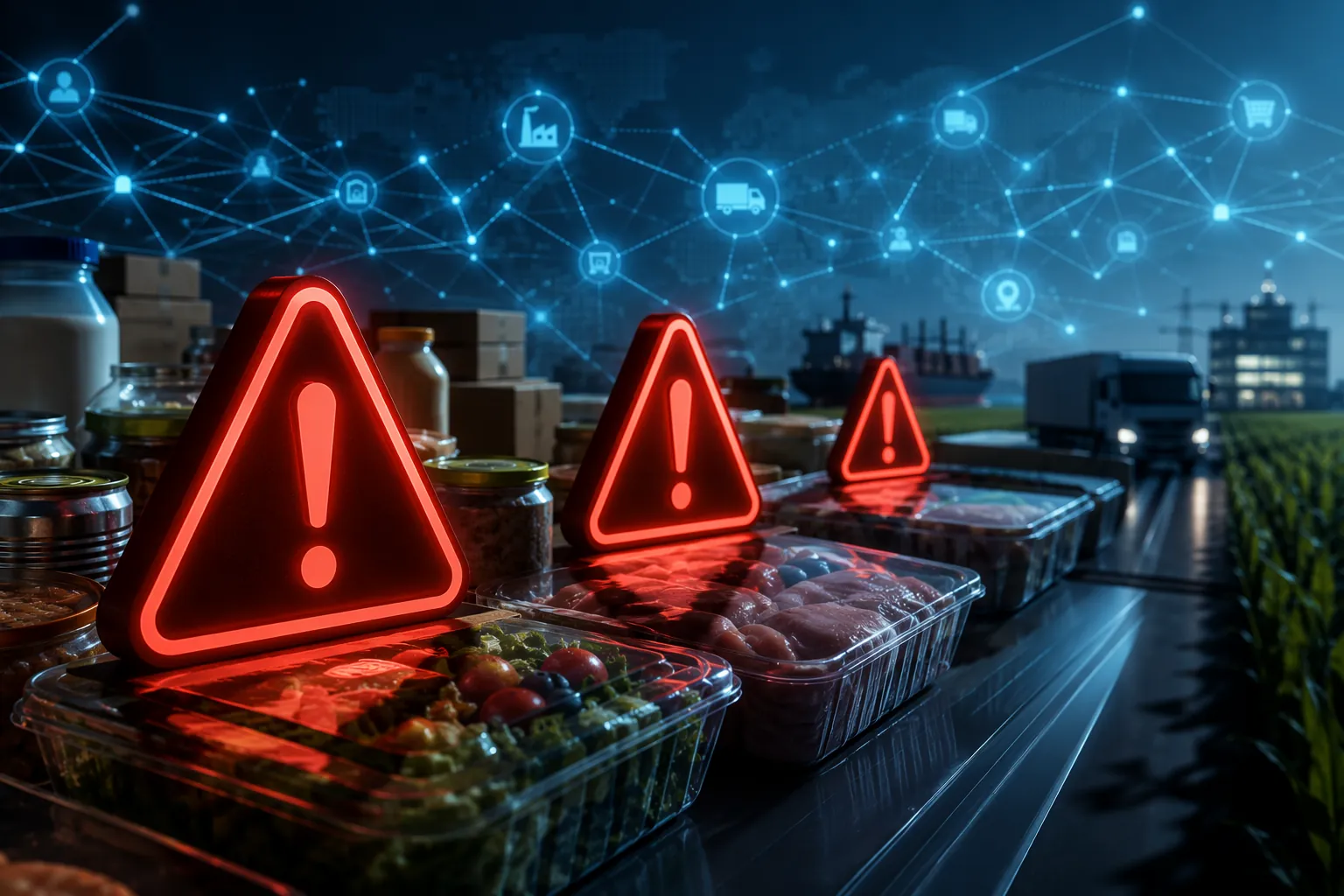
That is the practical question behind AI investment in food recall traceability across the supply chain in 2026. The issue is not whether AI sounds modern, or whether traceability is virtuous. The issue is whether a system shortens a task that currently expands recall scope, delays customer notification, increases product disposal, or forces staff to reconstruct supplier and shipment records after the fact.
The strongest business case does not sit evenly across every AI use case. It sits in two places where the evidence and the recall-cost drivers line up: computer vision for packaging and label verification, and automated lot tracing that can narrow traceback time. Predictive supplier scoring, cold-chain monitoring, and broad AI recall platforms may have a role, but they need a different level of proof before they belong at the center of a capital request.
The Cost Driver Is Usually Specific, Not Abstract
Food recall cost is often discussed as if it were a single invoice. In practice, it is a stack of separate workstreams: identify the affected lots, stop production or distribution, notify customers, coordinate retrieval, document disposal, handle regulator communications, answer retailer and distributor questions, investigate root cause, and prevent recurrence. The commonly cited average direct cost of a food recall is about $10 million, but the more useful question is which part of that cost a proposed system can actually reduce.
| Recall cost driver | Where AI traceability can help | Evidence strength in the current record |
|---|---|---|
| Wrong label, undeclared allergen, or packaging mismatch | Computer vision and inspection systems check label, package, and product attributes before shipment | Strongest fit because the failure mode is frequent, visual, and line-level |
| Slow lot isolation across suppliers, DCs, stores, or restaurants | Automated lot and location tracing reduces manual traceback work | Strong directional evidence, with important scope limits |
| Supplier fragmentation or weak incoming-material visibility | Supplier risk scoring and anomaly detection flag patterns for review | Logically relevant but less supported by named deployment numbers |
| Temperature abuse or transport condition excursions | IoT sensors and AI routing or monitoring tools alert teams earlier | Useful in defined cold-chain contexts, not a general recall-severity answer |
| Post-recall administration and customer response | Workflow tools help triage notifications and documentation | Potentially valuable, but platform claims need audit-quality proof |
This mapping matters because the wrong business case can buy the wrong system. A team facing repeated label escapes does not primarily need a grand prediction engine. It needs an inspection control that catches the wrong artwork, missing allergen declaration, incorrect language panel, or package-product mismatch before the pallet is released. A distributor unable to isolate affected lots does not first need a dashboard with a supply-chain map. It needs clean lot, location, shipment, and customer data that can survive pressure.
Label Verification Is the Cleanest AI Recall Case
Labeling errors caused 34.1% of U.S. food recalls in 2024.[1] That number deserves more attention than broad claims about AI detecting risk somewhere in the supply chain, because it points to a repeatable, mundane failure mode. A package carries the wrong label. An allergen is not declared. A product change is not reflected in the printed panel. A run starts with the wrong roll stock. These are not theoretical risks; they are operational errors at a point in the process where inspection can be made tighter.
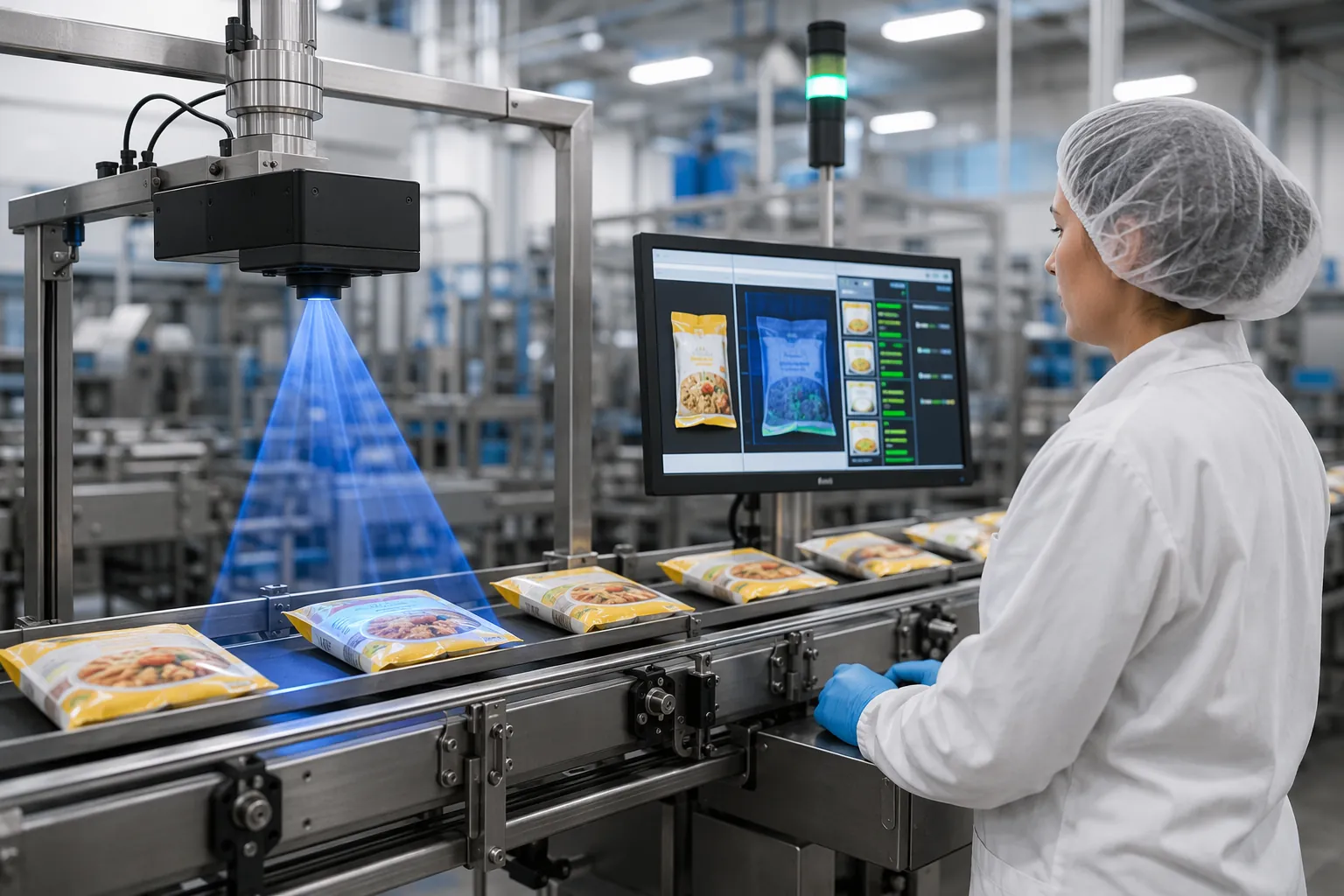
Undeclared allergens and labeling errors are operationally different from many pathogen outbreaks. They are often tied to packaging controls, artwork management, line clearance, changeover discipline, and final verification. A pathogen investigation may require environmental sampling, supplier investigation, epidemiology, and broad uncertainty about contamination points. A labeling failure is more likely to leave a visible or machine-readable mismatch: barcode, ingredient statement, allergen line, sell-by panel, SKU, language version, or package format.
That is why computer vision belongs near the front of the AI traceability discussion. It is not traceability in the narrow sense of tracing a lot backward through a chain. It is a prevention control that can stop a recall cause from escaping the facility. Vision systems can compare the package in front of the camera against the expected product and label data for that production order. When paired with line data, they create a record of what was checked, when, against which specification, and what happened when the system rejected an item.
The current evidence is not a license to assume every computer vision installation will reduce recalls. The strongest claim is narrower: for high-volume packaging lines with repeated label, barcode, artwork, or allergen-verification exposure, AI-assisted inspection maps directly to a documented recall cause. IFT has described food-safety uses of AI including computer vision and machine-learning-enhanced inspection systems, with the relevant value coming from improved detection and reduced false positives in specific inspection contexts rather than generalized supply-chain intelligence.[4]
A procurement case for this category should therefore start with escape history and line realities. Which SKUs have allergen complexity? Which lines have frequent changeovers? Which products share similar packaging? Where do manual checks depend on an operator comparing small print under time pressure? Where does a wrong label create a Class I exposure instead of a retailer chargeback? The system should be evaluated against those points, not against a vendor’s broad claim that AI improves food safety.
The acceptance criteria should also be uncomfortable enough to be useful. A buyer should ask whether the system can verify the actual label version used on the line, whether it integrates with production orders and approved artwork records, how it handles multi-pack and promotional formats, how rejects are documented, and who has override authority. False positives matter because a system that constantly stops a line will be bypassed. False negatives matter because one escaped allergen lot can erase the value of a year’s worth of inspection discipline.
Traceback Speed Changes Containment, Not the Original Failure
Lot tracing addresses a different part of the recall problem. It does not keep a pathogen out of a facility or guarantee a supplier shipped conforming material. Its value arrives after a signal appears: a positive test, a complaint pattern, a regulator inquiry, a customer report, or a suspected ingredient problem. At that point, the cost question becomes how much product must be held, retrieved, or destroyed while the team works out what actually moved where.
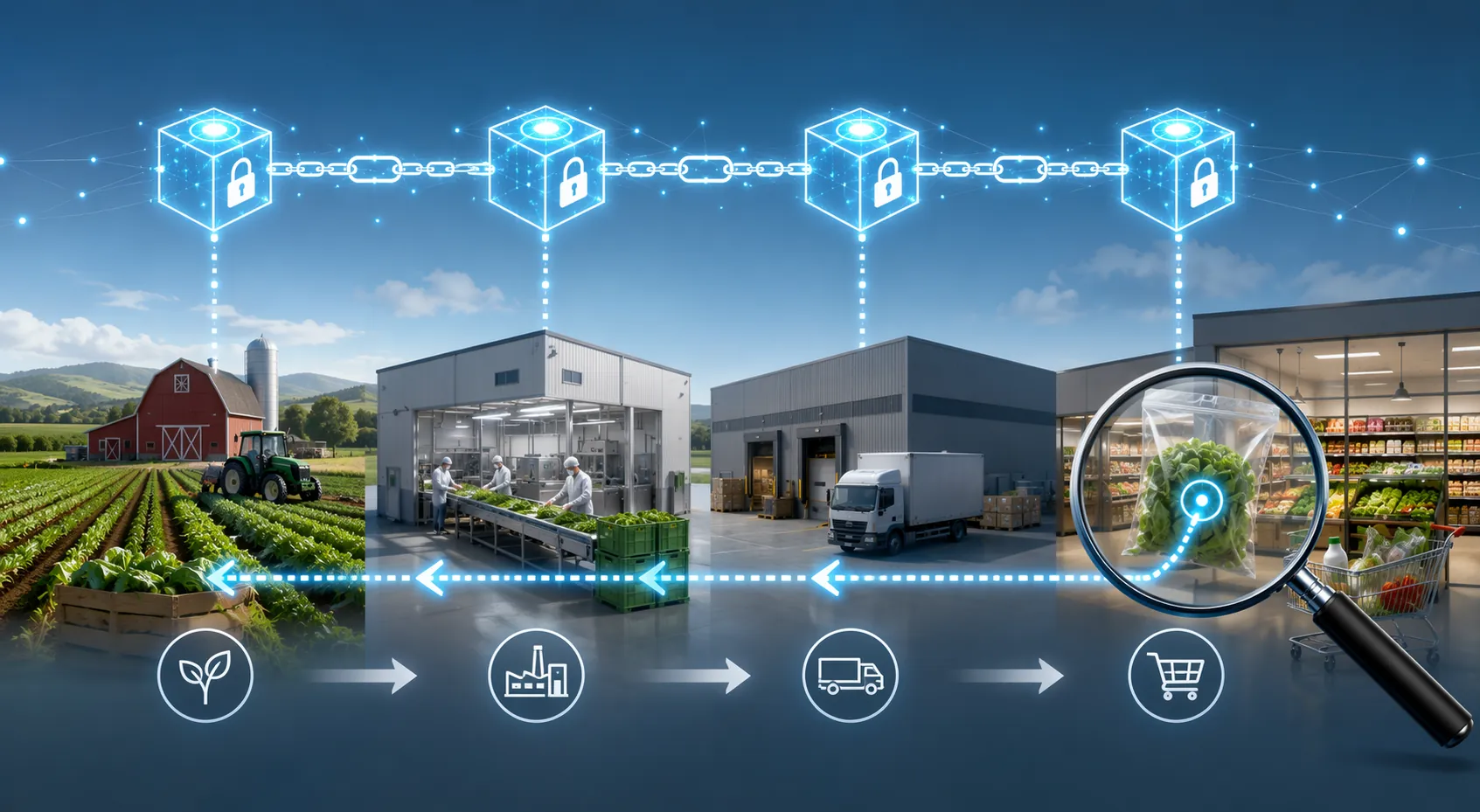
The most cited benchmark remains Walmart’s mango traceback work using Hyperledger Fabric: a traceback that took seven days was reduced to 2.2 seconds in the 2016–2018 proof-of-concept period.[5] That result should be treated as evidence of what standardized, shared, digital traceability data can make possible, not as proof that a full retail network now operates at that speed across all suppliers and products. The age and scope of the benchmark matter.
Even with that caveat, the operational lesson is valuable. Manual traceback often fails slowly because each node in the chain keeps records in its own format, with different identifiers, different location naming conventions, and different levels of lot discipline. A distributor may know what it received but not quickly link it to every customer shipment. A restaurant group may know the DC but not the lot-level exposure by location. A processor may identify a supplier but still need staff to reconcile production dates, rework, partial pallets, and substitutions.
Blockchain is not the magic part by itself. The useful work is the standardization and availability of lot, location, and event data across the chain. If the receiving event, transformation event, shipping event, and customer location are captured in interoperable form, the recall team can narrow the question from “Where did this product go?” to “Which lots, through which lanes, to which locations, during which window?” That difference determines whether the company pulls a region, a customer set, a week of production, or a specific lot path.
This is where the cost of overly broad recalls becomes material. Academic work on overly broad recalls supports the concern that imprecise recall scope can create avoidable costs when unaffected product is included because firms cannot isolate exposure more precisely.[6] For procurement and compliance teams, that is the part of traceability that can be turned into a business case: fewer unaffected units removed from commerce, faster customer answers, and less staff time spent reconstructing records.
The same discipline applies to GS1- and EPCIS-aligned approaches. Their value is not that they sound more technical than a spreadsheet. Their value is that they define how events and identifiers are shared. When restaurant-level or store-level exposure can be distinguished, the recall action can become more precise. But the system only performs if trading partners capture the required data consistently. A beautifully designed traceability platform fed by incomplete lot records becomes a faster way to discover that the records are incomplete.
Where Predictive and Cold-Chain AI Fit
Predictive supplier risk scoring is attractive because supplier fragmentation is a familiar root cause of blind spots. A manufacturer adding co-packers, ingredient brokers, seasonal suppliers, and alternate sources may increase resilience on paper while making recall reconstruction harder. AI models could help rank suppliers by complaint patterns, audit findings, nonconformance history, shipment anomalies, or missing documentation.
The evidence base in the current public record is thinner than the logic. Market analysis points to growing investment in AI-enabled food traceability and a food traceability market estimated at $21.8 billion in 2024 and projected to reach $38.5 billion by 2029, but market growth is not effectiveness evidence.[7] For a procurement committee, supplier scoring should be treated as a decision-support layer: useful if it changes audit priority, sourcing review, or incoming inspection intensity, but not proven merely because a platform can assign a risk score.
Cold-chain monitoring has clearer deployment examples, but a narrower recall connection. Hapag-Lloyd has deployed more than 100,000 smart reefer containers with live temperature, GPS, and humidity monitoring, and FreshDirect has used Google Maps AI to reduce routing work for about 1,000 orders from roughly 40 minutes to less than one minute.[8] Those are meaningful operating examples. They can reduce spoilage risk, improve logistics control, and speed exception handling. They do not, by themselves, answer the strongest recall-severity signals in the current data: labeling failures, concentrated outbreak harm, and massive volume swings.
FDA’s Elsa AI tool also belongs in the picture, but not as proof that private traceability platforms will deliver ROI. FDA has described Elsa as an internal tool for tasks such as reviewing food-safety data, comparing labels, and prioritizing inspections.[8] That signals institutional interest in AI-assisted review. It does not validate any particular manufacturer deployment, nor does it remove the buyer’s obligation to test whether a system changes recall outcomes inside its own operating model.
The Procurement Case Should Separate Prevention, Containment, and Administration
A credible AI traceability business case should not group every benefit under “recall reduction.” Label verification is a prevention control. Lot tracing is a containment and scope-control tool. Supplier scoring is an upstream risk-prioritization tool. Cold-chain monitoring is an integrity and exception-management tool. Recall workflow software is an administration tool. These categories may sit in one platform, but they do not prove the same outcome.
- For label verification, ask what failure modes the system catches before shipment and how performance is measured against known line risks.
- For lot tracing, ask how quickly the system can identify affected lots, locations, shipments, and customers using actual company data.
- For supplier scoring, ask what action changes when a supplier’s risk score changes.
- For cold-chain tools, ask which excursions trigger holds, investigations, or customer notifications.
- For recall administration, ask whether the system reduces documentation time, notification delay, or reconciliation errors.
This separation also protects the buyer from over-crediting platform claims. A vendor may be able to show a persuasive dashboard, but the test is whether the tool changes a recall-cost driver: fewer label escapes, faster isolation, narrower product holds, fewer unaffected customers notified, less manual reconstruction, or better evidence for regulators and trading partners.
The same standard applies to FSMA 204 preparation. Compliance guidance around the rule emphasizes traceability records and key data elements, but compliance readiness is not the same as recall excellence.[9] A company can collect required data and still struggle if identifiers are inconsistent, partner feeds arrive late, or internal teams cannot convert the records into a decision during an active recall.
What Is Defensible in 2026
The investment case for AI food recall traceability supply chain systems is real because recall severity has changed the downside calculation. Hospitalizations, affected units, and recalled pounds are moving in ways that make slow isolation and broad retrieval more expensive to tolerate. But the defensible case is narrower than the marketing category.
Computer vision for packaging and label verification deserves priority where allergen and label risk is high, because it targets a frequent recall cause at the point where the error can still be stopped. Automated lot tracing deserves priority where supplier, production, distribution, or customer complexity makes recall scope hard to define quickly. These are the two places where the operational failure, the available technology, and the business consequence meet cleanly enough for a serious 2026 procurement case.
Predictive supplier models, cold-chain AI, and recall workflow platforms can be valuable additions, especially in complex networks. They should be bought with narrower expectations: show the deployment evidence, define the decision that changes, and prove the system against a recall drill or historical incident. If it cannot shorten a specific task or prevent a repeatable error, it is not yet a recall-severity investment. It is another system waiting for the next investigation to reveal what it did not know.
References
- Food Recalls in 2024: Revealing the Statistics — FSNS
- Beyond the Label: What 2025's Product Recall Trends Reveal About Emerging Risk — CRC Group
- Volumes of recalled food at both the FDA and FSIS have increased dramatically — Food Safety News, December 2025
- How AI Is Reshaping Food Safety — IFT
- How Walmart brought unprecedented transparency to the food supply chain with Hyperledger Fabric — Linux Foundation
- Costs of Overly Broad Recalls — ScienceDirect
- AI-Enabled Traceability: The Next Wave of Supply Chain Innovation in Food — Supply Change Capital
- AI Food Supply Chain Traceability: 16 Advances (2026) — Yenra
- FSMA 204 Compliance Guide — inecta
§ 42 — Cited evidence
Flag an inaccuracy or submit a comparable account — Contribute or read how claims are verified in Methodology.