
§ 41 — Use-case analysis
How EU Compliance Rules Are Driving AI in Fashion Supply Chains
The EU Corporate Sustainability Due Diligence Directive (CSDDD), effective March 2026, has made AI-powered traceability a compliance operational requirement for fashion brands. This article identifies the specific AI capabilities now non-negotiable and how major planning vendors o9, Blue Yonder, and Kinaxis are responding.
- Function
- compliance
- AI technique
- entity resolution
- Evidence source
- Gartner, June 2026
The date that matters for fashion supply-chain teams is not a future net-zero milestone. It is 18 March 2026, when the EU Corporate Sustainability Due Diligence Directive entered into force under Directive EU 2026/470.[1] Because implementation is phased, the immediate consequence is planning work: legal, sourcing, compliance, merchandising, and IT teams now have to decide whether they can produce evidence about supplier conduct, product movement, and risk response quickly enough for the next reporting and assurance cycle.
That is why the phrase “sustainable fashion supply chain AI trends” has become more concrete in 2026. The buying question is no longer whether AI can make a brand’s sustainability program sound more advanced. It is whether the supply-chain system can trace materials and products, score supplier risk, simulate compliance exposure, and prepare product-level data for digital product passport requirements before a regulator, auditor, retailer, or investor asks for proof.

The pressure is not isolated to legal departments. Gartner named “Product Provenance” among its top supply-chain technology trends for 2026, a useful signal that traceability investment has moved into mainstream supply-chain technology roadmaps rather than remaining a sustainability niche.[2] Vogue’s 2026 supply-chain outlook captured the same operating mood from the fashion side, quoting Inspectorio’s Mark Burstein that traceability is moving “from compliance reporting to operational control.”[3]
That distinction matters. Compliance reporting is what happens after a period closes. Operational control is what happens while a purchase order is being placed, a supplier is being approved, a material is being substituted, or a shipment is being rerouted. CSDDD raises the cost of discovering too late that the system cannot explain where a garment’s inputs came from or why a supplier risk flag was allowed to sit unresolved.
What the Rule Pressure Turns Into Operationally
CSDDD does not, by itself, install a traceability platform or clean a supplier master file. It creates a due-diligence obligation that makes certain capabilities much harder to postpone. In fashion, those capabilities sit awkwardly across teams: sourcing owns supplier relationships, merchandising owns product decisions, planning owns demand and allocation, compliance owns evidence, and IT owns the systems that are supposed to connect all of it.
| Compliance pressure | Operating capability fashion teams need | Where AI is being applied |
|---|---|---|
| Due-diligence evidence under CSDDD | Supplier records tied to products, orders, facilities, and risk actions | Entity matching, supplier risk scoring, anomaly detection, evidence retrieval |
| Product provenance expectations | A product-level chain of custody from raw material or component through finished goods | Material mapping, lot or batch linkage, document extraction, provenance graphs |
| Digital Product Passport readiness under ESPR | Structured product data that can be shared beyond internal systems | Data classification, attribute completion, validation rules, integration workflows |
| Board and retailer scrutiny | Scenario views that show exposure by supplier, country, material, category, or brand | What-if planning, risk heat maps, compliance-impact simulation |
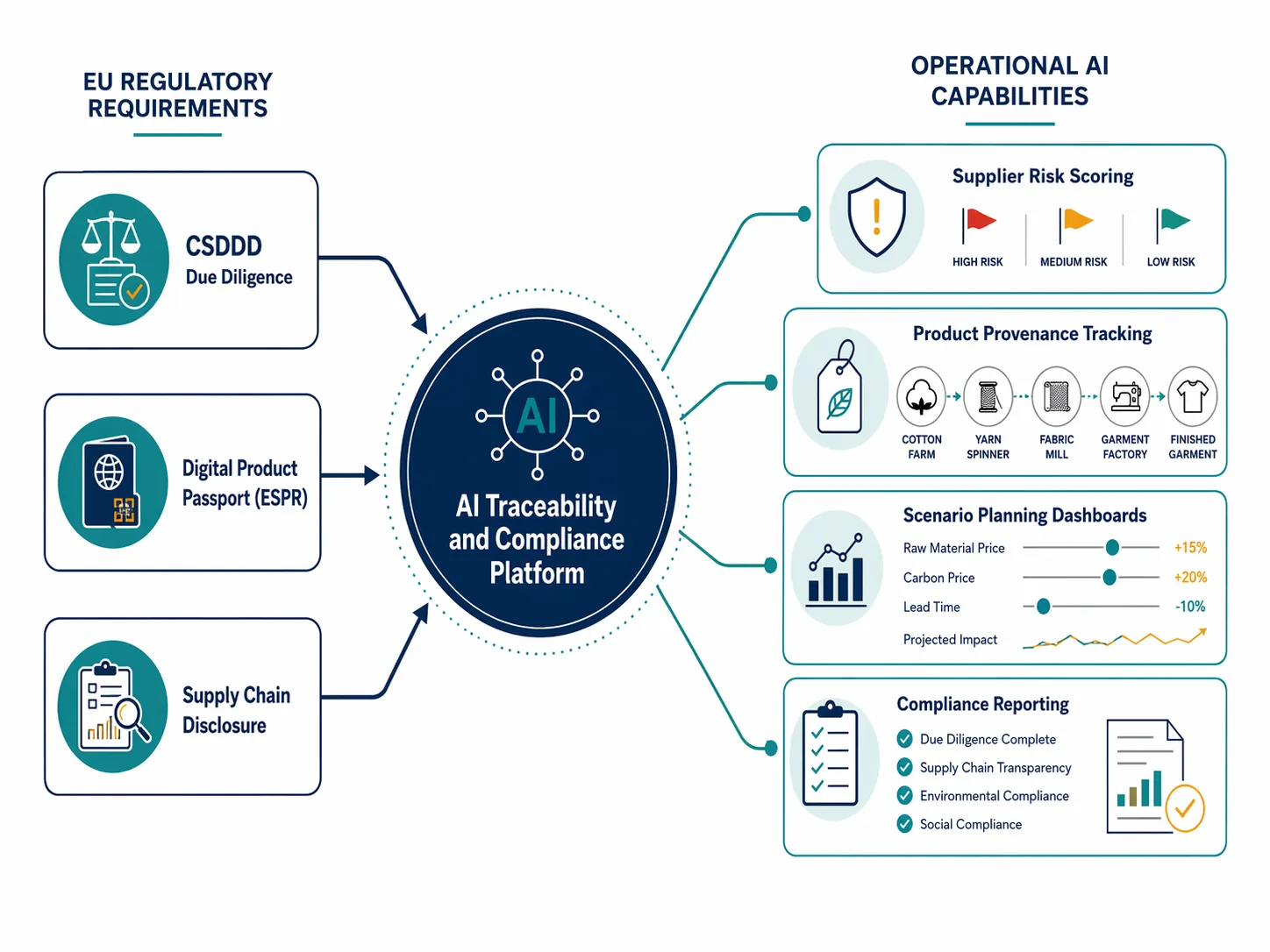
The first capability is supplier and product traceability. A compliance lead does not need a beautiful dashboard if the dashboard cannot connect a cotton blend, a mill, a cut-and-sew facility, a purchase order, and a corrective action. AI can help where records are messy: matching supplier names across systems, extracting information from certificates and invoices, flagging inconsistent facility addresses, and building relationship graphs between suppliers, materials, and finished goods.
The second capability is supplier risk scoring. This is where fashion teams should be careful about the word “risk.” A score is not evidence of harm, and it is not proof that due diligence has been completed. It is a prioritization device. Used well, it helps teams decide which suppliers require review, which products carry higher exposure, and where a sourcing decision would create a new compliance burden. Used lazily, it becomes another colored icon that no one can defend when challenged.
The third capability is provenance recordkeeping. Gartner’s emphasis on product provenance is important because it pushes the conversation from supplier-level policy statements toward item, component, and material histories.[2] In fashion, that shift is uncomfortable. A brand may know its tier-one factory and still lack reliable visibility into upstream material processing. A planning system may know demand and inventory but not the compliance status of the facility that made a substituted fabric.
The fourth capability is scenario planning around compliance exposure. A tariff shock, a factory disruption, or a supplier suspension does not wait for a sustainability committee meeting. Vogue cited Inspectorio’s State of Supply Chain 2025 finding that 95% of apparel executives saw tariffs as 2025’s biggest disruptor, which is not a CSDDD statistic but does show how normal regulatory and trade volatility has become for apparel operators.[3] If compliance exposure cannot be modeled alongside cost, lead time, and service risk, it will be treated as a side note until it becomes a blocker.
Digital Product Passports Make the Data Problem Less Internal
CSDDD is not the only EU layer changing the system requirements. Digital Product Passport expectations under the Ecodesign for Sustainable Products Regulation add a parallel pressure: product data has to become structured enough to travel outside the brand’s internal reporting pack. The available evidence supports a narrow conclusion: digital product passport readiness is becoming part of the same traceability business case, not proof that every fashion company already has passport-ready product data.
This is where AI’s role is practical rather than magical. It can classify product attributes, identify missing data, reconcile supplier-submitted records, and route exceptions. But a passport-ready record still depends on whether the brand collected the right material, facility, and process information in the first place. AI can accelerate validation and linkage; it cannot make an absent upstream record appear as verified evidence.
Published Fashion Examples Exist, but They Are Not Post-Mortems
There are published fashion examples that procurement and compliance teams can cite when building internal cases. BSI describes AI-powered sustainable fashion use cases including supply-chain mapping and names Stella McCartney, Farfetch, and H&M among examples associated with AI-enabled supply-chain visibility and sustainability work.[4] Nūl Global also discusses AI use cases in sustainable fashion and refers to brands including Stella McCartney, Farfetch, and H&M in the context of supply-chain mapping and sustainability applications.[5]
Those examples are useful as market references, not as audited proof that a specific deployment delivered full CSDDD compliance. The available material does not provide fashion-specific post-mortems with independent verification levels, before-and-after operating metrics, or auditor findings. The safer reading is that the use-case pattern is established, while the evidence base for deployment outcomes remains thinner than vendor presentations often imply.
How Planning Vendors Are Repositioning Around Compliance Work
The vendor response matters because planning platforms sit close to the decisions that create compliance exposure: what to buy, where to source, how to allocate, when to substitute, and how to respond when a constraint appears. The evidence here is asymmetrical. o9 and Blue Yonder provide clearer public sustainability and fashion-adjacent positioning. Kinaxis appears relevant through concurrent planning and apparel-oriented messaging, but the public fashion-specific sustainability evidence is thinner and more vendor-sourced.
o9: Scenario Planning Becomes the Compliance Bridge
o9’s most relevant angle is not simply that it has an ESG or sustainability module. It is the way its AI/ML operating-model argument connects planning decisions with fast-changing constraints. In an April 2025 article by Bill McRaith, former PVH chief supply chain officer, o9 described the fashion industry’s shift toward AI and machine-learning operating models, including the need to model uncertainty and make decisions across connected planning processes.[6]
For a CSDDD business case, that positioning is useful when it is translated into a workflow: if a supplier is flagged, which purchase orders are exposed; if a material source changes, which products need updated provenance records; if a region becomes higher risk, which assortments, delivery windows, and margin plans are affected. The compliance value is not the existence of a sustainability tab. It is whether risk data changes planning choices before commitments are locked.
Blue Yonder: Sustainability Data Moves Into Supply-Chain Execution Language
Blue Yonder’s public messaging is more explicit about sustainable supply-chain management. In April 2026, the company discussed “doubling down on sustainability in the supply chain,” including the use of embedded emissions data and sustainability considerations inside supply-chain decision-making.[7] In a Textile World article by Blue Yonder chief sustainability officer Saskia van Gendt, the company also framed AI as a force redesigning the global fashion supply chain, with attention to visibility, planning, and more responsive operations.[8]
The compliance relevance is clear enough: emissions and sustainability data are being pulled closer to operational planning rather than left in annual reporting. The caution is also clear. Vendor-published sustainability frameworks show product direction and buyer demand; they do not independently prove that a fashion customer can produce complete supplier-level due-diligence evidence under CSDDD. Buyers should separate roadmap fit from verified deployment performance.
Kinaxis: Concurrent Planning Fits the Problem, but Public Fashion Evidence Is Lighter
Kinaxis is relevant because concurrent planning is structurally aligned with compliance exposure. A supplier-risk change, logistics disruption, or material constraint should not have to travel through disconnected planning cycles before the business understands its impact. In principle, a concurrent planning environment can help fashion teams see the commercial and compliance consequences of a constraint at the same time.
The evidence threshold is different, though. Public materials point to Kinaxis Maestro and apparel-oriented vendor materials as the basis for discussing compliance-data planning, but they do not provide the same level of fashion-specific sustainability substantiation found in the o9 and Blue Yonder materials. That does not make Kinaxis irrelevant. It means buyers should ask harder questions about apparel reference customers, product-level provenance workflows, supplier-risk data models, and audit-support evidence before treating concurrent planning as a compliance answer.
| Vendor | Most relevant public positioning | Useful buyer question |
|---|---|---|
| o9 | AI/ML operating model, connected planning, ESG and sustainability scenario-planning positioning | Can supplier risk and product provenance data change sourcing, allocation, and substitution decisions inside the planning workflow? |
| Blue Yonder | Sustainable supply-chain management, embedded emissions data, AI-enabled fashion supply-chain visibility | Can sustainability and compliance attributes be tied to executable supply-chain decisions rather than annual reporting outputs? |
| Kinaxis | Concurrent planning and apparel-oriented planning materials, with thinner public fashion sustainability evidence | Can the platform demonstrate fashion-specific provenance, supplier-risk, and compliance-data workflows with verifiable customer evidence? |
The Data-Readiness Constraint Is the Part Demos Skip Fastest
The fragile part of AI traceability is not the model interface. It is the supplier data underneath it. BSI and Nūl both emphasize challenges around incomplete, fragmented, or siloed supply-chain data in fashion sustainability applications.[4][5] Fortude makes the same practical point from a data and AI perspective: fashion supply-chain AI depends on connected, reliable information across planning and operational systems.[9]
That is the “garbage in, garbage out” problem in procurement terms. A supplier may appear under different names in sourcing, finance, logistics, and compliance systems. A fabric mill may be connected to a product in a spreadsheet but not in the planning platform. Certificates may sit in portals without consistent product or facility identifiers. Corrective actions may be tracked by one team and invisible to the planner making the next buy decision.
AI can reduce some of that burden by matching entities, reading documents, identifying gaps, and flagging inconsistencies. But the compliance team still has to decide what counts as sufficient evidence, who approves supplier-risk overrides, how exceptions are documented, and when a product should be blocked because the provenance chain is incomplete. Those are operating controls, not model features.
A useful internal business case should therefore avoid claiming that an AI platform “solves CSDDD.” A stronger case is narrower and more defensible: it reduces the manual work required to connect supplier, product, and risk records; it gives planners earlier visibility into compliance exposure; it improves the odds that evidence can be retrieved when requested; and it creates a structure for digital product passport data rather than leaving it scattered across teams.
What Procurement and Compliance Teams Should Ask Before Buying
The best vendor conversations will be specific enough to make weak integrations visible. A fashion buyer does not need another abstract AI roadmap. The buyer needs to know whether a supplier-risk event can be traced to products, whether a product can be traced to upstream suppliers, whether missing evidence is surfaced before shipment, and whether a scenario plan shows both commercial and compliance consequences.
- Ask the vendor to demonstrate a product-to-supplier provenance path using fashion-like data, including material, facility, purchase order, and document links.
- Ask how supplier-risk scores are generated, updated, overridden, and audited; a score without governance will not carry much weight under scrutiny.
- Ask whether compliance exposure appears inside planning scenarios, not only in a sustainability reporting workspace.
- Ask how the platform handles incomplete provenance: warning, workflow task, sourcing block, executive exception, or silent gap.
- Ask for customer evidence that distinguishes live deployment from roadmap capability, especially for fashion-specific sustainability workflows.
This is also where legal and procurement need to sit in the same room. Legal can define what the company must be able to evidence. Procurement can explain which supplier records are actually obtainable. Planning can show where sourcing substitutions happen under time pressure. IT can identify which identifiers, integrations, and data-quality rules are missing. If those conversations happen after software selection, the implementation inherits the worst possible constraint: a compliance promise built on unverified data.
CSDDD is not merely encouraging AI adoption in fashion supply chains. It is making traceability, supplier-risk scoring, provenance records, and compliance scenario planning harder to treat as optional. The unresolved work is less glamorous: proving that the supplier and product data beneath those tools is complete enough, current enough, and governed well enough to survive scrutiny.
References
- Corporate Sustainability Due Diligence Directive (CSDDD) — European Commission.
- Gartner Identifies Top Supply Chain Technology Trends for 2026 — Gartner, June 2026.
- The Forces That Will Shape Fashion's Supply Chains in 2026 — Vogue, December 2025.
- From Source to Shelf: How AI Is Powering Sustainable Fashion — BSI, 2025.
- AI in Sustainable Fashion: Use Cases, Technology, Challenges — Nūl Global, February 2026.
- The Fashion Industry's Shift to an AI/ML Operating Model — o9 Solutions, April 2025.
- Doubling down on sustainability in the supply chain — Blue Yonder, April 2026.
- How AI Is Redesigning The Global Fashion Supply Chain — Textile World, September 2025.
- Navigating supply chain pressures in fashion with data and AI — Fortude, October 2024.
§ 42 — Cited evidence
Flag an inaccuracy or submit a comparable account — Contribute or read how claims are verified in Methodology.