§ 41 — Use-case analysis
Engine Fire Recalls and the Quality Management Gaps They Exposed
An evidence-backed analysis of how the Hyundai-Kia engine fire recall crisis exposed multi-tier quality-management and supply-chain visibility failures, and whether multi-tier traceability and scenario-planning platforms from o9, Kinaxis, and Blue Yonder could have narrowed the damage.
- Function
- quality management
- AI technique
- optimization
- Failure pattern
- traceability gap
- Evidence source
- Safety Research & Strategies (2021); NHTSA (2020)
The Hyundai-Kia fire crisis becomes easier to misread when it is compressed into “the defect.” By the time the recalls became a public quality-management problem, the operational damage was no longer limited to a bad bearing, a leaking brake component, or one supplier’s process miss. It had become a question of who could identify the affected vehicles, how narrowly they could define the recall population, whether owners could be reached, and how much dealer capacity would be consumed by vehicles that might never have carried the confirmed defect.
The scale in 2020 alone was enough to make that distinction matter. Between February and December 2020, Hyundai and Kia conducted more than 10 separate recalls covering more than 2.5 million vehicles for non-crash fire defects, according to Safety Research & Strategies’ account of the crisis and Consumer Reports’ later summary of the recurring fire-risk recalls.[1][2] In November 2020, the National Highway Traffic Safety Administration announced a $210 million civil penalty against Hyundai and Kia, described by NHTSA as the largest civil penalty it had collected for safety violations at the time.[3] In May 2021, a class-action settlement covering 3.9 million vehicles was valued at $1.3 billion, while Safety Research & Strategies cited more than 3,100 fires and 103 injuries in its review of the fire and engine-failure record.[1]
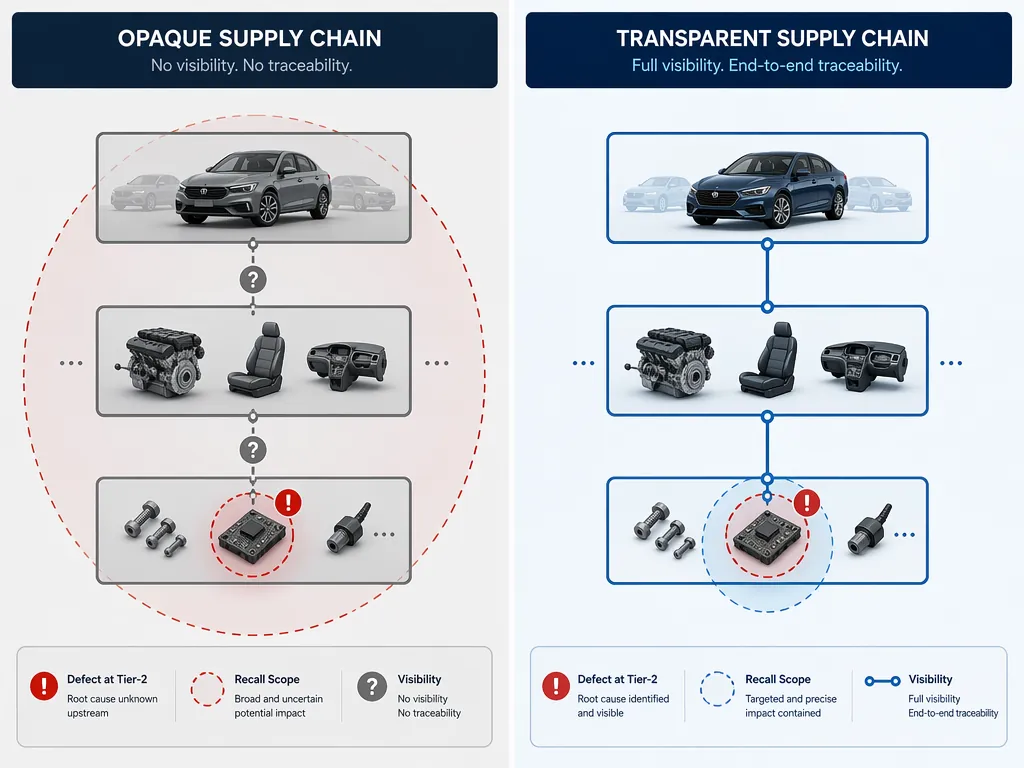
Those numbers are not just recall-count trivia. They are what happens when quality containment arrives late and traceability is too blunt. Safety Research & Strategies reported that the automakers acknowledged, in NHTSA-related filings, that out-of-date owner contact information and an inability to trace specific component lots forced recall populations to expand beyond the confirmed defect scope.[1][3] That is the moment a supplier-quality problem becomes a logistics problem: more mailings, more dealer inspections, more customer confusion, and more unrepaired vehicles remaining in service.
The defect started deep, but the failure widened upstream and downstream
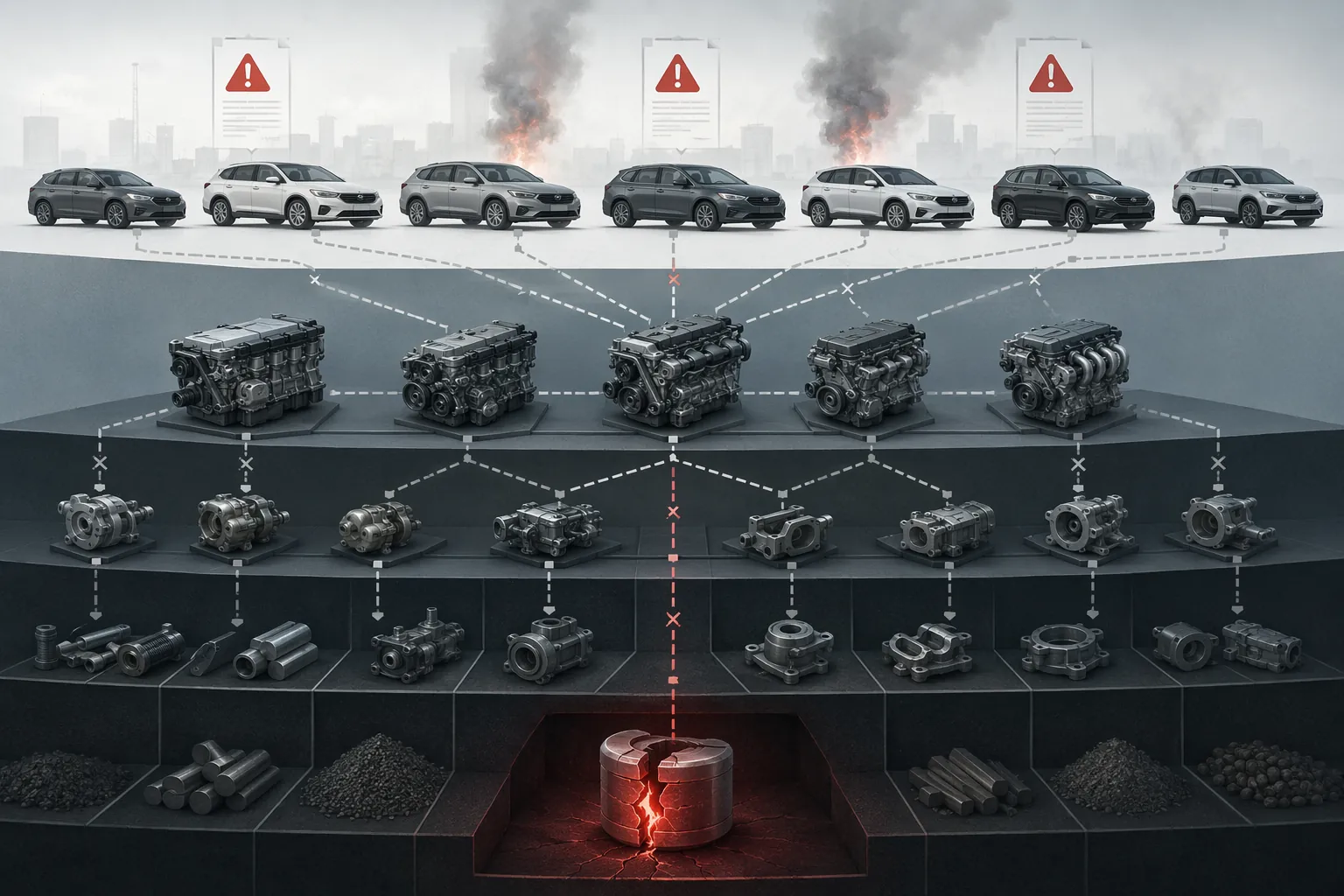
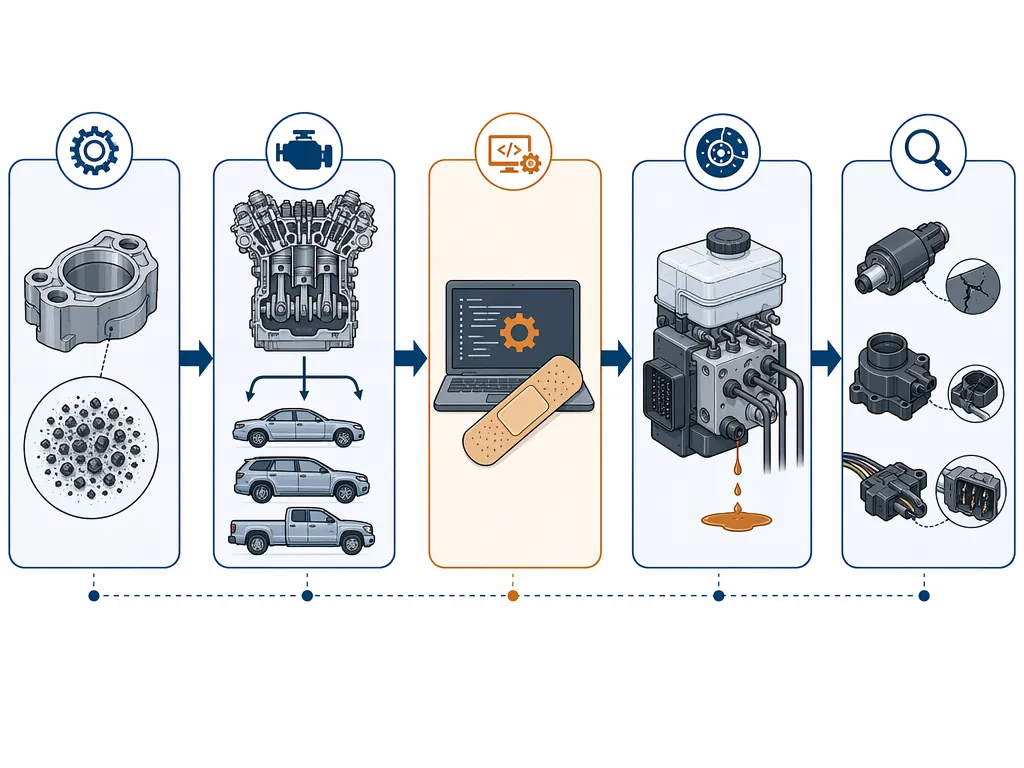
The best-known root-cause chain begins with Theta II engines and connecting-rod bearing damage tied to machining debris. Safety Research & Strategies traced the problem to debris left from crankshaft machining operations, which could restrict oil flow, damage bearings, and lead to engine seizure or fire risk.[1] That is an engineering and manufacturing failure. It is also a containment test: once field signals appear, the system either isolates the suspect population with confidence or it starts widening the net.
In a clean quality system, the path from a Tier-2 process condition to finished-vehicle exposure is not a mystery. The team should be able to move from process window, to lot, to component, to engine build, to vehicle identification number, to owner and dealer action. The Hyundai-Kia record shows how expensive it becomes when that path is incomplete. Shared engine architecture spread the consequence across multiple nameplates and model years, while the available traceability was not strong enough to keep recall populations as narrow as the confirmed defect evidence.
The Knock Sensor Detection System, or KSDS, is where the story stops looking like a conventional one-time recall. Hyundai and Kia deployed the software to detect abnormal engine vibration associated with bearing wear and to trigger protective behavior before catastrophic failure.[1] As a mitigation, that can be rational. As a quality-system marker, it also says something uncomfortable: the system was now listening for symptoms in the field because the upstream defect population could not be bounded cleanly enough at the source.
KSDS did not make later fire-risk issues disappear. Safety Research & Strategies’ chronology also points to subsequent fire risks tied to anti-lock brake hydraulic electronic control units, including brake-fluid leaks, and to Mando-related component defects.[1] Those were not the same physical failure mode as Theta II bearing damage. Treating them as one defect would flatten the case into folklore. The more useful reading is that different failure modes kept encountering the same organizational stress points: slow isolation, broad population definition, software or warranty remedies layered onto incomplete containment, and recall execution dependent on owner data that was not always current.
Origin, detection, containment, execution: four different jobs
A manufacturing defect can originate before anyone at the OEM sees a meaningful signal. That does not absolve the OEM or Tier-1 quality organization; it defines the first boundary. No planning platform, supplier portal, or risk dashboard prevents a machining operation from leaving debris behind if the defect is not observable in the data being captured. The question for quality management starts immediately after that: how quickly does the network notice, how accurately does it connect the signal to a supplier process, and how precisely can it identify the vehicles exposed?
| Job | What the team needs to know | What goes wrong when it is weak |
|---|---|---|
| Defect origin | Which process, supplier, material, or design condition created the risk | The organization debates cause while field failures accumulate |
| Detection | Which field, warranty, test, or supplier signal points to the failure mode | Software mitigations and inspections arrive after customers already carry the risk |
| Containment | Which lots, components, engines, plants, and VINs are actually exposed | Recall scope expands beyond the confirmed defect population |
| Execution | Which owners, dealers, parts, labor slots, and communications must move | Unrepaired vehicles remain in driveways while dealers absorb avoidable workload |
The Hyundai-Kia case exposed weakness in all four jobs, but not in the same way. The Theta II machining-debris issue is closest to origin. KSDS belongs mainly to detection and mitigation. The inability to trace specific component lots belongs to containment. Stale owner-contact data belongs to execution. Lumping them together as “quality visibility” is convenient in a software demo and useless in a recall command center.
The recall population problem deserves particular attention because it is where imperfect traceability turns into cost. If the team cannot say which vehicles received which suspect part or were built from which process window, it has two unattractive choices: recall broadly and overload the downstream network, or recall narrowly and risk leaving exposed vehicles on the road. Safety Research & Strategies’ reporting that component-lot traceability limits helped widen recall populations is the kind of operational fact that should carry more weight than another chart of total recall counts.[1]
Why shared architecture made the containment problem larger
Shared architecture is efficient until a defect moves through it. The same economies that make common engines, components, and suppliers attractive in production can make containment geometrically harder when the process history is not cleanly mapped. A defect that appears to sit inside one component family can cross brand, model-year, plant, and service-part boundaries before the quality team has finished reconstructing build records.
That is why the Hyundai-Kia crisis should not be treated as a warning against platform sharing itself. The warning is narrower and more practical: shared parts need shared traceability discipline. If the quality record is organized around internal silos while the component architecture is shared across brands and models, the recall team inherits a map that does not match the product.
Dealer operations then become the shock absorber. Dealers do not receive an abstract root-cause tree; they receive customers, repair procedures, parts constraints, appointment backlogs, and vehicles whose owners may have heard about fire risk before the service network has enough capacity to resolve it. When recall scope is broader than the confirmed defect set, some of that dealer labor is spent managing uncertainty rather than removing known-risk components.
The platform question is not “could AI have prevented it?”
For supply-chain AI vendors, the tempting claim is that better visibility reduces risk. The Hyundai-Kia case requires a stricter test. A platform would have needed to change a real operational event: shorten the time from field signal to suspect-part isolation, narrow the VIN population, map dealer and parts consequences faster, or prioritize supplier-risk investigations before the defect became visible through fires and failures.
That test separates three capabilities that are often sold together: multi-tier traceability, concurrent scenario planning, and upstream supplier-risk scoring. They overlap, but they would not have helped at the same moment.
o9: useful only if interoperability reaches the component record
o9’s most relevant claim is not generic AI planning. It is interoperability across multi-tier automotive networks. o9 says it achieved Catena-X Demand and Capacity Management certification in early 2026, which the company presents as evidence that its platform can participate in open automotive data exchange for demand and capacity collaboration.[4] That is a vendor-published signal, not an independent proof that o9 would have changed the Hyundai-Kia outcome.
The counterfactual value is specific. If component-lot, supplier-process, engine-build, and VIN data had been interoperable and current across the relevant tiers, the recall team could plausibly have narrowed the suspected population faster. That would not have stopped machining debris from entering a component. It could have reduced the amount of uncertainty transferred to owners, dealers, and parts planners after the field signal became serious.
The caveat is just as important as the capability. Catena-X certification in 2026 does not tell us how complete the data would have been in an earlier Hyundai-Kia-style supply network, how consistently suppliers would have maintained lot genealogy, or whether field-failure data would have been linked quickly enough to the manufacturing history. Interoperability is necessary for recall-scope narrowing, but the useful artifact is still the traceable component record.
Kinaxis Maestro: faster consequence mapping, not defect discovery
Kinaxis positions Maestro around concurrent planning: the ability to evaluate demand, supply, inventory, capacity, and operational constraints together instead of passing sequential plans from one function to the next.[5] In a recall context, that matters after the suspect population is at least partially defined. The planning problem becomes: which vehicles, which parts, which dealers, which labor windows, which owner communications, and which alternate allocations move first?
For a Hyundai-Kia-like crisis, Maestro’s plausible contribution would be scenario speed. If a quality team is testing whether the affected population is one engine build window, several plants, or a broader architecture family, concurrent planning can show the downstream consequences of each boundary. A narrow boundary may reduce dealer burden but risk under-inclusion. A broad boundary may be safer but consume parts and service capacity faster than the network can absorb.
That is valuable, but it should not be confused with root-cause detection. A planning engine can model the network consequence of a component failure scenario once the scenario is defined. It cannot infer a hidden Tier-2 machining defect unless the signals feeding the model expose it. In this case, the stronger claim is not “Kinaxis would have prevented fires.” It is that concurrent planning could have made containment and execution trade-offs visible sooner.
Blue Yonder: risk scoring depends on whether the risk is visible yet
Blue Yonder’s relevant angle is upstream supplier visibility and risk prioritization. The company markets supply-chain capabilities that can help organizations monitor supplier and network risk, prioritize exceptions, and use predictive signals in planning decisions.[6] Against the Hyundai-Kia case, the stress test is whether those signals would have surfaced abnormal supplier or component risk before field failures made the problem obvious.
Risk scoring can improve attention. It can push a supplier, plant, process, or component family higher in the queue when quality, delivery, warranty, audit, or capacity signals deteriorate. But risk scoring is only as strong as the signals available before the defect becomes observable. If machining debris is not captured in process data, inspection data, supplier deviation records, or early warranty signals, a risk model may have nothing meaningful to score.
That makes Blue Yonder’s fit more plausible for prioritization than for prevention. In a fire-recall environment with multiple suspected causes, supplier-risk scoring could help decide which upstream relationships deserve immediate audit or data reconciliation. It would not, by itself, solve the harder genealogy problem: proving which finished vehicles received which suspect components.
Where the counterfactual becomes credible
The credible software counterfactual is not a fully automated recall decision. It is a shorter and better-controlled chain of work:
- Field and warranty signals are linked faster to suspect components and supplier process histories.
- Lot genealogy narrows which engines, assemblies, and VINs require action.
- Scenario planning shows the parts, labor, dealer, and owner-contact consequences of alternative recall boundaries.
- Supplier-risk scoring helps prioritize audits and data requests when several potential fire causes are active.
- Recall execution uses cleaner owner and vehicle data, reducing the gap between announced remedy and completed repair.
That is enough to matter. A recall boundary that is 10 percent too broad or one month too slow is not an accounting abstraction; it is additional dealer throughput, additional parts allocation pressure, additional customer communications, and additional vehicles sitting unrepaired. The research materials do not support a claim that o9, Kinaxis, or Blue Yonder would have prevented the Hyundai-Kia defects. They do support a more limited and more operationally useful point: traceability and planning platforms address the failure modes that turn a supplier defect into a sprawling recall execution problem.
There is also a boundary around the vendor set. RELEX and Anaplan are not discussed here because no relevant recall-logistics evidence was identified in the supplied research. Adding them for symmetry would make the analysis look broader while making it less grounded.
The line quality leaders should hold
The Hyundai-Kia fire recalls were both an engineering problem and a quality-management problem. The machining debris, bearing damage, brake-fluid leak risks, and component defects were real technical issues. But the size and duration of the crisis were shaped by the system around those defects: traceability, field-signal interpretation, supplier-quality escalation, owner data, recall population definition, dealer execution, and warranty remedy design.
Multi-tier traceability and scenario-planning platforms could plausibly have narrowed recall scope, accelerated isolation, and reduced unnecessary logistics burden. They could have helped quality and planning teams move from “something in this architecture is failing” to a more defensible vehicle population faster. They would not have prevented an undiscovered Tier-2 machining defect from occurring. Any platform claim that blurs that distinction is asking the recall team to buy visibility and pretend it is prevention.
References
- Hyundai-Kia's Billion Dollar Engine Problem, SafetyResearch.net, May 2021.
- Why So Many Hyundai and Kia Vehicles Get Recalled for Fire Risk, Consumer Reports.
- Consent Order, National Highway Traffic Safety Administration, November 2020.
- Automotive OEMs, o9 Solutions, 2026.
- Kinaxis Maestro, Kinaxis.
- Supply Chain Risk Management, Blue Yonder.
§ 42 — Cited evidence
Flag an inaccuracy or submit a comparable account — Contribute or read how claims are verified in Methodology.