
§ 41 — Use-case analysis
Why a Quiet El Niño Hurricane Season Still Threatens Supply Chains
NOAA and CSU forecast below-average named storms for the 2026 Atlantic hurricane season, but supply chain planners should not relax preparedness: a single landfall this year would be more disruptive per event than in prior quiet El Niño seasons because commodity inflation from the Iran war, FEMA capacity reductions, and rapid intensification trends all amplify operational and financial impact.
- Function
- risk-management
- AI technique
- forecasting
- Evidence source
- NOAA, CSU, Risk Management Magazine, Yale Climate Connections, AccuWeather, House Homeland Security Committee, Baker Donelson
The 2026 Atlantic hurricane forecast gives executives an easy sentence to remember and a dangerous one to overuse: below normal. NOAA’s May 21 outlook called for 8 to 14 named storms, while Colorado State University’s June 10 update narrowed its forecast to 11 named storms and a 24% probability of a major hurricane landfall on the U.S. coastline, below the 43% historical average.[1][2] That is useful information. It is not a waiver for thinner contingency budgets, delayed generator contracts, lighter fuel reserves, or insurance renewals built around last year’s replacement costs.
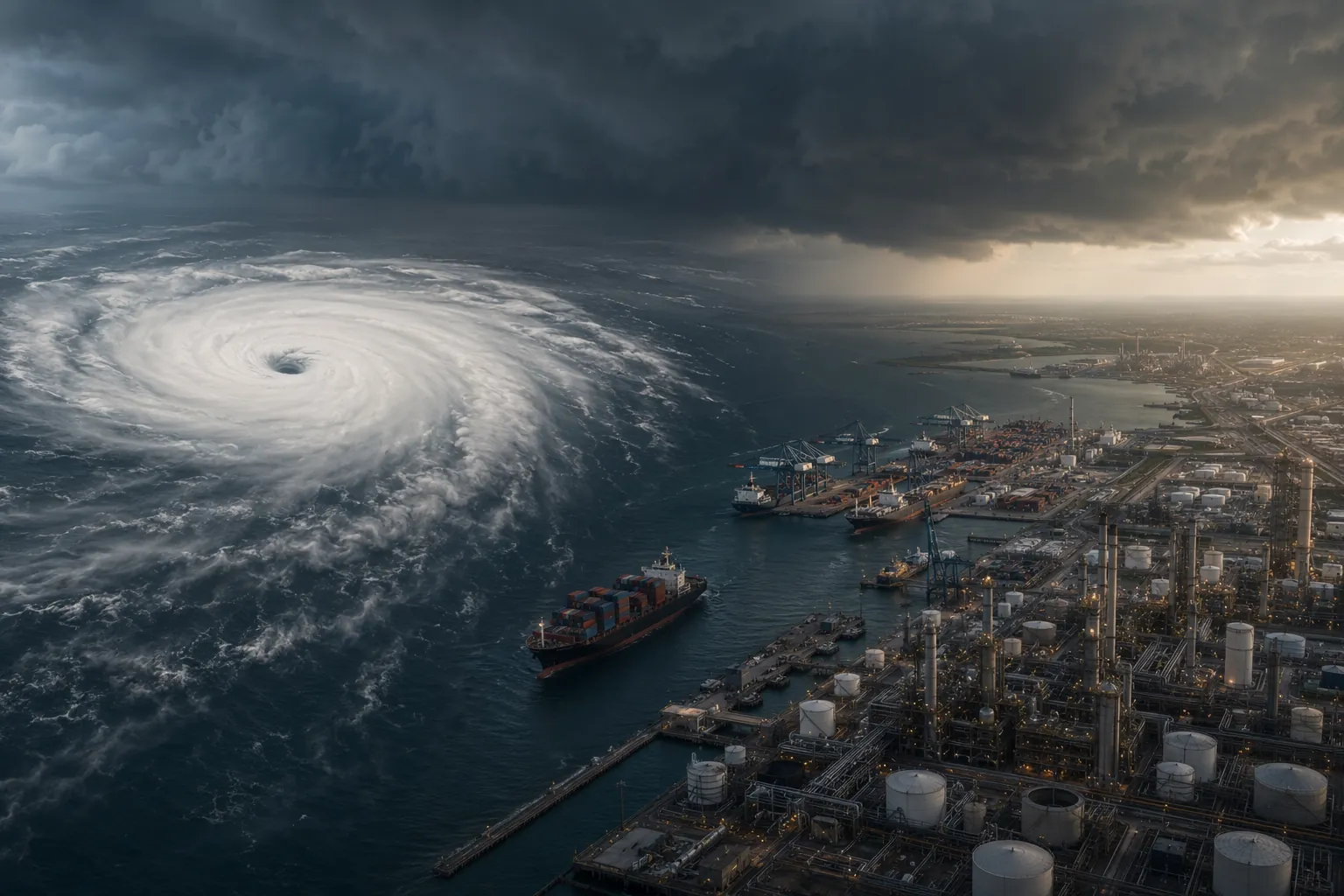
For supply chain teams, the better question is not how many storms the basin produces. It is what happens if one storm reaches a port, refinery corridor, warehouse cluster, rail interchange, or coastal manufacturing site while fuel, repair materials, public recovery capacity, and insurance values are already under strain.
El Niño is the reason the quiet-season headline has credibility. NOAA’s Climate Prediction Center declared El Niño conditions on June 11, 2026, with a 63% probability of reaching “very strong” status, and the usual Atlantic mechanism is straightforward: stronger vertical wind shear makes it harder for tropical systems to organize and maintain strength across the basin.[3][4] That supports a lower storm-count forecast. It does not tell a procurement buyer whether plywood will be available after landfall, whether a fuel supplier can honor priority delivery, or whether a claim adjuster will accept a replacement-cost estimate based on prices that moved after the policy was bound.
Below Average Is Not the Same as Operationally Safe
CSU’s 24% major-landfall probability is meaningfully lower than its historical average, and that matters.[2] A risk manager should not pretend the seasonal odds are normal. But a one-in-four probability is still a live planning condition for firms with exposed assets, especially when the consequence side of the equation has changed.
Named-storm counts are basin statistics. Supply chain losses are site, lane, and supplier events. A weak season can still produce a disruptive landfall if the affected area is a fuel hub, a port-dependent import node, a regional DC cluster, or a manufacturing corridor with limited alternate carriers. The damage is not allocated evenly across the Atlantic. It shows up as vessels waiting outside a closed port, chassis trapped in the wrong market, employees unable to reach shifts, backup power burning through expensive diesel, and procurement teams discovering that the cheapest supplier agreement did not reserve capacity when everyone called at once.
| Forecast Signal | What It Means | What It Does Not Mean |
|---|---|---|
| NOAA: 8–14 named storms | The basin is expected to be less active than normal. | Individual coastal assets are not cleared of landfall exposure. |
| CSU: 11 named storms | The June outlook further reduced expected activity. | Contingency budgets can safely be cut. |
| CSU: 24% major-landfall probability | Major-landfall odds are below the 43% historical average. | A major landfall is impossible or operationally negligible. |
| El Niño wind shear | Atlantic storm formation and maintenance can be suppressed. | Close-to-coast development, rapid intensification, or one damaging landfall can be ignored. |
The Cost Side of One Landfall Has Moved
The most immediate difference between 2026 and a more ordinary quiet El Niño year is the commodity backdrop. Risk Management Magazine’s June 16, 2026 sourcing-chain outlook reported that crude has traded near $100 per barrel since the February 2026 Strait of Hormuz closure, and cited supply chain analysts warning that even if the strait reopened immediately, normalization would take at least six months.[5] For a coastal logistics operation, that is not a macroeconomic footnote. It touches generator fuel, drayage rates, linehaul surcharges, emergency trucking, resin-based packaging, tires, hoses, roofing materials, temporary repairs, and the cost of idling assets while alternatives are arranged.
Fuel is usually treated as a preparedness item: verify tank levels, confirm priority supply, test generators, document burn rates. In 2026 it is also a budget exposure. If crude remains near $100 per barrel, a facility that planned backup-power costs from older assumptions may find that the plan still works mechanically but fails financially. The contract exists, the generator runs, and the post-event invoice becomes the surprise.
The same pressure shows up in repair materials. Baker Donelson’s commodity analysis, cited in the June 2026 Risk Management Magazine outlook, pointed to price surges in cement, steel, concrete, and aluminum tied to Iran-war sourcing disruptions.[5][6] The article also connected the broader shock to plywood, plastics, and rubber costs reaching multi-year highs.[5] Those are not interchangeable line items after a storm. Cement and steel affect rebuilding schedules. Plywood affects temporary protection and emergency dry-in work. Plastics and rubber run through packaging, vehicle parts, dock equipment, hoses, belts, seals, and tires.
Maritime routing adds another practical layer. The same June 16 sourcing-chain outlook described Africa rerouting that can add about two weeks of transit time.[5] That matters before a storm as much as after one. If critical spares, temporary roofing materials, generator components, forklift tires, or MRO inventory are already on a longer water path, the final week before landfall is a poor time to discover that “available” meant available at origin.

This is where insurance values deserve more attention than they often get in a quiet forecast year. A policy limit based on prior replacement assumptions can look adequate until the same square footage, equipment, and temporary works have to be priced in a market where fuel, steel, cement, plywood, plastics, and rubber have moved. That is a directional replacement-cost gap, not a formal underwriting conclusion. But it is the kind of gap that turns a covered loss into a board-level argument about deductibles, sublimits, delay costs, and cash timing.
Recovery Capacity Is Also Part of the Supply Chain
A storm plan often assumes that the public recovery system will function in the background: debris removal begins, roads reopen, emergency declarations move, reimbursement channels activate, and utilities coordinate with government agencies. In 2026, that assumption deserves a harder read. A May 14, 2026 House Homeland Security Committee letter cited a 14% FEMA workforce reduction, 50% leadership vacancies, a $100,000 secretarial-approval threshold for certain spending, and elimination of the BRIC mitigation program.[7]
Those figures do not prove how any single post-storm response will unfold. They do signal a recovery environment with less slack. Fewer staff and vacant leadership roles can slow coordination. A low approval threshold can create administrative friction at exactly the point when decisions need to move in hours, not committee cycles. The loss of BRIC removes a mitigation channel that many communities used before disaster, not after.
For private-sector logistics teams, the operational consequence is indirect but real. If public recovery is slower, trucks wait longer for passable roads. Employees wait longer for safe housing, fuel, child care, or medical access. Temporary power may be needed for more days. Yard cleanup, drainage repairs, and facility inspections may compete with municipal priorities. A supplier that is physically undamaged can still be unavailable if its workforce, road access, or local fuel supply is disrupted.
This is the awkward week after a storm that rarely appears in seasonal forecasts. A company may have hardened its own site and still lose throughput because the surrounding system is not back. The gate opens, but drivers cannot reach it. The warehouse has power, but the carrier’s terminal does not. The port resumes limited operations, but appointments, customs exams, chassis flows, and rail connections remain uneven. Recovery capacity is a supply chain variable, not a civic abstraction.
The Final 72 Hours Are Less Reliable Than the Calendar Suggests
A quiet seasonal outlook can quietly push preparation into the future. The logic is familiar: fewer storms expected, budget pressure now, vendor contracts can wait, insurance review can happen later, fuel reserve decisions can be revisited in August. That works only if the warning window remains generous.
The recent record argues for caution about that assumption. Yale Climate Connections’ June 2026 review of the prior season noted that 4 of 5 hurricanes in 2025 reached Category 3 or higher, and Hurricane Melissa caused $12 billion in damage.[8] That does not mean 2026 will repeat 2025. It does show why a low storm count can still leave little margin if the storms that do form intensify quickly.
AccuWeather has also warned about “homegrown hurricanes” during El Niño years: systems that form close to the coast and leave minimal lead time for preparation.[9] For supply chains, close-in formation changes the work sequence. Long-lead work cannot be shoved into the watch-and-warning period. Fuel deliveries, temporary labor, yard moves, container prioritization, roof protection, inventory repositioning, and carrier commitments all compete for the same compressed market at the same time.
The final 72 hours are best reserved for execution, not procurement discovery. If a contract still needs legal approval, if a generator vendor has not confirmed service territory priority, if a carrier agreement has no storm allocation language, or if a supplier’s alternate site has never been tested against actual lane capacity, the forecast has already done too much damage by making the risk feel postponed.
What Should Change in Q3 Planning
The practical adjustment is not to plan as if 2026 will be an active Atlantic season. The practical adjustment is to plan as if any relevant landfall carries a higher per-event burden than the named-storm count implies.
Start with fuel. A facility that depends on backup power should know not only tank capacity and burn rate, but also delivery priority, supplier allocation rules, driver availability, and the price assumption behind the emergency budget. If generator fuel is modeled on outdated crude assumptions, the plan may be operationally sound and financially underfunded.
Then move to repair materials and critical spares. The question is not whether vendors list cement, steel, plywood, plastics, rubber goods, or aluminum components in a catalog. It is whether inventory is physically positioned, whether substitutions are approved, whether temporary repairs meet insurer and safety requirements, and whether import-dependent items are exposed to rerouting delays.
Insurance needs a separate pass. Replacement-cost assumptions should be compared against current material and labor conditions, especially for coastal industrial sites, cold storage, port-adjacent warehouses, and facilities with specialized equipment. The uncomfortable question is whether the limit would rebuild the asset in 2026 conditions, not whether it matched a prior valuation exercise.
Supplier and carrier reviews should be tied to named locations rather than generic continuity statements. Which alternate port receives cargo if the primary gateway closes? Which carrier has committed capacity after a regional evacuation? Which supplier site shares the same fuel, power, road, or workforce exposure as the primary site? Which customer orders are protected first if throughput falls for a week?
The FEMA capacity issue belongs in that same review. Private plans often assume public systems will recover quickly enough to support commercial restart. In 2026, companies should test how long they can operate with constrained roads, slower debris clearance, uneven fuel access, delayed inspections, and administrative bottlenecks around public recovery. That test does not require predicting a failed response. It requires admitting that a thinner recovery system leaves less room for optimistic restart dates.
The Planning Variable Is Severity per Event
NOAA and CSU may be right about a below-average Atlantic season. El Niño wind shear may suppress basin activity. The major-landfall probability may remain below the historical average. None of that settles the budget question for a company with coastal logistics exposure.
For Q3 2026, the relevant planning variable is the amplified cost and recovery burden of the one storm that could intersect the network. Fuel is more expensive. Repair materials are stressed. Maritime routing is slower. Public recovery capacity appears tighter. Rapid intensification and close-to-coast formation can compress the preparation window. Insurance values may not reflect the current replacement environment.
That is enough to justify a harder look at contingency budgets, fuel and repair-material assumptions, insurance limits, supplier and carrier lead times, and restart dependencies. The quiet forecast should reduce nobody’s obligation to verify whether “below normal” has already been translated into “underprepared.”
References
- NOAA predicts below-normal 2026 Atlantic hurricane season, NOAA, May 21, 2026.
- June 10, 2026 updated forecast, Colorado State University, June 10, 2026.
- El Niño arrival and 2025 season recap, Yale Climate Connections, June 2026.
- How El Niño impacts Atlantic hurricane season, NOAA/AOML.
- Comprehensive 2026 hurricane season sourcing chain outlook, Risk Management Magazine, June 16, 2026.
- Commodity analysis on Iran-war Middle East sourcing disruptions, Baker Donelson.
- House Homeland Security Committee letter, House Homeland Security Committee, May 14, 2026.
- 2025 Atlantic hurricane season recap, Yale Climate Connections, June 2026.
- Homegrown hurricane warning, AccuWeather.
§ 42 — Cited evidence
Flag an inaccuracy or submit a comparable account — Contribute or read how claims are verified in Methodology.