§ 41 — Use-case analysis
How AI Supply Chain Tracking Detected the July 2026 Egg Recall
The July 2026 Midwest Poultry Services recall of 19 million eggs was detected preemptively through environmental monitoring, before any consumer illnesses. This case shows how early detection capability — supported by AI-powered supply chain tracking — can reduce recall scope by up to 95% and justify traceability investment.
- Function
- recall management
- AI technique
- traceability analytics
- Failure pattern
- inability to isolate contaminated lots
- Evidence source
- FDA recall notice (Midwest Poultry Services, July 2026)
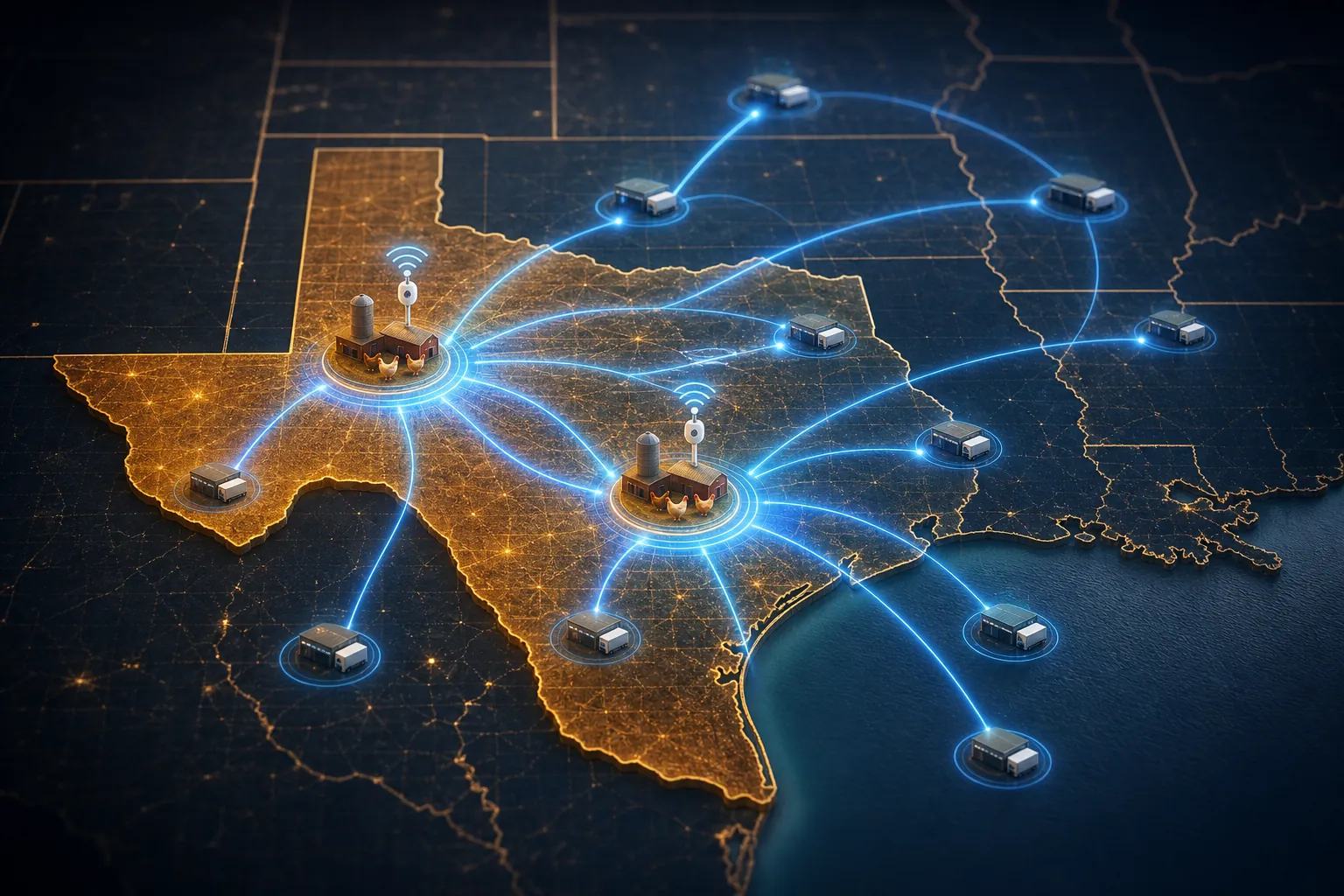
The useful part of the July 2026 egg recall starts before a shopper got sick, before a retailer-facing statement had to explain illnesses, and before the recall scope became a public argument. On July 22, 2026, Midwest Poultry Services, L.P. recalled 1,589,577 dozen shell eggs — more than 19 million eggs — after “proactive environmental monitoring and root cause analysis” identified possible Salmonella Enteritidis contamination associated with two Texas farms. The recalled eggs were sold under Kroger, Brookshire’s, Simple Truth, Country Morning, and Sunups brands, distributed in Texas, Oklahoma, Arkansas, Louisiana, Kansas, and Missouri, and carried Julian dates from June 6 through July 3, 2026. At the time of the announcement, no illnesses had been reported.[1]
| Recall element | July 2026 record |
|---|---|
| Company | Midwest Poultry Services, L.P. |
| Recall date | July 22, 2026 |
| Product volume | 1,589,577 dozen shell eggs, or more than 19 million eggs |
| Brands named | Kroger, Brookshire’s, Simple Truth, Country Morning, Sunups |
| Distribution states | TX, OK, AR, LA, KS, MO |
| Date coding | Julian dates June 6–July 3, 2026 |
| Detection basis | Proactive environmental monitoring and root-cause analysis at two Texas farms |
| Illness status at announcement | No reported illnesses |
That table is doing more work than a broad claim about artificial intelligence would. It shows the actual shape of the operational problem: two farms, a defined production-date range, named brands, named states, and a recall initiated from monitoring and investigation rather than from confirmed consumer harm. The FDA notice does not say that Midwest Poultry Services used AI or machine learning. It says the signal came from proactive environmental monitoring and root-cause analysis.[1] The AI relevance comes from a narrower inference: 2026 food-supply-chain literature describes AI-powered systems as tools for reading environmental, sensor, supplier, facility, and shipment data quickly enough to help teams detect risks and isolate affected lots. That is different from saying a named AI vendor prevented this recall from becoming an outbreak.
The First Hour Is Where The Recall Gets Expensive
Once a contamination signal appears, the food safety lead has two bad choices and one good one. Under-recall, and people may be exposed. Over-recall, and the company destroys safe product, empties shelves unnecessarily, expands retailer notifications, and invites brand damage that may outlive the immediate event. The good choice is not a smaller recall by instinct. It is a narrower recall by evidence.
That evidence has to arrive fast enough to matter. A distribution team needs to know which lots left which facility, which brands they became, where they shipped, and whether the suspect window should stop at one farm, two farms, one production run, several date codes, or a much wider hold. A grocery procurement lead is watching the same clock from the other side: every hour of uncertainty can turn a contained vendor action into a category-level exposure conversation.
The July recall still covered more than 19 million eggs, so it was not small.[1] But size alone is the wrong measure. The sharper question is whether proactive monitoring and traceability kept the recall from becoming larger than the evidence required. A 19 million-egg recall attached to two farms, specific brands, six states, and a defined Julian-date range is a very different operating problem from a recall that begins with illnesses, uncertain source attribution, and an expanding distribution map.
Reactive Recalls Burn Money Through Ambiguity
The economic case for traceability investment is strongest when it reduces ambiguity before the public-health signal has already widened. FoodReady, in self-published content citing industry studies that it does not directly link, reports that modern traceability technology can reduce recall scope by 50% to 95% compared with systems that cannot isolate specific lots. The same FoodReady article reports an average direct recall cost of $10 million, plus a 2% to 8% post-recall market-share loss.[2]
Those figures should not be treated as independently verified egg-industry math. They are vendor-published figures, and the cited underlying studies are not provided in the brief. Still, they describe the right cost categories. Recall cost is not just disposal. It includes labor, freight, reverse logistics, retailer coordination, customer service, testing, legal review, public communications, production disruption, and the commercial penalty of having buyers wonder whether a supplier can define its own risk boundary.
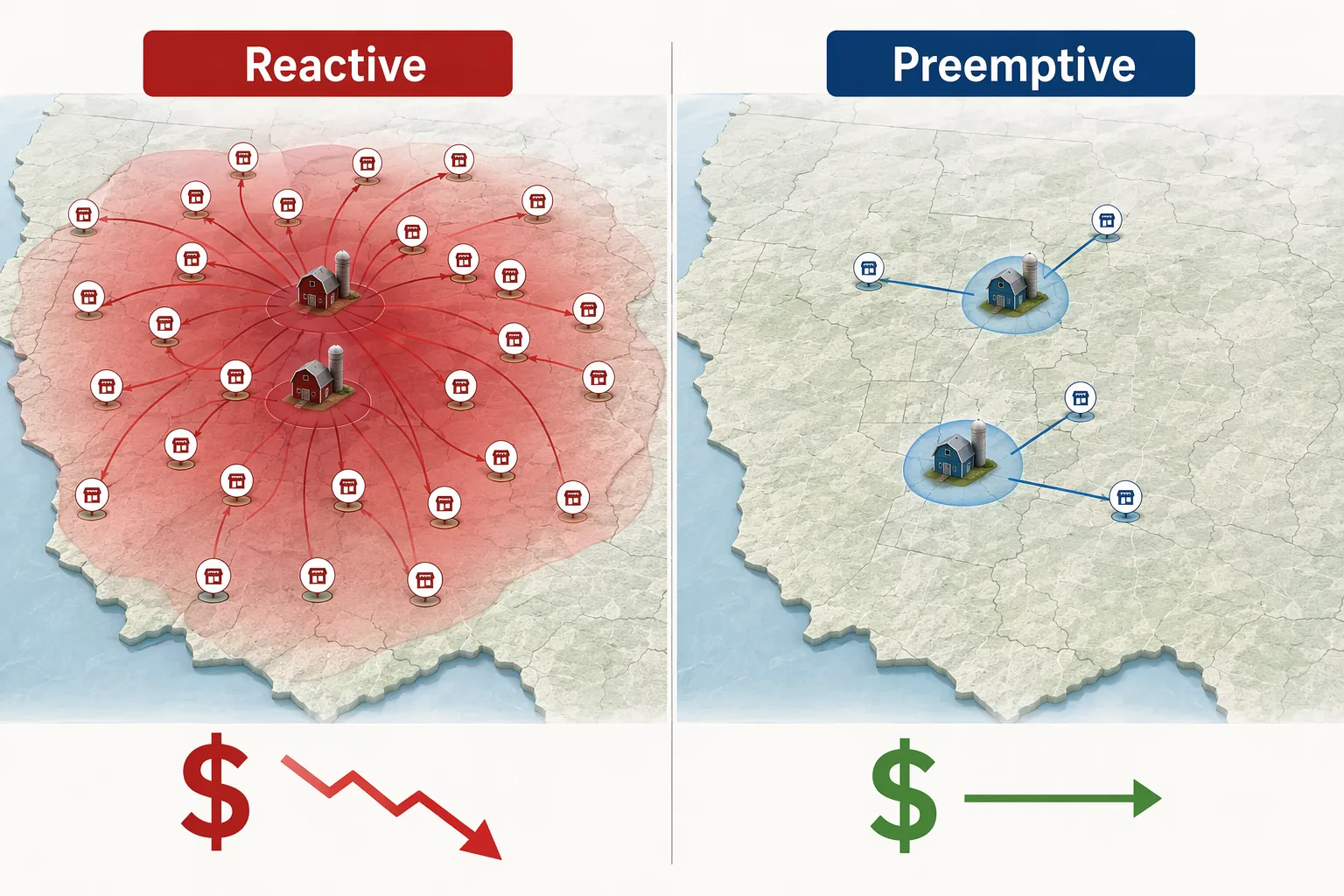
A reactive recall usually starts after someone outside the operation has more certainty than the operation does: a consumer complaint, a cluster of illnesses, a regulator’s test, or a retailer escalation. At that point, the company is not only tracing product. It is reconstructing what happened while customers, regulators, and buyers are already asking why the company did not know sooner.
A preemptive recall has a different cost profile. The company still spends money, and the public notice may still be large. But the recall can be built around an internal signal, a root-cause hypothesis, and lot-level records before illness reports force a broader public-health investigation. That matters because the most expensive recall scope is often the scope chosen because nobody can prove what to exclude.
In the July 2026 case, the evidence boundary was not abstract. The FDA notice tied the action to two Texas farms and a defined production-date range.[1] For planning and procurement teams, that is the difference between asking, “Which stores received implicated lots?” and asking, “How much of this supplier’s egg volume do we have to treat as suspect until someone can reconstruct the chain?” The first question can be worked. The second question spreads.
What The Operating Mechanism Looks Like
The workflow behind a narrower recall is not mystical. Environmental monitoring flags a risk in or around the production environment. Root-cause analysis tests whether the signal is tied to a farm, house, line, handling process, time window, or other operating condition. Traceability records then connect the suspected origin to lots, brands, date codes, shipments, distribution centers, and retail destinations.
Where AI-powered tracking systems can help, if they are actually deployed and connected to usable data, is in shortening the distance between those steps. Industry coverage in 2026 describes AI food traceability systems that analyze production, supplier, facility, logistics, and product-movement data to improve recall readiness and source identification.[3] Separate food-logistics coverage describes AI as a tool 3PLs can use to manage product recalls by helping identify affected products, coordinate workflows, and improve response speed.[4]
That does not mean AI “finds Salmonella” in some standalone, press-release sense. In a practical recall room, the value is more mundane and more useful. The system can surface an unusual environmental-monitoring pattern. It can compare the suspect window against supplier and facility records. It can show which lots share the same relevant conditions. It can help distribution teams avoid treating unrelated shipments as implicated merely because the paper trail is too slow to interrogate.
- Detection: environmental monitoring identifies a possible contamination risk before confirmed illness reports.
- Investigation: root-cause analysis narrows the suspected origin and time window.
- Isolation: lot, brand, date-code, facility, and shipment records define the implicated product set.
- Execution: distribution, retail, quality, and communications teams act from the same scope instead of debating competing versions of the recall boundary.
The July notice confirms the first two parts: proactive environmental monitoring and root-cause analysis.[1] It also gives enough product and distribution detail to show that lot and market boundaries existed. What it does not confirm is the software architecture behind those decisions. That distinction matters. A good traceability argument does not need to pretend the public record says more than it says.
Why Lot Isolation Is The Investment Case
For a procurement or supply-chain planning director, the investment question is not whether AI sounds modern. It is whether the system gives the company a smaller, defensible problem at the moment when the organization is most tempted to choose a larger, safer-looking recall because the records are not ready.
The difference shows up in direct cost first. If a company can isolate the affected lots, it can avoid pulling unrelated product, reduce replacement volume, limit freight and disposal, and keep unaffected lanes moving. FoodReady’s reported 50% to 95% recall-scope reduction claim should be read cautiously, but it captures why traceability projects get economic attention: every case, pallet, and store that can be credibly excluded from a recall reduces the cost of action without reducing the seriousness of the response.[2]
The second cost is retailer confidence. Grocery buyers do not only judge whether a supplier issues a recall. They judge whether the supplier can answer follow-up questions quickly: Which distribution centers? Which date codes? Which private-label programs? Which stores? Which replenishment orders are safe to continue? A supplier with precise traceability can keep the conversation operational. A supplier without it forces the retailer to manage uncertainty in front of shoppers.
The third cost is market-share leakage. FoodReady reports a 2% to 8% post-recall market-share loss in its discussion of recall economics.[2] Again, that figure is vendor-published and not egg-specific in the available material. But the mechanism is familiar: the longer the story remains broad, unresolved, or poorly bounded, the easier it is for buyers and consumers to substitute away from the affected supplier or brand family.
This is why faster paperwork is a weak version of the value proposition. A system that generates a compliant report after the suspected product has already moved widely may help with administration. A system that supports earlier detection and defensible lot isolation changes the commercial shape of the incident.
FSMA 204 Raises The Floor, But The Deadline Is Not The Point
Shell eggs are on the FDA Food Traceability List under the FSMA Final Rule on Requirements for Additional Traceability Records. The FDA has also discussed large annualized benefits from preventing or reducing overly broad recalls, and the compliance timeline has been extended to July 2028 while the underlying data model remains relevant.[5]
That matters, but only up to a point. A compliance deadline can force recordkeeping discipline. It cannot, by itself, make a recall team faster in the first hour. The operational value comes when those records are clean enough, connected enough, and searchable enough to answer the questions that decide recall scope.
FoodReady reports that fewer than 40% of affected food companies have implemented systems that can meet FSMA 204 requirements.[2] Because that figure also comes from self-published content, it should not be treated as a settled industry census. It does, however, match the practical concern many buyers already have: regulatory readiness and operational recall readiness are related, but they are not identical.
The Onion Contrast
The clearest contrast is not another egg recall. It is the 2024 E. coli onion outbreak discussed in 2026 recall-readiness coverage, where traceability gaps prevented clean source isolation.[6][7] That case is useful here because it shows the other posture: the supply chain is trying to work backward through imperfect visibility while public-health and commercial consequences are already unfolding.
The lesson is not that onions and eggs behave the same way. They do not. The useful comparison is procedural. When a source cannot be isolated, the recall perimeter tends to expand until the available evidence catches up. When monitoring, root-cause work, and traceability records identify a narrower suspect set earlier, the organization has a better chance of acting before the uncertainty becomes the recall.
What To Ask Before Buying The Dashboard
For teams evaluating AI-driven traceability platforms, the July egg recall points to a better set of questions than “Does the platform use AI?” The first question is whether the system can connect environmental-monitoring events to lot, facility, supplier, brand, shipment, and customer records without manual reconstruction. The second is whether it can preserve a defensible audit trail when the recall boundary is challenged by a retailer, regulator, insurer, or internal legal team.
The third question is whether the platform can distinguish confidence levels. A contamination signal, a root-cause hypothesis, and a confirmed implicated lot are not the same thing. If the system collapses all three into a single red alert, it may accelerate panic rather than improve decisions. If it lets quality, procurement, and distribution teams see what is known, what is suspected, and what is excluded, it becomes more than a visualization layer.
The fourth question is whether the tool supports action across trading partners. In a branded and private-label recall, the producer’s facts have to become retailer instructions quickly. That means date codes, distribution centers, purchase orders, store lists, customer notifications, product holds, returns, and replacement plans need to line up. A traceability platform that performs well inside one facility but cannot carry the answer into retail execution leaves too much money in the gap.
This is also where vendor-neutral language is important. The available research does not identify a specific o9, Blue Yonder, Kinaxis, RELEX, Anaplan, or adjacent deployment at Midwest Poultry Services. The case supports an operating thesis, not a named-vendor endorsement: preemptive monitoring plus traceability gives recall teams a narrower and faster problem to solve.
A Bounded Read On The July 2026 Egg Recall
The July 2026 Midwest Poultry Services recall does not prove that a named AI system detected Salmonella risk or prevented a public-health event. The public FDA record supports a narrower and stronger conclusion: the recall was initiated after proactive environmental monitoring and root-cause analysis at two Texas farms, with no illnesses reported at announcement.[1]
That is still a meaningful result. It shows why the economic case for AI-enabled traceability is strongest when the technology helps move the supply chain from explanation-after-harm to containment-before-harm. The investment earns its argument when it improves early warning, narrows lot isolation, reduces unnecessary recall scope, and gives food safety, distribution, procurement, and retail teams the same evidence boundary before ambiguity becomes the most expensive part of the incident.
References
- Midwest Poultry Services, L.P. Recalls Shell Eggs Due to Possible Salmonella Enteritidis Contamination, FDA
- Transforming Food Safety With AI-Native Traceability Across Hundreds of Facilities, FoodReady
- AI Food Supply Chain Traceability: 16 Advances (2026), Yenra
- How AI Helps 3PLs Manage Product Recalls, Food Logistics
- FSMA Final Rule on Requirements for Additional Traceability Records, FDA
- Recall Readiness in 2026: Regulatory Shifts Are Raising the Stakes, CRC Group
- How Technology Shapes Food Recall Readiness in 2026, Food Logistics
§ 42 — Cited evidence
Flag an inaccuracy or submit a comparable account — Contribute or read how claims are verified in Methodology.