§ 41 — Use-case analysis
Can AI supply chain visibility prevent egg recalls?
The 2025 egg recall exposed a critical gap in in-transit visibility as contaminated eggs reached stores for 21 days after last distribution. This analysis examines whether AI-powered shipment monitoring from FourKites and project44 could have intercepted those shipments, finding that while temperature monitoring and geofence alerting exist, a FSMA 204-native recall-containment module does not—creating both a purchase risk and an integration opportunity for early adopters.
The hard part of an egg recall is not discovering, in the abstract, that a product has a problem. The hard part is what happens after distribution has already happened: which cartons are still moving, which ones have crossed a dock door, which customer owns them now, and who has the authority to stop the next handoff.
The August Egg Company recall is a useful stress test because it puts that operational clock in plain view. The FDA outbreak investigation tied the recall to about 20 million eggs, 134 illnesses, distribution from February 3 to May 15, 2025, at least nine brand labels, and at least nine states; recall initiation came 21 days after the last reported distribution date.[1] That is exactly the kind of footprint where “visibility” either becomes a containment tool or stays a dashboard someone checks after the product is already on a shelf.

For an AI-supported egg recall response, the first question is not whether a platform can draw a truck on a map. It is whether the visibility event can become an authorized hold before the shipment reaches retail. A logistics director or QA lead would need shipment identity, lot or SKU relationship, destination, trailer condition, current location, carrier contact, ownership status, and a clean instruction path into the systems that actually govern movement.
That distinction matters because contaminated eggs do not wait for a clean executive narrative. They keep moving through linehaul, cross-dock, store replenishment, and customer receiving routines unless something interrupts the routine. If the affected product is already at a retailer DC, the problem is a hold and quarantine workflow. If it is on a truck, the problem is a stop, redirect, or refuse-receipt workflow. If it is under several private labels, the problem is also translation: one recall scope has to map to many commercial identities.
What AI Visibility Can Already Supply
The sensor and alerting layer is not imaginary. FourKites says 18 of the top 20 global food and beverage shippers use its platform, and it cites Land O’Lakes reducing median dwell time per load by 21% within three months.[2] Those are not recall interception results, but they do show that large food shippers already use real-time logistics data to change operational behavior, not just to decorate a control tower.
Kraft Heinz selected FourKites for real-time tracking and temperature monitoring across its North American supply chain, according to FourKites’ announcement.[3] In a refrigerated food network, that matters because temperature status and location status are two of the few signals that can tell an operator whether a shipment is merely late, potentially compromised, or in the wrong place at the wrong time.
project44 describes a similar capability set for food and beverage supply chains: temperature monitoring with real-time notification when a trailer falls outside an acceptable range, plus order-level visibility down to purchase order and SKU for recall scoping. Its food and beverage page names Blue Diamond Growers for single-SKU visibility across complex distribution and HARIBO for global shipment visibility.[4]
| Capability | Why it matters during an egg recall | What the cited evidence actually proves |
|---|---|---|
| Real-time shipment tracking | Shows whether affected product may still be in motion rather than already received | Platforms are deployed for live shipment visibility in food and beverage networks |
| Temperature monitoring | Adds trailer-condition context when deciding whether to hold, inspect, or quarantine | Vendors disclose monitoring and notification capabilities, including food-chain use cases |
| Geofence or location-based alerting | Can warn when a shipment approaches a store, DC, or quarantine boundary | The visibility layer can produce operational events tied to location |
| Order, PO, or SKU-level visibility | Helps translate a recall scope into affected commercial units | project44 describes visibility down to purchase order and SKU for recall scoping |
Taken together, these capabilities could have supplied some of the ingredients missing from a messy egg recall: a list of loads still active, their destinations, their arrival risk, their carrier status, and their relationship to a recall scope. That is meaningful. It is also not the same as proving that FourKites or project44 would have intercepted August Egg Company shipments before retail, because neither vendor has published a food-recall-specific egg-scale interception case.
The Missing Link Is the Authorized Stop
In normal operations, a visibility platform can tell a dispatcher that a truck is late, a trailer is warming, or a shipment is approaching a facility. During a recall, the platform has to do something more specific: match a recall scope to open shipments and trigger a controlled action that the warehouse, transportation, QA, carrier, and customer teams will all recognize.
That is where the soft version of the AI story usually breaks. “We can see the truck” does not mean “we stopped the eggs.” The stop requires a business rule, an owner, a system-of-record update, and an audit trail. If the affected lot, purchase order, or SKU is identified in a recall system but the transportation management system still shows the load as deliverable, the carrier will keep following the tender. If the WMS has not placed inventory on hold, a receiving team can still process the product. If the customer has not received a disposition instruction, the driver may arrive with no one ready to refuse or quarantine the load.
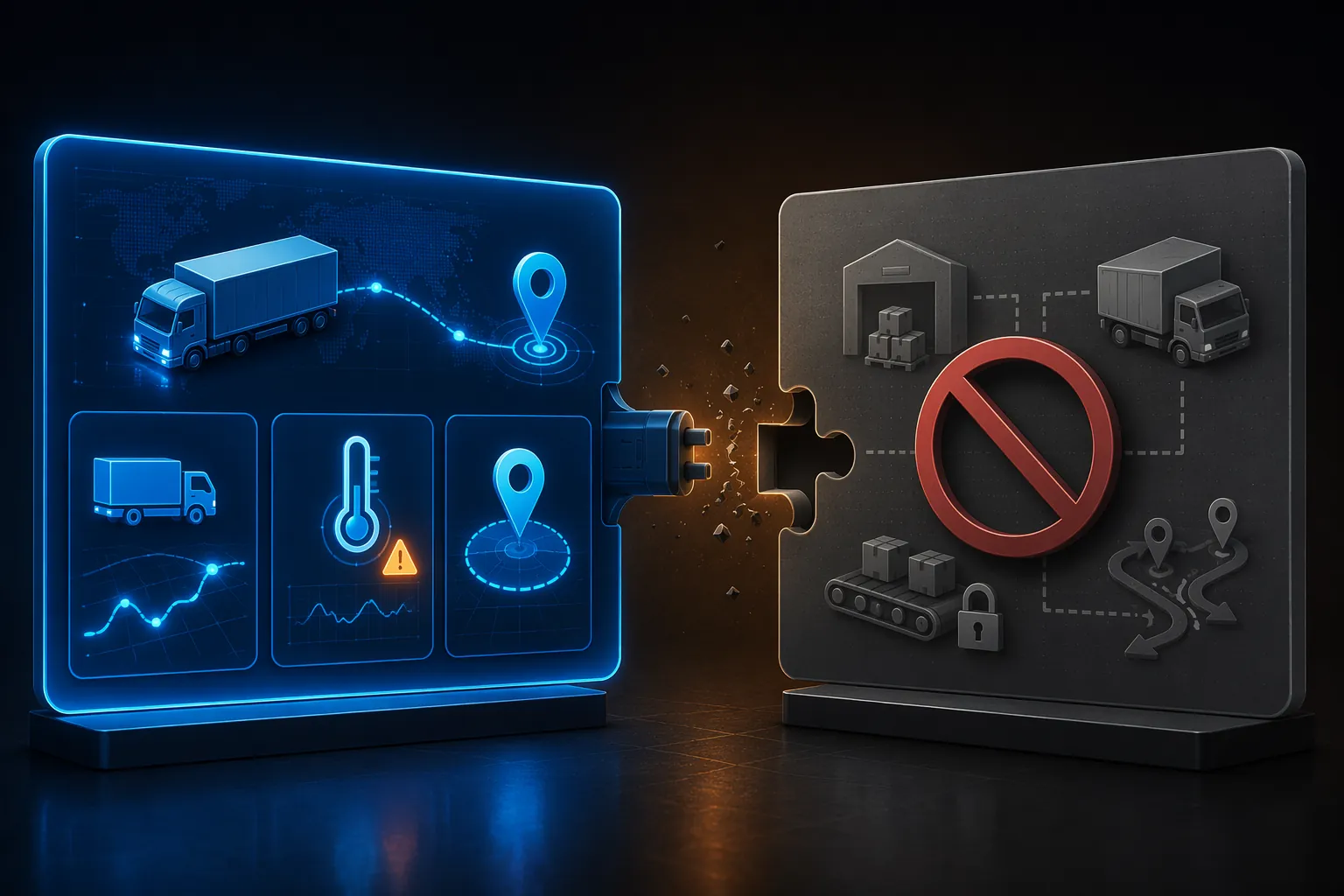
Food Logistics describes the recall-management path in broader 3PL terms: AI can help flag relevant product, connect recall information to operational decisions, and support faster containment workflows.[5] That framing is useful, but it should not be stretched into proof that the named visibility platforms already provide a recall-native module for egg producers. The available evidence supports a narrower conclusion: the monitoring and event layer exists; the recall-hold orchestration layer still has to be designed, integrated, and governed.
A Recall-Native Workflow Would Look Different From a Shipment Alert
A useful recall workflow starts with the recall scope, not the truck. The affected lot, production window, supplier site, purchase order, customer order, SKU, or label identity becomes the primary object. The platform then searches active and recently delivered shipments, identifies which ones contain affected product, ranks them by containment urgency, and issues role-specific instructions.
- For in-transit loads, the instruction may be hold at next safe location, return to origin, divert to quarantine, or proceed only after QA release.
- For retailer DC arrivals, the instruction may be receive into blocked status, segregate by pallet or SKU, and prevent store allocation.
- For loads already delivered, the instruction shifts to customer notification, inventory hold, and downstream trace.
- For carriers, the instruction has to be operationally clear enough to override the tender without creating an unsafe roadside decision.
The system also has to know when not to overreach. A temperature exception is not the same as a pathogen recall. A shipment entering a geofence is not automatically contaminated. A SKU match may be too broad if the recall scope is narrower than the commercial item. That is why a recall-native module needs both traceability logic and execution authority; otherwise, it either misses product or creates false holds that operators learn to distrust.
How the August Egg Recall Would Have Tested the System
The 2025 recall footprint would have forced a platform to handle three problems at once. First, time: the last distribution date and recall initiation were separated by 21 days.[1] Some product may already have been consumed, some may have been in retail inventory, and some may have been somewhere in the distribution network. Without documented real-time shipment visibility in place for this recall, there is no defensible before-and-after metric for how many eggs could have been intercepted.
Second, identity: the eggs moved under at least nine brand labels.[1] In a recall, brand proliferation is not a marketing detail; it is a traceability burden. The same physical risk can appear to customers as different labels, item descriptions, and replenishment relationships. A visibility platform that sees only the carrier load but not the purchase order, SKU, or affected product relationship is only halfway useful.
Third, geography: distribution across at least nine states expands the number of receiving parties, carrier lanes, and local execution points that may need instructions.[1] A control tower can centralize the view, but containment still happens at the dock, in the yard, in a carrier dispatch office, or inside a retailer’s inventory system. The farther the product has moved, the less useful a generic alert becomes.
A mature visibility setup could have answered practical questions faster: Are any affected shipments still tendered but not picked up? Are any on the road? Which ones are approaching customer facilities? Which customers have received them but not allocated them? Which carriers need stop instructions now? Those answers would not erase the recall, but they could shrink the time between recall scope and containment action.
What Buyers Should Ask Before Treating Visibility as Recall Automation
For egg producers, distributors, and retailers, the purchase risk is buying a visibility platform and assuming the recall workflow comes with it. The integration opportunity is using that platform as the event layer for a recall-containment process that already knows how to hold inventory, reroute shipments, and document decisions.
A serious evaluation should get specific quickly. Ask whether recall scope can be ingested by lot, PO, SKU, supplier, production window, and customer order. Ask whether the platform can compare that scope against active tenders, in-transit shipments, delivered-but-unreceived inventory, and DC inventory. Ask who approves a hold, where that approval is logged, and whether the instruction writes back into the WMS or TMS rather than sitting in an email thread.
- Can the platform turn a recall scope into an affected-shipment worklist without manual spreadsheet matching?
- Can geofence rules distinguish “approaching retail DC” from “safe to continue” during an active recall?
- Can temperature exceptions and recall holds be kept separate when they require different QA decisions?
- Can hold, divert, return, and quarantine instructions be sent to carriers and written back to execution systems?
- Can the audit trail show who authorized each action, when the carrier received it, and when the receiving site confirmed disposition?
Those questions matter more than a generic AI claim. Predictive ETA, anomaly detection, and shipment matching can all help, but recall containment is a controlled process. The system must be able to tell the difference between “watch this load” and “this load is no longer authorized to deliver.”
The Narrow Answer
AI-powered visibility platforms could supply the ingredients for in-transit interception during an egg recall: real-time location, temperature monitoring, event alerts, geofences, and order or SKU-level context. FourKites and project44 both show credible capability signals in large food and beverage supply chains.[2][3][4]
Egg producers should not treat that as full recall automation. The public evidence does not show a FourKites or project44 egg-recall case where affected shipments were identified, held, rerouted, and quarantined at recall scale. The August Egg Company counterfactual also cannot be measured from the available record because there is no documented real-time visibility system to compare against.
The practical path is integration: connect recall scope, shipment status, geofence rules, temperature exceptions, WMS and TMS holds, carrier instructions, and quarantine routing into one auditable workflow. That is the difference between knowing where contaminated eggs might be and stopping them before the next operational handoff.
For the broader recall operating model, ChainSignal’s analysis of AI recall management in food safety covers the outcome side of the problem. Its AI supply chain disaster recovery planning piece maps the response discipline around disruption. This egg-recall test sits between the two: the moment when visibility has to become a controlled stop.
References
- FDA outbreak investigation June 2025, FDA, June 2025.
- Food & Beverage, FourKites.
- Kraft Heinz Selects FourKites for Real-Time Supply Chain Tracking and Analytics, FourKites.
- Food & Beverage, project44.
- How AI Helps 3PLs Manage Product Recalls, Food Logistics.
§ 42 — Cited evidence
Flag an inaccuracy or submit a comparable account — Contribute or read how claims are verified in Methodology.