§ 41 — Use-case analysis
How digital traceability could have shortened the 2026 Cyclospora outbreak
An analysis of the 2026 Cyclospora outbreak's traceback bottlenecks and a vendor-specific evaluation of whether AI-powered traceability platforms (Blue Yonder, o9, Kinaxis-TraceLink) could have compressed the recall window from weeks to days — and where biology still limits technology.
- Function
- traceability
- AI technique
- optimization
- Failure pattern
- data silos
- Evidence source
- FDA Investigation (July 2026)
The 2026 Cyclospora lettuce outbreak was not a case of investigators staring into a blank map. By the July 24 CDC update, the outbreak had more than 4,173 confirmed domestic cases since May 1 across 41 states, with 98 hospitalizations; CNN also reported at least 7,400 additional unconfirmed cases and noted that the event had surpassed the prior U.S. record of roughly 1,500 cases tied to raspberries.[1][2] The human scale matters here because every day spent reconciling records was not just an internal traceability delay. It was another day in which retailers, restaurants, distributors, state investigators, and exposed consumers were operating with an incomplete picture.
The contradiction is that the epidemiology was unusually loud. In CDC interviews, 90% of cases reported eating iceberg lettuce.[3] That is the kind of signal food-safety teams hope for when they are trying to narrow a broad gastrointestinal illness cluster into a specific commodity, supplier, and lot window. Yet the recall still had to move through 27 states, multiple lot codes, Best-if-Used-By dates from July 18 through August 3, 2026, and separate paths through Walmart retail, Taco Bell foodservice, and other foodservice channels.[4]
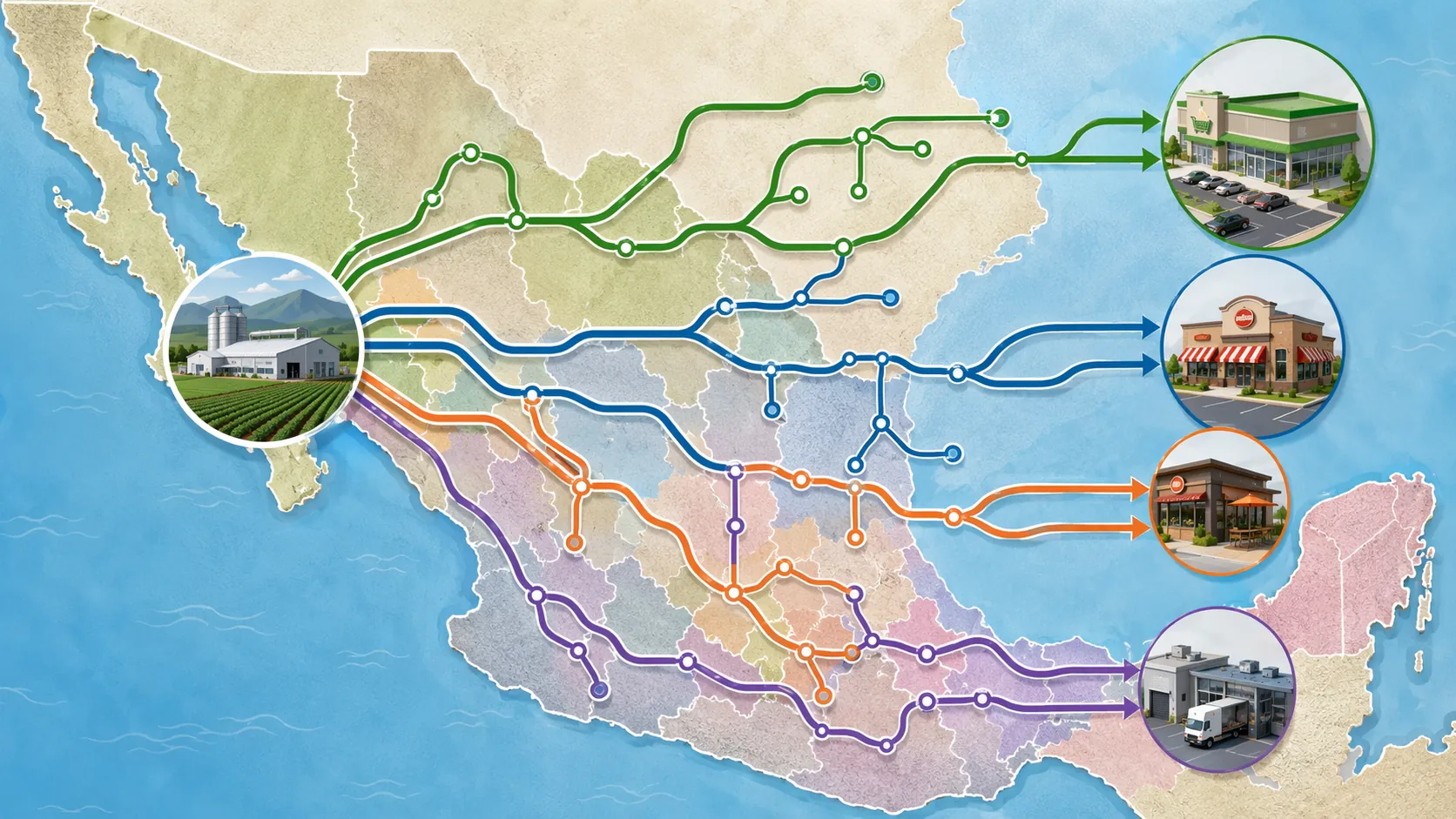
That gap between a strong case signal and a slow operational narrowing is where digital traceability deserves a serious look. Not because a platform can prevent contaminated lettuce from entering the supply chain by itself. It cannot. But because the traceback work in this outbreak exposed exactly the kind of multi-party record problem that modern lot-level, networked traceability systems are built to compress.
The Bottleneck Was Not One Missing Dashboard
The FDA traceback investigation converged on Taylor Farms de Mexico, but that did not immediately translate into a neat, single-action recall.[4] The practical work was messier: match patient exposure histories to points of service, match those outlets to distributors, match distributor shipments to lot codes, separate affected from unaffected dates, and decide how far upstream or downstream the recall needed to reach.
Anyone who has sat through these calls knows how quickly the word “traceability” becomes slippery. A retailer may have item-level sales history and warehouse receipts. A foodservice operator may have distributor invoices and restaurant delivery records. A processor may have internal production lots. A supplier portal may hold one version of the truth, an ERP another, and a PDF certificate yet another. The outbreak record does not support the claim that all of those records were absent. It supports the narrower and more useful conclusion that they were not readily interoperable at the speed the event required.
Michigan’s chief medical executive put the problem less politely, describing the traceback process as “very, very manual” and dependent on “very antiquated data systems.”[5] That quote lands because it names the work that tends to vanish in executive summaries: the phone calls, spreadsheet joins, invoice pulls, location crosswalks, date-window debates, and repeated checks against incomplete records.
FSMA 204 was designed for this terrain. Its Critical Tracking Event and Key Data Element architecture requires covered entities handling foods on the Food Traceability List to maintain standardized traceability records at specific points in the chain. The original compliance date was January 20, 2026; FDA extended the deadline by 30 months to July 20, 2028.[6] That timing does not make the rule a magic shield. It does frame this outbreak as a missed-readiness window: the country experienced its largest recorded Cyclospora outbreak after the original compliance date had passed but before the extended date forced fuller adoption.
For readers who need the broader compliance mechanics, ChainSignal’s produce traceability and FSMA 204 use case covers the general framework. The point here is narrower: this outbreak shows which parts of the traceback workflow could plausibly have moved faster if CTE/KDE-style data had already been captured, standardized, and exchanged across the actual retail, foodservice, distributor, processor, and supplier network.
Where Digital Traceability Could Have Compressed Time
The right benchmark is not whether software could have “solved” Cyclospora. The better question is which hours or days in the traceback chain could have been removed once investigators had a strong iceberg lettuce signal. The recall’s scope gives a useful way to separate the friction points.
| Traceback friction point | What had to be reconciled | What a stronger digital architecture could compress |
|---|---|---|
| Lot-level chain of custody | Processor lots, shipment records, receiving events, and Best-if-Used-By windows | Manual matching of dates, lots, and destinations |
| Multi-tier supplier visibility | Supplier, processor, distributor, retailer, and foodservice relationships | Back-and-forth requests for upstream and downstream records |
| Network integrations | ERP, warehouse, quality, distributor, and customer systems | Format conversion and duplicate reconciliation |
| Lab and environmental context | PCR results, sampling limits, agricultural water conditions, and farm-level risk factors | Only partially compressible; some uncertainty remains scientific, not transactional |
The first category is the cleanest fit for traceability tooling. Blue Yonder describes Chain of Custody capabilities for immutable, lot-level tracking aligned with FSMA 204 traceability requirements.[7] Treated carefully, that is a relevant vendor-documented capability, not an independent implementation audit. In an outbreak like this one, the useful feature is not the word “immutable.” It is the ability to connect a received lot, a transformation or packing event, a shipment, a customer, and a date window without rebuilding the chain from separate exports.
If Walmart retail locations, Taco Bell foodservice distribution, other foodservice accounts, and upstream processor records had been participating in a shared or interoperable lot-chain model, investigators would still have had to validate the exposure signal. But they could have asked a more precise question earlier: which destinations received the suspect lots tied to the relevant production and Best-if-Used-By dates? That is the difference between a broad “who bought lettuce from whom?” exercise and a constrained lot-destination query.
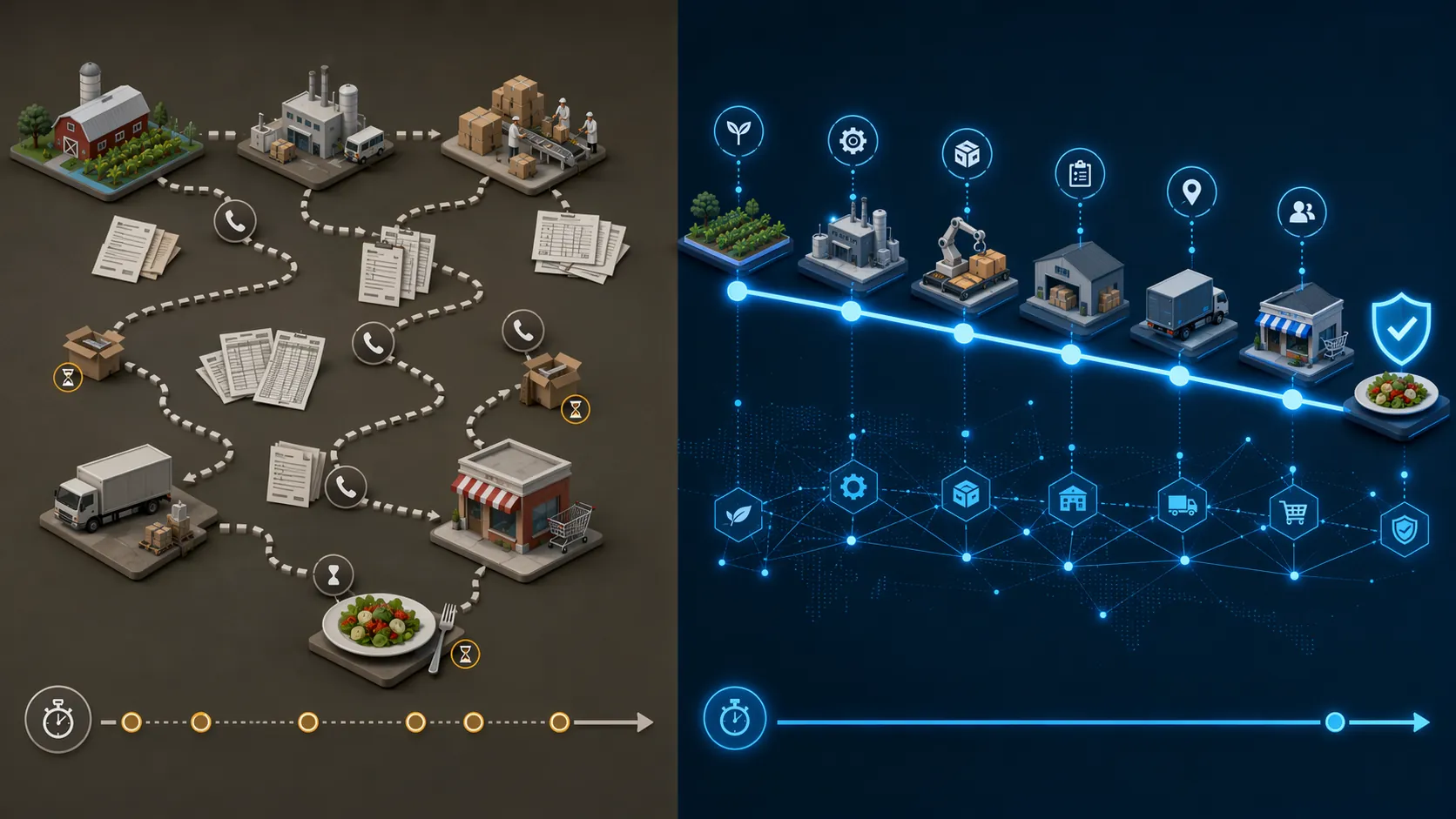
The second category is multi-tier aggregation. o9 Solutions describes supplier visibility and multi-tier planning capabilities intended to connect supplier data across tiers.[8] Again, the public documentation should not be mistaken for proof that a specific grocery or foodservice implementation would have performed during this outbreak. Still, the capability maps to a real bottleneck: investigators often need the distributor’s customer list, the customer’s receiving record, the processor’s production record, and the supplier’s field or harvest linkage before they can narrow a recall without either missing affected product or pulling too much unaffected product.
The third category is network integration. Kinaxis has described supply-chain orchestration capabilities connected with TraceLink network integrations.[9] In a recall, this matters because the weakest link is often not whether one company has clean internal data. It is whether that data can be exchanged with the next actor quickly enough to support a public-health decision. The practical value is a shorter cycle between request, extraction, translation, validation, and response.
Put together, these capabilities could plausibly have moved parts of the recall window from weeks toward days. The strongest candidate for compression is the period after the epidemiological signal pointed to iceberg lettuce and before the recall scope was narrowed across states, lot codes, date windows, and channels. That is a data-assembly problem, and the outbreak record gives no reason to romanticize the manual version of it.
Why One Vendor Stack Would Not Have Been Enough
The tempting slide-deck answer is to draw a single platform over the whole chain and call the gap closed. The 2026 outbreak does not support that. Blue Yonder’s lot-level chain of custody, o9’s multi-tier supplier visibility, and Kinaxis-TraceLink-style network integrations each address a different slice of the problem.[7][8][9] They are adjacent, not identical.
For a retailer, the decisive question is whether store, DC, supplier, and recall execution data can be tied to specific lots quickly enough to remove affected product while limiting unnecessary withdrawal. For a foodservice operator, the pressure point is often distributor-to-restaurant visibility: which cases went to which locations, on which dates, and under which item substitutions? For a processor or supplier, the hardest question may sit upstream of a finished lot, especially if farm, harvest, wash, water, and packing data are not in the same operating environment as customer shipment data.
That is why interoperability matters more than a beautiful single-vendor narrative. A practical architecture for an event like this would need FSMA 204-aligned lot events, supplier-tier visibility, distributor and customer network exchange, and recall workflow execution. It would also need participation. A pristine internal chain of custody at one actor does not answer the public-health question if the next actor can only respond with a spreadsheet two days later.
There is also a coverage gap that conventional traceability platforms do not close on their own: farm-level agricultural water data and Cyclospora-specific testing context. The record here does not show a single vendor product independently verified to integrate field-level risk, agricultural water monitoring, PCR sampling results, lot transformation, distributor movement, retail sale, and restaurant delivery into one outbreak-ready operating picture. A stitched architecture is not a compromise phrase. It is the actual requirement.
The False Positive Is the Boundary Line
The FDA’s investigation included an important inflection point: an initial positive PCR result was later determined to be a false positive.[4] That fact should slow down any claim that better supply-chain data would have cleanly prevented the outbreak or produced a perfectly decisive recall path. A traceability system can show where a lot moved. It cannot turn an uncertain lab result into a certain one.
Cyclospora is a particularly poor fit for simplistic prevention language. The parasite has a 1- to 2-week environmental maturation period, is resistant to standard chlorine sanitizers, and can be unevenly distributed in contaminated product or water.[10] Those features complicate both prevention and detection. A negative or ambiguous test does not necessarily mean a supply chain is clean; a positive result, as this outbreak showed, still has to be interpreted and confirmed in context.
The FDA BAM Chapter 19b Mit1C PCR target illustrates the detection problem at low concentrations. The method is reported as having 100% detection at 200 oocysts, but 69.23% detection at 5 oocysts.[10] That does not make PCR unhelpful. It means that low-oocyst contamination can sit near the edge of detection, where sampling design, sample distribution, and confirmatory interpretation matter.
This is the point at which the word “prevent” needs discipline. Digital traceability can reduce the time needed to identify suspect lots, locate product, notify customers, and execute a narrower recall. It can support containment. It can improve accountability. It can make the next investigation less dependent on antiquated records. But Cyclospora’s biology, underdiagnosis, and reporting lag mean that even a strong system may be working with delayed and incomplete illness data. True case counts are likely higher because of underdiagnosis and a reporting lag of up to six weeks.[1]
A Defensible Estimate: Weeks Toward Days, Not Instant Prevention
A realistic post-mortem separates three clocks. The first is the illness clock: exposure, incubation, diagnosis, interview, and reporting. Traceability software has limited leverage there. The second is the evidence clock: epidemiological convergence, product testing, environmental assessment, and interpretation of uncertain results. Software can organize evidence but cannot eliminate laboratory limits. The third is the records clock: who supplied whom, which lots moved where, which dates matter, and which channels still hold product. That is where the 2026 recall looked most compressible.
In this outbreak, the records clock carried avoidable drag. A 90% iceberg lettuce signal should have allowed faster operational narrowing if the relevant lot, shipment, receiving, and customer records were already standardized and exchangeable.[3] Instead, the recall had to be assembled across 27 states, multiple lot codes, a July 18-August 3 Best-if-Used-By range, and both retail and foodservice paths.[4] Those are not exotic data objects. They are the ordinary coordinates of a modern produce recall.
The strongest claim the evidence supports is that AI-powered digital traceability could have compressed the traceback and recall-scoping work from weeks toward days if the affected network already had verified participation across processors, distributors, retailers, foodservice customers, and relevant upstream suppliers. The evidence does not support a claim that Blue Yonder, o9, Kinaxis, TraceLink, or any adjacent platform would alone have prevented the outbreak. It supports a more operationally useful conclusion: the right stitched architecture could have reduced the manual reconciliation burden at the exact moment when public-health teams needed faster answers.
That distinction is not vendor skepticism for its own sake. It is the difference between buying software for an audit and building an outbreak-ready data network. The 2026 Cyclospora lettuce recall showed that the signal can arrive before the system is ready to act on it.
References
- CDC HAN-00531, Centers for Disease Control and Prevention, July 24, 2026.
- Cyclospora outbreak linked to lettuce becomes largest in US history, CNN, July 21, 2026.
- CDC Investigation Update: Cyclospora Illnesses Linked to Iceberg Lettuce, Centers for Disease Control and Prevention, July 2026.
- FDA Investigation of 5-State Outbreak of Cyclospora Illnesses Linked to Iceberg Lettuce, U.S. Food and Drug Administration, July 19, 2026.
- Cyclospora Outbreak Linked to Lettuce Shows Gaps in Food Traceability, Consumer Reports, July 2026.
- FSMA Final Rule on Requirements for Additional Traceability Records for Certain Foods, U.S. Food and Drug Administration.
- Chain of Custody, Blue Yonder.
- Supplier Collaboration and Multi-Tier Visibility, o9 Solutions.
- Kinaxis and TraceLink Supply Chain Network Integration Documentation, Kinaxis.
- Bacteriological Analytical Manual Chapter 19b: Molecular Detection of Cyclospora cayetanensis in Fresh Produce Using Real-Time PCR, U.S. Food and Drug Administration.
§ 42 — Cited evidence
Flag an inaccuracy or submit a comparable account — Contribute or read how claims are verified in Methodology.