§ 41 — Use-case analysis
Why data center power stability is a hidden risk for supply-chain AI
Grid stability events can disrupt supply-chain AI platforms in ways that capacity planning misses. This article examines evidence from recent regional grid failures and offers a framework for evaluating vendor resilience.
- Function
- supply-chain planning
- AI technique
- optimization
- Failure pattern
- power-stability workflow disruption
- Evidence source
- Belfer Center report, Reuters, HyperFrame Research
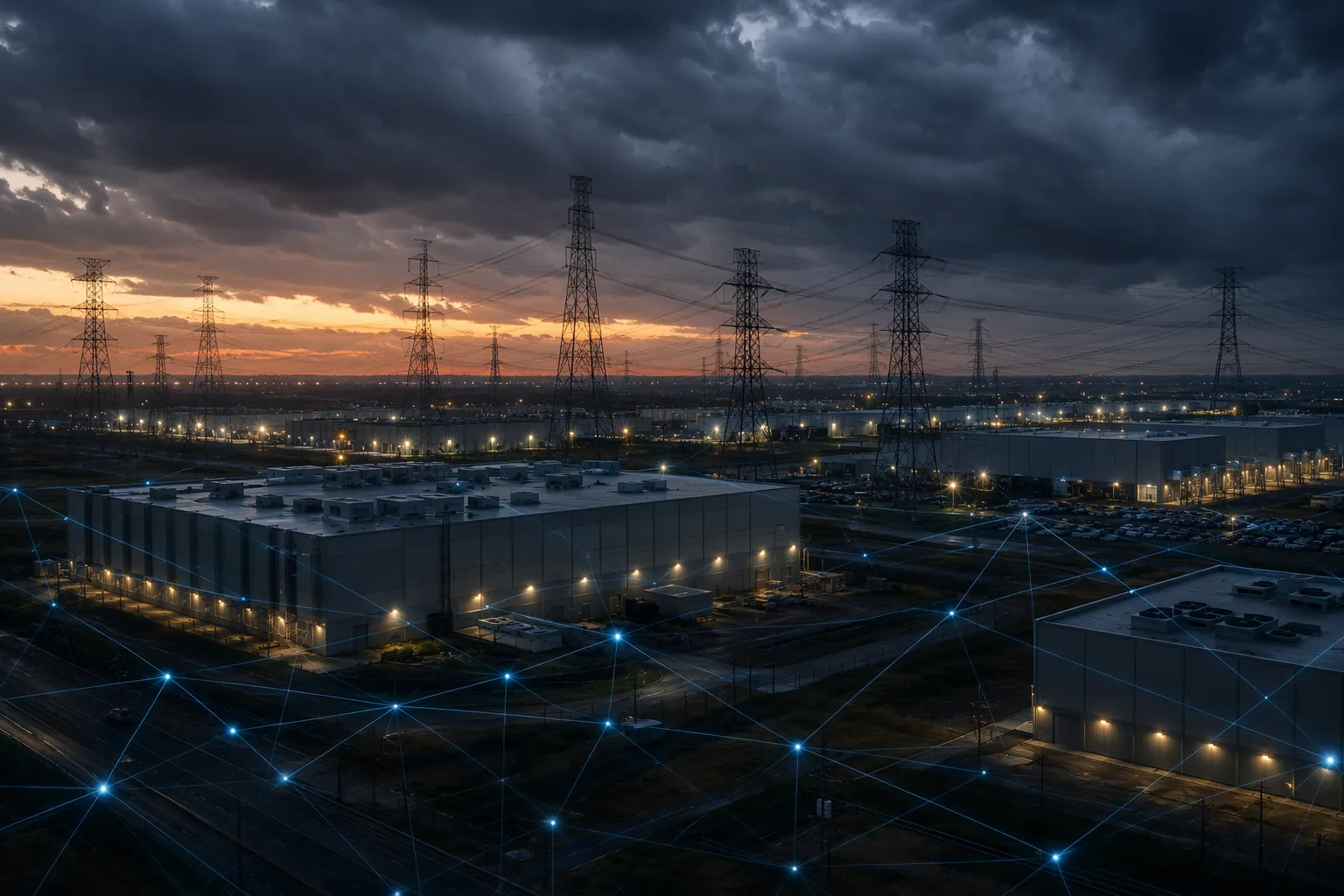
In July 2024, a grid disturbance in Northern Virginia exposed a data center power stability risk that supply-chain teams rarely include in vendor scorecards. More than 60 data centers disconnected from the grid at roughly the same time, removing about 1,500 MW of load almost instantly and forcing emergency stabilization actions by grid operators.[1][2] That is not the same problem as a region simply running short of future generating capacity. It is a stability event: too much electrical behavior changing too quickly for the system to absorb cleanly.
For a planning or fulfillment team, the uncomfortable part is not that data centers use a lot of electricity. Everyone buying AI-enabled software has heard that by now. The more useful question is narrower: if a supply-chain AI platform depends on concentrated cloud infrastructure, has the vendor tested what happens when the grid around that infrastructure becomes unstable, not merely when one server, rack, zone, or region is declared unavailable?
The Northern Virginia Event Was Not Just A Capacity Warning
Capacity language can make infrastructure risk sound orderly. Planners forecast load, utilities add generation and transmission, data center operators sign interconnection agreements, and buyers assume the platform either stays up or fails over. The Northern Virginia incident does not fit that tidy picture. The reported problem was a sudden loss of load from a large number of data centers, not a slow march toward a known shortage.[1][2]
That distinction matters because supply-chain software does not only need a login page to respond. It needs timing. A replenishment run needs the right input snapshot. A multi-echelon inventory optimization job needs to complete against a coherent set of assumptions. A promising engine needs to know whether it is using fresh inventory, stale allocations, or a fallback cache. A procurement workflow may be technically accessible while integrations are delayed, queues are replaying, or optimization output has been discarded.
The Belfer Center describes Northern Virginia as a uniquely concentrated data center region, hosting about 70% of global internet traffic and roughly 4,900 MW of operating data center capacity.[1] Those figures do not prove that every supply-chain AI vendor operating in or near the region is exposed in the same way. Architecture matters. Region selection matters. Workload scheduling matters. So does whether a vendor’s failover design preserves the business process or merely keeps the application endpoint alive. But the concentration does raise the diligence bar. A buyer should not accept a generic availability-zone answer when the underlying regional load behavior has already shown it can become a grid event.
AI Loads Can Move Faster Than Older Grid Assumptions
Traditional industrial load is often discussed as something that ramps. AI infrastructure can behave less politely. HyperFrame Research, cited by Data Center Knowledge, describes AI workload power draw swinging by hundreds of MW in seconds as large training or inference jobs start and stop, with protection schemes designed around more gradual changes potentially cascading under the wrong settings.[3]
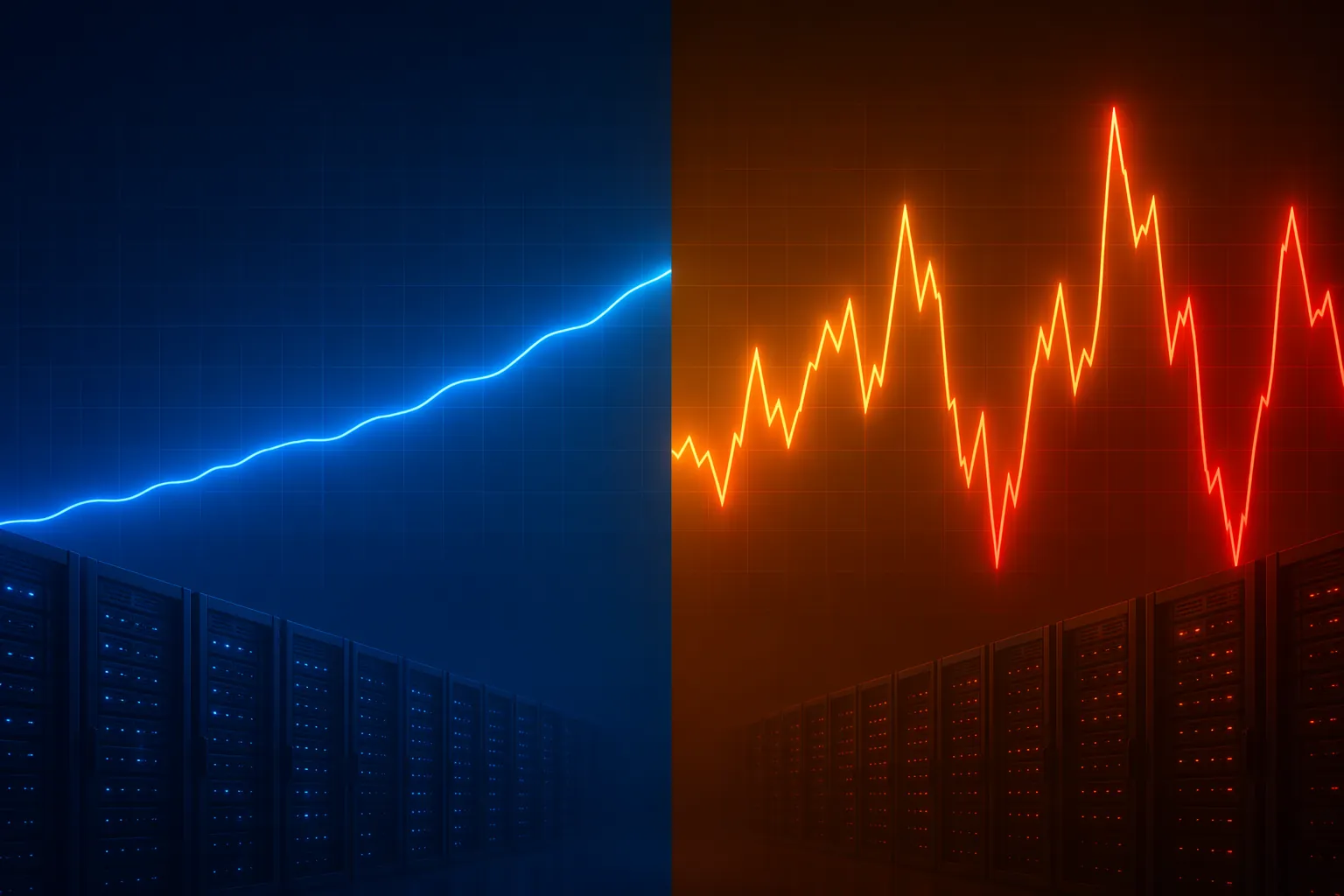
This is where the usual software resilience vocabulary starts to blur. A vendor can have redundant compute. A cloud provider can operate multiple zones. A service dashboard can show acceptable uptime over a month. None of those statements necessarily answers whether a large optimization workload was interrupted during a fast regional power swing, restarted from a valid checkpoint, replayed against the same input state, and returned output that operations teams could trust.
The hard part is that the application layer may not look broken in a clean, dramatic way. A planner may see a current screen but be working from an inventory picture that missed an integration cycle. A customer service team may get a promise date from a degraded model path without realizing the most recent capacity updates were not included. A procurement automation flow may hold purchase recommendations while upstream demand changes continue to arrive. Those are not classic outage stories. They are continuity stories.
Regional Signals Buyers Should Not Flatten Into A Single “Power Shortage” Story
Northern Virginia is the strongest case because there was a documented stability incident. Other regions matter because they show how concentrated data center demand is reshaping the operating environment around cloud infrastructure.
| Region Or Market | Evidence In The Record | What A Supply-Chain AI Buyer Should Take From It |
|---|---|---|
| Northern Virginia | More than 60 data centers disconnected simultaneously in July 2024, removing about 1,500 MW of load; the region hosts about 70% of global internet traffic and about 4,900 MW of operating data center capacity.[1][2] | Ask whether vendor-hosted workloads have been tested against rapid regional instability, not only conventional zone failure. |
| PJM | PJM failed its 2027 capacity auction by 6,600 MW, with 94% of projected load growth attributed to data centers, according to Wharton Knowledge citing PJM data.[4] | Treat future regional headroom as a resilience input, especially for compute-heavy planning workloads. |
| ERCOT / Texas | ERCOT projects 145 GW of peak demand by 2031, including 32 GW from data centers, according to the Belfer Center.[1] | Ask whether hosting concentration and workload growth are being reviewed together, not separately. |
The PJM and ERCOT figures should not be stretched into claims that a specific supply-chain platform will fail in those markets. They are not outage evidence. They are regional pressure signals. The operational lesson is that vendor diligence should move beyond “which cloud?” and “which SLA?” toward “which regional dependencies carry correlated power behavior?”
What Breaks Inside A Supply-Chain AI Workflow
The weak point is usually the handoff between infrastructure recovery and business-process recovery. Cloud failover can restore service while leaving a planning workflow in a questionable state. That difference is easy to miss until someone has to decide whether to release orders, rerun a plan, or explain why two teams acted from different versions of reality.
Optimization Runs Can Fail Without Producing An Obvious Outage
A multi-echelon inventory optimization run may consume demand forecasts, on-hand inventory, supplier constraints, lead times, service-level targets, and cost assumptions. If the job stops midway through a regional instability event, the important question is not only whether compute restarts. It is whether the job resumes from a valid checkpoint, restarts from the beginning, silently falls back to a prior answer, or leaves downstream users waiting on a plan that will arrive too late for the execution window.
A clean technical recovery can still create operational damage. If the night run misses the cutoff for procurement review, buyers may place orders manually. If a replenishment recommendation is delayed until after transportation planning locks, the system may be “available” while the useful decision has already moved outside the workflow.
Order Promising Can Freeze At The Worst Moment
Available-to-promise and capable-to-promise logic depends on freshness. During an instability event, the application may still serve requests while one or more feeds lag: warehouse inventory, production capacity, carrier commitments, substitution rules, or allocation updates. A conservative fail mode may freeze promising and protect the business from bad commitments. An aggressive fail mode may keep accepting orders against stale assumptions. Neither choice is purely technical; both decide who bears the consequence.
Inventory Views Can Desynchronize Across Teams
Supply-chain AI systems often sit between ERP, warehouse management, transportation, supplier collaboration, and planning applications. When a regional platform event interrupts integration timing, different teams may keep working from systems that appear current locally. The planning view, the ERP record, and the warehouse allocation screen can diverge for long enough to create real commitments. By the time the systems reconcile, the argument is no longer about uptime. It is about which team acted reasonably based on the data it had.
Failover May Preserve The Screen But Not The Decision
A vendor can fail over the user interface and still lose continuity in the decision process. The missing pieces are usually mundane: queue order, job state, model version, input timestamp, integration replay, exception ownership. Buyers should care less about whether the architecture diagram contains multiple boxes and more about what happens to an unfinished workload when power instability interrupts the region underneath those boxes.
Vendor Claims Need A More Specific Test
This is not an argument that Blue Yonder, Kinaxis, o9, RELEX, Anaplan, or any other planning platform is uniquely exposed. It is also not an argument that a hyperscaler-hosted product is automatically fragile. The point is that exposure is architecture-specific, region-specific, and workload-specific. Procurement teams should avoid both lazy comfort and lazy blame.
Kinaxis has acknowledged at a high level that the AI infrastructure boom creates a supply-chain challenge, which is useful vendor-side framing but not evidence that any particular resilience design has been tested against rapid grid instability.[5] That distinction should become standard in buyer conversations. A blog post recognizing infrastructure pressure is not the same as a test report showing how a planning workload behaves when regional power conditions change abruptly.
The same care applies when discussing cloud hosts. If a vendor runs on Azure, AWS, Google Cloud, or another provider, the buyer still needs the next layer of detail: which regions, which active-active or active-passive design, which data replication model, which workload restart policy, and which operational processes are guaranteed to remain coherent during failover. A cloud brand name is not a resilience proof.
Some secondary commentary has circulated around forecasts that a large share of AI data centers could become power-constrained by 2027. Without primary-source verification, that kind of figure should not carry the argument. The documented Northern Virginia event, the HyperFrame explanation of fast AI power swings, and the regional demand signals from PJM and ERCOT are already enough to justify a sharper procurement standard.
A Practical Evaluation Framework
The next vendor review does not need to turn the supply-chain team into power engineers. It does need to stop treating power stability as someone else’s footnote. The useful questions are specific enough that a vendor, cloud provider, or implementation partner should be able to route them to the right owner.
- Regional hosting diversity: Which cloud regions support the production environment, and are critical planning workloads concentrated in data center markets with known grid pressure or documented stability events?
- Failover testing history: Has the vendor tested failover during unfinished optimization, planning, promising, or procurement workloads, rather than only testing application availability?
- Workload restart behavior: When an AI or optimization job stops mid-run, does it resume from checkpoint, restart from scratch, fall back to a prior result, or require manual intervention?
- Data freshness controls: How does the platform label, block, or degrade decisions when ERP, WMS, TMS, supplier, or demand feeds are delayed during a regional infrastructure event?
- Demand-response exposure: Do the relevant cloud providers or data center operators participate in utility demand-response programs that could throttle compute, and how would the vendor protect critical supply-chain workloads during those events?
- Incident evidence: Can the vendor provide post-test or post-incident artifacts showing decision continuity, queue replay, integration reconciliation, and user communication timelines?
The answer to these questions will vary by customer. A retailer using AI for non-urgent assortment analysis has a different risk profile from a manufacturer relying on daily constrained supply plans or a distributor making near-real-time promise commitments. A vendor that cannot answer immediately may still have a strong architecture. But if the only answer is a generic SLA, the buyer has learned something important.
Power stability has become part of supply-chain AI resilience because the decision process now depends on compute-heavy workloads running in concentrated regions. The procurement standard should follow the risk: prove that the platform can preserve operational continuity when the grid behaves badly, not merely that the dashboard stayed green.
References
- Belfer Center report on AI data centers and grid stability, Belfer Center, February 2026.
- Reuters reporting on the July 2024 Northern Virginia data center grid event, Reuters.
- HyperFrame Research analysis of AI workload power swings, Data Center Knowledge, May 2026.
- Wharton Knowledge coverage of PJM capacity auction data, Wharton Knowledge.
- Kinaxis blog post on the AI infrastructure boom creating a supply chain challenge, Kinaxis.com, 2026.
§ 42 — Cited evidence
Flag an inaccuracy or submit a comparable account — Contribute or read how claims are verified in Methodology.