§ 41 — Use-case analysis
Cyclospora Exposes Why Planning Platforms Need a Traceability Partner
The 2026 Cyclospora outbreak revealed that major supply-chain planning platforms lack the lot-level traceability FSMA 204 requires, forcing a manual, multi-week traceback. This analysis explains why procurement teams should co-invest in a dedicated traceability network rather than expect one platform to cover both planning and compliance.
- Function
- procurement
- AI technique
- inventory-optimization
- Failure pattern
- traceability gap
- Evidence source
- Consumer Reports (July 16, 2026)
The uncomfortable lesson from the 2026 Cyclospora outbreak is not that food companies lacked dashboards. It is that, when investigators needed to prove where specific lettuce lots had moved, the work still stretched across fragmented records, supplier contacts, test results, recall notices, and manual reconstruction.
By July 24, CDC was reporting at least 1,947 confirmed cases across 9 states in the Taco Bell-linked investigation, with 98 hospitalizations and no deaths; the first cases had been reported to CDC on May 13, 2026.[1] CIDRAP reported still larger state surveillance figures earlier that month, including more than 3,309 cases in Michigan and more than 1,119 in Ohio as of July 14.[2] The case counts explain the urgency. The supply-chain problem is what happened next.
Michigan’s chief medical executive described the traceback as “very, very manual” and tied the difficulty to “very antiquated data systems.”[3] That is the line procurement teams should sit with. A traceback that takes 77 days is not only a public-health burden; it is a systems audit conducted under pressure, with ill customers waiting, regulators asking for proof, and QA teams trying to turn partial commercial records into lot-level evidence.
The outbreak exposed a proof problem, not a visibility problem
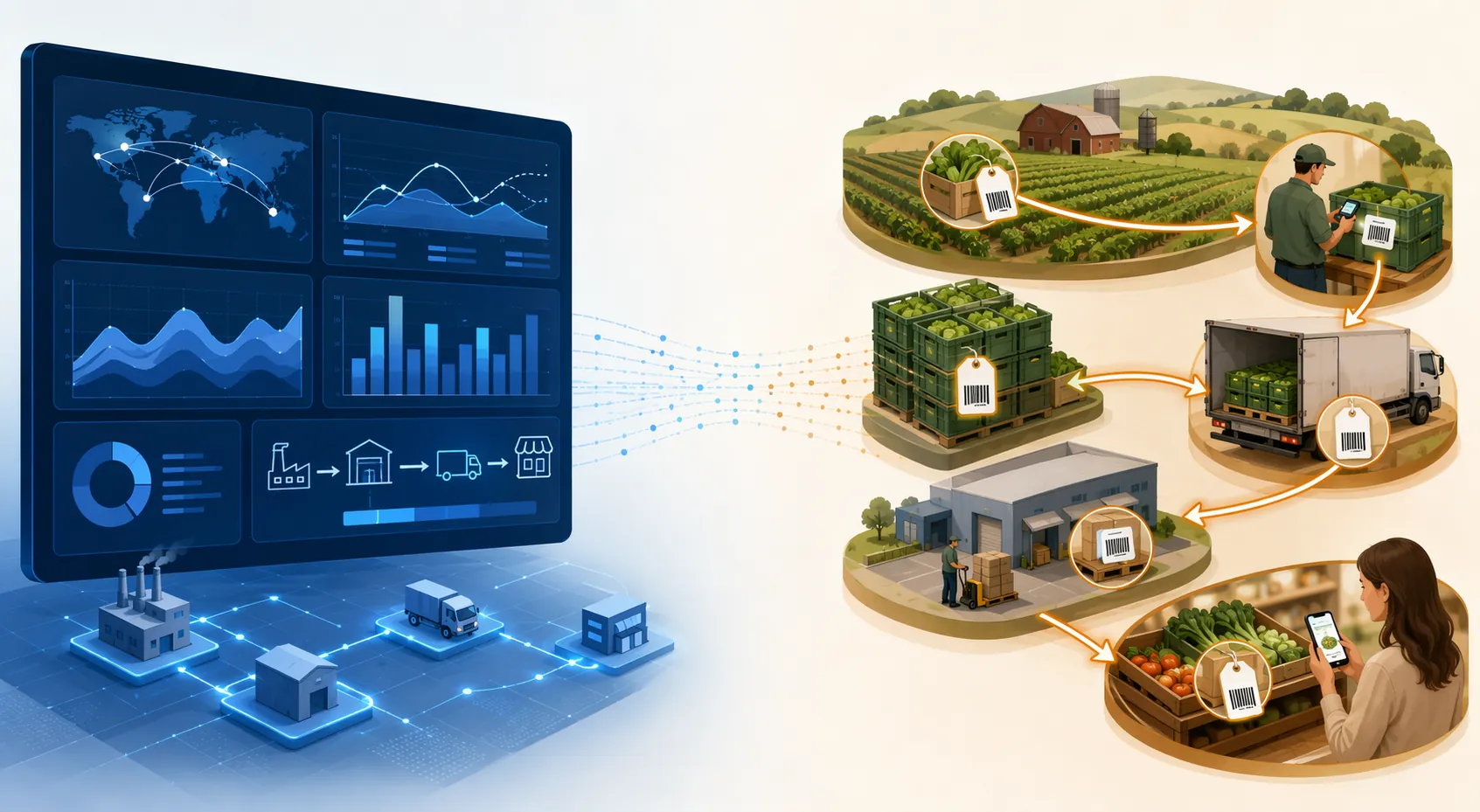
Planning visibility answers broad operating questions: expected demand, supply availability, inventory position, substitution options, allocation tradeoffs, and supplier constraints. Traceability proof answers a narrower and less forgiving question: which specific lot, from which source, moved through which transformation, shipment, receiving, and serving events?
Those questions can sit near each other in the same enterprise architecture. They are not the same control. A demand-planning suite can show that a region received iceberg lettuce from a supplier network. It does not necessarily prove the Critical Tracking Events, Key Data Elements, and traceability lot codes that FSMA 204 expects for foods on the Food Traceability List.
The Cyclospora investigation made that distinction operational. Investigators were not merely trying to see whether lettuce was somewhere in the network. They had to separate fields, lots, shipments, restaurant locations, time windows, and supplier records tightly enough to avoid sweeping safe product into the response. When the records could not narrow the exposure cleanly, the recall widened.
The July 19 testing incident sharpened the problem. FDA later determined that a lettuce sample previously reported as Cyclospora-positive “did not represent true amplification,” meaning it was treated as a false positive; Trustwell reported on July 20 that there were no confirmed positive product-testing results for Cyclospora as of that update.[4] With no confirmed positive product test to anchor the response, record quality mattered even more.
Taylor Farms then recalled all central Mexico-sourced iceberg lettuce rather than a narrower set of lots or fields, and media reports described the recall as spanning 27 states.[4][5] That is what imprecise traceability looks like in practice: a larger recall perimeter because the system cannot defend a smaller one.
Testing could not rescue weak lot records
Cyclospora is a poor pathogen for organizations that hope testing will compensate for weak records. Craig Hedberg, PhD, told CIDRAP that Cyclospora cannot be cultured in a lab, so the standard PulseNet subtyping approach used for pathogens such as Salmonella, E. coli, and Listeria does not apply.[2] Detection relies on PCR, and the parasite can be unevenly distributed across fields and lots, which makes sampling a fragile basis for narrowing responsibility.[6]
That does not make testing useless. It makes testing a supporting signal, not a substitute for event-level traceability. When the organism is hard to culture and may not be evenly present in sampled product, a negative or inconclusive test cannot establish where product went, which customers received it, or how tightly a recall can be scoped.
What FSMA 204 asks procurement to verify
FSMA 204 is not asking companies to have a general sense of supplier flow. It requires additional traceability records for foods on the Food Traceability List, organized around Critical Tracking Events and Key Data Elements, including traceability lot codes. FDA’s compliance date has been extended from January 20, 2026, to July 20, 2028, a 30-month delay directed by Congress.[7]
That delay changes the buying calendar, not the control requirement. Procurement teams evaluating enterprise planning systems in Q3 2026 are making architecture decisions inside the FSMA 204 runway. If a planning platform is selected now without a credible companion traceability network, the organization is likely creating a second project for 2028 rather than solving the compliance problem in the first project.
| Procurement question | Planning-platform answer | FSMA 204 traceability answer |
|---|---|---|
| What supply will be available? | Forecast demand, inventory, constraints, and allocation | Identify the lot source and event history behind covered food |
| Where is product in the network? | Model locations, lanes, stock positions, and replenishment | Record CTEs, KDEs, traceability lot codes, and trading-partner handoffs |
| How should the business respond to disruption? | Replan supply, substitutions, production, and service levels | Prove affected lots quickly enough to narrow recall scope |
| Who must participate? | Internal planning, procurement, merchandising, operations | Growers, shippers, processors, distributors, receivers, restaurants, retailers |
The major planning platforms are adjacent, not equivalent
A fair procurement evaluation should not turn this into a blanket dismissal of planning vendors. o9, Blue Yonder, Kinaxis, RELEX, and Anaplan each solve important supply-chain and commercial planning problems. The issue is narrower: based on current public positioning, procurement teams should not assume these platforms, by themselves, satisfy fresh-produce FSMA 204 lot-level traceability across trading partners.
Blue Yonder has the closest language, but still needs verification
Blue Yonder deserves the most careful reading because its Chain of Custody materials discuss lot tracking and serialization. Its public materials, however, emphasize pharmaceutical and other regulated supply-chain use cases rather than fresh-produce FSMA 204 CTE/KDE compliance.[8] That distinction matters. Lot tracking in one regulated context does not automatically mean a grocery or restaurant buyer has supplier-network onboarding, covered-food event capture, traceability lot-code management, and recall-scope workflows for fresh produce.
For a buyer, the correct question is not whether Blue Yonder can say “traceability.” It is whether the configured operating model captures the required produce events from growers, shippers, processors, distributors, and receiving locations in a format that can be produced quickly during an investigation. That answer requires demos, implementation evidence, and probably partner validation; it cannot be inferred safely from chain-of-custody language alone.
o9, Kinaxis, RELEX, and Anaplan optimize different decisions
o9’s public traceability positioning is tied more closely to value-chain modeling and Scope 3 sustainability visibility than to FSMA 204 fresh-produce lot tracing.[9] That is useful work, but sustainability traceability and outbreak traceback do not carry the same data burden. One can model supplier emissions or value-chain exposure without proving the movement of a specific lettuce lot through a restaurant distribution chain.
Kinaxis presents food-and-beverage planning capabilities around demand, supply, perishability, constraints, and rapid scenario response.[10] Those capabilities help companies make better planning decisions under volatility. They do not, in the public positioning available here, amount to a fresh-produce CTE/KDE capture network.
RELEX is strongest in retail forecasting, replenishment, inventory, and shelf-availability problems.[11] Anaplan is positioned around connected planning across finance, supply chain, sales, and operations.[12] Both can matter to a retailer or restaurant operator trying to align inventory and demand. Neither should be treated, on current public materials alone, as the system of record for FSMA 204 produce traceability.
The missing layer is a trading-partner traceability network
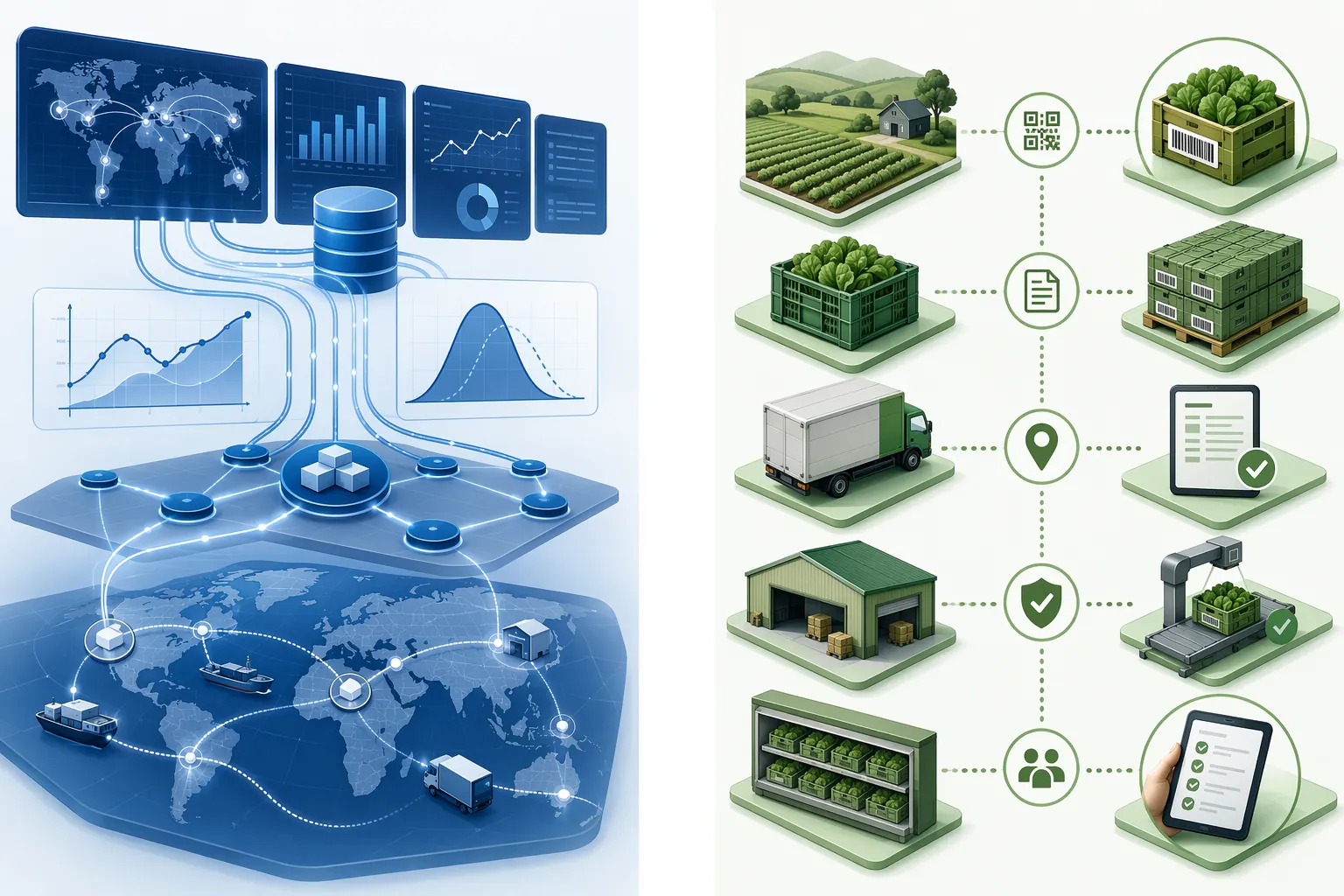
Fresh-produce traceability is not only a database problem inside the buyer’s four walls. It depends on whether upstream and downstream trading partners can create, share, preserve, and retrieve event records with the required lot specificity. That is why specialized traceability vendors have become the practical gap-fillers rather than decorative add-ons.
ReposiTrak reports more than 8.2 million supplier records, and Food Safety Magazine reported in 2026 that one large grocery retailer using ReposiTrak was the first to achieve full FSMA 204 compliance.[13] That does not make ReposiTrak the automatic choice for every buyer. It does show the kind of network scale and supplier-record depth procurement teams should ask about when a platform claims to cover traceability.
Trustwell FoodLogiQ, iFoodDS Trace Exchange with RedLine integration, SafetyChain, and integrated supplier-management suites such as TraceGains belong in the same evaluation conversation as examples of tools built closer to the compliance workflow. The sourced materials here do not support ranking them. They do support a simpler procurement conclusion: if the operating requirement is FSMA 204-level fresh-produce traceability, the buyer needs a dedicated traceability capability somewhere in the stack.
How to evaluate the combined stack before 2028
The practical answer is co-investment, not rip-and-replace. A planning platform can remain the right place for demand, replenishment, allocation, scenario planning, and supplier-capacity decisions. A traceability network or supplier-management traceability suite should carry the compliance record: CTEs, KDEs, traceability lot codes, trading-partner event history, and recall-scope evidence.
- Ask the planning vendor to show exactly where CTEs, KDEs, and traceability lot codes are created, stored, exchanged, and retrieved for covered fresh produce.
- Require evidence of supplier onboarding beyond internal master data, including growers, shippers, processors, distributors, receivers, and restaurant or retail endpoints.
- Define data ownership before implementation: who controls event records, who can export them, and how quickly records can be produced during an FDA or state investigation.
- Test recall-scope reduction, not only dashboard visibility. The scenario should prove whether the system can narrow affected lots instead of defaulting to broad regional recalls.
- Evaluate integration as an operating requirement, so planning decisions and traceability evidence connect without pretending one system performs both jobs natively.
Industry pressure is unlikely to disappear during the delay period. The International Fresh Produce Association has gone on record opposing continued delays to FSMA 204 compliance, signaling that parts of the produce industry want adoption to keep moving rather than slide indefinitely.[14] Buyers that wait until 2028 to discover the boundary between planning and traceability will be negotiating architecture, supplier participation, and compliance evidence at the same time.
The lesson from the Cyclospora outbreak is specific. Planning platforms are valuable for seeing and adjusting the business. FSMA 204 fresh-produce compliance requires proving lot movement across a trading-partner network. Procurement should buy the two capabilities as one operating stack, with integration and recall-scope reduction specified before the contract is signed.
References
- CDC Health Alert Network Health Advisory: Cyclosporiasis Outbreak Linked to Taco Bell Restaurants, Centers for Disease Control and Prevention, 2026
- CIDRAP: Cyclospora cases continue to rise in Midwest outbreak, Center for Infectious Disease Research and Policy, July 14, 2026
- Consumer Reports: Cyclospora Outbreak Linked to Taco Bell Sickens Thousands, Consumer Reports, July 16, 2026
- Trustwell: Cyclospora Outbreak Update: FDA Says Lettuce Test Was False Positive, Trustwell, July 20, 2026
- The Wall Street Journal: Taylor Farms Recalls Lettuce as Cyclospora Investigation Continues, The Wall Street Journal, 2026
- Smart Food Safe: Cyclospora Detection and Food Safety Testing Challenges, Smart Food Safe
- FDA: FSMA Final Rule on Requirements for Additional Traceability Records for Certain Foods, U.S. Food and Drug Administration
- Blue Yonder: Chain of Custody, Blue Yonder, 2025
- o9 Solutions: Traceability and Scope 3 Value Chain Planning Materials, o9 Solutions
- Kinaxis: Food and Beverage Supply Chain Planning, Kinaxis
- RELEX Solutions: Retail Forecasting and Replenishment, RELEX Solutions
- Anaplan: Connected Planning for Supply Chain, Anaplan
- Food Safety Magazine: Large Grocery Retailer First to Achieve Full FSMA 204 Compliance with ReposiTrak, Food Safety Magazine, 2026
- The Shelby Report: IFPA Opposes Continued FSMA 204 Delays, The Shelby Report, July 20, 2026
§ 42 — Cited evidence
Flag an inaccuracy or submit a comparable account — Contribute or read how claims are verified in Methodology.