§ 41 — Use-case analysis
Build custom Gemini Gems for supply chain planning
Supply-chain planning teams can build custom Gemini Gems as analysis assistants for tasks like forecast-exception review and safety-stock threshold checks, but they need to understand the capability boundaries—static knowledge, no live system access—before investing time.
- Function
- demand planning
- AI technique
- generative AI
- Failure pattern
- capability boundary misunderstanding
- Evidence source
- Google Workspace Blog, November 2024
The cleanest first use of custom Gemini Gems in supply chain planning is not a miniature planning engine. It is a Demand Exception Reviewer: a bounded assistant that reads a planner's daily forecast-vs-actual export, compares the exceptions against the team's written planning rules, and returns a review note that a human planner can defend in Monday's meeting.
That distinction matters. A useful Gem can reduce repetitive interpretation work: checking whether a demand spike falls inside an approved sensing window, whether a proposed override violates a documented threshold, whether a customer-level exception should be escalated, and whether the review note uses the same language the planning team already expects. It cannot reach into the ERP system, pull the latest order book, change a forecast, rebalance supply, or execute an allocation decision.
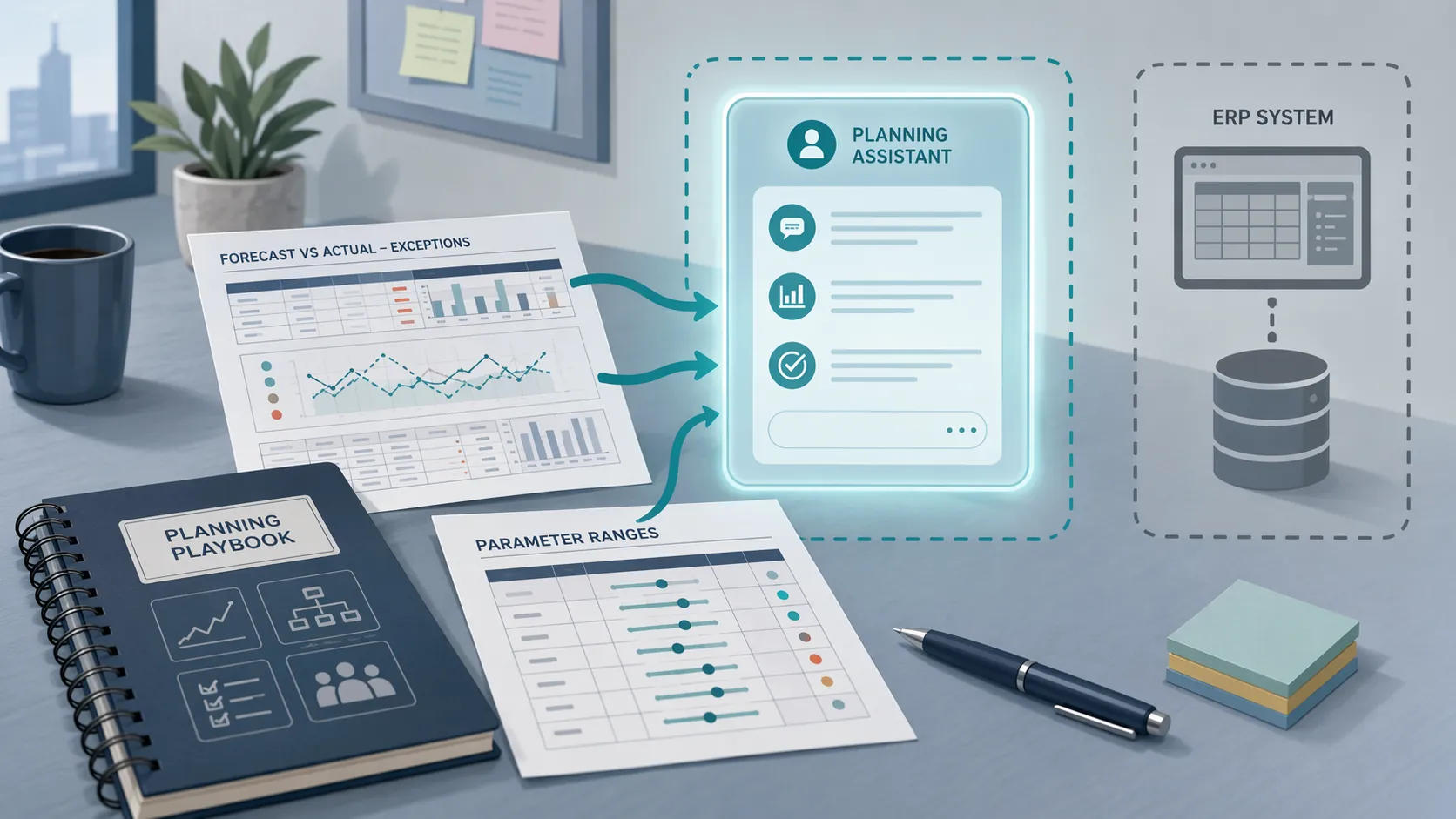
So the practical question behind custom Gemini Gems for supply chain planning is narrow: can a planning team, without engineering support, build an assistant that is better than a generic Gemini prompt for structured review work? Yes, if the team treats the Gem as a controlled analysis layer and puts real effort into its instructions, source files, and output format. No, if the team expects the Gem itself to become a live planning application.
Start With The Exception Queue, Not The AI Feature
A Demand Exception Reviewer Gem has a simple operating pattern. The planner uploads the current planning extract - for example, a forecast-vs-actual file, a daily exception output, or a demand-signal triage table. The Gem already has access to static planning knowledge: exception protocols, demand-sensing parameters, override rules, escalation criteria, and the preferred review template. The planner asks for an exception review, not a forecast change.
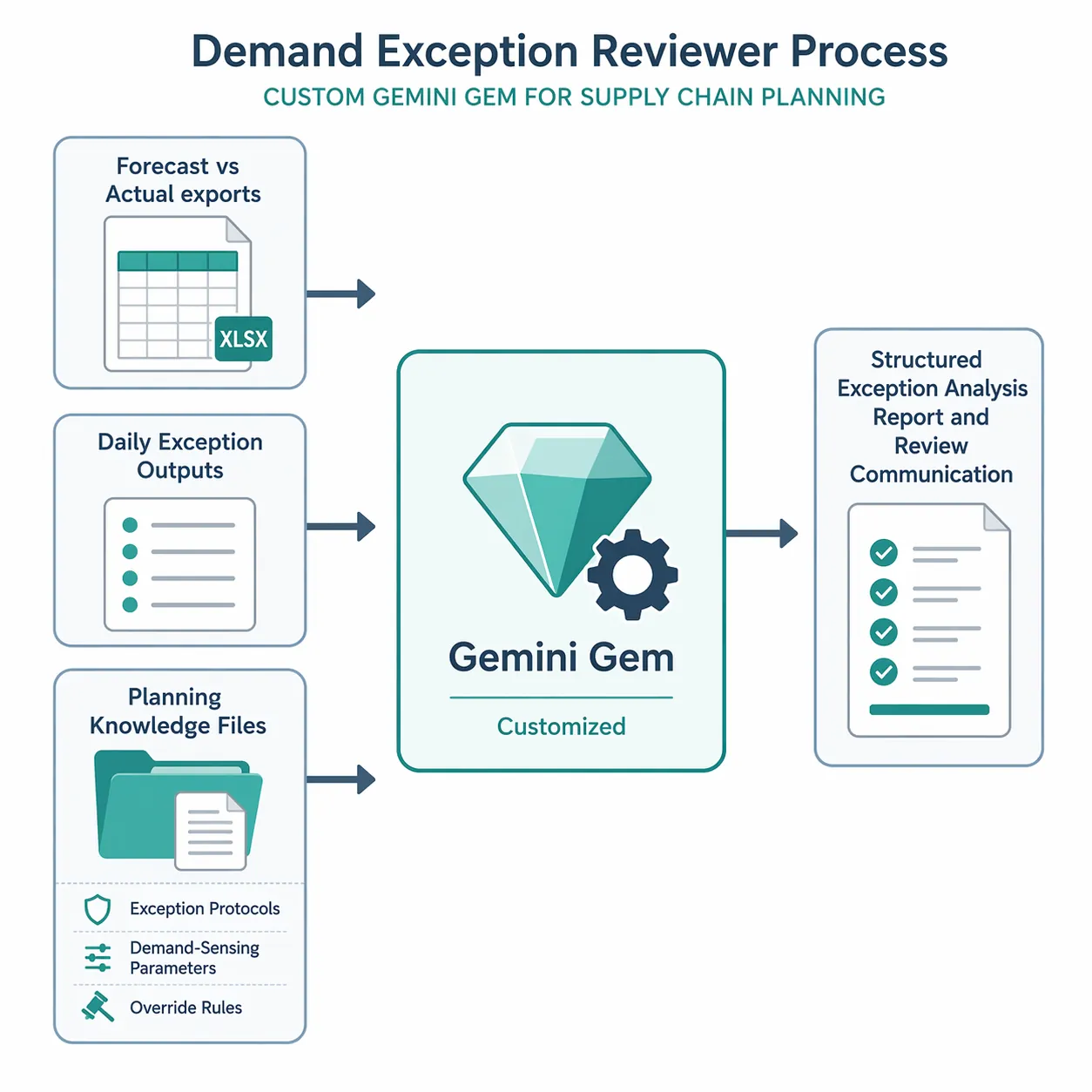
The output should look like something the team can use immediately: a ranked exception list, a reason-code suggestion, references to the relevant rule or threshold, a proposed planner action, and a meeting-ready explanation. If the Gem cannot show which assumption it used, the planner still has the same old problem - only now it is dressed up as AI.
| Planning Input | Gem Knowledge | Human-Reviewed Output |
|---|---|---|
| Forecast-vs-actual export | Forecast override rules and acceptable variance thresholds | Exceptions ranked by review priority with suggested reason codes |
| Daily exception report | Escalation protocol and planner ownership rules | Items to discuss in the planning review meeting |
| Demand-signal triage file | Demand-sensing parameters and customer or channel notes | Signals marked as explainable, uncertain, or escalation-worthy |
| Safety-stock threshold check | Inventory policy ranges and service-level guidance | Items that appear outside documented policy boundaries |
This is the right test case because it stays inside the Gem boundary. The Gem analyzes documents and produces communication. It does not need live inventory, transactional order status, ATP logic, optimizer calls, or write-back authority. A planner can compare its output against the same exception queue they already review manually.
What Makes A Planning Gem Different From A Generic Prompt
Gemini Gems became more relevant for internal business use when Google added the ability to upload up to 10 knowledge files per Gem, along with Drive integration for business context, in November 2024. The same update positioned Gems as custom experts inside Gemini and noted availability in Gemini Advanced subscriptions, with Gemini Business listed at $19.99 per user per month and inclusion in Google Workspace plans for eligible users.[1]
That makes the pilot economics unusually friendly for a team that already has the right Google access. The expensive part is not model access. The expensive part is making the planning logic explicit enough that the Gem stops behaving like a polished generalist.
Google's own Gem creation guidance uses a four-part instruction structure: Persona, Task, Context, and Format.[2] In planning language, those are not prompt-engineering decorations. They are the difference between a review assistant that respects the operating model and a chatbot that gives plausible commentary.
Persona: Name The Planning Seat Precisely
Do not tell the Gem to act as a supply chain expert. Tell it which chair it occupies. A demand-planning exception reviewer behaves differently from an inventory policy analyst or a procurement risk screener. The Gem should know whether it is reviewing statistical forecast exceptions, safety-stock violations, constraint-driven allocation notes, or supplier performance signals.
A usable role instruction might say that the Gem reviews demand-planning exceptions for a regional planning team, applies documented override and escalation rules, flags missing assumptions, and avoids recommending system changes unless a human planner confirms them. That last clause is not cosmetic. It prevents the assistant from drifting into execution language.
Task: Define The Review, Not The Whole Planning Job
The task should be narrow enough to audit. For a Demand Exception Reviewer, the task is to read an uploaded exception file, identify rows that meet documented review criteria, explain which rule applies, classify the likely exception type, and draft a planner-facing note. It is not to create the unconstrained demand plan, optimize inventory, or approve overrides.
This is where many pilots get loose. If the task asks for 'insights,' the Gem will provide insights. Some will be useful. Some will be generic. A planning team needs a repeatable review operation: compare input to rule, classify, explain, and prepare for review.
Context: Upload The Rules That Usually Live In People's Heads
The 10-file limit forces discipline.[1] A planning team should not upload every deck in the shared drive. It should choose the documents that a senior planner would actually consult when deciding whether an exception deserves action.
- Exception-handling protocol: which variances matter, how severity is classified, and when escalation is required.
- Demand-sensing parameters: which signal windows, customer events, promotion inputs, or channel changes are valid review context.
- Forecast override policy: who can override, what evidence is required, and which reason codes are allowed.
- Planning calendar: cutoff dates, lock windows, review cadence, and exceptions that cannot be changed after freeze.
- Output template: the exact structure expected in the weekly demand review or S&OP pre-read.
Drive integration helps when those documents are maintained centrally, but it does not remove the need for ownership. Someone still has to decide which rule is current, which override policy is retired, and which local workaround should not become standard operating procedure.
Format: Make The Output Match The Review Meeting
Format is where a Gem earns time back. The requested output should be specific: a table with item, location, exception type, rule applied, evidence, confidence note, proposed planner action, and review owner. For meeting notes, require language that separates observed facts from suggested interpretation. For escalations, require a short explanation that a demand planner can paste into the workflow tool or send to a supply planner.
Google has said its magic-wand instruction assistant can help users refine Gem instructions, but the domain knowledge still has to come from the user.[3] That is the right warning label. A Gem can help polish instructions; it cannot infer a company's cutoff calendar or the undocumented rule a senior planner uses before challenging a sales override.
The Setup Burden Is The Control Mechanism
A good planning Gem is deliberately boring in the same way a good exception report is boring. The setup work should reduce ambiguity before the first planner uses it.
- Choose one repetitive planning decision support task, such as demand exception review or safety-stock threshold checking.
- Collect the few documents that govern that task and remove obsolete, conflicting, or purely aspirational rules.
- Write the role description as a planning role with clear limits, not as a generic supply chain expert.
- Define the task in auditable verbs: compare, classify, flag, explain, draft.
- Require an output format that mirrors the existing review template and names the rule or source assumption used.
- Test the Gem against a recent exception file where the team already knows the accepted planner decisions.
That last test is the closest a team can get to a practical benchmark without formal evaluation data. Give the same file to a generic Gemini prompt and to the custom Gem. Compare missed exceptions, unsupported recommendations, format cleanup time, and the number of follow-up questions a planner has to ask. The point is not whether the Gem sounds more expert. The point is whether it handles the same queue with fewer missed assumptions and less rework.
Kartaca's July 2025 example of a production-quality Gem instruction set for a Google Cloud pre-sales role is useful here, even though it is not a supply chain deployment. The example shows the level of specificity needed: role definition, workflow boundaries, qualifying questions, response structure, and tone guidance.[4] A planning Gem needs the same seriousness, translated into exception criteria, planning policies, and review outputs.
Where The Boundary Sits
The most dangerous misunderstanding is to treat a Gem as if it has live planning-system awareness. It does not. A Gem works with the conversation, uploaded files, and connected documents available to it. That is enough for document-driven review and structured communication. It is not enough for live order-book visibility, current inventory position, constraint solver calls, or approved write-back to ERP, APS, WMS, or procurement systems.
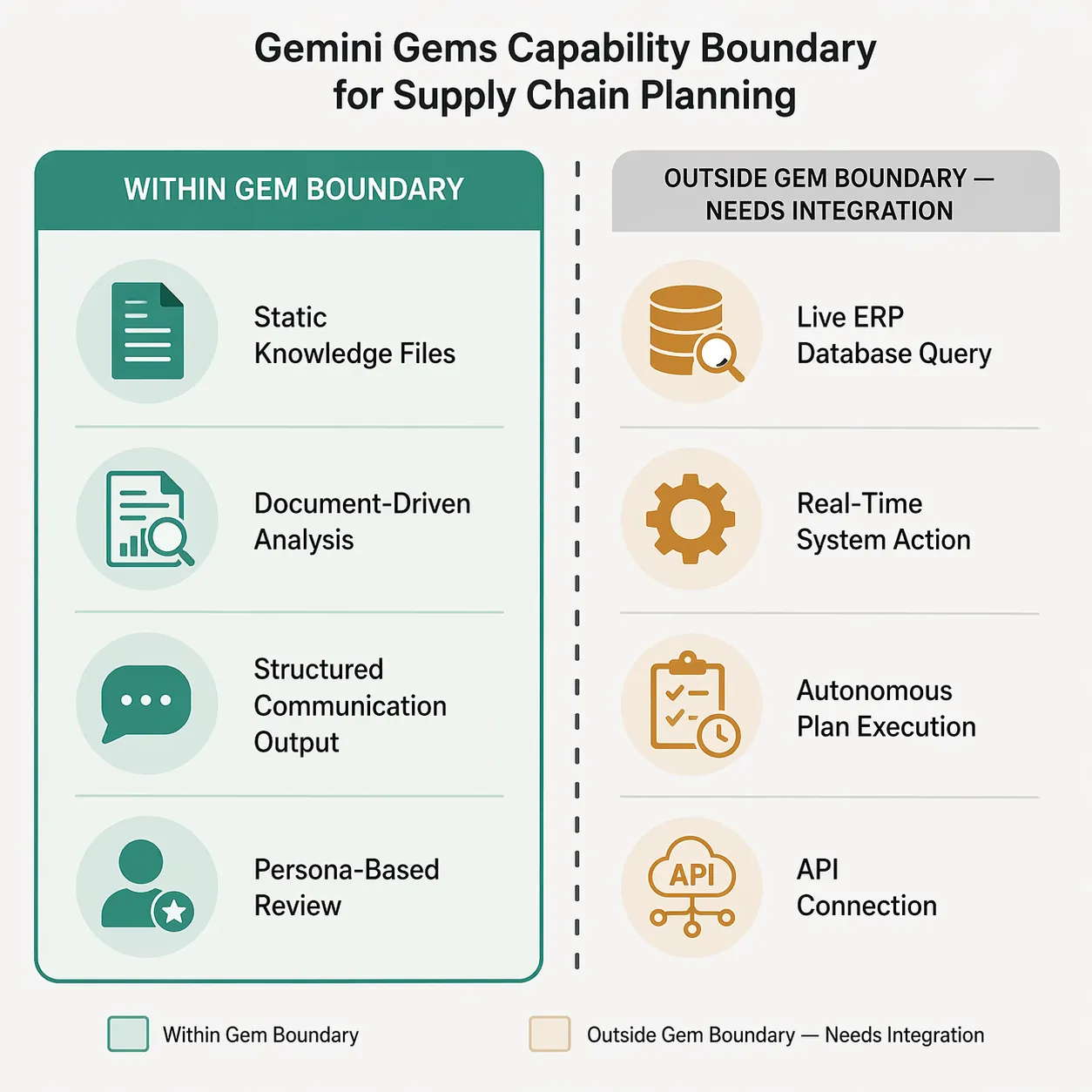
That boundary is not a small technical footnote. It determines which planning tasks belong in a Gem pilot and which ones belong in an integration program.
| Inside A Custom Gemini Gem | Outside A Custom Gemini Gem |
|---|---|
| Reviewing an uploaded exception file against static planning rules | Querying live ERP, APS, or data-warehouse tables on demand |
| Drafting a weekly exception summary in the team's format | Writing forecast overrides back into the planning system |
| Checking whether a proposed action appears to violate a documented policy | Running autonomous optimization or constraint-based allocation |
| Using uploaded playbooks and Drive-connected documents as context | Calling external APIs as part of a live planning workflow |
| Supporting a human planner's review decision | Replacing planner approval, governance, or audit control |
If the business case depends on live-system action, the right architecture is not a Gem. Google's developer ecosystem points toward agent and data-platform patterns for that kind of work. For example, a 2026 Google Codelab demonstrates Gemini 3 Flash with AlloyDB for deterministic inventory vision and supplier matching, which is a different technical path from a no-code Gem.[5] It shows that Gemini-based supply chain workflows can be engineered around databases and application logic; it does not make Gems live-integrated planning agents.
The same caution applies to vendor agent examples. o9 Solutions described agentic AI patterns in June 2025, including agents that surface planning insights from unstructured data, evaluate what-if scenarios, and run multi-layer causal analysis.[6] That is evidence of an adjacent enterprise-planning direction, but it is vendor-sourced evidence and not validation that Gemini Gems themselves have been deployed for supply chain planning.
What Evidence Is Still Missing
As of July 2026, there is no public named enterprise deployment showing Gemini Gems used specifically for supply chain planning. That does not make the pattern imaginary; the product capabilities and workflow fit are clear enough to justify a pilot. But it does mean this should not be sold internally as a proven planning case study.
There is also no published benchmark comparing planning-specific Gem performance against generic Gemini prompts or vendor-native planning copilots. That is the evidence gap a serious pilot has to close for its own environment. A director should ask whether the Gem improves consistency, cycle time, and auditability on the team's own exception history, not whether AI assistants are generally useful.
Enterprise risk teams will also care about compliance posture. Google's November 2024 Workspace announcement said the update added HIPAA, ISO 27017, ISO 27018, ISO 27701, and ISO 9001 certifications for Gemini in Workspace.[1] That is relevant for data-security review, especially in regulated or customer-sensitive environments, but it is not a substitute for deciding which planning files may be uploaded, how access is controlled, and whether supplier or customer data needs redaction.
When A Pilot Deserves IT Attention
The phrase 'no engineering support' often hides work that lands on IT later: access design, data handling, audit questions, and cleanup after a shadow process becomes popular. A planning team can build the first Gem itself, but the pilot should still have a lightweight governance frame.
- Use non-production or already-approved planning exports for the first tests.
- Name a document owner for every uploaded playbook, rule file, and template.
- Require the Gem to cite or name the rule it applies in every recommendation.
- Keep human approval outside the Gem and inside the existing planning workflow.
- Compare performance against a generic prompt and against the current manual process.
- Stop the pilot if users begin treating the Gem's output as system-of-record truth.
A pilot deserves more formal IT involvement when the requested next step is data freshness, system action, or integration. If users ask the Gem to pull live inventory, call a forecast API, update a purchase plan, or orchestrate multi-system workflow, the team has crossed out of Gem territory.
For that class of work, teams should evaluate agent-platform architecture instead. UI Bakery's 2026 analysis describes Vertex AI Agent Builder pricing in usage-based terms, including $0.0864 per vCPU-hour plus token costs; Google also moved this category toward the Gemini Enterprise Agent Platform naming in April 2026.[7] The important point is not the exact bill estimate for a hypothetical planning agent. It is that live integration introduces engineering, security, and operating costs that a Gem pilot deliberately avoids.
A Practical Go/No-Go Test
Build a custom Gemini Gem if the planning task is structured, repetitive, document-driven, and human-reviewed. Demand exception review fits. Safety-stock threshold checks can fit. Demand-signal triage can fit when the relevant parameters are documented and the input file is supplied by the planner.
Do not invest in a Gem as a substitute for live planning-system integration, autonomous optimization, or system-of-record execution. The capability is useful precisely because it is small: it can make repetitive analysis and communication more consistent without waiting for a six-month IT queue. The same smallness becomes a liability the moment the team pretends it has live ERP access or approval authority.
The best pilot is a side-by-side test on real historical exceptions. If the custom Gem catches more of the team's own documented rules than a generic prompt, reduces cleanup time, and produces review notes planners are willing to stand behind, keep refining it. If its value depends on pretending static files are live planning data, stop there and move the conversation to an integration platform.
References
- New Gemini Gems provide deeper knowledge and business context, Google Workspace Blog, November 2024.
- Create and manage Gems in Gemini Apps, Google Help.
- 5 tips for getting more out of Gems in Gemini, Google Blog, September 2024.
- Smarter Workdays Start Here: How to Use Gemini Gems Like a Pro, Kartaca, July 2025.
- Visual Commerce with Gemini 3 and AlloyDB, Google Codelab, 2026.
- o9 Co-Founder and CEO charts the next AI-driven frontier in enterprise planning and execution, o9 Solutions, June 2025.
- Vertex AI Agent Builder: Pricing, Features, and Alternatives, UI Bakery, 2026.
§ 42 — Cited evidence
Flag an inaccuracy or submit a comparable account — Contribute or read how claims are verified in Methodology.