
§ 41 — Use-case analysis
What Claude Opus 5 Can Do for Supply Chain Planning
This article maps Claude Opus 5's published capabilities to three supply chain planning pain points, showing where it outperforms prior LLMs and where statistical models remain superior.
- Function
- supply-chain-planning
- AI technique
- generative-ai
- Failure pattern
- llm-numerical-forecasting-limitation
- Evidence source
- Anthropic Introducing Claude Opus 5
Claude Opus 5 was released on July 24, 2026, so any answer about supply-chain planning use cases for Claude Opus 5 has to start with a caveat: there are no published enterprise supply-chain case studies using Opus 5 yet. The useful question, one day after release, is narrower. Which published capabilities map cleanly to real planning work, and which claims still stop at the edge of forecasting models, optimization solvers, ERP workflows, and human approval?
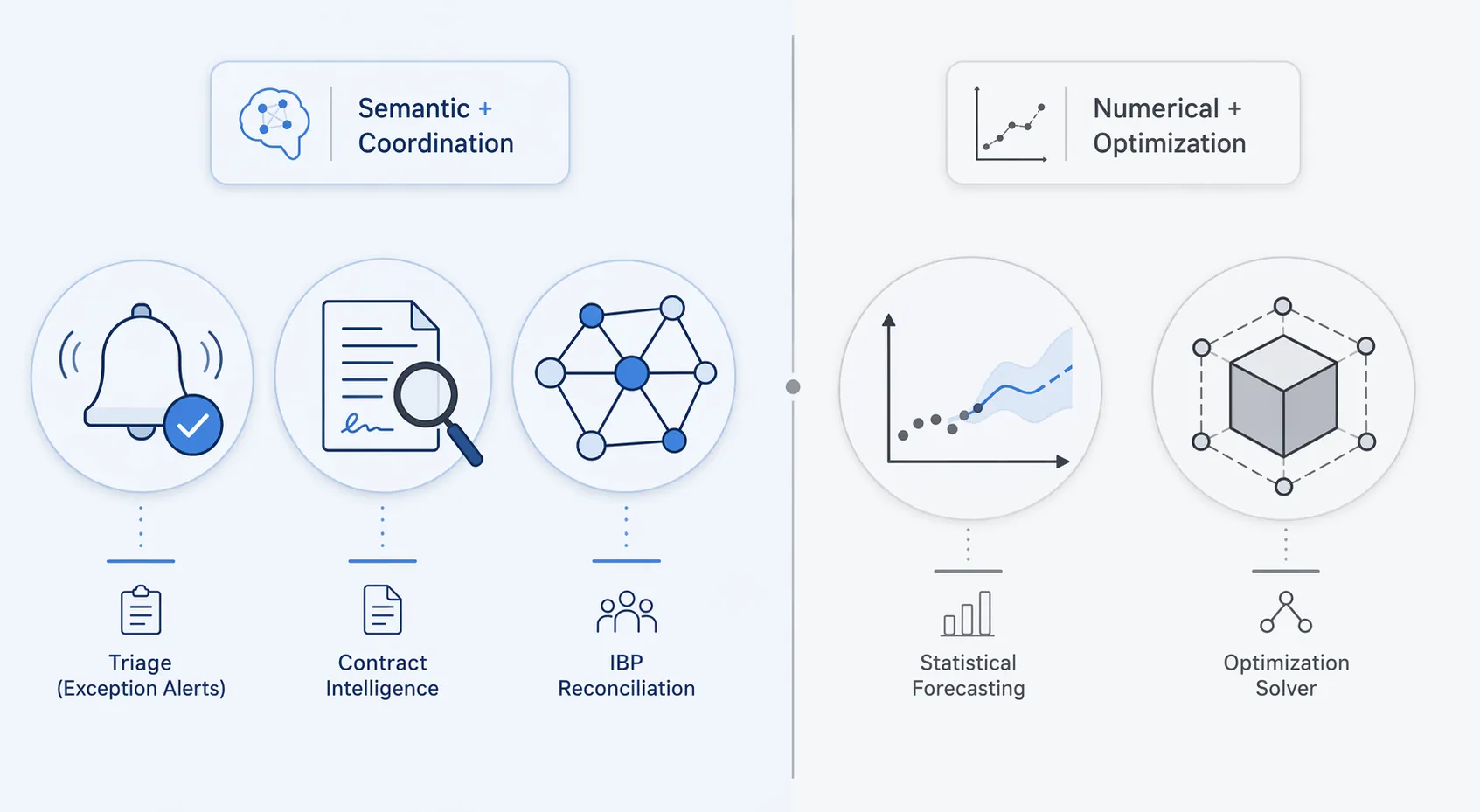
The early answer is that Opus 5 looks most useful around exception triage, IBP reconciliation, and contract or sourcing document intelligence. It should not be treated as a replacement for statistical forecasting, multi-echelon inventory optimization, or constrained planning engines. Anthropic lists Opus 5 at $5 per million input tokens and $25 per million output tokens, with a 1M-token context window and adjustable effort levels of low, medium, and high; AWS says Opus 5 is available on Amazon Bedrock with a zero-data-retention option, which matters for supplier contracts, pricing terms, and customer-sensitive planning data.[1][2]

| Planning work | Where Opus 5 fits | Where it should not be the system of record |
|---|---|---|
| Exception management | Reads alerts, shipment notes, emails, policy rules, and prior resolutions; drafts severity, cause, next action, and escalation rationale | Final service, inventory, and allocation decisions still need planning rules, available-to-promise logic, and human approval |
| Continuous IBP reconciliation | Compares assumptions across sales, finance, supply, procurement, and operations documents; flags conflicts before the meeting deck hardens | Scenario feasibility, constrained supply response, and financial optimization remain with planning engines and solvers |
| Contract and sourcing document intelligence | Reads long agreements, amendments, tariff notes, emails, and clause histories; extracts obligations, discounts, risk flags, and exceptions | Commercial decisions still need procurement governance, legal review, and master-data validation |
| Demand forecasting | Explains drivers, documents overrides, and audits forecast-change narratives | Baseline forecast generation should remain with statistical and machine-learning forecasting models |
| Constrained optimization | Translates business questions into model inputs, explains solver outputs, and prepares exception narratives | Capacity, lead-time, inventory, service-level, and cost trade-offs should remain with specialized optimization systems |
The Right Boundary: Semantic Coordination, Not Numerical Decisioning
A useful way to place Opus 5 is the Cranfield-led LLM-in-supply-chain framework, which separates LLM applications into forecasting and simulation, semantic automation, and cognitive coordination. That review covers research through April 2025, so it does not evaluate Opus 5 itself. Its value here is categorical: it keeps the model from being praised for the wrong job.[3]
Most of the interesting Opus 5 claims sit in semantic automation and cognitive coordination. A planner does not need a language model to recalculate a seasonal baseline better than a trained forecasting model. The planner needs help sorting 2,000 alerts into 200 real exceptions, matching each one to the right policy or contract clause, explaining why the model overrode last month’s assumption, and preserving enough audit trail that the next reviewer can disagree intelligently.
That is why the trust issue matters. RELEX, a supply-chain planning vendor with a commercial interest in AI adoption, reports that 67% of supply-chain leaders say their confidence in AI has increased and 71% plan investment in generative AI, while only 10% trust AI to make critical decisions without human review.[4] The gap is not philosophical. It shows up as an approval queue, a governance objection, or an S&OP meeting where nobody wants to own a black-box recommendation.
Exception Triage Is the Strongest Near-Term Use Case
Exception management is where Opus 5 has the cleanest bridge from prior evidence to supply-chain planning work. Anthropic cites a DoorDash deployment using earlier Claude models that reduced handle time by 44% and reached about 97% accuracy in exception triage.[1] That is not an Opus 5 supply-chain planning case. It is still operationally relevant because the measured outcome is not a benchmark score or a demo transcript. It is handle time and classification accuracy inside an exception workflow.
The planning analogue is familiar. A late inbound shipment triggers a stockout risk. The system also has an expediting note from procurement, a supplier email, a substitute-material rule, a customer allocation policy, and a recent forecast override from sales. Earlier LLM pilots often did well when the facts were placed neatly in front of them and poorly when the work required checking whether the facts conflicted. Opus 5’s published emphasis on self-verification is relevant because exception triage is a verification task before it is a generation task.[1]
- Read the alert, related order history, notes, policies, supplier messages, and prior planner actions.
- Classify whether the issue is informational, policy-driven, capacity-driven, supplier-driven, demand-driven, or genuinely unresolved.
- Check its own classification against available evidence before escalating.
- Return an auditable summary: what changed, which evidence matters, what action is recommended, and what a human must approve.
The key design choice is to make Opus 5 reduce planner investigation time, not silently resolve the exception. A good pilot would track queue deflection, time to first useful classification, rework rate, escalation accuracy, and planner override reasons. A weak pilot would ask whether the model produced fluent narratives that managers liked in a workshop.
This is also where Opus 5’s benchmarks become useful only after translation. Anthropic reports stronger performance on Frontier-Bench, Zapier AutomationBench, OSWorld 2.0, and ARC-AGI 3, including roughly 1.5 times the next-best pass rate on Zapier AutomationBench.[1] For a planning team, the relevant reading is not that a model won a leaderboard. It is that multi-step tool use, self-correction, and pattern handling are closer to the daily mechanics of exception triage than plain summarization ever was.
Contract and Sourcing Documents Are a Better Fit Than Forecast Math
Procurement and sourcing teams have a long-context problem before they have a model-selection problem. Supplier agreements, side letters, volume commitments, tariff clauses, amendment chains, email exceptions, and regional policy notes rarely sit in one clean table. Opus 5’s 1M-token context window is therefore more than a convenience feature if the task is to assemble a defensible view of what the company is already obligated to do.[1]
The closest supply-chain evidence comes from outside Opus 5. David Simchi-Levi describes an automotive OEM using LLM-based contract analysis to identify missed volume discounts, with millions in savings.[5] The point is not that Opus 5 has reproduced that outcome. The point is that contract analysis is already a proven LLM-shaped workload: long documents, scattered clauses, ambiguous obligations, and commercial consequences when the review misses something.
Anthropic’s early-access examples add adjacent support. A trading firm reported 9 percentage points higher financial-modeling accuracy with 60% less time, another early-access result cited an 11% data-analysis improvement, and Box reported a 17% due-diligence improvement.[1] These are not procurement-planning deployments, and they come through a vendor announcement. They do, however, point toward the same work pattern: read messy business material, extract financially relevant facts, reason over them, and produce a reviewable output.
For sourcing, the better use case is not “negotiate with suppliers.” It is a narrower document-intelligence workflow: identify clauses linked to volume rebates, minimum-order quantities, service penalties, force majeure, tariff pass-throughs, country-of-origin requirements, price-indexing formulas, and exclusivity obligations; then connect those clauses to the supplier, item, region, and planning horizon affected. A planner can use that output when deciding whether an exception is truly a supply problem, a contract problem, or a master-data problem.
Data retention belongs in the design discussion at the beginning, not after legal discovers the pilot. The operating boundary here is straightforward: Anthropic’s API has default 30-day retention, while AWS highlights a zero-data-retention option for Opus 5 on Bedrock.[2] For supplier contracts and commercial terms, that difference can decide where the model is allowed to run.
Continuous IBP Reconciliation Is Plausible, With Solvers Still in the Loop
IBP work is full of semantic drift. Sales says the promotion is “unchanged,” finance assumes a margin recovery, procurement expects a tariff pass-through, operations caps a constrained line, and the demand plan quietly keeps last month’s uplift. By the time the meeting starts, the conflict has already been converted into slides.
Opus 5’s long context and tool-use orientation could help here by continuously comparing assumptions across documents, plans, tickets, spreadsheets, and meeting notes. The model is not deciding the consensus plan. It is surfacing contradictions before they harden: a forecast override with no supply response, a cost assumption that contradicts the sourcing note, a capacity constraint missing from the revenue scenario, or a service-level target that no longer matches the inventory policy.
The relevant adjacent precedent is Microsoft OptiGuide, described as an LLM-based scenario-query tool that reduced analysis for server-deployment planning from days to minutes.[5] That case matters because the LLM did not replace the planning system. It helped users ask planning questions and get scenario analysis faster. For IBP, that is a more defensible architecture than asking a frontier model to become the optimizer.
A practical Opus 5 IBP pilot would sit between the planning platform and the meeting process. It would prepare conflict notes, trace assumption lineage, draft questions for accountable owners, and explain what changed since the prior cycle. It would also call existing tools for the numerical work: demand forecast engines, inventory models, allocation logic, and constrained supply solvers.
Where Opus 5 Should Stay Out of the Core
Demand forecasting is not a natural place to make Opus 5 the numerical engine. ARIMA, Prophet, gradient-boosted trees, causal models, and other statistical methods are built to learn from structured time-series data, quantify error, and run repeatably across item-location hierarchies. Opus 5 can explain forecast drivers, summarize override rationale, identify missing context, and audit whether a planner’s stated reason matches the data in front of them. That is valuable. It is not the same as producing the baseline forecast.
Constrained optimization has the same boundary. A large language model can help translate business questions into scenario setup, interpret solver output, and make exception narratives readable. It should not be trusted to internally respect capacity, lead time, bill-of-material, service-level, minimum-order, shelf-life, transportation, and inventory constraints without a specialized solver checking the math.
This is why specialized planning architectures still matter. RELEX’s own agentic AI framing points to a pattern in which a planning engine handles numerical optimization while AI agents support reasoning and workflow around it.[4] The vendor has an interest in that architecture, but the division of labor is sensible: keep the numerical core deterministic, measurable, and constraint-aware; use the LLM where the work is language-heavy, cross-functional, and exception-driven.
A Pilot Architecture Planners Can Defend in Q3 2026
The defensible Opus 5 pilot is not a general “AI planner.” It is a bounded workflow with auditable inputs, reviewable outputs, human approval, and existing systems left in charge of numerical decisions. Start with exception triage if the planning organization already has a high-volume queue and enough historical resolutions to judge accuracy. Start with contract intelligence if procurement has long agreements and known leakage around discounts, obligations, tariff treatment, or clause exceptions. Start with IBP reconciliation if the pain is assumption drift across functions rather than weak forecast algorithms.
- Use Opus 5 to classify, summarize, verify, and escalate planning exceptions.
- Use it to read supplier and sourcing documents before a planner, buyer, or legal reviewer makes the decision.
- Use it to reconcile assumptions across IBP materials and prepare questions for accountable owners.
- Do not use it as the baseline forecast engine, inventory optimizer, or constrained supply-planning solver.
- Require an audit trail showing sources used, conflicts found, checks performed, and the human approver.
That posture gives Opus 5 real work without pretending it has become a planning engine. The model belongs as a semantic automation and cognitive coordination layer around ERP, IBP, procurement, and optimization systems. In July 2026, that is the architecture a planning manager can explain without apologizing for either the AI or the math.
References
- Introducing Claude Opus 5, Anthropic, July 24, 2026.
- Introducing Claude Opus 5 on AWS, AWS Machine Learning Blog.
- Large language models in supply chain management: a systematic literature review, Taylor & Francis, 2026.
- Supply Chain AI, RELEX Solutions, 2026.
- The future of supply chain planning: Faster, smarter decisions with LLMs, MIT Executive Education.
§ 42 — Cited evidence
Flag an inaccuracy or submit a comparable account — Contribute or read how claims are verified in Methodology.